
Europe Online Food Delivery Market to Reach US$76.39 Billion by 2034 as Digital Convenience and Sustainable Delivery Redefine Food Services
Growing smartphone adoption, expanding cross-border delivery networks, AI-powered logistics, and sustainability initiatives are driving rapid growth in Europe's online food delivery market.

Online Food Delivery Continues Transforming Europe's Food Service Industry
The way Europeans order and consume food has changed dramatically over the past decade. Smartphones, digital payments, and fast internet connectivity have transformed online food delivery from a convenience into an everyday service used by millions of consumers. Whether ordering restaurant meals, groceries, or products from cloud kitchens, customers increasingly expect fast, reliable, and personalized delivery experiences.
Restaurants, delivery platforms, and technology providers continue investing in digital innovation to meet these expectations. Artificial intelligence, real-time order tracking, optimized delivery routes, subscription services, and environmentally friendly delivery solutions are reshaping the competitive landscape. As urban lifestyles become busier and digital adoption continues rising, online food delivery is expected to remain one of Europe's fastest-growing digital service industries.
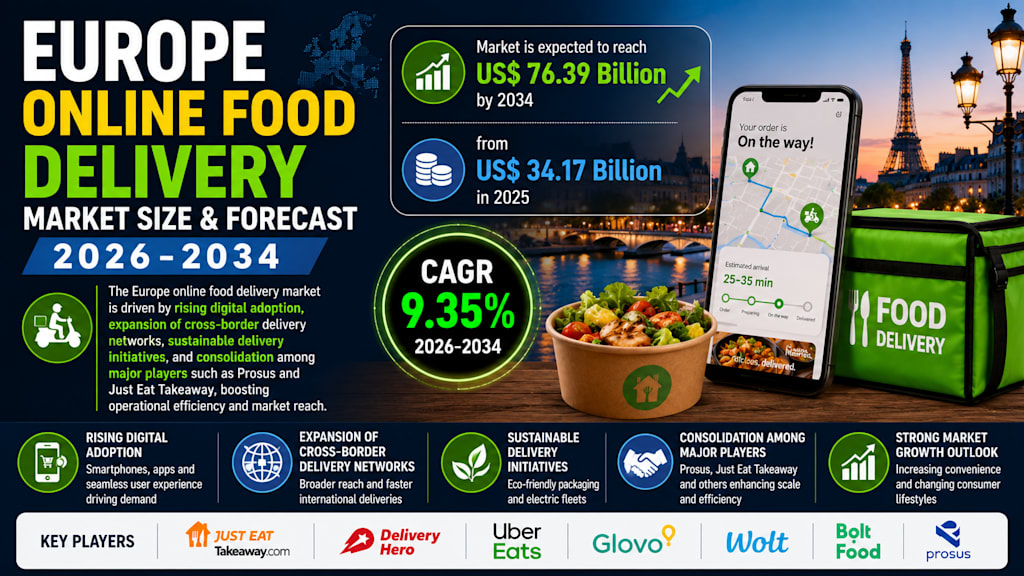
According to the latest market outlook, the Europe Online Food Delivery Market is projected to grow from US$34.17 billion in 2025 to US$76.39 billion by 2034, registering a compound annual growth rate (CAGR) of 9.35% during 2026–2034. Rising digital adoption, cross-border expansion, AI-powered logistics, and sustainable delivery initiatives continue supporting long-term market growth.
Online Food Delivery Has Become Part of Everyday Life
Online food delivery platforms enable consumers to browse restaurant menus, customize meals, complete secure digital payments, and track deliveries in real time through mobile applications and websites.
The ecosystem connects restaurants, cloud kitchens, grocery stores, logistics providers, and consumers using advanced digital technologies.
Modern platforms increasingly provide subscription programs, loyalty rewards, contactless delivery, personalized recommendations, and integrated grocery delivery services.
These innovations improve customer convenience while helping restaurants expand their reach beyond traditional dine-in operations.
Digital Adoption Continues Driving Market Growth
One of the strongest drivers of Europe's online food delivery market is the continued growth of digital technology adoption.
High smartphone penetration, widespread broadband connectivity, and increasing consumer confidence in online payments have made app-based food ordering more accessible than ever.
Consumers increasingly prefer digital ordering because it offers convenience, menu transparency, personalized recommendations, and secure payment options.
The growing popularity of mobile commerce continues encouraging restaurants and delivery platforms to invest heavily in digital customer experiences.
Market Consolidation Strengthens Industry Expansion
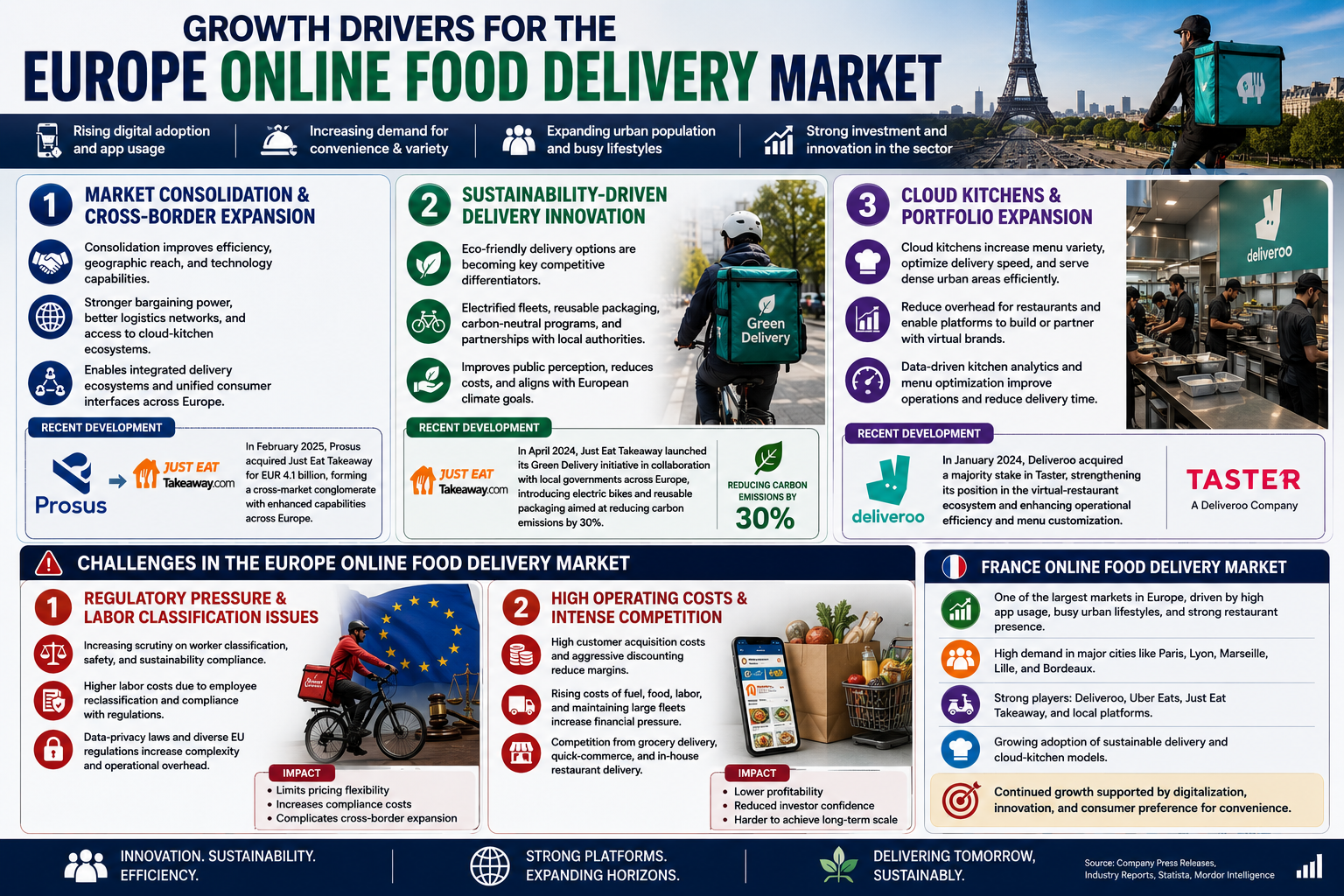
Consolidation among leading delivery platforms is reshaping Europe's competitive landscape.
Large companies continue acquiring regional operators to strengthen logistics capabilities, expand geographic coverage, improve operational efficiency, and enhance technology platforms.
These strategic acquisitions enable delivery companies to optimize route planning, negotiate stronger restaurant partnerships, and improve customer service across multiple countries.
Cross-border expansion also allows platforms to leverage economies of scale while introducing standardized digital experiences throughout Europe.
Artificial Intelligence Improves Delivery Efficiency
Artificial intelligence has become one of the most important technologies supporting online food delivery.
AI-powered algorithms optimize delivery routes, predict customer demand, improve restaurant recommendations, estimate delivery times, and balance courier assignments.
Machine learning also helps platforms personalize promotions based on customer preferences while reducing operational costs.
Advanced analytics improve inventory forecasting and enhance cloud kitchen operations, enabling faster order preparation and higher customer satisfaction.
Continuous AI innovation remains a major contributor to market growth.
Sustainability Is Becoming a Competitive Advantage
Environmental responsibility has become increasingly important within Europe's online food delivery industry.
Consumers increasingly prefer companies that reduce carbon emissions through electric delivery vehicles, bicycles, reusable packaging, and environmentally friendly logistics.
Delivery platforms continue investing in electric mobility, sustainable packaging materials, and carbon reduction initiatives to comply with European environmental policies.
Government support for green transportation further strengthens adoption of sustainable delivery technologies across major European cities.
Cloud Kitchens Expand Market Opportunities
Cloud kitchens continue reshaping Europe's restaurant industry.
These delivery-focused kitchens operate without traditional dining areas, allowing businesses to reduce operating costs while serving multiple virtual restaurant brands from a single location.
Cloud kitchens improve delivery efficiency by positioning food preparation closer to high-demand urban areas.
Advanced kitchen analytics, AI-driven menu optimization, and integrated delivery platforms continue enhancing operational performance.
Growing consumer acceptance of virtual restaurant brands further strengthens this expanding business model.
Mobile Applications Lead Consumer Engagement
Mobile applications remain the dominant platform for online food delivery.
Consumers increasingly prefer smartphone apps because they offer intuitive interfaces, secure payment systems, real-time order tracking, personalized promotions, and loyalty rewards.
Continuous improvements in user experience, multilingual support, digital wallets, and AI-powered recommendations continue increasing customer retention.
Mobile applications have become the primary communication channel connecting restaurants, delivery partners, and consumers.
Online Payments Continue Supporting Growth
Digital payment systems play a central role in Europe's online food delivery ecosystem.
Consumers increasingly utilize digital wallets, credit cards, instant bank transfers, biometric authentication, and contactless payment methods when ordering food online.
Secure payment processing improves transaction speed while increasing customer confidence.
Integrated subscription payments, cashback programs, and loyalty rewards further encourage repeat purchases across online delivery platforms.
Order-Focused Systems Improve Operational Efficiency
Order-focused food delivery systems have become essential operational technologies.
These digital platforms coordinate customer orders, restaurant preparation, courier assignment, inventory synchronization, and delivery routing in real time.
Cloud-based systems improve communication between restaurants and delivery personnel while minimizing delays and operational errors.
As delivery volumes continue increasing, advanced order management software remains critical for maintaining service quality and customer satisfaction.
Regulatory Challenges Continue Affecting the Industry
Despite impressive market growth, regulatory compliance remains an important challenge.
European governments continue strengthening labor regulations governing gig economy workers, employee classification, minimum wages, and occupational safety.
Environmental regulations addressing emissions, packaging waste, and urban traffic management also increase operational complexity.
Companies operating across multiple European countries must comply with varying national regulations, creating additional administrative and legal challenges.
Profitability Remains Under Pressure
Although consumer demand continues growing, profitability remains a significant concern for many delivery platforms.
Aggressive promotional pricing, high customer acquisition costs, rising fuel prices, labor expenses, and competition from grocery delivery services continue placing pressure on operating margins.
Restaurants increasingly developing their own delivery services also intensify competition.
To improve long-term profitability, companies continue investing in automation, artificial intelligence, logistics optimization, and operational efficiency.
Regional Markets Continue Driving Growth
France remains one of Europe's leading online food delivery markets due to high digital engagement, widespread mobile commerce, growing sustainability initiatives, and strong restaurant participation in delivery platforms.
Germany continues experiencing strong growth through advanced logistics infrastructure, increasing quick-commerce adoption, high purchasing power, and growing consumer demand for environmentally responsible delivery services.
Italy continues expanding as internet penetration, smartphone adoption, and urban digital lifestyles encourage greater use of online food ordering across major cities including Milan, Rome, Turin, and Bologna.
Spain remains a rapidly growing market supported by widespread internet usage, strong smartphone penetration, expanding grocery delivery services, and increasing investment in sustainable last-mile logistics.
Together, these countries continue driving innovation and expansion across Europe's online food delivery industry.
Innovation Will Shape the Future of Food Delivery
The future of Europe's online food delivery market will be driven by artificial intelligence, autonomous logistics, sustainable transportation, digital payments, and personalized customer experiences.
Companies continue investing in AI-powered demand forecasting, robotic delivery technologies, cloud kitchen expansion, reusable packaging systems, and integrated grocery delivery platforms.
Future innovations are expected to improve operational efficiency while enhancing convenience for both restaurants and consumers.
As digital lifestyles continue evolving, online food delivery will become an even more important component of Europe's modern food service economy.
Final Thoughts
Europe's online food delivery market continues demonstrating impressive growth as consumers increasingly embrace digital convenience, fast delivery, and personalized food ordering experiences.
The projected expansion from US$34.17 billion in 2025 to US$76.39 billion by 2034, supported by a 9.35% CAGR, reflects rising smartphone adoption, expanding AI-powered logistics, sustainable delivery innovation, and continuous investment in digital food platforms.
Although regulatory complexity, labor costs, and competitive pressures remain important challenges, ongoing advances in artificial intelligence, cloud kitchens, digital payments, and environmentally responsible delivery solutions position Europe's online food delivery industry for sustained long-term growth. As technology continues transforming consumer dining habits, online food delivery will remain one of the region's most dynamic digital service markets.
About the Creator
Enjoyed the story? Support the Creator.
Subscribe for free to receive all their stories in your feed.
Comments
There are no comments for this story
Be the first to respond and start the conversation.