
Europe Non-Invasive Prenatal Testing Market Set for Rapid Growth as Demand for Safer Prenatal Screening Accelerates
Europe NIPT Market to Reach Nearly US$ 2 Billion by 2033 Amid Rising Maternal Age and Precision Healthcare Trends

The European healthcare landscape is undergoing a profound transformation, and one of the fastest-growing areas is non-invasive prenatal testing (NIPT). As expectant parents increasingly seek safer, earlier, and more accurate prenatal screening options, Europe’s NIPT market is gaining substantial momentum across public and private healthcare systems.
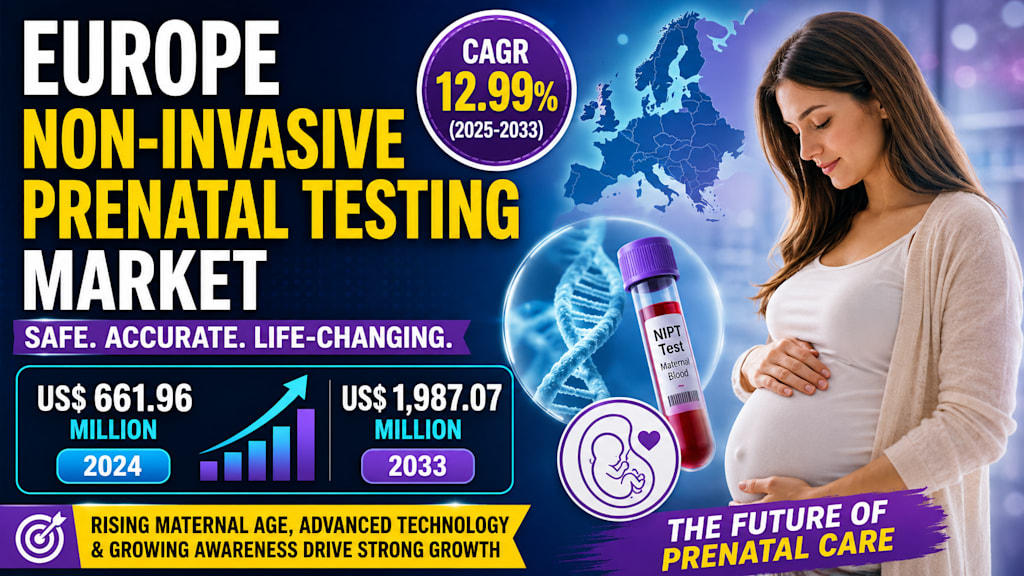
According to Renub Research, the Europe Non-Invasive Prenatal Testing Market is projected to rise from US$ 661.96 million in 2024 to US$ 1,987.07 million by 2033, expanding at a remarkable CAGR of 12.99% during 2025–2033.
The market’s strong growth trajectory reflects broader healthcare trends including rising maternal age, increasing awareness of genetic disorders, advancements in genomic technology, and the growing shift toward preventive and personalized healthcare solutions.
Understanding the Rise of Non-Invasive Prenatal Testing
Non-invasive prenatal testing has revolutionized prenatal screening by enabling healthcare providers to detect fetal chromosomal abnormalities through a simple maternal blood sample. Unlike invasive procedures such as amniocentesis or chorionic villus sampling, NIPT carries no miscarriage risk, making it an attractive option for expectant families.
The test primarily screens for conditions including:
Down Syndrome (Trisomy 21)
Edwards Syndrome (Trisomy 18)
Patau Syndrome (Trisomy 13)
Turner Syndrome
Its accuracy is one of the major reasons behind its growing popularity. In many cases, NIPT demonstrates accuracy rates exceeding 99% for detecting Down syndrome.
As healthcare systems across Europe focus more heavily on early disease detection and preventive medicine, NIPT is increasingly becoming part of routine prenatal care.
Rising Maternal Age Is Fueling Demand
One of the strongest drivers behind the Europe NIPT market is the region’s aging maternal population. Women across Europe are increasingly delaying childbirth due to career goals, economic considerations, lifestyle preferences, and educational pursuits.
According to the report, nearly 47% of women in the European Union who gave birth to their first child in 2019 were within the average age range of 28.4 years. Additionally, over 82,000 women above 45 years gave birth during the same year.
Advanced maternal age is strongly associated with higher risks of chromosomal abnormalities in pregnancies. As a result, healthcare providers are recommending NIPT more frequently for early and safer prenatal screening.
This demographic trend is expected to continue over the coming decade, ensuring steady demand for prenatal genetic testing services throughout Europe.
Precision Medicine and Personalized Healthcare Expand Opportunities
Europe’s broader transition toward personalized medicine is also contributing significantly to the growth of the NIPT industry.
Modern healthcare systems increasingly prioritize individualized treatment strategies, predictive diagnostics, and patient-specific care pathways. NIPT aligns perfectly with these goals by offering highly personalized prenatal insights based on fetal DNA analysis.
Expectant parents today are more informed and proactive regarding healthcare decisions. They want early, reliable information that helps them make confident choices during pregnancy. NIPT satisfies this demand by providing accurate genetic insights without invasive risks.
Healthcare providers are also embracing NIPT because it reduces unnecessary invasive procedures while improving patient experience and clinical outcomes.
Government Support and Clinical Guidelines Strengthen Adoption
Another critical growth factor is the increasing regulatory and institutional support across Europe.
Several European countries have integrated NIPT into national prenatal screening frameworks, particularly for high-risk pregnancies. Public health agencies and clinical organizations are developing standardized protocols to improve diagnostic quality, patient safety, and ethical compliance.
Countries such as Germany, France, the United Kingdom, and the Netherlands have emerged as leading adopters due to strong healthcare infrastructure and supportive public health policies.
These initiatives are encouraging healthcare providers to incorporate NIPT into mainstream prenatal services, further accelerating market penetration.
Cross-Border Healthcare Is Expanding the Market
Europe’s interconnected healthcare ecosystem is also supporting market growth through medical tourism and cross-border healthcare access.
Patients from countries with limited NIPT availability often travel to nations offering advanced prenatal screening technologies. Germany, Belgium, and the Netherlands are becoming preferred destinations for high-quality prenatal diagnostics due to superior infrastructure and advanced laboratory capabilities.
This medical mobility encourages competition among providers, improves innovation standards, and promotes wider adoption of high-quality testing services across the region.
Private clinics are also actively marketing NIPT services internationally, contributing to increased awareness and broader market reach.
Technology Advancements Are Transforming Prenatal Diagnostics
Technological innovation remains central to the rapid evolution of the NIPT market.
Advanced next-generation sequencing (NGS), bioinformatics tools, and AI-powered data interpretation are dramatically improving testing accuracy, speed, and affordability. Laboratories are now capable of delivering faster results with enhanced reliability, making NIPT more practical for routine clinical use.
Companies are continuously investing in research and development to expand the capabilities of prenatal testing. Modern NIPT platforms can now detect a wider range of chromosomal conditions and microdeletions, improving diagnostic precision.
For example, BGI Genomics introduced the NIFTY test in Germany under the brand name “Previa Test,” reporting sensitivity rates above 99%.
As technological barriers continue to decrease, broader adoption across hospitals and diagnostic laboratories is expected.
France Emerges as a Key Market
France is rapidly becoming one of Europe’s most influential NIPT markets.
Growing awareness among pregnant women, improved prenatal healthcare services, and increasing government support are fueling adoption across the country. France’s healthcare system has expanded access to NIPT, particularly for high-risk pregnancies, helping improve prenatal care outcomes nationwide.
However, challenges remain. Rural access disparities and shortages of trained genetic counselors continue to create gaps in patient support and education. Despite these limitations, France remains well-positioned for strong long-term growth due to its advanced healthcare infrastructure and growing investment in women’s health technologies.
Germany Strengthens Its Leadership Position
Germany continues to play a central role in the European NIPT industry.
As one of Europe’s largest healthcare markets, Germany has rapidly integrated NIPT into prenatal screening programs. The country benefits from sophisticated healthcare infrastructure, strong laboratory networks, and high healthcare expenditure.
German healthcare providers increasingly recommend NIPT for high-risk pregnancies due to its strong safety profile and clinical reliability.
Still, Germany faces important challenges regarding equal access and adequate genetic counseling support. Policymakers and healthcare providers are working to close these gaps while maintaining high-quality patient care standards.
United Kingdom Witnesses Growing Adoption
The United Kingdom is also experiencing substantial growth in NIPT adoption.
Growing awareness among expectant parents, combined with technological advancements in genomic medicine, is helping drive market expansion. NIPT is increasingly viewed as a valuable alternative to invasive prenatal testing methods.
The UK’s public and private healthcare sectors both contribute to the market’s development. However, geographic disparities in access and affordability continue to pose challenges for some patients.
Continued investment in healthcare infrastructure and genetic counseling services will be essential to ensuring equitable access across the country.
Market Challenges Continue to Exist
Despite the impressive growth outlook, the European NIPT market still faces several important challenges.
Uneven Access Across Europe
One of the biggest issues is unequal access between Western and Eastern European nations.
While countries such as Germany, France, and the UK have successfully integrated NIPT into public healthcare systems, many Eastern and Southern European countries continue to struggle with limited funding, inconsistent regulations, and weaker healthcare infrastructure.
These disparities create significant inequalities in prenatal care access across the continent.
Public Misunderstanding and Misinformation
Another major challenge is the lack of public understanding surrounding NIPT.
Many patients mistakenly believe NIPT is a definitive diagnostic test rather than a highly accurate screening tool. This misunderstanding can lead to emotional stress, confusion, and unrealistic expectations.
Experts emphasize the importance of better patient education, stronger public health communication, and expanded access to professional genetic counseling services to address these concerns effectively.
Competitive Landscape Intensifies
The Europe NIPT market features intense competition among global diagnostics and genomics companies seeking to strengthen their market share.
Key companies operating in the market include:
Eurofins Scientific
Roche
Invitae Corporation
Illumina Inc.
Natera Inc.
Centogene NV
QIAGEN
These organizations are heavily investing in genomic research, AI-based diagnostics, laboratory expansion, and strategic partnerships to strengthen their presence across Europe.
10 Recent Developments Shaping the Europe NIPT Industry
1. Roche Expanded Digital Diagnostics Capabilities
Roche continued integrating AI-driven genomic analytics into prenatal diagnostics to improve testing efficiency and reporting accuracy.
2. Illumina Accelerated Sequencing Innovation
Illumina Inc. enhanced next-generation sequencing platforms designed to improve affordability and scalability of NIPT services globally.
3. Natera Increased International Market Expansion
Natera Inc. expanded commercial outreach efforts in European prenatal diagnostics and genetic screening services.
4. Eurofins Strengthened Genomic Testing Networks
Eurofins Scientific invested in laboratory expansion and advanced prenatal genomics infrastructure across Europe.
5. QIAGEN Improved Molecular Diagnostic Solutions
QIAGEN focused on enhancing molecular workflow technologies supporting faster prenatal testing analysis.
6. Invitae Expanded Genetic Counseling Services
Invitae Corporation increased emphasis on patient education and digital genetic counseling support systems.
7. Centogene Advanced Rare Disease Genomics
Centogene NV strengthened its genomic research initiatives involving prenatal and rare disease diagnostics.
8. European Hospitals Increased NIPT Integration
Major healthcare providers across France, Germany, and the UK expanded NIPT availability within routine prenatal care programs.
9. Growing Public Awareness Campaigns
Healthcare organizations across Europe launched educational initiatives focused on prenatal screening awareness and informed pregnancy care.
10. Increased Private Investment in Prenatal Diagnostics
Private healthcare providers and diagnostic laboratories accelerated investments in advanced prenatal testing technologies to meet rising patient demand.
Future Outlook Remains Highly Positive
The future of the Europe Non-Invasive Prenatal Testing market looks exceptionally promising.
Growing healthcare digitization, rising maternal age, increased prenatal health awareness, and rapid advances in genomic science are expected to sustain long-term market expansion. As healthcare systems increasingly embrace preventive and precision medicine, NIPT will likely become a standard component of prenatal care across Europe.
Public-private collaborations, regulatory support, and technological innovation will continue reshaping the competitive landscape over the next decade.
Most importantly, NIPT is helping redefine prenatal healthcare by offering safer, earlier, and more informed pregnancy screening solutions for millions of families across Europe.
Final Thoughts
The Europe Non-Invasive Prenatal Testing market represents far more than a rapidly growing healthcare segment. It reflects a major transformation in how prenatal care is delivered in the modern healthcare era.
As genetic technologies become more sophisticated and accessible, NIPT is emerging as a cornerstone of personalized prenatal medicine. The market’s projected growth toward nearly US$ 2 billion by 2033 highlights the enormous confidence healthcare providers, patients, and investors have in this technology.
While challenges surrounding affordability, education, and equal access still require attention, the long-term outlook remains highly optimistic. Europe’s healthcare sector is clearly moving toward a future where safer, smarter, and more personalized prenatal diagnostics become the global standard.
About the Creator
Enjoyed the story? Support the Creator.
Subscribe for free to receive all their stories in your feed.
Comments
There are no comments for this story
Be the first to respond and start the conversation.