
Europe Movie Market Is Reinventing the Cinema Experience in the Streaming Era
Premium theaters, regional storytelling, digital platforms, and immersive viewing technologies are reshaping the future of Europe’s film industry.

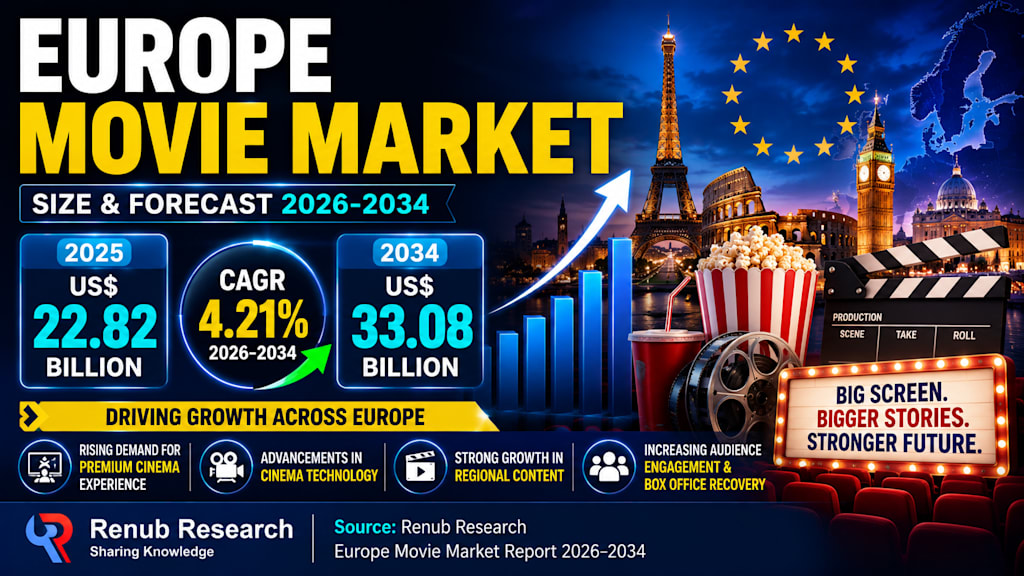
The European movie industry is entering a new phase of transformation. While streaming platforms continue to reshape how audiences consume content, theaters across Europe are evolving rather than disappearing. Premium cinema experiences, regional storytelling, technological innovation, and government-backed film production are helping the market maintain steady growth despite changing viewing habits.
According to Renub Research, the Europe Movie Market is projected to grow from US$ 22.82 billion in 2025 to US$ 33.08 billion by 2034, expanding at a CAGR of 4.21% between 2026 and 2034. The market’s growth is being supported by rising demand for premium cinema experiences, strong local content production, and advancements in movie technology across the region.
Europe remains one of the most culturally influential movie markets in the world. From artistic independent films to blockbuster franchises, the region continues to shape global cinema while adapting to rapid digital transformation.
Movies remain deeply connected to European culture
Cinema has always played a major role in Europe’s cultural identity. European films are recognized globally for their artistic storytelling, realism, historical depth, and socially conscious themes. Countries such as France, Germany, Italy, and the United Kingdom have long-established film industries that continue to influence global filmmaking traditions.
Film festivals including Cannes, Venice, and Berlin have further strengthened Europe’s reputation as a creative powerhouse for cinema. These festivals not only celebrate storytelling and filmmaking excellence but also provide global exposure to regional productions and emerging filmmakers.
European audiences also maintain a balanced preference for both Hollywood blockbusters and local productions. This diversity of viewing habits creates a unique environment where international franchises and independent regional stories coexist successfully.
The growth of multiplex theaters, improvements in digital projection systems, and increasing accessibility through streaming services have expanded movie consumption across Europe in recent years.
Streaming platforms are transforming the market
One of the most significant changes in the European movie industry has been the rapid expansion of streaming services and digital platforms. Platforms such as Netflix, Amazon Prime Video, and regional streaming services have dramatically increased consumer access to movies and television content.
Streaming services have changed viewing habits by offering convenience, affordability, and on-demand entertainment. Consumers can now access a wide range of international and local films from their homes, which has increased overall content consumption across Europe.
However, streaming is not only competing with theaters — it is also supporting the broader movie ecosystem. Many platforms are heavily investing in original European productions, helping expand regional storytelling and creating additional revenue opportunities for filmmakers.
The report highlights HBO Max’s European expansion plans, including launches across Germany, Italy, Austria, Switzerland, Luxembourg, and Liechtenstein in January 2026. This expansion reflects how global streaming companies increasingly view Europe as a major content and subscriber growth market.
Government support continues to strengthen European cinema
Unlike many global film industries, European cinema benefits heavily from cultural and institutional support. Governments across Europe provide grants, subsidies, tax incentives, and funding programs that help local filmmakers produce high-quality films.
This support is essential because many artistic or culturally important films may not achieve large commercial revenues immediately. Government backing allows filmmakers to focus on storytelling quality and cultural representation rather than relying solely on box office performance.
Film festivals also play a critical role in supporting the industry by attracting investors, distributors, and international audiences. European films often gain worldwide recognition through festival exposure before achieving broader commercial success.
In December 2025, the German government announced a new annual production fund worth €7.5 million focused on supporting first and second feature films. The initiative demonstrates Europe’s continued commitment to nurturing creative talent and sustaining local cinema production.
Premium cinema experiences are helping theaters compete
Despite the rise of streaming, movie theaters across Europe are finding new ways to attract audiences. One of the strongest trends driving market growth is the demand for premium cinema experiences.
Modern theaters are increasingly equipped with advanced technologies such as IMAX, Dolby Atmos, luxury seating, and immersive 3D projection systems. These upgrades create experiences that are difficult to replicate at home, even with high-quality televisions and streaming subscriptions.
Consumers, especially in urban areas, are increasingly willing to pay for experience-driven entertainment. Event films, premieres, exclusive screenings, and large-format cinematic experiences continue attracting moviegoers seeking something more immersive than standard home viewing.
The report mentions that Vue, one of Europe’s largest privately owned cinema operators, introduced a new premium large-format cinema experience called “Epic” in July 2025. Such investments show how theaters are evolving into premium entertainment destinations rather than simply screening venues.
Streaming competition remains a major challenge
Even with premium upgrades, competition from streaming services remains one of the biggest challenges facing Europe’s movie theaters. Many consumers now prefer watching movies from home because streaming offers lower costs, convenience, and immediate access to vast content libraries.
Smaller theaters and independent cinemas are particularly vulnerable because they struggle to compete with the convenience and scale of global streaming platforms. Non-blockbuster films often face declining theater attendance as audiences increasingly reserve cinema visits for major franchise releases or event-based experiences.
This shift in consumer behavior is forcing theater operators to rethink business models, improve customer experiences, and diversify revenue streams.
Rising costs are creating financial pressure
The European movie market is also dealing with high production and operational expenses. Producing quality films requires substantial investments in talent, technology, locations, visual effects, and post-production work. European productions often face budget limitations compared to large Hollywood studios.
Movie theaters themselves also face increasing operational costs, including rent, staffing, maintenance, and technology upgrades. Inflation and economic uncertainty are adding further pressure to profit margins.
To maintain profitability, some theaters may increase ticket prices, which can create affordability concerns for price-sensitive audiences. Balancing premium experiences with accessible pricing will remain one of the industry’s biggest strategic challenges in the coming years.
Ticket sales continue to anchor the industry
Movie ticket sales remain one of the most important revenue sources in Europe’s film ecosystem. Major markets such as the United Kingdom, France, Germany, and Italy contribute heavily to regional box office performance.
Premium viewing formats like IMAX, 4DX, and luxury seating have also increased average ticket prices, helping theaters generate stronger revenue per customer. High population density in major European cities further supports consistent theater attendance.
Film festivals, cultural events, and franchise releases continue to drive interest in cinema-going experiences. Although smaller films increasingly compete with streaming platforms, event-based cinema remains highly valuable across Europe.
Food and beverage sales are becoming increasingly important
Food and beverage sales represent another major revenue stream for European cinemas. In many cases, concession sales generate higher profit margins than ticket revenue itself.
Traditional snacks such as popcorn and soft drinks remain popular, but European theaters are increasingly introducing gourmet foods, organic options, dine-in experiences, and even alcoholic beverages such as wine and beer.
Luxury cinema experiences are particularly popular in urban areas where audiences are willing to spend more on premium entertainment experiences. Combo deals and bundled offerings are also helping theaters improve customer spending and retention.
3D and immersive formats still matter
The digital 3D movie market remains an important niche within Europe’s broader movie industry. Although the initial excitement around 3D films has stabilized, immersive formats still perform strongly in genres such as action, fantasy, science fiction, and animation.
Advancements in digital projection technology have improved comfort and visual quality, helping maintain consumer interest in premium cinematic experiences. While not every movie is released in 3D, the format continues to serve as a valuable value-added service for theaters.
Young audiences are shaping the future of cinema
The 18–24 age group remains one of the most influential audience segments in the European movie market. Younger viewers are highly active on social media and often treat movie-going as a social activity shared with friends and peers.
Genres such as horror, comedy, fantasy, and superhero films are especially popular among younger consumers. This demographic is also highly receptive to technological innovation, including premium theater formats and immersive cinematic experiences.
At the same time, younger viewers are price-sensitive and often respond strongly to discounts, subscription models, and student offers. Their behavior will continue influencing theater marketing and pricing strategies across Europe.
France continues leading artistic cinema
France remains one of Europe’s strongest movie markets due to its deep cultural connection to cinema and strong government support for local productions. The country maintains strict local content quotas and offers tax incentives to support domestic filmmaking.
French audiences continue to support both local and international films, while prestigious events such as the Cannes Film Festival strengthen France’s global influence in cinema.
Samsung’s installation of Onyx Cinema LED displays at Pathé Palace in Paris demonstrates how advanced visual technologies are also enhancing premium movie experiences in France.
Germany and the UK remain major growth markets
Germany’s movie market benefits from strong economic conditions, advanced cinema infrastructure, and major international events such as the Berlin International Film Festival. Premium cinema formats including IMAX and HDR projection systems are becoming increasingly common across the country.
The United Kingdom continues to be one of the most globally influential movie markets, supported by world-class studios, highly skilled production talent, and strong international collaboration. Premium cinema experiences and franchise films continue driving ticket sales despite competition from streaming platforms.
The Netherlands reflects Europe’s digital cinema evolution
The Netherlands demonstrates how digital innovation and strong cinema culture can coexist successfully. The country’s audiences continue visiting theaters frequently despite widespread streaming adoption.
Innovations such as on-demand private cinema experiences show how theaters are experimenting with personalization and convenience to attract modern audiences.
Major companies continue competing for audience attention
The European movie market includes several major theater operators and cinema chains competing across premium experiences, technology upgrades, and customer engagement strategies. Companies highlighted in the report include Cinemark Holding, Regal Cinemas, CGV Cinemas, AMC Theatres, Marcus Theatres, B&B Theatres, AMC, and Empire Cinema.
Competition will likely intensify as theaters continue adapting to evolving consumer expectations and digital disruption.
Final thoughts
The European movie industry is proving that cinema can evolve alongside streaming rather than disappear because of it. According to Renub Research, the market’s expected growth from US$ 22.82 billion in 2025 to US$ 33.08 billion by 2034 highlights the resilience of theatrical entertainment in Europe.
Streaming services have undoubtedly changed viewing habits, but premium theater experiences, strong regional storytelling, government support, and immersive technologies continue giving European cinema a unique identity.
About the Creator
Enjoyed the story? Support the Creator.
Subscribe for free to receive all their stories in your feed.
Comments
There are no comments for this story
Be the first to respond and start the conversation.