
Europe High-Intensity Focused Ultrasound Market to Reach USD 65.57 Billion by 2033 Amid Rising Demand for Non-Invasive Cancer Treatments
Advanced MRI-Guided Technologies, Growing Oncology Applications, and Expanding Aesthetic Procedures Are Driving Rapid HIFU Adoption Across Europe

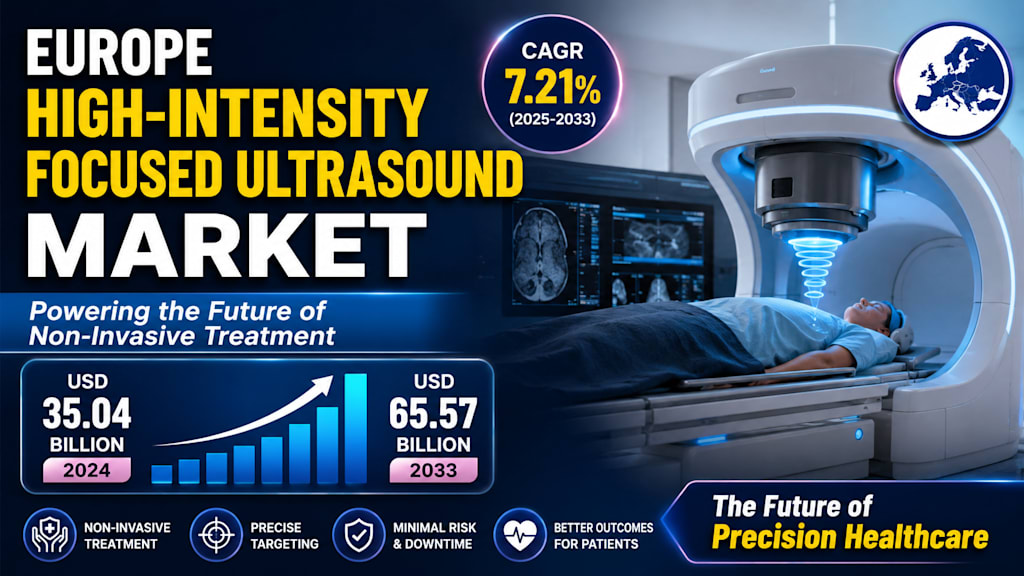
The Europe High-Intensity Focused Ultrasound (HIFU) Market is entering a transformative growth phase as hospitals, research centers, and aesthetic clinics increasingly adopt non-invasive therapeutic technologies. According to Renub Research, the Europe HIFU Market was valued at USD 35.04 billion in 2024 and is projected to reach USD 65.57 billion by 2033, expanding at a CAGR of 7.21% during 2025–2033.
HIFU technology is rapidly changing how physicians treat tumors, uterine fibroids, neurological disorders, and cosmetic concerns. By using focused ultrasound energy to destroy targeted tissues without surgery, HIFU offers patients a safer and faster alternative to conventional procedures. European healthcare systems are increasingly embracing this technology due to its precision, reduced hospitalization requirements, and minimal recovery periods.
As healthcare providers continue prioritizing patient-centric treatment solutions, the demand for minimally invasive procedures is expected to fuel strong market growth throughout the forecast period.
What Is High-Intensity Focused Ultrasound (HIFU)?
High-Intensity Focused Ultrasound is a cutting-edge medical technology that uses concentrated ultrasound waves to generate heat within targeted tissue areas. This thermal energy destroys abnormal tissue cells while preserving surrounding healthy structures.
Unlike traditional surgical procedures, HIFU does not require incisions, radiation exposure, or prolonged hospital stays. The treatment is image-guided, typically using MRI or ultrasound imaging systems, allowing clinicians to monitor treatment accuracy in real time.
HIFU is now widely used for:
- Prostate cancer treatment
- Uterine fibroid therapy
- Liver tumor ablation
- Neurological disorder management
- Skin tightening and cosmetic enhancement
- Pain management for bone metastases
Countries such as Germany, France, and the United Kingdom are at the forefront of HIFU integration across hospitals and specialty clinics.
Rising Preference for Non-Invasive Procedures Boosting Market Growth
One of the strongest drivers behind Europe’s HIFU market expansion is the growing preference for minimally invasive and non-surgical procedures.
Modern patients increasingly seek therapies that reduce pain, minimize surgical complications, shorten recovery periods, and avoid lengthy hospital admissions. HIFU addresses all of these concerns while maintaining strong therapeutic effectiveness.
Healthcare providers also benefit from improved operational efficiency because non-invasive procedures typically require shorter treatment times and lower post-operative care costs.
The growing cancer burden in Europe further supports market growth. According to GLOBOCAN estimates cited in the report, Europe recorded approximately:
- 325,000 new colon cancer cases in 2020
- 182,000 rectal cancer cases in 2020
By 2040, those figures are expected to rise significantly, increasing the need for advanced minimally invasive treatment solutions.
As a result, hospitals and oncology centers are increasingly incorporating HIFU into their treatment portfolios.
MRI-Guided HIFU Technology Enhancing Precision Medicine
Technological innovation remains a major factor accelerating HIFU adoption throughout Europe.
MRI-guided HIFU systems provide clinicians with highly detailed imaging capabilities, allowing them to monitor tissue temperature and treatment precision in real time. These systems improve targeting accuracy while minimizing complications.
Advanced imaging integration has made HIFU particularly effective for sensitive treatments involving:
- Prostate tumors
- Uterine fibroids
- Bone metastases
- Neurological disorders
Collaborations between European research institutions and medical device companies are also accelerating innovation in MRI-HIFU systems.
In February 2025, Royal Philips announced EU Medical Device Regulation certification for its Radiology Operations Command Center Console, enabling real-time remote radiology support and improving diagnostic imaging quality across Europe.
Such innovations are strengthening Europe’s position as a global leader in precision-focused ultrasound technologies.
Oncology Applications Continue Expanding Across Europe
Cancer treatment remains one of the largest application areas for HIFU in Europe.
The technology is increasingly used for localized tumor ablation due to its ability to precisely destroy cancerous tissue while preserving surrounding healthy organs. Physicians across Europe are adopting HIFU for:
- Prostate cancer
- Liver cancer
- Pancreatic tumors
- Bone metastases
HIFU’s non-invasive nature is especially valuable for elderly patients and individuals who may not tolerate traditional surgery well.
Among oncology segments, prostate cancer treatment is witnessing especially strong growth. Hospitals in Germany and the UK are increasingly integrating HIFU into urology departments because of favorable clinical outcomes and fewer long-term side effects compared to surgery or radiation therapy.
As cancer prevalence continues rising across Europe, demand for advanced focused ultrasound therapies is expected to remain robust.
Aesthetic Medicine Becoming a High-Growth Opportunity
Beyond oncology, the aesthetic medicine sector is emerging as a significant revenue contributor to the Europe HIFU market.
Consumers are increasingly seeking non-surgical cosmetic procedures that provide visible results without downtime. HIFU treatments are now widely used for:
- Skin tightening
- Wrinkle reduction
- Facial contouring
- Non-invasive lifting procedures
Clinics throughout France, Italy, and the UK are rapidly adopting HIFU-based aesthetic systems as patient demand for anti-aging procedures grows.
The popularity of minimally invasive beauty treatments among younger consumers and aging populations alike is expected to create substantial long-term opportunities for HIFU manufacturers.
Hospitals and Research Centers Leading Adoption
European hospitals remain the primary end users of HIFU systems, particularly in oncology, gynecology, and urology departments.
Large healthcare institutions are investing heavily in advanced imaging infrastructure and specialized treatment capabilities. Educational programs and partnerships with technology providers are also helping clinicians gain expertise in focused ultrasound procedures.
Meanwhile, research centers across Europe continue to play a critical role in developing next-generation HIFU applications.
Countries including France, Germany, and the Netherlands are actively conducting clinical trials focused on:
- Expanding therapeutic indications
- Improving treatment protocols
- Validating long-term safety
- Enhancing procedural efficiency
Strong support from both public healthcare systems and private investors continues driving innovation in this segment.
France Emerging as a Major Innovation Hub
France has become one of Europe’s most active HIFU markets due to its advanced healthcare ecosystem and strong research culture.
French hospitals increasingly use HIFU for treating cancers and uterine fibroids, while aesthetic applications are also growing rapidly.
In February 2025, EDAP TMS S.A announced the enrollment of the first patient in its French pancreatic cancer HIFU clinical trial known as PULS. The study aims to evaluate both safety and efficacy for pancreatic cancer treatment.
Government-backed research initiatives and growing clinical adoption are positioning France as a leading center for HIFU innovation.
Germany Strengthening Leadership in Precision Medicine
Germany continues to dominate Europe’s HIFU landscape due to its sophisticated healthcare infrastructure and emphasis on precision medicine.
German hospitals increasingly integrate HIFU into standard treatment pathways for:
- Prostate cancer
- Liver tumors
- Aesthetic procedures
Strong collaboration between universities and medical device manufacturers is accelerating technological development in the country.
In April 2024, Insightec announced European availability and CE clearance for Exablate Prime, its next-generation neuro-focused ultrasound platform designed to improve treatment precision and patient experience.
Germany’s continued investment in advanced healthcare technology is expected to maintain its leadership position within the regional market.
United Kingdom Accelerating Clinical Adoption
The United Kingdom is witnessing growing adoption of HIFU technologies across both public and private healthcare systems.
NHS hospitals are increasingly evaluating HIFU for cancer and fibroid treatment due to growing clinical evidence supporting its effectiveness. Meanwhile, private clinics continue expanding HIFU-based aesthetic offerings.
In January 2023, the UK Focused Ultrasound Foundation launched initiatives to promote focused ultrasound adoption and research across the country.
Government support for non-invasive therapies and healthcare modernization is expected to accelerate future market growth in the UK.
Key Challenges Still Impacting Market Expansion
Despite strong growth prospects, the Europe HIFU market still faces several challenges.
High Equipment Costs
MRI-guided HIFU systems are expensive to purchase, install, and maintain. Smaller hospitals and clinics often struggle to afford the required infrastructure and specialized training.
Limited Reimbursement Policies
Many European healthcare systems still offer limited reimbursement coverage for HIFU procedures, reducing accessibility for patients and slowing provider adoption.
Clinical Awareness Gaps
Although awareness is improving, some healthcare professionals remain unfamiliar with HIFU’s full capabilities and treatment benefits. Continued physician education will be essential for broader mainstream adoption.
10 Recent Developments by Leading Companies
1. Royal Philips
Received EU MDR certification for remote radiology scanning support technology in February 2025.
2. EDAP TMS S.A
Initiated pancreatic cancer HIFU clinical trials in France during 2025.
3. Insightec
Launched Exablate Prime in Europe following CE clearance in 2024.
4. Toosonix A/S
Started clinical dermatology trials for basal cell carcinoma treatment using HIFU technology.
5. Koninklijke Philips N.V.
Expanded advanced imaging integration capabilities supporting MRI-guided HIFU applications.
6. Medtronic Plc.
Continued investments in minimally invasive therapeutic technologies across Europe.
7. Johnson & Johnson
Strengthened innovation focus on image-guided therapeutic systems.
8. Theraclion
Expanded research initiatives targeting non-invasive therapeutic ultrasound applications.
9. Hitachi Ltd.
Advanced ultrasound imaging solutions supporting precision-focused therapies.
10. Stryker
Increased investments in advanced surgical and non-invasive treatment technologies.
Competitive Landscape
The Europe HIFU market remains highly competitive, with major companies focusing on innovation, strategic partnerships, clinical trials, and geographic expansion.
Key market participants include:
- Koninklijke Philips N.V.
- EDAP TMS S.A
- Johnson & Johnson
- Medtronic Plc.
- Hitachi Ltd.
- Theraclion
- Stryker
- General Electric
Companies are increasingly emphasizing AI-driven imaging, precision targeting, and expanded therapeutic applications to strengthen market positioning.
Final Thoughts
The Europe High-Intensity Focused Ultrasound Market is poised for substantial expansion as healthcare systems continue shifting toward safer, faster, and more patient-friendly treatment solutions.
Growing cancer prevalence, advancements in MRI-guided imaging, rising demand for aesthetic procedures, and strong clinical research activity are collectively accelerating HIFU adoption across Europe.
While equipment costs and reimbursement challenges remain obstacles, ongoing technological innovation and increasing physician awareness are expected to support long-term market growth.
With Europe continuing to lead global innovation in non-invasive therapeutic technologies, HIFU is likely to become an increasingly important component of modern medical care throughout the next decade.
About the Creator
Enjoyed the story? Support the Creator.
Subscribe for free to receive all their stories in your feed.
Comments
There are no comments for this story
Be the first to respond and start the conversation.