
Europe Halal Food Market Set to Surpass US$ 1 Trillion by 2033 Amid Rising Ethical Consumption and Expanding Muslim Population
Growing demand for halal-certified products, evolving retail ecosystems, and increasing interest from non-Muslim consumers are transforming Europe’s halal food landscape.

Introduction
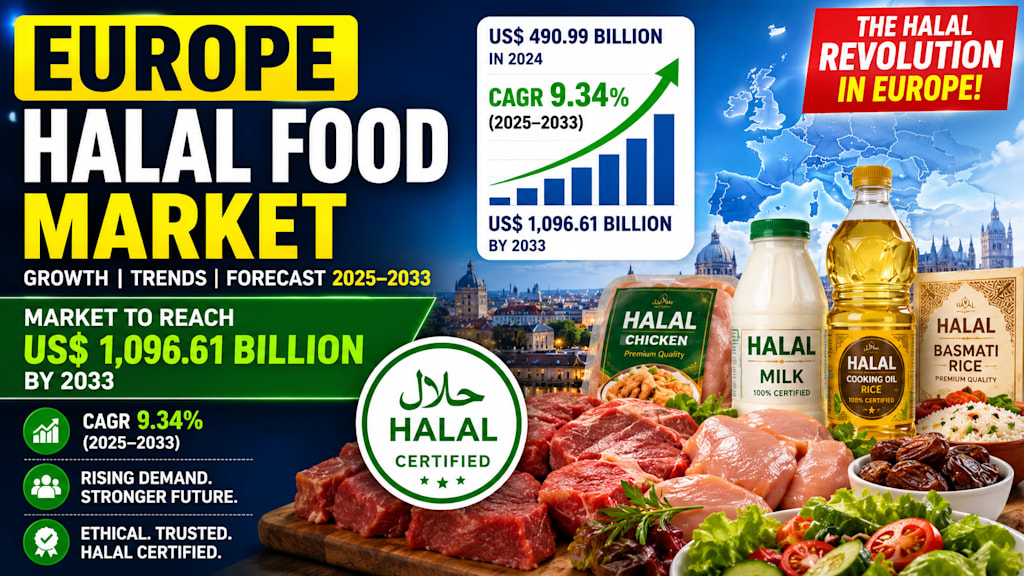
The Europe halal food market is entering a transformative growth phase as changing demographics, rising awareness about ethical food practices, and growing consumer demand for certified products continue to reshape the region’s food industry. According to Renub Research, the Europe halal food market is projected to grow from US$ 490.99 billion in 2024 to an impressive US$ 1,096.61 billion by 2033, expanding at a CAGR of 9.34% during 2025 to 2033
Europe’s halal food sector is no longer confined to traditional meat products or niche ethnic stores. The market has evolved into a mainstream food category encompassing dairy products, cereals, ready-to-eat meals, confectionery, beverages, frozen foods, and organic halal-certified offerings. Increased retail penetration, e-commerce expansion, and innovation in halal-certified packaged foods are helping the market gain widespread acceptance across the continent.
Rising Muslim Population Driving Long-Term Market Growth
One of the biggest factors fueling growth in the European halal food market is the steadily increasing Muslim population across major countries such as the United Kingdom, France, Germany, and Italy. As Europe becomes increasingly multicultural, demand for halal-certified food products is rising consistently.
According to the report, the Pew Research Center estimates that Europe’s Muslim population will rise significantly by 2030, creating a strong and expanding customer base for halal food manufacturers and retailers.
The United Kingdom alone recorded approximately 3.9 million Muslims in 2021, according to the Office for National Statistics (ONS). Younger Muslim consumers, often referred to as “Generation M,” are becoming increasingly influential in shaping food preferences and purchasing behavior across Europe.
This younger demographic is highly brand-conscious, digitally connected, and more willing to spend on premium halal-certified products that align with religious, ethical, and sustainability values.
Ethical and Quality Perception Expanding Consumer Base
Interestingly, halal food products are increasingly attracting non-Muslim consumers as well. Many Europeans associate halal-certified products with better hygiene standards, transparency, ethical sourcing, and improved animal welfare practices.
As consumer awareness regarding food quality and traceability grows, halal products are gaining popularity beyond religious boundaries. Supermarkets, convenience stores, and online platforms are rapidly expanding their halal food portfolios to cater to a broader audience.
The perception of halal food as clean, healthy, and responsibly produced has significantly strengthened market acceptance in countries such as France, Germany, and the United Kingdom.
Supermarkets and E-Commerce Expanding Market Reach
Retail transformation is playing a crucial role in market expansion. Previously, halal food products were largely available only through specialty ethnic stores. However, mainstream retailers and online grocery platforms are now investing aggressively in halal-certified offerings.
Large hypermarkets and supermarkets across Europe are increasing shelf space dedicated to halal products, while e-commerce platforms are improving accessibility for younger and tech-savvy consumers.
Digital food delivery platforms and grocery apps are also contributing to the rapid growth of the halal food ecosystem by offering consumers convenient access to a diverse range of certified products.
The report highlights that online channels are becoming particularly important in urban European markets where convenience and product variety strongly influence purchasing decisions.
Innovation in Organic, Vegan, and Sustainable Halal Products
Product innovation is another major trend shaping the future of the Europe halal food market. Food manufacturers are increasingly introducing halal-certified organic foods, vegan products, sustainable meal options, and healthier packaged foods to meet evolving consumer expectations.
Modern consumers are seeking products that align not only with religious requirements but also with environmental and ethical values. As a result, halal-certified plant-based foods, clean-label snacks, and sustainably sourced ingredients are becoming increasingly popular across Europe.
Manufacturers are also focusing on premium packaging, transparent labeling, and traceability technologies to strengthen consumer trust and brand loyalty.
France Emerging as a Key Halal Food Hub
France continues to hold a dominant position within the European halal food industry due to its large Muslim population and advanced certification ecosystem.
The report notes that France has one of the largest Muslim populations in Western Europe, representing over 8% of the country’s population. The French halal market is estimated to be worth approximately 5.5 billion euros, with halal food accounting for a substantial share of total market revenue.
French retailers and food producers are investing heavily in halal certification systems to improve transparency and ensure compliance with Islamic dietary laws.
In addition, growing demand for ethical food products among non-Muslim consumers is further accelerating market growth across the country.
Germany Witnessing Strong Demand for Halal-Certified Foods
Germany is emerging as another significant growth market for halal food in Europe. Rising migration, demographic changes, and increasing cultural diversity are contributing to growing demand for halal-certified products.
According to the report, a survey conducted among Muslims in Germany found that nearly 88% of respondents considered halal food highly important, while 94% preferred certified halal products.
German food manufacturers and retailers are responding by expanding halal-certified product offerings across meat, dairy, snacks, and prepared foods.
The country’s improving certification processes and increasing awareness regarding halal standards are helping strengthen consumer confidence and drive further market penetration.
United Kingdom Market Continues to Expand
The United Kingdom halal food market is also experiencing strong momentum due to rising multiculturalism and growing demand for ethical food consumption.
Halal-certified products are increasingly available across mainstream supermarket chains, convenience stores, and online platforms throughout the UK. Consumers are seeking halal food not only for religious reasons but also due to perceived advantages related to food quality, animal welfare, and hygiene standards.
The UK market is also benefiting from product diversification, including ready-to-eat meals, frozen foods, snacks, and premium halal meat products.
Fragmented Certification Standards Remain a Challenge
Despite strong growth prospects, the Europe halal food market continues to face several challenges. One of the primary obstacles is the fragmented halal certification landscape across different European countries.
The report explains that varying certification standards and differing interpretations of halal regulations create confusion among consumers and increase operational complexity for manufacturers.
The lack of a unified European halal certification framework can also make cross-border trade more difficult and expensive for food companies seeking to expand internationally.
Industry experts believe that greater standardization and harmonization of certification systems will be essential for long-term market stability and consumer confidence.
Regulatory Restrictions and Animal Welfare Debates
Regulatory and legal restrictions surrounding halal slaughter practices also remain a sensitive issue in parts of Europe.
Several countries have introduced regulations requiring pre-slaughter stunning, which some Islamic authorities believe conflicts with traditional halal practices. These debates continue to generate political, legal, and ethical discussions that impact market operations and investment decisions.
Balancing religious freedom with animal welfare regulations remains one of the most complex challenges facing the European halal food industry today.
Growing Investments and Business Expansion Fuel Competition
Competition within the European halal food market is intensifying as multinational food companies, retailers, and startups expand their halal-certified product portfolios.
Major industry participants are increasingly investing in product innovation, certification infrastructure, digital marketing, and strategic retail partnerships to strengthen market presence.
The industry is also witnessing rising merger activity, regional expansion, and investments in supply chain traceability technologies to ensure product authenticity and compliance.
10 Recent Developments in the Europe Halal Food Market
Nestlé SA expanded its halal-certified packaged food offerings across several European retail chains to strengthen regional market penetration.
Carrefour SA increased halal product shelf space in hypermarkets across France and Belgium to address rising consumer demand.
Cargill Inc. enhanced its halal meat processing capabilities in Europe to improve supply chain efficiency and certification compliance.
BRF SA strengthened partnerships with European distributors to increase availability of halal poultry products.
Kawan Food Berhad expanded frozen halal food exports into key European supermarket chains.
American Halal Company Inc. introduced new ready-to-eat halal snack products targeting younger consumers in Europe.
Al Islami Foods expanded distribution partnerships with online grocery platforms to improve accessibility across European markets.
GetHalal Group launched halal food delivery services in Germany to cater to growing Muslim households and convenience-driven consumers.
The Halal Food Company introduced five new prepared halal meals in Sainsbury’s stores across the United Kingdom.
Crescent Foods Inc. increased investment in premium halal-certified meat products to meet rising demand for ethical and traceable food solutions.
Market Segmentation Highlights
The Europe halal food market is segmented across several major product categories including:
Meat, Poultry & Seafood
Fruits & Vegetables
Dairy Products
Cereals & Grains
Oil, Fats & Waxes
Confectionery
Others
Distribution channels covered in the market include:
Hypermarkets & Supermarkets
Online Stores
Convenience Stores
Specialty Stores
Others
Key countries analyzed in the report include France, Germany, Italy, Spain, the United Kingdom, Belgium, the Netherlands, Russia, Poland, Greece, Norway, Romania, Portugal, and the Rest of Europe.
Final Thoughts
The Europe halal food market is rapidly evolving into one of the region’s most dynamic and high-growth food sectors. Rising Muslim populations, increasing ethical consumption trends, expanding retail accessibility, and growing product innovation are collectively transforming the industry landscape.
Although challenges related to certification fragmentation and regulatory complexities persist, long-term growth opportunities remain exceptionally strong. Companies that prioritize transparency, sustainability, digital accessibility, and certification reliability are expected to gain significant competitive advantages in the coming years.
As halal food becomes increasingly mainstream across Europe, the market is poised to cross the US$ 1 trillion milestone by 2033, creating substantial opportunities for food manufacturers, retailers, investors, and technology providers alike.
Tags: Europe Halal Food Market, Halal Food Industry, Europe Food Market, Halal Certified Products, Ethical Food Consumption, Food Industry Trends, Retail Market Europe, Renub Research, Halal Market Forecast, Europe Consumer Trends
About the Creator
Enjoyed the story? Support the Creator.
Subscribe for free to receive all their stories in your feed.
Comments
There are no comments for this story
Be the first to respond and start the conversation.