
Europe Food Safety Testing Market: Why Is Food Safety Becoming More Important Than Ever Across Europe?
Stringent regulations, growing consumer awareness, technological innovation, and increasingly complex food supply chains are driving strong growth in Europe’s food safety testing market through 2034.

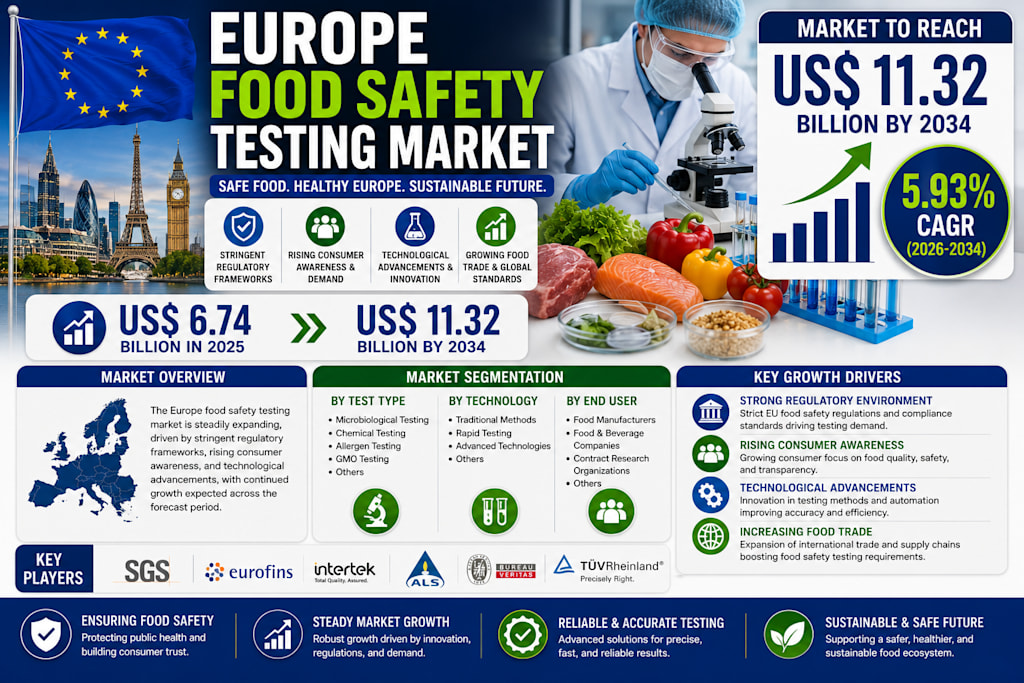
Food safety has become one of the most critical concerns for governments, businesses, and consumers worldwide. In Europe, where food quality standards are among the strictest globally, ensuring that food products are safe, authentic, and compliant with regulations is a top priority. As food supply chains become increasingly globalized and consumer expectations continue to rise, food safety testing has evolved into an essential component of the modern food industry.
From farm to table, food products pass through multiple stages of production, processing, packaging, transportation, and distribution. At each step, there is a risk of contamination, adulteration, or quality issues. Food safety testing helps identify potential hazards before products reach consumers, protecting public health while maintaining trust in food brands.
According to Renub Research, the Europe Food Safety Testing Market is expected to grow from US$ 6.74 billion in 2025 to US$ 11.32 billion by 2034, expanding at a CAGR of 5.93% from 2026 to 2034. The market's growth is supported by stringent regulatory frameworks, increasing consumer awareness, technological advancements, and rising demand for transparency across food supply chains.

The Growing Importance of Food Safety Testing
Food safety testing refers to a range of scientific procedures used to detect contaminants, pathogens, allergens, pesticides, toxins, and other harmful substances in food products. These tests help ensure that food products comply with regulatory standards and are safe for human consumption.
Testing services cover multiple areas, including microbiological analysis, chemical testing, allergen detection, residue analysis, and authenticity verification. Food manufacturers, processors, distributors, retailers, and regulatory agencies rely heavily on testing to maintain product quality and consumer confidence.
As food supply chains become increasingly interconnected across countries and continents, food safety testing has become more important than ever. The globalization of food trade means that contamination risks can emerge at multiple points within the supply chain, making comprehensive testing essential for maintaining food integrity.
Strict Regulatory Frameworks Continue to Drive Market Growth
One of the strongest drivers of Europe's food safety testing market is the region's highly regulated food industry.
European regulatory authorities enforce comprehensive food safety standards designed to protect public health and maintain product quality. These regulations require food manufacturers and suppliers to conduct extensive testing throughout production and distribution processes.
Food businesses must regularly monitor products for contaminants, verify ingredient composition, and ensure compliance with labeling requirements. Failure to comply can result in financial penalties, product recalls, legal consequences, and reputational damage.
The harmonization of food safety regulations across European countries has further increased the demand for testing services. Companies operating across multiple markets must consistently meet stringent standards, encouraging ongoing investment in advanced testing solutions.
Additionally, regulatory requirements continue evolving as new risks emerge and scientific understanding improves. These ongoing updates create sustained demand for testing services as businesses strive to remain compliant.
Rising Consumer Awareness Is Increasing Testing Requirements
Today's consumers are more informed than ever about food quality, safety, and sourcing practices.
Growing awareness regarding foodborne illnesses, contamination risks, allergens, and chemical residues has significantly influenced purchasing decisions. Consumers increasingly expect food manufacturers to provide safe, transparent, and high-quality products.
This shift in consumer behavior has encouraged companies to strengthen quality assurance programs and invest in advanced testing technologies. Businesses recognize that maintaining consumer trust is essential for long-term success in a highly competitive marketplace.
Demand for organic foods, clean-label products, minimally processed ingredients, and sustainable production methods has further increased the need for specialized testing services. Consumers want reassurance that products meet the claims displayed on packaging and comply with industry standards.
As transparency becomes a central expectation within the food industry, food safety testing plays an increasingly important role in verifying product quality and authenticity.
Technological Innovation Is Transforming Food Safety Testing
Technology has become a major catalyst for growth and innovation within the food safety testing industry.
Traditional testing methods often required lengthy analysis periods before results became available. Today, modern technologies enable faster, more accurate, and more efficient testing procedures.
Rapid diagnostic methods, automated laboratory systems, molecular testing techniques, and advanced analytical equipment have dramatically improved testing performance. These innovations allow laboratories to identify contaminants more quickly while maintaining high levels of precision.
Automation has also reduced human error and improved consistency across testing procedures. Laboratories increasingly utilize robotics, artificial intelligence, and digital workflow systems to streamline operations and improve productivity.
The adoption of sophisticated testing technologies helps manufacturers respond more quickly to potential risks while enhancing overall food safety management.
Advanced Data Management Enhances Traceability
Traceability has become an essential aspect of food safety management.
Modern food safety testing increasingly relies on integrated data management systems that allow businesses to track products throughout the supply chain. These systems provide valuable visibility into sourcing, production, transportation, and distribution processes.
Advanced digital tools help identify contamination sources more efficiently and support rapid corrective actions when issues arise. Improved traceability also facilitates regulatory compliance and strengthens consumer confidence.
By combining laboratory testing with digital monitoring solutions, food companies can establish more robust quality control systems and reduce the likelihood of food safety incidents.
As supply chains become increasingly complex, traceability technologies will continue playing a critical role in industry development.
Increasing Demand for Specialized Testing Services
The growing diversity of food products has created demand for more specialized testing solutions.
Consumers increasingly purchase products with unique nutritional claims, organic certifications, allergen-free formulations, and functional ingredients. These trends require more sophisticated testing methods capable of verifying product characteristics accurately.
Allergen testing has become particularly important due to the increasing prevalence of food allergies and intolerances. Manufacturers must ensure accurate labeling while preventing cross-contamination during production.
Similarly, testing for pesticide residues, mycotoxins, genetically modified organisms (GMOs), and food authenticity has gained greater significance.
As food innovation continues accelerating, testing laboratories must continuously expand their capabilities to address emerging industry needs.
Food Supply Chain Complexity Creates New Challenges
While globalization offers numerous opportunities for food manufacturers, it also introduces significant food safety challenges.
Food products often travel through multiple countries and processing stages before reaching consumers. Each stage presents potential risks related to contamination, handling errors, environmental exposure, or ingredient variability.
The sourcing of raw materials from diverse geographic regions further complicates quality assurance efforts. Different suppliers may operate under varying standards, increasing the need for rigorous testing and verification.
Coordinating testing activities across complex supply chains requires strong collaboration among producers, processors, distributors, retailers, and regulatory authorities.
Food safety testing providers play a vital role in helping organizations manage these complexities while ensuring product integrity and compliance.
High Operational Costs Remain a Key Industry Challenge
Despite strong growth prospects, the food safety testing market faces several challenges.
One of the most significant concerns is the high cost associated with operating advanced testing facilities. Establishing and maintaining laboratories requires substantial investments in equipment, infrastructure, software systems, and highly skilled personnel.
Regulatory compliance also generates ongoing expenses. Laboratories must continuously update procedures, maintain certifications, invest in staff training, and adopt new technologies to meet evolving standards.
Smaller organizations often face difficulties managing these costs while remaining competitive. The need for high-quality reagents, sophisticated instruments, and specialized expertise can place considerable pressure on operational budgets.
Balancing quality, efficiency, and profitability remains an important challenge for industry participants.
Pathogen Testing Continues to Dominate Market Demand
Among all testing categories, pathogen testing remains one of the most critical segments.
Foodborne pathogens such as Salmonella, Listeria, and E. coli pose serious risks to public health and can result in significant product recalls if not detected early.
Manufacturers conduct routine pathogen testing to identify contamination before products enter the market. Advances in molecular diagnostics and rapid detection methods have significantly improved the effectiveness of pathogen monitoring programs.
As regulatory scrutiny and consumer expectations continue increasing, demand for reliable pathogen testing services is expected to remain strong throughout the forecast period.
France Food Safety Testing Market
France represents one of Europe's most important food safety testing markets.
The country's strong agricultural sector, extensive food manufacturing industry, and strict regulatory standards create consistent demand for testing services. Food producers rely heavily on microbiological, chemical, and allergen testing to maintain product quality and compliance.
Increasing consumer awareness regarding food safety and authenticity further supports market growth. France's emphasis on quality assurance and innovation positions it as a major contributor to the European food safety testing industry.
Germany Food Safety Testing Market
Germany remains one of Europe's largest food-producing nations and a leading market for food safety testing.
The country benefits from advanced laboratory infrastructure, strong regulatory oversight, and widespread adoption of innovative testing technologies. Food manufacturers prioritize quality control and safety monitoring to meet both domestic and international requirements.
Growing demand for processed foods, packaged products, and export-oriented food production continues supporting testing service demand across Germany.
Italy Food Safety Testing Market
Italy's strong culinary tradition and commitment to food authenticity make safety testing a critical industry component.
Manufacturers rely on extensive testing procedures to ensure product quality, verify ingredient authenticity, and maintain compliance with national and European regulations.
The growing popularity of organic foods, specialty products, and premium exports further increases demand for advanced testing solutions.
Italy's focus on preserving food heritage while meeting modern safety standards continues supporting market expansion.
Spain Food Safety Testing Market
Spain's diverse food industry and significant export activity contribute to strong demand for food safety testing services.
Producers utilize testing solutions to ensure compliance with European regulations and maintain product quality throughout the supply chain. Microbiological analysis, residue testing, and chemical testing remain particularly important.
Consumer awareness, export requirements, and technological advancements continue supporting growth within Spain's food safety testing market.
Recent Industry Developments Highlight Ongoing Innovation
Innovation remains a defining characteristic of Europe's food safety testing industry.
In August 2025, Vienna-based ViruSure introduced a new viral contamination detection test utilizing Oxford Nanopore technology for rapid and cost-effective viral screening.
In July 2025, Sysmex Europe SE partnered with SMD GmbH to expand access to advanced pathogen identification solutions through the geneLEAD VIII Platform.
Earlier in January 2025, the UK Health Security Agency launched the metagenomics Surveillance Collaboration and Analysis Programme (mSCAPE), an innovative biosecurity surveillance system designed to monitor pathogens using metagenomic data.
These developments demonstrate the industry's commitment to enhancing testing accuracy, speed, and surveillance capabilities.
Future Outlook
The future of Europe's food safety testing market remains highly promising.
Growing regulatory requirements, increasing consumer awareness, technological innovation, and rising demand for food transparency will continue driving market growth through 2034.
Organizations that invest in advanced testing technologies, automation, traceability solutions, and data-driven quality management systems will be best positioned to capitalize on emerging opportunities.
As food supply chains become increasingly complex and consumer expectations continue rising, food safety testing will remain an indispensable component of Europe's food industry.
Final Thoughts
Europe's food safety testing market serves as a critical safeguard for public health, product quality, and consumer confidence. From pathogen detection and allergen analysis to traceability systems and advanced diagnostics, testing services play an essential role in ensuring food integrity across the continent.
With the market projected to grow from US$ 6.74 billion in 2025 to US$ 11.32 billion by 2034, significant opportunities exist for laboratories, technology providers, food manufacturers, and regulatory stakeholders. Companies that prioritize innovation, compliance, and transparency will be best positioned to thrive in Europe's evolving food safety landscape.
About the Creator
Enjoyed the story? Support the Creator.
Subscribe for free to receive all their stories in your feed.
Comments
There are no comments for this story
Be the first to respond and start the conversation.