
Europe Fertilizer Market Set to Exceed $56 Billion by 2034 as Sustainable Farming Reshapes Agriculture
Precision agriculture, eco-friendly fertilizers, and food security concerns are driving the next phase of growth across Europe's fertilizer industry.

Agriculture has always been at the heart of Europe's economy, culture, and food security. Yet modern farming faces a complex challenge: producing more food for a growing population while reducing environmental impact and preserving natural resources.
At the center of this balancing act lies the fertilizer industry.
Fertilizers play a critical role in maintaining soil fertility, improving crop yields, and supporting agricultural productivity. As European farmers increasingly embrace sustainability, precision farming, and advanced nutrient management strategies, the fertilizer sector is undergoing a significant transformation.
According to Renub Research, the Europe Fertilizer Market is expected to grow from US$44.62 billion in 2025 to US$56.12 billion by 2034, registering a compound annual growth rate (CAGR) of 2.58% between 2026 and 2034. The market's growth is being driven by rising demand for crop productivity, food security concerns, precision agriculture adoption, and increasing use of sustainable fertilizer solutions.
As agriculture evolves to meet both economic and environmental goals, fertilizers remain one of the most important tools available to European farmers.
Why Fertilizers Remain Essential for Modern Agriculture
Fertilizers provide crops with critical nutrients needed for healthy growth and optimal productivity.
Nitrogen, phosphorus, and potassium remain the primary nutrients used in agricultural production, while secondary nutrients and micronutrients help maintain soil health and support plant development.
Across Europe, fertilizers are widely applied to cereal crops, vegetables, fruits, oilseeds, and horticultural products. With limited arable land available and increasing pressure to maximize yields, fertilizers play an essential role in ensuring consistent food production.
European agriculture faces unique challenges, including changing climate conditions, stricter environmental regulations, and growing consumer demand for sustainable food systems.
As a result, farmers are increasingly seeking solutions that improve productivity while minimizing environmental impact.
The fertilizer industry is responding with innovative products designed to deliver nutrients more efficiently and sustainably than traditional approaches.
Precision Agriculture Is Transforming Fertilizer Use
One of the most significant trends shaping the European fertilizer market is the rapid adoption of precision agriculture.
Modern farming technologies allow growers to apply fertilizers with unprecedented accuracy.
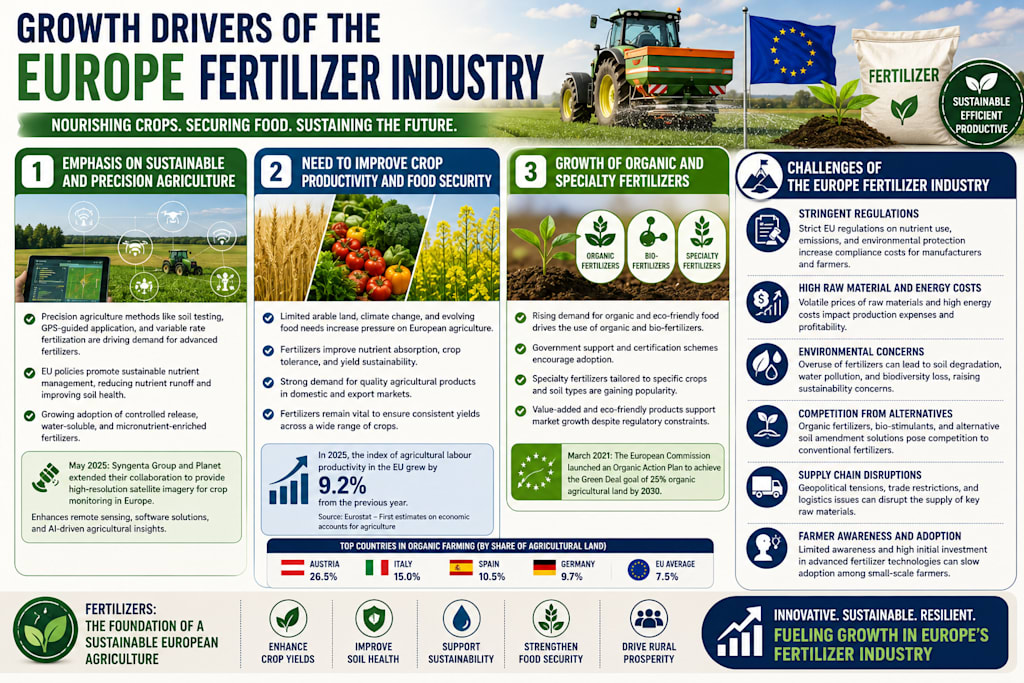
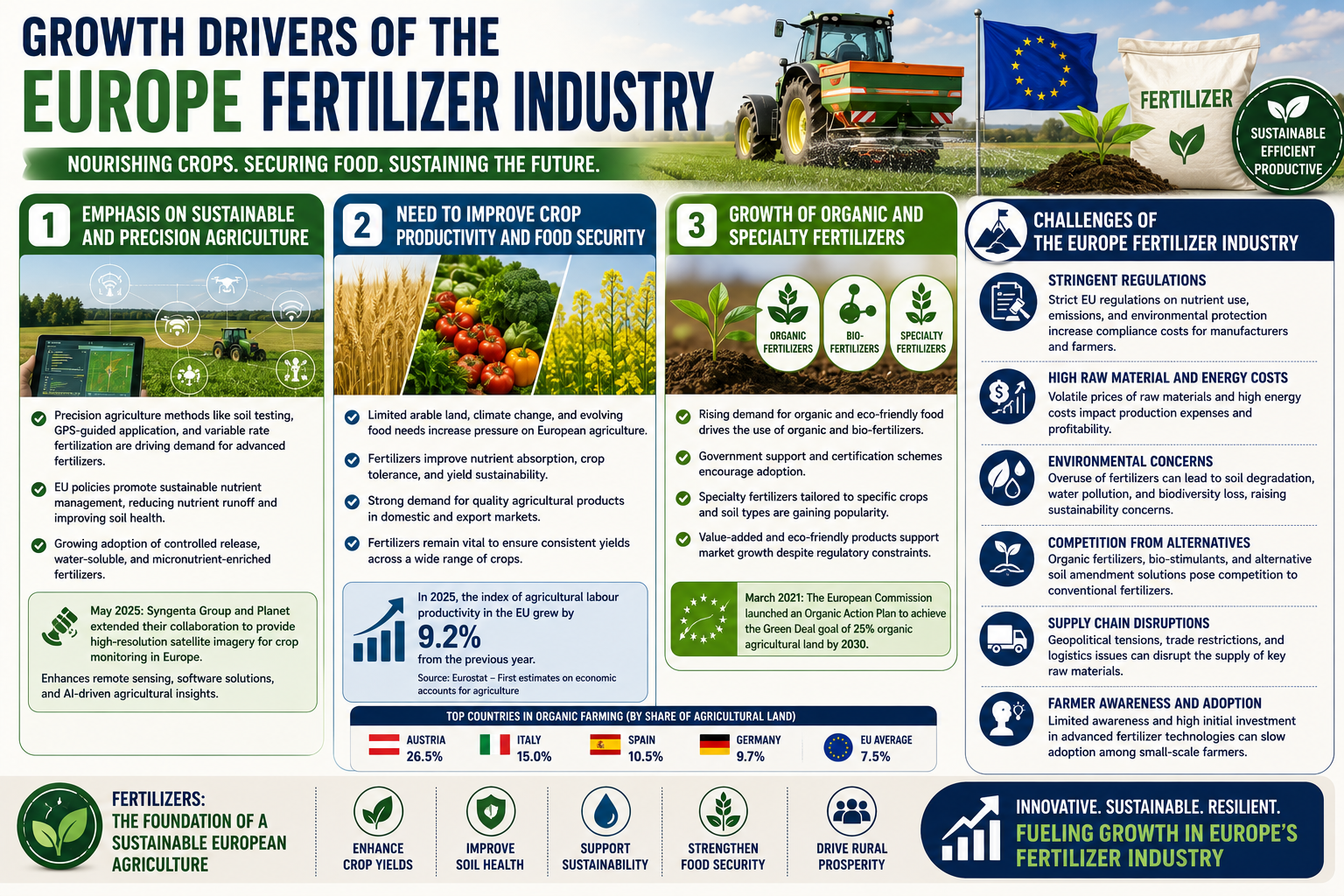
Using GPS-guided equipment, soil testing, satellite imagery, sensors, and variable-rate application systems, farmers can deliver nutrients exactly where and when they are needed.
This targeted approach improves nutrient efficiency, reduces waste, and lowers environmental impact.
Precision agriculture also helps farmers optimize input costs while maximizing crop performance.
As sustainability requirements become stricter across Europe, the demand for fertilizers that integrate with advanced farming technologies continues to increase.
In May 2025, Syngenta Group and Planet expanded their collaboration to provide high-resolution satellite imagery for crop monitoring across Europe, further supporting data-driven agricultural decision-making and precision nutrient management.
These developments demonstrate how digital technology is becoming increasingly important to fertilizer application strategies.
Food Security Continues to Drive Demand
Europe faces ongoing pressure to maintain stable food production while dealing with environmental constraints and climate-related challenges.
Population growth, evolving dietary preferences, and changing global trade patterns have reinforced the importance of agricultural productivity.
Fertilizers remain one of the most effective tools for improving crop yields and ensuring reliable harvests.
They support production across a wide range of crops, including cereals, fruits, vegetables, and oilseeds that form the foundation of Europe's food system.
The importance of productivity is reflected in broader agricultural performance indicators. According to Eurostat estimates, agricultural labor productivity within the European Union increased by approximately 9.2% in 2025, highlighting ongoing efforts to improve efficiency throughout the agricultural sector.
As food security remains a strategic priority, fertilizers will continue playing a critical role in supporting Europe's agricultural output.
Organic and Specialty Fertilizers Are Gaining Momentum
Consumer demand for environmentally responsible food production is reshaping the fertilizer landscape.
Organic farming continues expanding across Europe as consumers increasingly seek products perceived as healthier and more sustainable.
This shift has created strong demand for organic fertilizers, biofertilizers, and specialty nutrient solutions designed to support sustainable farming systems.
Specialty fertilizers tailored to specific crops, soil conditions, and nutrient requirements are also becoming increasingly popular.
These products help farmers improve nutrient efficiency while minimizing environmental risks such as runoff and soil degradation.
Government policies are further accelerating adoption.
The European Commission's Organic Action Plan aims to ensure that 25% of agricultural land within the European Union is managed organically by 2030. Countries such as Austria, Italy, Spain, and Germany are already among Europe's leaders in organic agriculture.
As organic farming expands, demand for environmentally friendly fertilizer solutions is expected to grow significantly.
Nitrogen Fertilizers Continue to Dominate
Nitrogen fertilizers remain one of the most important segments of the European fertilizer market.
Nitrogen is essential for plant growth and plays a crucial role in crop productivity.
Products such as urea, nitrates, urea ammonium nitrate (UAN), and compound fertilizers are widely used across European agriculture.
However, nitrogen fertilizers are also subject to increasing scrutiny due to their environmental impact.
Governments and regulators are encouraging more efficient application methods and technologies that reduce nutrient losses and greenhouse gas emissions.
This has encouraged fertilizer manufacturers to develop advanced formulations designed to improve nutrient uptake and reduce waste.
The future of nitrogen fertilizers will likely be shaped by innovation focused on balancing productivity with environmental responsibility.
Potassium Fertilizers Support Crop Resilience
Potassium fertilizers are another essential component of modern agriculture.
They help improve water management, strengthen plant resistance to disease, and enhance crop quality.
Products such as muriate of potash and sulfate of potash are widely used in fruit, vegetable, and oilseed production.
European farmers increasingly recognize the importance of balanced nutrient programs that incorporate adequate potassium levels.
Climate change has heightened interest in potassium because of its role in helping crops withstand environmental stress.
Although Europe relies heavily on imported potash, efficient distribution systems and growing awareness of soil health continue supporting market demand.
Liquid Fertilizers Are Growing in Popularity
Liquid fertilizers represent one of the fastest-growing segments within the European fertilizer market.
Their popularity is closely linked to precision agriculture and advanced irrigation systems.
Liquid formulations provide rapid nutrient absorption and can be applied with high accuracy through fertigation and other delivery methods.
These products are particularly valuable for greenhouse production, horticulture, and high-value crops where precise nutrient management is essential.
Farmers appreciate their ease of application, reduced nutrient losses, and compatibility with modern agricultural technologies.
As resource efficiency becomes increasingly important, liquid fertilizers are expected to capture a growing share of the market.
Environmental Regulations Remain a Major Challenge
Despite positive growth prospects, the fertilizer industry faces significant regulatory challenges.
Europe maintains some of the world's strictest environmental standards related to nutrient management, greenhouse gas emissions, and water quality protection.
While these regulations support sustainability goals, they also create compliance costs and operational challenges for manufacturers.
Companies must invest heavily in research, innovation, and cleaner production methods to meet evolving requirements.
These investments can affect profitability and create barriers for smaller market participants.
Balancing environmental responsibility with economic competitiveness remains one of the industry's most important challenges.
Volatile Energy and Raw Material Costs Create Pressure
Another major concern for fertilizer producers is cost volatility.
Many fertilizers depend on raw materials such as natural gas, phosphates, and potash, all of which are vulnerable to supply chain disruptions and price fluctuations.
Energy costs are particularly important for nitrogen fertilizer production, where natural gas serves as a critical input.
Geopolitical events, market instability, and changing trade dynamics can significantly affect production economics.
Manufacturers must continuously manage these risks while maintaining reliable supply and competitive pricing.
These cost pressures remain a key challenge throughout the European fertilizer value chain.
Country Markets Reflect Diverse Agricultural Priorities
France remains one of Europe's largest fertilizer markets due to its extensive agricultural sector and large-scale production of cereals, fruits, vegetables, and oilseeds. The country continues investing in precision agriculture and sustainable nutrient management. In May 2024, FertigHy announced plans to establish a low-carbon hydrogen and fertilizer production facility in northern France.
The United Kingdom continues promoting nutrient efficiency and soil health through precision agriculture initiatives while increasing adoption of high-performance fertilizers. In January 2026, SoilWorx expanded its operations into mainland UK markets with new organo-mineral fertilizer solutions.
Germany remains focused on nutrient-efficient and environmentally responsible fertilizer solutions, reflecting the country's strong emphasis on sustainability and agricultural productivity.
Meanwhile, the Netherlands continues leading innovation in greenhouse agriculture and precision nutrient management. In February 2025, Haifa North West Europe introduced Haifa Soluble DUO, a water-soluble fertilizer designed to optimize calcium and nutrient delivery without increasing nitrogen inputs.
These regional developments demonstrate the diverse opportunities driving growth throughout Europe.
Final Thoughts
The European fertilizer industry is entering a new era defined by sustainability, innovation, and efficiency.
With the market projected to surpass US$56.12 billion by 2034, fertilizers will remain essential for maintaining food security, improving crop productivity, and supporting the region's agricultural economy.
The rise of precision agriculture, organic farming, specialty fertilizers, and advanced nutrient management systems is reshaping how nutrients are delivered to crops. At the same time, environmental regulations and cost pressures are encouraging manufacturers to innovate and develop more sustainable solutions.
For farmers, fertilizer companies, and policymakers alike, the future of agriculture will depend on finding the right balance between productivity and environmental stewardship.
As Europe continues building a more sustainable agricultural future, fertilizers will remain a cornerstone of that transformation.
About the Creator
Enjoyed the story? Support the Creator.
Subscribe for free to receive all their stories in your feed.
Comments
There are no comments for this story
Be the first to respond and start the conversation.