
Europe Fertilizer Market Set for Sustainable Growth as Precision Agriculture and Food Security Drive Demand
Rising adoption of innovative fertilizers, growing focus on sustainable farming, and the need to improve agricultural productivity are shaping the future of the European fertilizer industry.

Agriculture remains one of the most important pillars of Europe's economy and food system. Despite technological advancements and modernization across industries, the success of farming still depends heavily on one essential factor: maintaining healthy and productive soil. As Europe faces growing pressure to enhance food security, improve crop yields, and meet ambitious environmental goals, fertilizers continue to play a critical role in supporting agricultural productivity.
Today, the fertilizer industry is undergoing a significant transformation. Farmers are no longer focused solely on maximizing yields. Instead, they are increasingly seeking solutions that balance productivity with environmental sustainability, efficient nutrient management, and regulatory compliance. This shift is driving demand for innovative fertilizers, precision agriculture technologies, and environmentally responsible farming practices.
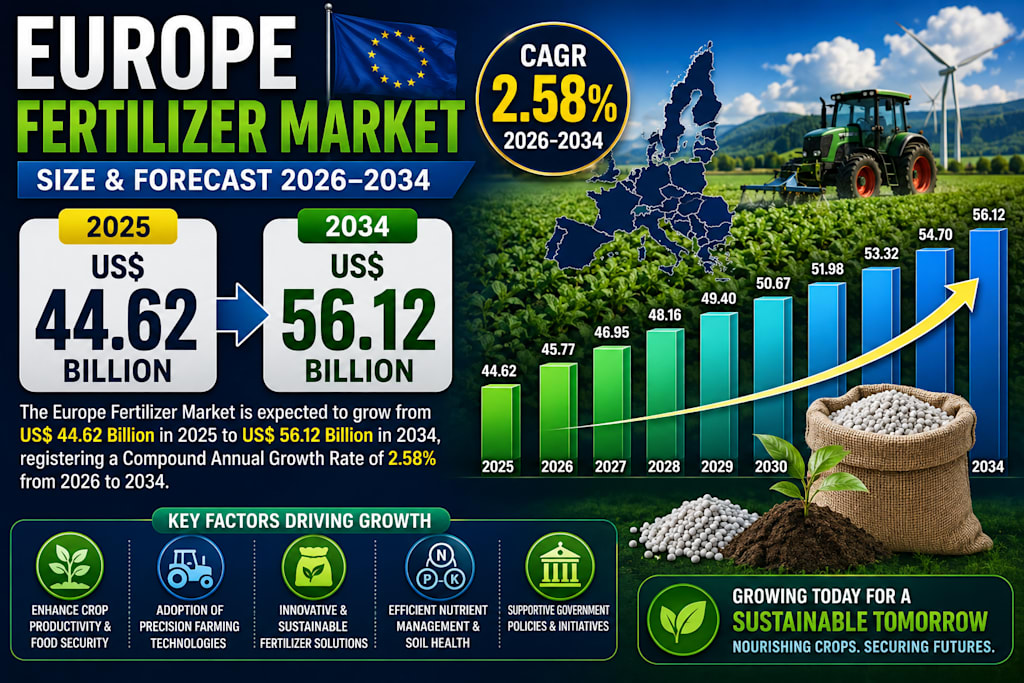
According to Renub Research, the Europe Fertilizer Market is expected to grow from US$44.62 billion in 2025 to US$56.12 billion by 2034, registering a compound annual growth rate (CAGR) of 2.58% from 2026 to 2034. The market's steady expansion reflects the growing importance of sustainable agriculture, technological innovation, and food security across the region.

Fertilizers Remain Essential to Modern Agriculture
Fertilizers are substances applied to soil or crops to provide nutrients necessary for healthy plant growth. These nutrients include nitrogen, phosphorus, potassium, and a range of secondary nutrients and micronutrients that support crop development.
Without adequate nutrient supplementation, soil fertility declines over time, resulting in lower crop yields and reduced agricultural productivity. Fertilizers help replenish essential nutrients removed during cultivation, ensuring that crops can achieve optimal growth and quality.
European agriculture relies heavily on fertilizers because of limited arable land, changing climate conditions, and increasing food demand. Farmers must maximize productivity while maintaining environmental responsibility, making efficient nutrient management more important than ever.
As agricultural practices continue evolving, fertilizers remain a cornerstone of Europe's food production system.
Food Security Continues to Drive Demand
One of the strongest factors supporting the European fertilizer market is the ongoing need to ensure food security.
Europe's population continues to require a reliable supply of cereals, fruits, vegetables, oilseeds, and other agricultural products. At the same time, farmers face growing challenges from climate change, land constraints, and shifting environmental regulations.
Fertilizers play a crucial role in helping producers maintain consistent yields despite these pressures.
Modern nutrient solutions enable crops to absorb nutrients more efficiently, improve resilience to environmental stress, and support higher productivity levels. These benefits are especially important as agricultural producers work to meet growing domestic and international demand.
With food security remaining a strategic priority across Europe, fertilizer demand is expected to remain stable and resilient.
Precision Agriculture Is Transforming Fertilizer Use
One of the most significant trends shaping the fertilizer industry is the rapid adoption of precision agriculture.
Traditional farming often relied on applying fertilizers uniformly across entire fields. Today, precision farming technologies allow growers to apply nutrients exactly where and when they are needed.
Tools such as GPS-guided equipment, satellite monitoring, soil testing, remote sensing, and data analytics help farmers optimize fertilizer use while reducing waste.
This targeted approach improves nutrient efficiency, lowers costs, enhances crop performance, and minimizes environmental impact.
As precision agriculture becomes increasingly common across Europe, demand for specialized fertilizers designed for variable-rate application and advanced nutrient management continues to grow.
Sustainability Is Reshaping the Industry
Environmental sustainability has become a defining force within the European fertilizer market.
European governments, consumers, and agricultural organizations are placing increasing emphasis on reducing nutrient runoff, protecting water quality, lowering greenhouse gas emissions, and improving soil health.
As a result, fertilizer manufacturers are investing heavily in developing products that support sustainable farming practices.
Controlled-release fertilizers, water-soluble fertilizers, micronutrient-enriched products, and enhanced-efficiency nutrient solutions are gaining popularity because they deliver nutrients more effectively while minimizing environmental losses.
The transition toward sustainable agriculture is expected to remain one of the most important long-term growth drivers for the industry.
The Rise of Organic and Specialty Fertilizers
Demand for organic and specialty fertilizers is increasing throughout Europe.
Consumers are becoming more interested in organic food production, while governments continue promoting environmentally friendly farming methods. This trend has created significant opportunities for alternative fertilizer products that align with sustainable agricultural goals.
Organic fertilizers, biofertilizers, and specialty nutrient solutions are increasingly used to support crop health, improve soil quality, and reduce dependence on conventional chemical inputs.
Specialty fertilizers designed for specific crops, soil conditions, and farming systems are also gaining traction among growers seeking higher productivity and improved nutrient efficiency.
As organic agriculture continues expanding across Europe, demand for these innovative fertilizer categories is expected to grow steadily.
The European Green Deal Is Influencing Market Development
The European Union's sustainability initiatives are having a major impact on fertilizer usage and agricultural practices.
Policies associated with the European Green Deal encourage more sustainable farming methods while promoting biodiversity, resource efficiency, and reduced environmental impact.
One of the most ambitious goals is increasing the proportion of agricultural land dedicated to organic farming. This objective is encouraging greater adoption of organic nutrient solutions and environmentally responsible fertilizer products.
Countries such as Austria, Italy, Spain, and Germany have already made significant progress in expanding organic agriculture.
These policy initiatives are expected to continue influencing fertilizer demand patterns and product innovation throughout the forecast period.
Nitrogen Fertilizers Remain the Largest Segment
Nitrogen-based fertilizers continue to dominate the European fertilizer market.
Nitrogen is one of the most important nutrients for plant growth because it supports leaf development, photosynthesis, and overall crop productivity. Products such as urea, nitrates, UAN solutions, and compound fertilizers are widely used across cereal, vegetable, and oilseed production systems.
Despite environmental concerns related to nitrogen emissions and nutrient runoff, demand remains strong due to the critical role these fertilizers play in maintaining agricultural productivity.
Manufacturers are increasingly developing enhanced-efficiency nitrogen products that improve nutrient uptake while reducing environmental losses.
This innovation is helping ensure the long-term relevance of nitrogen fertilizers within sustainable farming systems.
Potassium Fertilizers Support Crop Quality
Potassium fertilizers represent another important segment of the European fertilizer industry.
Potassium plays a vital role in plant health by improving water regulation, disease resistance, root development, and crop quality. It is particularly important for fruit, vegetable, and oilseed production.
As climate change increases the frequency of environmental stress events such as droughts and temperature fluctuations, farmers are placing greater emphasis on potassium nutrition to improve crop resilience.
Growing awareness of balanced nutrient management is supporting continued demand for potassium fertilizers throughout Europe.
Liquid Fertilizers Gain Popularity
Liquid fertilizers are experiencing increasing adoption across European agriculture.
These products offer several advantages, including uniform nutrient distribution, rapid absorption, and compatibility with advanced irrigation systems such as fertigation.
Liquid fertilizers are especially popular in greenhouse operations, horticulture, and high-value crop production, where precision nutrient delivery is essential.
Their ease of handling and ability to support targeted application strategies make them attractive to farmers focused on maximizing efficiency and sustainability.
As precision farming practices continue expanding, liquid fertilizer demand is expected to grow steadily.
France Remains a Key Fertilizer Market
France is one of Europe's largest fertilizer markets due to its extensive agricultural sector.
The country produces a wide range of crops, including cereals, oilseeds, fruits, and vegetables, all of which require effective nutrient management to maintain productivity.
French farmers are increasingly adopting balanced fertilization strategies and precision agriculture technologies to improve soil health while complying with environmental regulations.
Recent investments in low-carbon fertilizer production facilities further demonstrate France's commitment to combining agricultural productivity with sustainability.
As the country's agricultural sector continues modernizing, fertilizer demand is expected to remain stable.
Germany Focuses on Sustainable Nutrient Management
Germany's fertilizer market is characterized by a strong emphasis on environmental responsibility.
Strict regulations governing nutrient runoff and fertilizer application have encouraged farmers to adopt more efficient nutrient management practices.
Precision fertilizers, organic nutrient solutions, and environmentally friendly products are becoming increasingly popular as growers seek to balance productivity with sustainability.
Advanced soil analysis technologies and data-driven farming practices are helping optimize fertilizer use while reducing environmental impact.
Germany's commitment to sustainable agriculture continues to shape the evolution of its fertilizer market.
The Netherlands Leads in Agricultural Innovation
Despite its relatively small size, the Netherlands remains one of Europe's most advanced agricultural economies.
Dutch farmers utilize sophisticated greenhouse systems, precision agriculture technologies, and efficient nutrient management strategies to achieve exceptionally high productivity levels.
The country has become a leader in nutrient recycling, controlled fertilizer application, and sustainable agricultural innovation.
Government policies encouraging efficient resource use and environmental stewardship have accelerated adoption of advanced fertilizer technologies.
The Netherlands serves as an important example of how innovation can support both productivity and sustainability.
Challenges Continue to Affect the Industry
While growth prospects remain positive, the fertilizer industry faces several challenges.
One of the most significant issues is the increasing complexity of environmental regulations. Compliance with strict standards related to emissions, nutrient runoff, and soil protection often requires substantial investment from manufacturers and farmers alike.
Regulatory requirements can increase operational costs and limit flexibility within the market.
At the same time, fertilizer production remains highly sensitive to fluctuations in raw material and energy prices.
Natural gas, phosphate, and potash prices can vary significantly due to geopolitical developments, supply chain disruptions, and global market conditions.
These cost pressures create uncertainty for both producers and agricultural customers.
Innovation Will Shape the Future
The future of the European fertilizer market will be driven by innovation.
Advancements in controlled-release technologies, biological fertilizers, digital agriculture, nutrient monitoring systems, and precision application techniques are expected to transform the industry.
Manufacturers that successfully develop products capable of improving nutrient efficiency while reducing environmental impact will be well positioned for long-term success.
Collaboration among governments, agricultural organizations, technology providers, and fertilizer companies will also play a crucial role in achieving sustainability goals while maintaining food security.
Final Thoughts
The Europe fertilizer market is evolving in response to some of the most important challenges facing modern agriculture: feeding a growing population, protecting natural resources, and adapting to climate change.
Fertilizers remain indispensable for maintaining crop productivity, but the industry's future increasingly depends on innovation, efficiency, and environmental responsibility.
With the market projected to grow from US$44.62 billion in 2025 to US$56.12 billion by 2034, opportunities remain substantial for manufacturers, distributors, farmers, and technology providers.
As precision agriculture, sustainable farming practices, and specialty nutrient solutions continue gaining momentum, the European fertilizer industry is positioned to play a central role in building a more productive and environmentally responsible agricultural future.
About the Creator
Enjoyed the story? Support the Creator.
Subscribe for free to receive all their stories in your feed.
Comments
There are no comments for this story
Be the first to respond and start the conversation.