
Europe Electric Vehicle Charging Infrastructure Market to Surpass USD 64.34 Billion by 2033 as EV Adoption Accelerates Across the Region
Government Policies, Private Investments, and Smart City Initiatives Drive Massive Growth in Europe's Charging Network

Europe’s EV Charging Revolution Is Gaining Momentum
Europe is rapidly transforming into one of the world's most advanced electric mobility ecosystems. As governments tighten emissions regulations and consumers increasingly embrace electric vehicles (EVs), charging infrastructure has become the backbone of the continent’s transportation transition.
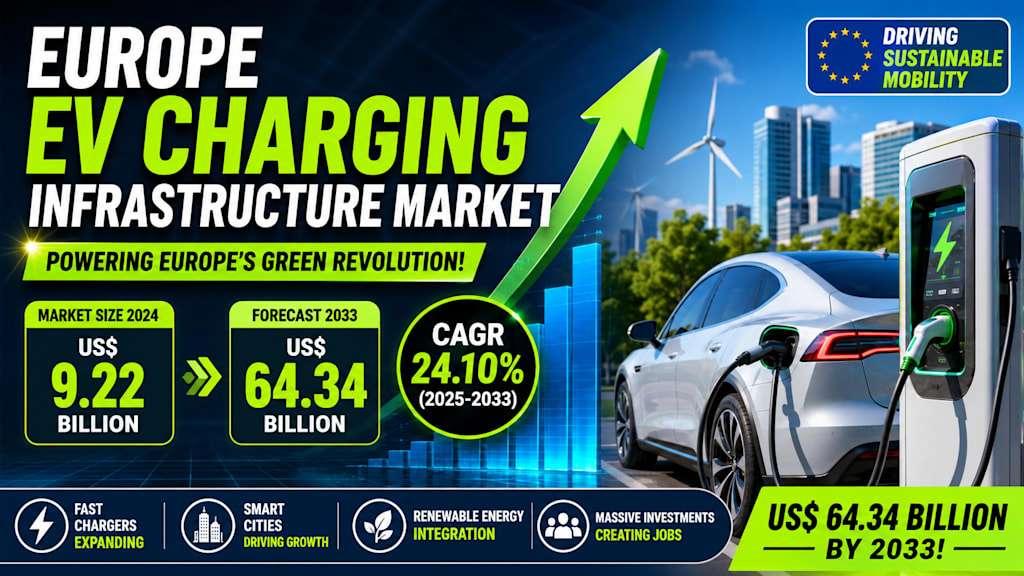
According to Renub Research, the Europe Electric Vehicle Charging Infrastructure Market is projected to grow from US$ 9.22 Billion in 2024 to US$ 64.34 Billion by 2033, expanding at an impressive CAGR of 24.10% between 2025 and 2033.
The remarkable growth highlights Europe’s determination to achieve climate neutrality while creating a seamless charging experience for millions of EV owners. As electric vehicles become mainstream, the demand for accessible, reliable, and high-speed charging solutions continues to surge across the region.
Why Europe Leads the Global EV Charging Infrastructure Market
Europe has emerged as a global leader in electric vehicle infrastructure due to a combination of strong government support, aggressive climate targets, and increasing consumer awareness.
The European Union has committed to reducing greenhouse gas emissions significantly under initiatives such as the European Green Deal and the Fit for 55 package. These policies encourage the deployment of charging stations while supporting EV adoption through incentives and regulatory measures.
By the end of 2023, the European Union had approximately 700,000 public charging stations. However, the European Commission aims to increase that number to around 3.5 million charging stations by 2030, highlighting the immense expansion still required.
Countries such as the Netherlands, Germany, and Norway continue to lead infrastructure deployment, creating a model that other European nations are now working to replicate.
Rising EV Sales Are Creating Massive Infrastructure Demand
The popularity of electric vehicles across Europe is growing at an unprecedented pace.
Consumers are increasingly shifting toward EVs due to:
Rising fuel prices
Environmental concerns
Government subsidies
Improved vehicle performance
Expanding charging accessibility
As EV ownership grows, the need for extensive charging networks becomes increasingly important. Drivers expect charging stations to be as accessible as traditional fuel stations.
This expectation is encouraging governments, utilities, charging network operators, and automakers to invest heavily in infrastructure expansion.
The result is a rapidly evolving ecosystem that includes home charging, workplace charging, public charging hubs, and ultra-fast highway charging corridors.
Government Policies Continue to Fuel Market Growth
One of the strongest growth drivers in Europe’s charging infrastructure market is government intervention.
European governments have introduced numerous programs aimed at accelerating EV adoption and infrastructure deployment. These include:
Direct subsidies for charging station installation
Tax incentives for EV owners
Grants for municipalities
Investment funds for public charging networks
Carbon reduction mandates
Such initiatives create a favorable environment for both public and private stakeholders.
Governments recognize that without sufficient charging infrastructure, EV adoption could slow significantly. Therefore, charging deployment remains a strategic priority across the continent.
Private Sector Investments Are Transforming the Industry
While governments provide policy support, private companies are supplying much of the capital and innovation needed to expand charging networks.
Major energy companies, technology firms, charging operators, and automotive manufacturers are investing billions of dollars into infrastructure projects.
Automakers increasingly view charging networks as a critical extension of their vehicle offerings. Dedicated charging ecosystems help improve customer satisfaction and encourage consumers to switch to electric mobility.
Public-private partnerships are also becoming increasingly common. These collaborations combine government support with private-sector expertise, helping accelerate charging station deployment in both urban and rural areas.
Such investments are helping Europe build one of the most comprehensive EV charging networks in the world.
Smart Cities Are Accelerating Charging Infrastructure Development
Urbanization is creating new opportunities for EV charging deployment.
Across Europe, cities are embracing smart city initiatives focused on sustainability, connectivity, and efficient energy management. Charging infrastructure plays a central role in these strategies.
Modern charging stations are increasingly integrated with:
Smart grids
Renewable energy systems
Energy storage technologies
Digital payment platforms
Real-time monitoring systems
This integration allows cities to manage electricity demand more efficiently while improving charging convenience for users.
As smart city projects expand, charging infrastructure is expected to become an essential element of urban planning throughout Europe.
Renewable Energy Integration Enhances Sustainability
A unique characteristic of Europe's EV charging market is the growing integration of renewable energy sources.
Many charging operators are incorporating:
Solar energy
Wind power
Battery storage systems
Grid-balancing technologies
These solutions reduce the carbon footprint of charging operations while supporting Europe’s long-term sustainability objectives.
Renewable-powered charging stations are becoming increasingly attractive to governments, businesses, and environmentally conscious consumers.
The combination of electric transportation and renewable energy creates a powerful pathway toward a cleaner and more sustainable future.
Fast Charging Technology Is Becoming a Key Market Focus
As EV ownership expands, consumer expectations regarding charging speed continue to rise.
Fast and ultra-fast charging technologies are becoming essential for reducing charging times and improving convenience.
Modern charging networks now offer:
DC fast chargers
High-power charging systems
Highway charging hubs
Ultra-fast charging corridors
These solutions allow drivers to recharge vehicles in significantly less time compared to traditional charging methods.
The continued rollout of fast charging stations is expected to be a major contributor to market growth throughout the forecast period.
Key Challenges Facing the Market
Despite strong growth prospects, several challenges continue to impact the European charging infrastructure industry.
Uneven Infrastructure Distribution
One of the most significant challenges is the uneven deployment of charging stations across Europe.
Countries such as Germany, Norway, and the Netherlands enjoy extensive charging coverage, while several Eastern and Southern European nations still lag behind.
This imbalance creates challenges for cross-border EV travel and limits adoption in underserved regions.
Addressing these disparities will require coordinated policy efforts and increased investment.
High Installation and Maintenance Costs
Deploying EV charging infrastructure requires substantial financial resources.
Key cost factors include:
Grid upgrades
Equipment procurement
Site acquisition
Civil engineering work
Ongoing maintenance
Fast charging stations are particularly expensive due to their higher power requirements.
To ensure sustainable expansion, stakeholders must continue exploring innovative financing models and cost-sharing partnerships.
Country Spotlight: Germany Leads Infrastructure Expansion
Germany remains one of Europe's largest and most influential EV charging markets.
The country has established ambitious targets to install over one million charging stations by 2030.
Government incentives, strong automotive industry support, and growing consumer demand continue to drive investment throughout the country.
However, challenges such as regional disparities and grid modernization requirements remain important priorities for policymakers and industry leaders.
United Kingdom Strengthens Charging Network
The United Kingdom is making substantial progress in expanding its EV charging ecosystem.
National plans to phase out internal combustion engine vehicles have accelerated infrastructure deployment.
The country continues to focus on:
Fast charger installation
Highway charging corridors
Workplace charging
Residential charging solutions
Private-sector participation is helping improve network reliability and user experience while supporting broader sustainability goals.
France and Italy Continue Rapid Development
France and Italy are also investing heavily in EV charging infrastructure.
Government incentives, regulatory support, and corporate investments are helping increase charging station availability across both countries.
These efforts focus on enhancing:
Accessibility
Charging speed
User convenience
Regional network coverage
Although challenges remain, both nations are making significant progress toward their electric mobility objectives.
10 Recent Industry Developments
In February 2025, over 3,500 EV charging solution providers committed to expanding their workforce, potentially creating more than 162,000 jobs by 2030.
E.ON, Eldrive, and ZSE announced a partnership to deploy over 1,400 charging stations across 13 European countries by 2027.
Fast-charging corridor projects continue expanding along major European highways.
Smart charging technologies are increasingly being integrated into urban infrastructure projects.
Renewable energy-powered charging stations are gaining popularity across Western Europe.
Public-private partnerships are accelerating infrastructure deployment in underserved regions.
Major automakers continue investing in proprietary charging networks.
Grid modernization projects are being launched to support high-capacity charging systems.
Connected charging stations are increasingly replacing traditional standalone units.
Governments across Europe continue introducing funding programs aimed at expanding EV charging accessibility.
Leading Companies Shaping the Market
Several major industry participants are driving innovation and expansion across Europe:
ABB Ltd.
ChargePoint, Inc.
Blink Charging Co.
Eaton Corporation
Tesla Inc.
Webasto Group
Schneider Electric
Siemens
Delta Electronics
Final Thoughts
Europe’s electric vehicle charging infrastructure market is entering a transformative decade. As governments intensify climate commitments, consumers embrace electric mobility, and private investors accelerate infrastructure deployment, charging networks will become increasingly widespread and sophisticated.
The projected rise from US$ 9.22 Billion in 2024 to US$ 64.34 Billion by 2033 reflects more than market growth—it represents a fundamental shift in how Europe approaches transportation, energy consumption, and sustainability.
With continued investment, technological innovation, and policy support, Europe is well positioned to remain a global leader in electric mobility and charging infrastructure development for years to come.
Source: Renub Research Market Analysis
About the Creator
Enjoyed the story? Support the Creator.
Subscribe for free to receive all their stories in your feed.
Comments
There are no comments for this story
Be the first to respond and start the conversation.