
Europe Defibrillator Market to Reach US$ 7.23 Billion by 2033 Amid Rising Cardiac Emergencies and Public AED Expansion
Increasing cardiovascular disease burden, government-backed public access defibrillation programs, and rapid innovation in implantable and external defibrillators are accelerating market growth across Europe.

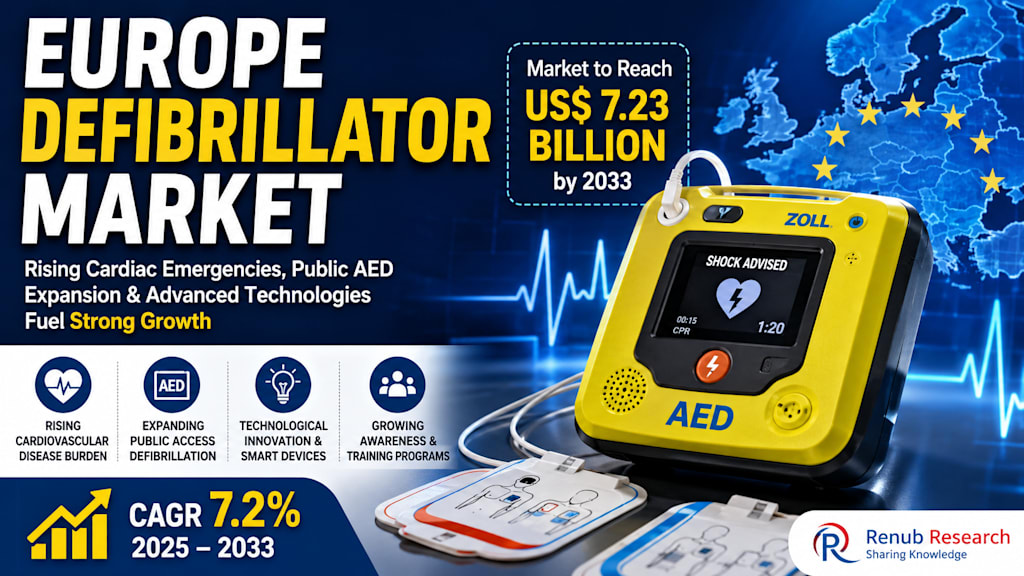
The Europe Defibrillator Market is witnessing strong momentum as healthcare systems across the region intensify efforts to reduce deaths caused by sudden cardiac arrest (SCA) and other cardiovascular diseases. According to Renub Research, the market was valued at US$ 3.87 billion in 2024 and is projected to reach US$ 7.23 billion by 2033, growing at a CAGR of 7.2% from 2025 to 2033.
The market’s growth is being fueled by the increasing prevalence of heart-related disorders, expanding awareness regarding emergency cardiac care, wider deployment of automated external defibrillators (AEDs) in public spaces, and continuous technological innovation in implantable and wearable cardiac devices.
Across Europe, governments, hospitals, sports authorities, and healthcare organizations are aggressively promoting rapid-response cardiac care systems. This shift is transforming defibrillators from specialized hospital devices into mainstream lifesaving tools available in airports, offices, schools, malls, railway stations, and even homes.
Rising Cardiovascular Disease Cases Driving Defibrillator Demand
Cardiovascular diseases continue to remain the leading cause of mortality across Europe, creating substantial demand for emergency cardiac treatment technologies. According to the report, cardiovascular diseases account for over 42.5% of annual deaths in the European region, representing nearly 10,000 deaths every day.
The growing incidence of arrhythmias, heart failure, coronary artery disease, and sudden cardiac arrest is significantly increasing the need for both implantable and external defibrillators. Aging populations in countries such as Germany, Italy, and France are further intensifying the burden of chronic cardiac diseases.
Healthcare experts believe rapid intervention during cardiac arrest can dramatically improve survival rates. As a result, healthcare providers and policymakers are prioritizing wider access to defibrillators in clinical and public settings.
The increasing prevalence of sedentary lifestyles, obesity, smoking, diabetes, and hypertension across Europe is also contributing to the sharp rise in cardiovascular emergencies.
Public Access Defibrillation Programs Expanding Across Europe
One of the strongest growth drivers for the Europe defibrillator market is the aggressive implementation of Public Access Defibrillation (PAD) initiatives.
Several European governments have introduced regulations mandating AED installations in public places including:
- Airports
- Shopping centers
- Schools
- Stadiums
- Corporate offices
- Transportation hubs
- Railway stations
- Sports facilities
Countries such as France and the United Kingdom have emerged as leaders in promoting community-based emergency cardiac preparedness. Public awareness campaigns, CPR education programs, and AED training initiatives are significantly improving emergency response outcomes.
The report notes that more than 500,000 people across Europe received CPR and AED training through certified programs during 2023.
Additionally, the European Resuscitation Council collaborated with national authorities to encourage mandatory AED training in workplaces with more than 50 employees. These initiatives are helping create a more responsive emergency care ecosystem across the region.
Technology Advancements Reshaping the Market
Technological innovation remains a major catalyst transforming the European defibrillator industry.
Manufacturers are increasingly introducing lightweight, portable, and highly automated devices that can be operated by non-medical individuals during emergencies. Modern AEDs now feature:
- Voice-guided instructions
- Real-time CPR feedback
- Bluetooth connectivity
- Remote monitoring capabilities
- Cloud-based data management
- Extended battery life
- Enhanced portability
- Smartphone integration
These innovations are improving device usability while expanding adoption beyond hospitals into homes, schools, workplaces, and recreational areas.
Implantable Cardioverter Defibrillators (ICDs) are also evolving rapidly with miniaturized designs and advanced remote monitoring systems that allow physicians to track patients more efficiently.
The integration of defibrillators with hospital electronic health record systems and telemedicine platforms is further improving patient care coordination across Europe.
Implantable Defibrillators Witness Growing Adoption
The implantable defibrillator segment is experiencing significant growth due to increasing rates of arrhythmias and chronic heart diseases.
Implantable Cardioverter Defibrillators (ICDs) and Cardiac Resynchronization Therapy Defibrillators (CRT-Ds) are increasingly being used for patients considered at high risk of sudden cardiac arrest.
Western European nations such as Germany, France, and the United Kingdom are leading in ICD adoption due to:
- Advanced healthcare infrastructure
- Favorable reimbursement systems
- Strong physician awareness
- Better access to cardiac specialists
- Increased investment in cardiac care technology
Continuous advancements in battery efficiency and wireless monitoring are also improving long-term patient outcomes.
External Defibrillator Market Expanding Rapidly
The external defibrillator segment, particularly AEDs, is witnessing strong expansion throughout Europe.
Public awareness regarding sudden cardiac arrest management has increased dramatically in recent years, encouraging businesses, schools, and public institutions to install AEDs.
Corporate organizations are also incorporating defibrillators into workplace safety frameworks. Many multinational companies operating across Europe now maintain emergency response protocols that include onsite AED availability and employee CPR training.
The growing adoption of semi-automatic and fully automatic AEDs is expected to further accelerate the market during the forecast period.
Hospitals Continue to Lead Market Adoption
Hospitals remain the largest end-user segment in the European defibrillator market.
Emergency departments, operating theaters, intensive care units (ICUs), and cardiac specialty centers rely heavily on advanced defibrillation systems for critical cardiac interventions.
Modern hospital defibrillators now include advanced ECG monitoring, automated documentation systems, and enhanced diagnostic capabilities. These features are improving clinical efficiency while reducing treatment delays during emergencies.
Countries including Germany, France, and the Netherlands continue investing heavily in advanced cardiac care infrastructure, supporting sustained market expansion.
Home Healthcare Segment Gains Momentum
Europe’s growing elderly population and rising preference for home-based chronic disease management are creating strong opportunities for home healthcare defibrillators.
Portable AEDs and wearable cardiac defibrillators are becoming increasingly popular among high-risk cardiac patients who require immediate emergency protection outside hospital environments.
Telemedicine integration and expanding insurance coverage for home healthcare devices are further boosting market growth.
Healthcare providers across Western Europe are increasingly encouraging remote patient monitoring solutions, supporting broader adoption of wearable cardiac technologies.
Germany Leads the European Market
Germany currently dominates the Europe defibrillator market due to its highly developed healthcare infrastructure and strong cardiac care ecosystem.
The country maintains one of the highest implantation rates for ICDs in Europe and has an extensive network of public AED installations.
Strong insurance coverage, favorable reimbursement policies, and ongoing investments in healthcare modernization are contributing significantly to market leadership.
German hospitals also continue adopting cutting-edge defibrillation technologies supported by collaborations between domestic and international medical device companies.
France Strengthens Public Defibrillation Network
France has emerged as a major growth market due to strong government mandates requiring AED installations in public locations.
The country’s healthcare system actively supports cardiac emergency preparedness through training programs, awareness campaigns, and advanced cardiac treatment centers.
France is also becoming an important innovation hub for implantable cardiac devices and Bluetooth-enabled defibrillation technologies.
United Kingdom Focuses on Community Cardiac Care
The United Kingdom continues expanding its public access defibrillation programs with strong support from charities and healthcare organizations.
The National Health Service (NHS) has accelerated AED deployment across healthcare facilities and public environments. Rising cardiovascular disease prevalence and increasing elderly populations are further supporting demand.
The UK is also seeing growing interest in portable and wearable defibrillator technologies designed for home-based cardiac monitoring and emergency response.
Market Challenges Remain
Despite strong growth prospects, the Europe defibrillator market faces several important challenges.
High device costs, particularly for implantable systems, remain a significant barrier in lower-income regions and underfunded healthcare systems.
The financial burden associated with surgical implantation, post-operative care, and device replacement can limit broader accessibility.
Additionally, Europe’s strict Medical Device Regulation (MDR) framework creates lengthy approval timelines and increased compliance costs for manufacturers.
Product recalls linked to battery or software failures have also raised concerns regarding device reliability and patient safety.
Recent Developments by Major Companies
1. Asahi Kasei Corporation / ZOLL Receives EU MDR Approval
In October 2024, ZOLL, an Asahi Kasei company, announced EU MDR approval for its ZOLL AED Plus defibrillator, strengthening its regulatory position across Europe.
2. ZOLL Medical Corporation Expands AED 3 Portfolio
The ZOLL AED 3 received MDR approval in January 2024, supporting broader European deployment.
3. MicroPort CRM Launches Bluetooth-Enabled ICDs
In April 2024, MicroPort CRM introduced TALENTIA and ENERGYA ICD and CRT-D systems featuring Bluetooth connectivity.
4. Royal Papworth Hospital NHS Foundation Trust Adopts Next-Generation ICD
In February 2024, patients at Royal Papworth Hospital became the first in Europe outside clinical trials to receive a new implantable cardioverter-defibrillator system.
5. Rapid Response Revival Introduces Portable CellAED
CellAED became the world’s first personal portable defibrillator aimed at improving emergency cardiac survival rates.
6. Medtronic Plc. Continues Advancing Remote Monitoring
Medtronic continues expanding remote cardiac monitoring capabilities integrated with implantable defibrillators across Europe.
7. Philips Healthcare Strengthens Public AED Deployment
Philips Healthcare is increasing focus on easy-to-use AED systems for public access and workplace emergency programs.
8. Boston Scientific Corporation Expands Cardiac Rhythm Solutions
Boston Scientific continues investing in advanced ICD and CRT-D technologies for European cardiac care markets.
9. Stryker Corporation Enhances Emergency Response Portfolio
Stryker is strengthening its external defibrillator offerings for hospitals and emergency response teams across Europe.
10. Abbott Focuses on Connected Cardiac Care
Abbott continues integrating digital connectivity and patient monitoring capabilities into cardiac rhythm management solutions.
Final Thoughts
The Europe Defibrillator Market is entering a transformative growth phase driven by rising cardiovascular disease prevalence, increasing public awareness regarding cardiac emergencies, and rapid innovation in lifesaving medical technologies.
Governments across Europe are prioritizing widespread AED deployment and emergency preparedness, while healthcare providers continue investing in advanced implantable and wearable cardiac care systems.
As technology becomes more accessible, portable, and connected, defibrillators are expected to become an increasingly essential part of both institutional healthcare and everyday public safety infrastructure.
With strong support from policymakers, healthcare institutions, and medical device manufacturers, Europe is poised to remain one of the most dynamic and innovation-driven defibrillator markets globally over the next decade.
About the Creator
Enjoyed the story? Support the Creator.
Subscribe for free to receive all their stories in your feed.
Comments
There are no comments for this story
Be the first to respond and start the conversation.