
Europe Corn Starch Market to Reach US$ 11.77 Billion by 2033 as Demand for Gluten-Free Foods and Sustainable Industrial Applications Accelerates
Growing food processing needs, expanding pharmaceutical usage, and rising adoption of biodegradable materials are reshaping the European corn starch industry

Europe Corn Starch Market Enters a New Era of Growth
The European corn starch industry is undergoing a significant transformation as manufacturers, food producers, and industrial users increasingly turn toward versatile, plant-based ingredients. Corn starch, once viewed primarily as a food thickener, has become a critical raw material across multiple sectors including food processing, pharmaceuticals, textiles, paper manufacturing, biodegradable packaging, and bio-based chemicals.
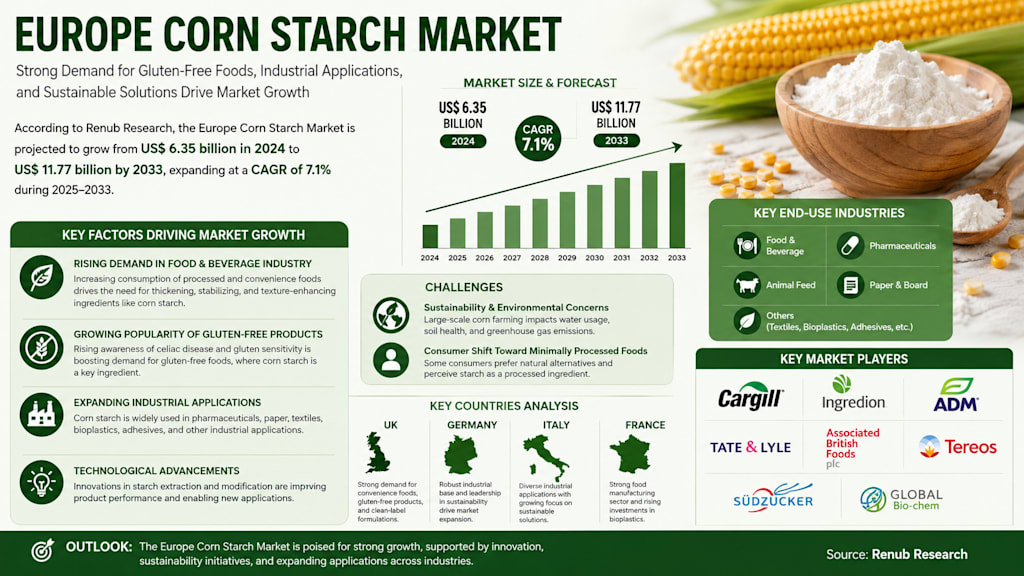
According to Renub Research, the Europe Corn Starch Market is projected to grow from US$ 6.35 billion in 2024 to US$ 11.77 billion by 2033, expanding at a CAGR of 7.1% during 2025–2033. This steady growth reflects changing consumer preferences, technological innovation, and increasing demand for sustainable materials across Europe.
As businesses seek environmentally friendly alternatives and consumers demand healthier food options, corn starch is emerging as a key ingredient that bridges both trends.
Why Corn Starch Is Becoming Increasingly Important
Corn starch is extracted from the endosperm of corn kernels and is widely recognized for its thickening, binding, stabilizing, and gelling properties. These characteristics make it indispensable in food manufacturing and numerous industrial applications.
What makes corn starch particularly attractive is its adaptability. It can be processed into modified starches, sweeteners, adhesives, biodegradable materials, and pharmaceutical excipients. This broad functionality allows manufacturers to use it across diverse production environments while maintaining cost efficiency.
Europe's strong agricultural infrastructure, advanced food processing capabilities, and supportive sustainability regulations have further accelerated market expansion.
Food and Beverage Industry Remains the Largest Growth Driver
One of the most significant factors fueling market growth is the increasing demand from the food and beverage industry.
Modern consumers are purchasing more packaged foods, ready-to-eat meals, sauces, soups, bakery products, snacks, and convenience foods than ever before. These products rely heavily on corn starch for texture improvement, moisture retention, and shelf-life enhancement.
Food manufacturers value corn starch because it delivers consistency while maintaining product quality. Whether used in desserts, gravies, bakery fillings, or frozen meals, corn starch plays a vital role in achieving the desired texture and stability.
As urban lifestyles become busier and convenience remains a priority, demand for processed food products is expected to continue growing across Europe, creating long-term opportunities for starch manufacturers.
The Gluten-Free Revolution Is Creating New Opportunities
Another major growth catalyst is the rapid expansion of the gluten-free food segment.
Awareness of celiac disease and gluten sensitivity has increased significantly over the past decade. In addition, many consumers now choose gluten-free diets as part of broader health and wellness lifestyles.
Because corn starch is naturally gluten-free, it has become an essential ingredient in gluten-free bread, cakes, cookies, snacks, and processed foods. Manufacturers frequently use it as a substitute for wheat-based ingredients while maintaining desirable texture and product structure.
The premium nature of many gluten-free products also allows food companies to generate higher margins, encouraging continued investment in corn starch-based formulations.
As health-conscious consumers seek allergen-friendly food alternatives, corn starch demand is likely to rise further throughout Europe.
Industrial Applications Are Expanding Beyond Traditional Markets
While food remains the dominant end-use segment, industrial applications are becoming increasingly important growth contributors.
In the pharmaceutical industry, corn starch is widely used as a tablet binder and disintegrant, ensuring effective drug delivery and product performance.
In paper manufacturing, starch enhances paper strength, printability, and surface quality. Textile manufacturers use corn starch during fabric finishing processes to improve stiffness and weaving efficiency.
One of the most promising areas involves biodegradable materials. As Europe intensifies efforts to reduce plastic waste, manufacturers are increasingly incorporating corn starch into eco-friendly packaging solutions and bioplastics.
These emerging applications are helping diversify market demand and reduce reliance on any single industry sector.
Sustainability Trends Are Reshaping Market Dynamics
Environmental sustainability has become one of the defining themes across Europe's industrial landscape.
Governments, businesses, and consumers are placing greater emphasis on reducing carbon emissions, minimizing plastic waste, and adopting renewable materials. Corn starch aligns well with these objectives because it originates from renewable agricultural resources and can serve as a feedstock for biodegradable products.
The European Union's sustainability initiatives have encouraged investment in bio-based chemicals, compostable packaging, and green manufacturing technologies. These developments are creating new opportunities for corn starch producers.
Companies are increasingly investing in research and development to improve starch modification technologies, enabling enhanced performance across industrial and packaging applications.
As sustainability continues to influence purchasing decisions and regulatory frameworks, corn starch is expected to play an even larger role in Europe's circular economy.
Technological Innovations Are Enhancing Product Performance
Continuous innovation remains a key factor supporting market growth.
Advanced starch extraction and modification technologies have significantly improved production efficiency and expanded application possibilities. Modern processing techniques allow manufacturers to develop starch products with customized functionality tailored to specific industries.
Modified starches, for example, offer improved stability under varying temperatures, acidity levels, and processing conditions. These enhanced characteristics make them highly attractive for food manufacturers seeking consistent product quality.
Research efforts are also focusing on improving starch performance in biodegradable plastics, adhesives, and pharmaceutical formulations.
As technological capabilities continue advancing, corn starch will become increasingly valuable as a multifunctional industrial ingredient.
Challenges Facing the Europe Corn Starch Industry
Despite strong growth prospects, the market faces several important challenges.
Environmental Concerns Linked to Corn Cultivation
Although corn starch itself is considered a bio-based product, large-scale corn farming can create environmental pressures. Intensive cultivation often requires significant water resources, fertilizers, and pesticides.
These agricultural practices can contribute to soil degradation, water pollution, and greenhouse gas emissions if not managed responsibly.
As European regulators strengthen environmental standards, producers may face additional costs related to sustainable farming practices and supply chain transparency.
Consumer Preference for Minimally Processed Foods
Another challenge comes from the growing popularity of whole-food and minimally processed diets.
Some consumers perceive corn starch as a processed ingredient and may favor alternatives such as chia seeds, agar, or other natural thickening agents.
To address these concerns, manufacturers are increasingly focusing on clean-label formulations and educating consumers about the functionality and safety of corn starch in food products.
Regional Market Insights
United Kingdom
The United Kingdom remains an important market due to strong demand for gluten-free foods, convenience products, and clean-label formulations.
Corn starch is widely used in sauces, soups, bakery products, and ready-to-eat meals. Additionally, sustainability initiatives are driving adoption in biodegradable packaging and pharmaceutical applications.
Despite potential supply chain complexities associated with imported corn, continued innovation supports long-term market growth.
Germany
Germany represents one of Europe's most influential corn starch markets.
Its robust food processing, pharmaceutical, paper, and textile industries generate substantial demand for starch-based ingredients. Germany's leadership in sustainability and green technologies is also encouraging greater use of corn starch in bioplastics and eco-friendly packaging solutions.
Italy
Italy's diversified industrial economy supports broad usage of corn starch across food processing, pharmaceuticals, textiles, and biodegradable materials.
Growing emphasis on sustainability and environmentally responsible manufacturing continues to create opportunities for corn starch producers despite challenges related to raw material costs and agricultural sustainability.
France
France remains a major contributor to regional market growth.
The country's strong food manufacturing sector utilizes corn starch extensively for thickening, stabilizing, and gelling applications. Rising investments in sustainable packaging and bioplastics are expected to strengthen future demand.
Competitive Landscape
The European corn starch market features several multinational companies that continue investing in innovation, sustainability, and capacity expansion.
Major industry participants include:
Cargill Inc.
Ingredion Inc.
Archer Daniels Midland Company
Tate & Lyle
Associated British Foods plc
Tereos Group
Südzucker AG
Global Bio-Chem Technology Group Company Ltd.
10 Recent Industry Developments
1. Cargill Expanded Specialty Starch Portfolio
The company strengthened its specialty starch offerings to support clean-label food applications and sustainable manufacturing initiatives.
2. Ingredion Introduced Advanced Functional Starches
Ingredion launched innovative starch solutions designed to improve texture, stability, and shelf-life in processed foods.
3. ADM Increased Investment in Sustainable Ingredients
ADM expanded its focus on renewable ingredient development and environmentally responsible production methods.
4. Tate & Lyle Enhanced Clean-Label Solutions
The company broadened its portfolio of starch-based ingredients targeting health-conscious consumers.
5. Tereos Advanced Bioplastics Research
Tereos continued investments in bio-based packaging materials derived from starch technologies.
6. Südzucker Expanded Industrial Starch Applications
The company increased efforts to develop starch products for paper, textile, and adhesive industries.
7. Associated British Foods Strengthened Ingredient Innovation
The group expanded R&D initiatives focused on functional food ingredients and starch technologies.
8. European Manufacturers Increased Capacity Modernization
Several starch producers upgraded facilities to improve production efficiency and sustainability performance.
9. Growing Investment in Biodegradable Packaging
Industry participants accelerated development of starch-based alternatives to conventional plastics.
10. Rising Collaboration Across Food and Industrial Sectors
Manufacturers increasingly partnered with food companies and packaging firms to create next-generation starch applications.
Final Thoughts
The Europe Corn Starch Market is entering a period of sustained expansion driven by powerful trends in food innovation, health-conscious consumption, industrial diversification, and environmental sustainability.
With the market forecast to grow from US$ 6.35 billion in 2024 to US$ 11.77 billion by 2033, opportunities continue to emerge across food processing, pharmaceuticals, biodegradable packaging, paper manufacturing, and advanced industrial applications.
While challenges related to sustainability and changing consumer perceptions remain, ongoing technological innovation and increasing demand for renewable materials position corn starch as a critical ingredient for Europe's future industrial and food ecosystems. Companies that successfully balance performance, sustainability, and consumer expectations will be best positioned to capitalize on this evolving market landscape.
About the Creator
Enjoyed the story? Support the Creator.
Subscribe for free to receive all their stories in your feed.
Comments
There are no comments for this story
Be the first to respond and start the conversation.