
Europe Biopsy Devices Market Set to Reach US$1.21 Billion by 2034 as Cancer Screening and Minimally Invasive Diagnostics Drive Growth
Rising cancer cases, expanding preventive healthcare programs, and advancements in minimally invasive biopsy technologies are fueling steady growth across Europe's biopsy devices industry.

Introduction: Early Disease Detection Becomes a Healthcare Priority
Healthcare systems across Europe are increasingly emphasizing early diagnosis and preventive medicine as essential strategies for improving patient outcomes and reducing long-term healthcare costs. Among the many diagnostic technologies supporting this shift, biopsy devices play a critical role in detecting cancer and other serious medical conditions at earlier and more treatable stages.
Biopsy procedures allow healthcare professionals to collect tissue samples for detailed laboratory examination, helping physicians accurately diagnose diseases and develop effective treatment plans. As cancer rates continue to rise throughout Europe, demand for reliable, precise, and minimally invasive biopsy technologies is growing rapidly.
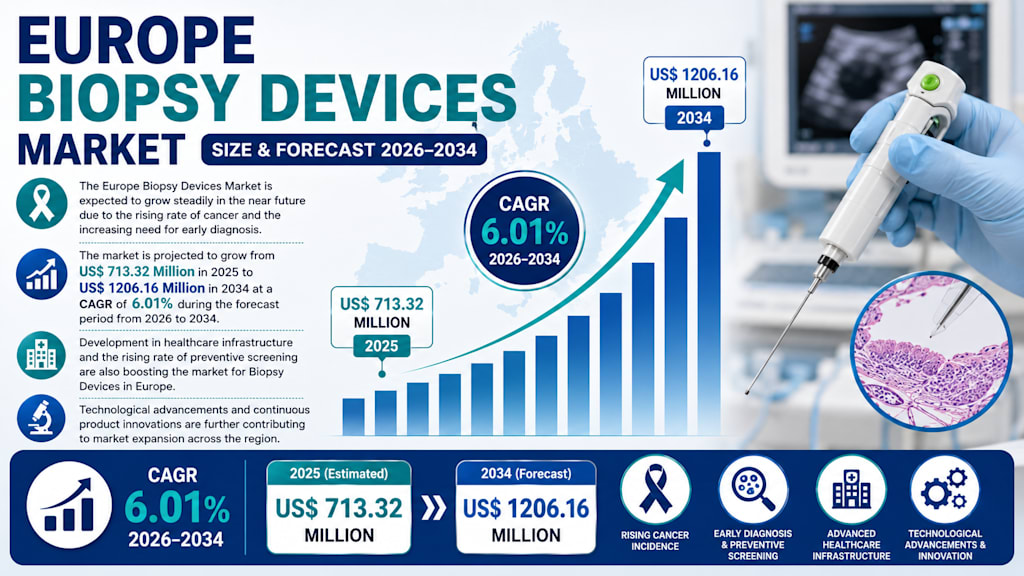
According to Renub Research, the Europe Biopsy Devices Market is projected to grow from US$ 713.32 million in 2025 to US$ 1,206.16 million by 2034, expanding at a compound annual growth rate (CAGR) of 6.01% between 2026 and 2034. Growth is being supported by increasing cancer prevalence, advancements in diagnostic technologies, government-sponsored screening programs, and continued improvements in healthcare infrastructure.
As healthcare providers place greater emphasis on accurate and early disease detection, biopsy devices are becoming increasingly important tools within modern diagnostic medicine.

Understanding the Role of Biopsy Devices
Biopsy devices are specialized medical instruments used to collect small tissue or cell samples from the body for diagnostic evaluation. These samples are examined under a microscope to identify abnormalities, including cancer, infections, inflammation, and other medical conditions.
Several types of biopsy devices are commonly used in healthcare settings, including needle biopsy systems, vacuum-assisted biopsy devices, core biopsy needles, and biopsy forceps. These technologies enable physicians to obtain diagnostic samples with minimal disruption to surrounding tissues.
Biopsies are routinely performed in organs such as the breast, lung, liver, prostate, skin, and gastrointestinal tract.
The growing preference for minimally invasive procedures has increased the adoption of modern biopsy technologies that provide accurate results while reducing patient discomfort, procedural risks, and recovery times.
As diagnostic medicine continues evolving, biopsy devices remain fundamental tools for disease detection and treatment planning.
Rising Cancer Cases Continue to Drive Market Growth
One of the most significant factors supporting growth in Europe's biopsy devices market is the increasing prevalence of cancer.
According to the European Cancer Information System, approximately 2.74 million new cancer cases were reported across Europe in 2022, and this figure is expected to rise to 3.24 million by 2040. Breast cancer, prostate cancer, lung cancer, and colorectal cancer account for roughly half of all diagnosed cancer cases.
The aging population across Europe represents a major contributor to this trend. Older individuals face higher risks of developing cancer and other chronic diseases that often require tissue sampling and laboratory analysis for diagnosis.
The report also notes that approximately 1.29 million cancer-related deaths were recorded in Europe during 2022, highlighting the urgent need for early detection and effective diagnostic tools.
Because biopsy procedures remain essential for confirming cancer diagnoses, growing disease incidence continues generating strong demand for biopsy devices throughout the region.
Technological Innovation Is Improving Diagnostic Accuracy
Advances in biopsy technology are significantly enhancing diagnostic precision and patient experiences.
Modern biopsy devices are increasingly designed to be minimally invasive, enabling healthcare professionals to obtain tissue samples with greater accuracy while reducing discomfort and procedural complications. Innovations such as image-guided systems, vacuum-assisted biopsy devices, and advanced needle technologies have improved both efficiency and clinical outcomes.
Image-guided procedures allow physicians to target suspicious tissue more accurately, minimizing the risk of sampling errors and improving diagnostic reliability.
The report highlights Olympus Corporation's launch of SecureFlex, a single-use fine needle biopsy device introduced in Europe and Japan, reflecting ongoing industry investment in safer and more effective diagnostic solutions.
As manufacturers continue investing in research and development, future biopsy technologies are expected to deliver even higher levels of precision and patient safety.
Government Screening Programs Are Supporting Market Expansion
Government-led cancer screening initiatives have become an important driver of demand for biopsy devices across Europe.
Many European countries operate national screening programs focused on breast, cervical, prostate, and colorectal cancers. These programs encourage early detection and significantly increase the number of diagnostic procedures performed each year.
As more patients undergo routine screenings, the need for confirmatory diagnostic procedures such as biopsies continues to rise.
Hospitals, clinics, and diagnostic centers are increasingly investing in advanced biopsy technologies to support growing patient volumes and improve diagnostic capabilities.
The report notes that the EU4Health projects PRAISE-U, SOLACE, and TOGAS have developed and tested new cancer screening protocols across multiple European Union member states, highlighting the region's ongoing commitment to preventive healthcare.
These initiatives are expected to contribute significantly to long-term market growth.
Needle-Based Biopsy Devices Remain a Leading Segment
Needle-based biopsy devices continue to account for a substantial share of the European market.
Techniques such as fine needle aspiration and core needle biopsy are widely used because they provide accurate diagnostic results while minimizing patient discomfort and recovery times. These procedures are particularly valuable in diagnosing breast, lung, prostate, and liver cancers.
Healthcare professionals often prefer needle-based techniques because they are less invasive and generally more cost-effective than surgical biopsy procedures.
Continuous improvements in needle design and imaging integration have further enhanced procedural safety and efficiency.
As demand for minimally invasive diagnostics continues increasing, needle-based biopsy devices are expected to remain one of the most important product categories within the market.
CT-Guided Biopsies Continue to Gain Adoption
CT-guided biopsy procedures have become increasingly important for diagnosing abnormalities located in difficult-to-access areas of the body.
Computed tomography imaging allows healthcare providers to precisely locate suspicious tissue and guide biopsy instruments with exceptional accuracy. These procedures are commonly used for lesions located in the lungs, liver, abdomen, and other internal organs.
The ability to improve targeting precision while minimizing procedural risks makes CT-guided biopsies highly valuable in clinical practice.
As diagnostic imaging technologies continue advancing, CT-guided procedures are expected to remain an important growth area within the European biopsy devices market.
MRI-Guided Biopsy Devices Offer Advanced Diagnostic Capabilities
MRI-guided biopsy systems represent one of the most technologically advanced segments within the market.
Magnetic resonance imaging provides highly detailed visualization of soft tissues, allowing physicians to identify abnormalities that may not be visible using other imaging methods. This capability is particularly important in diagnosing breast, prostate, and brain cancers.
MRI-guided biopsies improve diagnostic accuracy while reducing the likelihood of false-negative results.
European healthcare institutions continue investing in MRI-guided technologies as they seek to enhance precision medicine and improve patient outcomes.
As awareness of advanced imaging-guided diagnostics increases, demand for MRI-guided biopsy systems is expected to grow steadily.
Diagnostic Laboratories Are Expanding Their Role
Diagnostic laboratories represent a critical segment within the biopsy devices market.
After tissue samples are collected, laboratories utilize specialized equipment to analyze specimens and identify disease characteristics. The growing number of biopsy procedures being performed throughout Europe is creating increased demand for advanced laboratory diagnostic systems.
Technological innovations in laboratory automation and digital pathology are improving efficiency and accuracy.
Government initiatives focused on early disease detection are also supporting investments in laboratory infrastructure.
As personalized medicine and precision diagnostics continue advancing, diagnostic laboratories are expected to play an increasingly important role in healthcare delivery.
Hospitals and Clinics Remain the Largest End Users
Hospitals and clinics continue to account for the majority of biopsy device utilization across Europe.
These facilities possess the specialized equipment, imaging technologies, and trained healthcare professionals required to perform biopsy procedures safely and effectively. The increasing prevalence of cancer and chronic diseases has led hospitals to invest heavily in advanced diagnostic capabilities.
Growing patient awareness regarding preventive healthcare is also contributing to higher demand for diagnostic services.
In addition, outpatient clinics are increasingly adopting advanced biopsy equipment, making diagnostic services more accessible to broader patient populations.
The expansion of healthcare infrastructure throughout Europe continues supporting strong demand within this segment.
Regional Markets Continue to Expand
France
France's biopsy devices market is benefiting from strong government support for cancer screening programs and preventive healthcare initiatives.
National screening efforts focused on breast, colorectal, and prostate cancers have increased demand for diagnostic procedures. The report highlights a partnership between Roche France and Institut Gustave Roussy to develop in-house liquid biopsy testing capabilities using advanced genomic profiling technologies.
United Kingdom
The United Kingdom continues experiencing growth due to National Health Service screening programs and investments in advanced diagnostic technologies.
The report highlights CamPROBE®, a specialized prostate biopsy device developed in Cambridge and expanded through a distribution partnership designed to increase availability across UK healthcare facilities.
Germany
Germany remains one of Europe's most advanced healthcare markets, supported by extensive hospital networks, strong medical device manufacturing capabilities, and significant investments in minimally invasive technologies.
The country's emphasis on innovation and patient-centered care continues supporting market growth.
Russia
Russia's biopsy devices market is expanding due to healthcare modernization initiatives and increasing awareness regarding early disease detection.
Government investments in diagnostic infrastructure are improving access to advanced biopsy technologies in major healthcare centers throughout the country.
Challenges Continue to Affect Market Growth
Despite favorable growth prospects, the market faces several challenges.
One major concern is the high cost associated with advanced biopsy technologies. Image-guided systems, MRI-guided devices, and vacuum-assisted biopsy equipment often require substantial investment in both equipment and personnel training. These costs can create barriers for smaller healthcare providers.
Patient concerns regarding biopsy-related complications also influence adoption rates. Although modern procedures are generally safe, risks such as pain, bleeding, infection, and tissue damage can discourage some individuals from undergoing diagnostic testing.
Addressing these concerns through patient education and continued technological improvements will remain important for sustaining market growth.
Leading Companies Driving Innovation
The Europe biopsy devices market includes several major healthcare and diagnostic technology companies focused on improving diagnostic accuracy and patient outcomes.
Key organizations highlighted in the report include Becton, Dickinson and Company, Thermo Fisher Scientific Inc., Bio-Rad Laboratories, Exact Sciences, Biocept, Roche Diagnostics, Myriad Genetics Inc., QIAGEN, NeoGenomics Laboratories, and Quest Diagnostics Inc. These companies continue investing in advanced biopsy systems, molecular diagnostics, and precision medicine technologies.
Their innovations are helping shape the future of diagnostic healthcare across Europe.
Final Thoughts
The Europe biopsy devices market is entering a period of sustained growth driven by rising cancer incidence, expanding preventive healthcare programs, and continuous advancements in minimally invasive diagnostic technologies.
With the market projected to grow from US$ 713.32 million in 2025 to US$ 1.21 billion by 2034, biopsy devices are becoming increasingly important tools for early disease detection and precision healthcare. Growing demand for accurate diagnostics, improved patient outcomes, and advanced imaging-guided procedures is creating significant opportunities throughout the region.
Although challenges related to equipment costs and patient concerns remain, the long-term outlook remains highly positive. As European healthcare systems continue emphasizing early diagnosis and preventive care, biopsy technologies will play an increasingly vital role in improving treatment outcomes and supporting the future of modern medicine.
About the Creator
Enjoyed the story? Support the Creator.
Subscribe for free to receive all their stories in your feed.
Comments
There are no comments for this story
Be the first to respond and start the conversation.