
Ethiopia Greenhouse Horticulture Market 2026: Controlled Farming Growth, Export Demand & Sustainable Agriculture
Rising demand for year-round produce, government support, and adoption of modern farming techniques are driving growth in Ethiopia’s greenhouse horticulture market

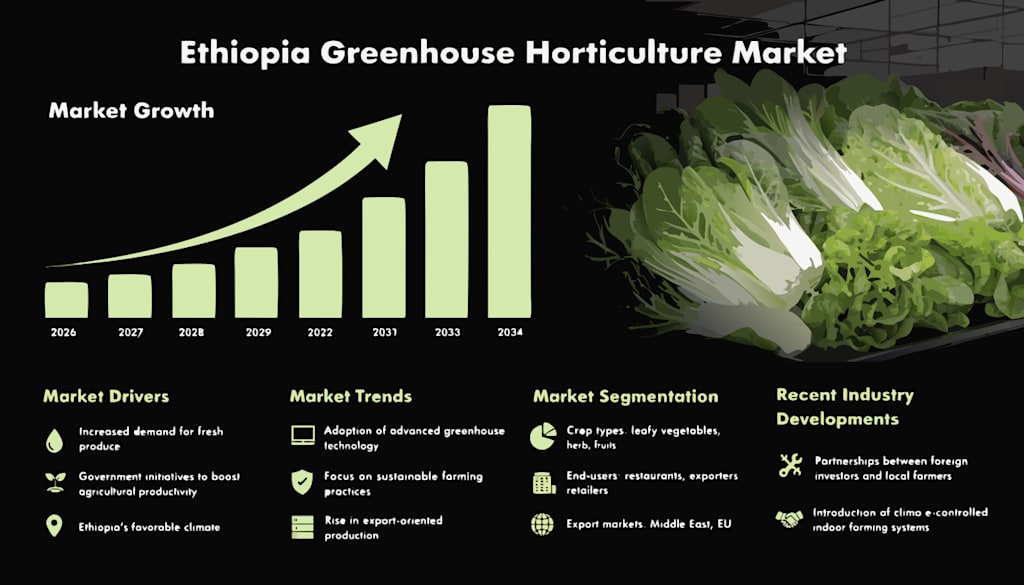
The Ethiopia greenhouse horticulture market is witnessing strong growth as increasing demand for high-quality produce, expanding export opportunities, and adoption of modern agricultural practices transform the country’s farming landscape. According to industry insights, the market reached USD 37.01 Million in 2025 and is projected to grow to USD 71.56 Million by 2034, exhibiting a CAGR of 7.60% during 2026–2034.
Greenhouse horticulture involves cultivating fruits, vegetables, and flowers in controlled environments, enabling year-round production, improved crop quality, and efficient resource utilization. This approach is gaining popularity in Ethiopia as farmers and agribusinesses seek to enhance productivity and meet growing domestic and international demand.
The market’s expansion reflects a shift toward sustainable and technology-driven agriculture, where efficiency and quality are key priorities.
What’s Driving Market Growth?
One of the primary drivers of the Ethiopia greenhouse horticulture market is the increasing demand for export-quality horticultural products. Ethiopia is a major exporter of flowers and fresh produce, particularly to European markets, driving the adoption of greenhouse farming techniques.
Government support and policy initiatives are another key growth factor. Programs promoting modern agriculture, investment incentives, and infrastructure development are encouraging farmers to adopt greenhouse systems.
The need for year-round production and climate resilience is also contributing to market growth. Greenhouse farming allows controlled cultivation, reducing the impact of weather variability and ensuring consistent supply.
Additionally, rising population and urbanization are increasing demand for fresh and high-quality food, further boosting market expansion.
Technological advancements, including drip irrigation, climate control systems, and hydroponics, are enhancing productivity and resource efficiency.
Market Segmentation & Key Insights
• By Crop Type:
o Vegetables dominate due to high domestic demand.
o Flowers represent a major export segment.
o Fruits are gaining traction with increasing consumption.
• By Technology:
o Plastic greenhouses are widely used due to affordability.
o Glass greenhouses are used for high-value crops.
o Advanced systems such as hydroponics are emerging.
• By Application:
o Commercial farming dominates the market.
o Research and small-scale farming are growing segments.
• By Region:
o Oromia and Addis Ababa regions lead due to infrastructure and investment.
o Other regions are expanding with agricultural development programs.
What the Opportunities Are?
The Ethiopia greenhouse horticulture market presents strong opportunities in export-oriented agriculture. Expanding access to international markets can drive higher revenue and encourage large-scale greenhouse adoption.
Another major opportunity lies in advanced farming technologies such as hydroponics and automated climate control systems, which can significantly improve productivity and crop quality.
The development of cold chain and logistics infrastructure also offers growth potential by reducing post-harvest losses and improving export efficiency.
There is also strong scope in organic and sustainable farming practices, as global demand for environmentally friendly produce continues to rise.
Additionally, partnerships between local farmers and international agribusinesses can enhance knowledge transfer and investment.
Recent News and Developments in Ethiopia Greenhouse Horticulture Market
January 2025: Ethiopia’s horticulture export revenue increased by approximately 9–11%, driven by rising demand for flowers and fresh produce in international markets.
April 2025: Government investment in agricultural modernization programs grew by nearly 12–14%, supporting the adoption of greenhouse farming technologies.
August 2025: Expansion of greenhouse farming projects increased cultivated area by around 8–10%, improving year-round production capacity.
November 2025: Adoption of advanced irrigation and climate control systems rose by approximately 10–12%, enhancing productivity and resource efficiency.
Why Should You Know About Ethiopia Greenhouse Horticulture Market?
The Ethiopia greenhouse horticulture market is important because it highlights the transformation of agriculture through technology, sustainability, and export-driven growth.
For investors, this market offers exposure to a high-growth agricultural segment supported by government initiatives, increasing exports, and rising food demand. The projected CAGR of 7.60% reflects strong growth potential.
For farmers and agribusinesses, the market presents opportunities to improve productivity, adopt modern techniques, and access global markets.
For policymakers and stakeholders, it underscores the importance of agricultural innovation, infrastructure development, and sustainable practices in driving economic growth.
In essence, the Ethiopia greenhouse horticulture market represents the convergence of agriculture, technology, and global trade — making it a dynamic and evolving sector with significant future potential.
About the Creator
Thomas
Market Research Analyst | Industry Trends & Forecasting | Turning market data into clear, actionable business insights across global sectors.
Enjoyed the story? Support the Creator.
Subscribe for free to receive all their stories in your feed.
Comments
There are no comments for this story
Be the first to respond and start the conversation.