
Ethiopia Dairy Market 2026: Livestock Transformation, Urban Nutrition & Processing Growth
How government breeding initiatives, foreign investment and formalization are reshaping Ethiopia's dairy landscape

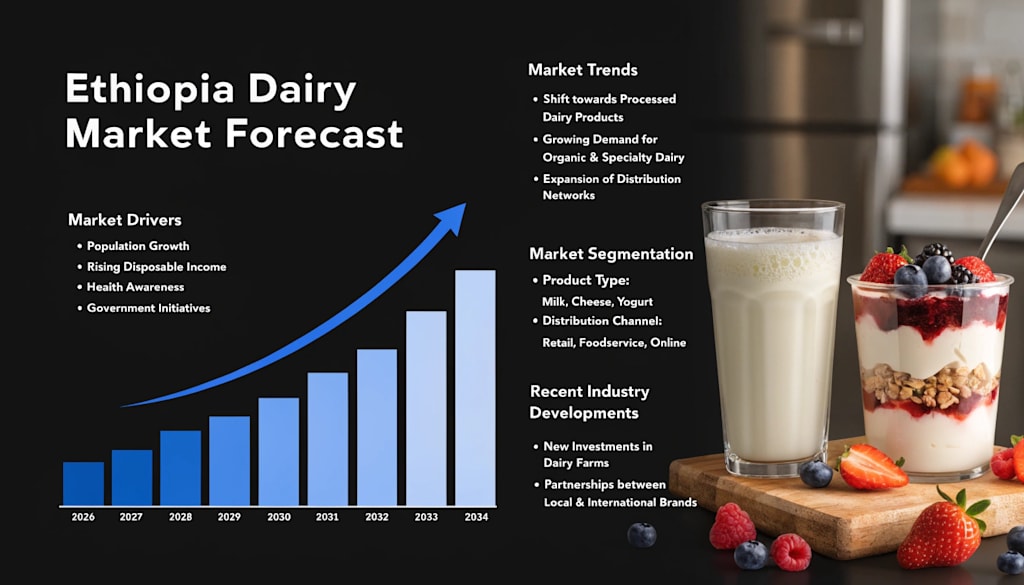
The Ethiopia dairy market is undergoing a quiet but consequential transformation as the country's vast livestock resources, government-led genetic improvement programs, and rapidly urbanizing population converge to create sustained demand for milk and value-added dairy products. The market — encompassing liquid milk, yoghurt, cheese, butter and powder — is primarily served by smallholder farmers, while an expanding formal processing sector gradually captures a greater share of the consumer base. According to IMARC Group, the market size reached USD 1,149.35 Million in 2025 and is projected to reach USD 1,702.90 Million by 2034, exhibiting a compound annual growth rate (CAGR) of 4.47% during 2026–2034.
Ethiopia possesses Africa's largest livestock population with over 15 million milking cows, yet average yields remain low, producing 12 billion litres of milk annually— still insufficient to meet nutritional needs. This production gap, combined with a per capita consumption rate of just 19 litres per year (only 11% of WHO recommendations), positions the sector as one of the most promising frontiers for agribusiness investment in East Africa.
What's Driving Market Growth?
Accelerated Genetic Improvement Under the Yelemat Tirufat Initiative. Ethiopia's dairy transformation is anchored in the government's flagship "Bounty of the Basket" (Yelemat Tirufat) program. Launched in November 2022, the initiative has nearly doubled milk production from 5.8 billion to an estimated 12 billion litres in just three years. Annual crossbreeding expanded from 500,000 animals to 3.8 million targeted in the third year, contributing to crossbred cattle numbers rising eightfold nationwide. The Ministry of Agriculture has invested heavily in local liquid nitrogen production for artificial insemination, with five new processing units — two already operational and three under installation — ensuring reliable supply for nationwide breeding efforts.
National Dairy Development Strategy and Institutional Frameworks. In December 2023, Ethiopia unveiled its National Dairy Development Strategy 2022–2031, developed in collaboration with the International Livestock Research Institute (ILRI), to quadruple milk production by 2031. The Livestock and Fisheries Sector Development Project (LFSDP), co-financed by the World Bank, has provided support to 3.2 million smallholder farmers across the Ethiopian highlands, focusing on producing and distributing improved crossbred dairy cattle to enhance productivity and accelerate commercialization.
Urbanization and Changing Consumption Patterns. Ethiopia's population, exceeding 114 million with rapid urbanization, is driving significant shifts in dietary preferences. Urban dairy expenditures have increased notably, with liquid milk gaining prominence over traditional butter-based products. Per capita milk consumption is projected to increase from 19 litres to nearly 28 litres by 2030. The number of dairy processing companies supplying pasteurized products has more than tripled over the past decade, improving availability of quality-assured dairy products for urban consumers.
Foreign Direct Investment and Private Sector Participation. International investment flows are accelerating sector modernization. In February 2025, Ethiopian Investment Holdings (EIH) and the Ethiopian Agricultural Business Corporation (EABC) signed a US$600 million shareholders agreement with UK private-equity firm Asset Green to develop an integrated dairy-farming and processing project, marking one of the largest foreign investments in Ethiopia's agribusiness sector.
Market Segmentation & Key Insights
By Product Type, Liquid Milk dominates the market with a share of 43.2% in 2025, driven by rising consumer preference for fresh pasteurized products and expanding urban retail networks. Enhanced food safety awareness has led to increased demand for pasteurized milk through proper retail channels, with organizations improving distribution to supermarkets, retail outlets, restaurants and institutions while developing cold chain storage.
By Region, Oromia Region leads the market with a share of 43.5% in 2025, benefiting from favorable agro ecological conditions and strategic proximity to Addis Ababa's substantial consumer market. The region hosts numerous dairy processing facilities — from major industry players to small-scale operations — with smallholder farmers supplying raw milk to processors and forming the backbone of the formal commercial dairy value chain.
What the Opportunities Are?
Value-Added Processed Dairy Products. As urban consumers increasingly seek convenience and variety, demand for flavoured yoghurts, premium cheese, UHT milk and other value-added products is growing. The Ethiopian Dairy Association reported a 12% rise in demand for flavoured yoghurts over the past year driven by urban consumers. Holland Dairy's Banana Yoghurt made with real Ethiopian bananas — priced at US$1.20 per 500 gram tubdemonstrates the commercial viability of local supply chains that differentiate through flavour innovation.
Cold Chain and Collection Infrastructure Development. Ethiopia's dairy value chain suffers from structural inefficiencies, including inadequate cold chain, high transportation costs and milk spoilage rates that remain high, particularly in rural areas. Holland Dairy's US$2 million cold storage facility in Bishoftu, capable of holding over 400,000 cups of yoghurt, addresses the distinct challenge of Orthodox Christian fasting periods — spanning over 200 days per year — which cause sharp temporary consumption declines. Investors can help solve these bottlenecks through better aggregation systems, solar-powered off-grid cooling solutions, and expanded processing capacity.
Supply Chain Formalization and Farmer Integration. Only a small fraction of milk currently reaches formal processors, who operate at just 28% of total capacity. Scaling up formalization requires better linkages between farmers and processors, quality assurance systems, and farmer cooperatives. Strengthening cooperatives has been shown to increase milk production by 17–57%, boost dairy household profit 11- to 21-fold, and raise cooperative balance 27- to 55-fold.
Animal Feed and Genetics Services. A significant deficit exists in feed and fodder, with a supply gap of 190,000 metric tonnes of concentrate feed annually. Moreover, less than 3% of Ethiopia's cattle are improved or hybrid breeds, leaving enormous room for growth in artificial insemination services, veterinary care and feed production.
Recent News and Developments in Ethiopia Dairy Market
May 2025: Holland Dairy unveiled a new premium cheese product made entirely from locally sourced milk using advanced Dutch technology, supporting more than 4,000 Ethiopian smallholder farmers and introducing a product that meets international standards. Commercial Director Jean-Paul Rieu noted, "We believe in the power of local... now, with advanced Dutch technology, we can create a truly exceptional cheese, one we believe will become the best in Africa".
May 2025: The Ethiopian Food and Drug Authority (EFDA) announced a major escalation of its milk safety efforts, implementing the Lactoscan state-of-the-art device for precise milk quality assessment and launching comprehensive training for inspectors from federal to district level.
June 2025: Holland Dairy commissioned a US$2 million cold storage facility (with 400,000+ cup capacity) and a matching wastewater treatment plant processing 120,000 litres daily, setting a benchmark for formal, sustainable agribusiness in Ethiopia.
February 2025: The Ethiopian government signed a US$600 million partnership with UK private-equity firm Asset Green for integrated dairy-farming and processing, representing one of the largest foreign agribusiness investments in the country's history.
March 2026: The Ethiopian Economics Association (EEA) launched a research project on "Business Climate Challenges in the Investment and Operation of Industrial Milk Processing Plants in Ethiopia," generating evidence to inform policy and guide sector improvements.
December 2025: The Ministry of Agriculture accelerated genetic improvement through its LFSDP, producing and distributing improved crossbred dairy cattle to smallholder farmers to increase milk yields, improve household nutrition, and raise rural incomes.
Why Should You Know About Ethiopia Dairy Market?
You should know about this market because it captures a rare convergence of government-led transformation, demographic tailwinds and critical infrastructure gaps — simultaneously a development story and a commercial opportunity. Ethiopia's dairy sector is not merely growing incrementally: it is undergoing structural change, moving from fragmented subsistence production toward formalized, commercial value chains.
For investors, the dairy market offers exposure to a long-term growth agricultural category anchored in rising protein demand, underutilized processing capacity (currently just 28% utilized), and significant import replacement opportunity ($50 million in annual dairy imports). The projected CAGR of 4.47% reflects steady demand growth, but the real opportunity lies in capturing value through processing infrastructure and supply chain modernization — segments where the growth ceiling is considerably higher.
For development partners, agribusiness investors and technology providers, understanding the interplay between Yelemat Tirufat's genetic gains, the National Dairy Development Strategy's 2031 targets and the persistent gaps in cold chain, feed supply and quality assurance helps shape intelligent engagement strategies across the value chain.
In essence, the Ethiopia dairy market captures how livestock genetics, nutritional security and commercial agriculture converge — making it a compelling area for investors seeking exposure to East Africa's most populous economy and a rare opportunity to participate in a foundational food system transformation.
About the Creator
Thomas
Market Research Analyst | Industry Trends & Forecasting | Turning market data into clear, actionable business insights across global sectors.
Enjoyed the story? Support the Creator.
Subscribe for free to receive all their stories in your feed.
Comments
There are no comments for this story
Be the first to respond and start the conversation.