
Ethiopia Avocado Market 2026: Value Chain Integration, Export Transformation & Processing Boom
How aggressive government expansion, cold chain logistics and a new wave of processing facilities are positioning Ethiopia as the next global avocado powerhouse

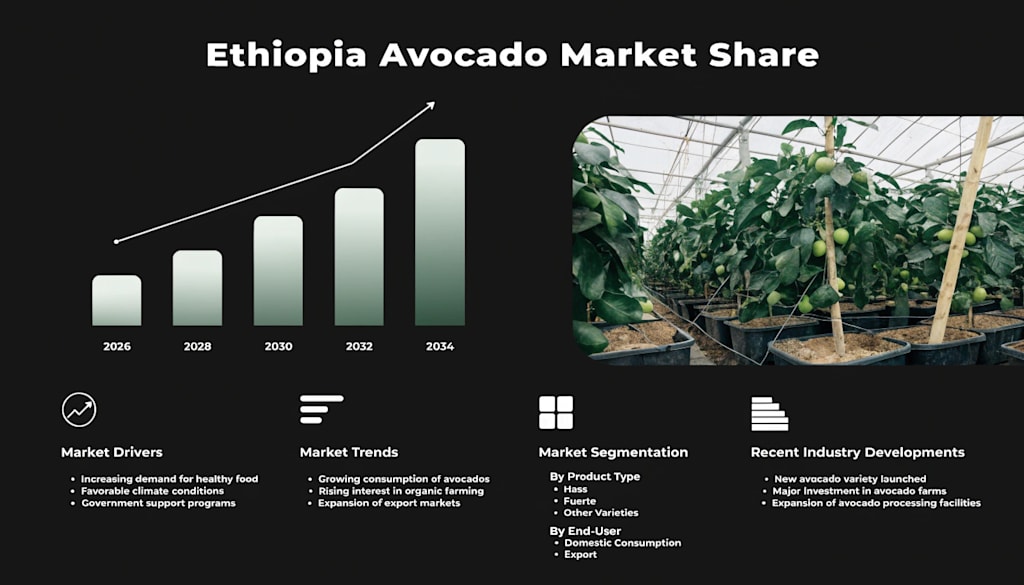
The Ethiopia avocado market is undergoing a profound structural transformation, evolving from a fragmented subsistence activity into a globally connected, vertically integrated agribusiness. Avocado products — encompassing fresh whole fruit, cold pressed crude oil, refined oil and organic puree — are increasingly being deployed across international supply chains serving European and Middle Eastern retail shelves, pharmaceutical factories, and biofuel processors. According to IMARC Group, the market size reached USD 22.59 Million in 2025 and is projected to reach USD 36.94 Million by 2034, exhibiting a compound annual growth rate (CAGR) of 5.62% during 2026–2034. However, headline figures obscure a more dramatic reality: under the government’s new National Avocado Development Program, the sector is targeting a 38.5 billion Birr (£260 million) investment that would increase annual yield from 400,000 tons to 3.8 million tons and cultivation from 100,000 hectares to 191,000 hectares within the next 15 years — a potential nine fold production expansion. As Ethiopia shifts its export logistics from expensive air freight to cost competitive sea lanes, domestic processing capacity escalates, and Oromia emerges as the dominant growing region, avocado has become the most strategically important non coffee horticultural crop in the national agricultural diversification agenda.
What’s Driving Market Growth?
National Avocado Development Program and Green Legacy Seedling Distribution. The Ethiopian government has placed avocado at the centre of its agricultural transformation strategy. The newly launched National Avocado Development Program — a 15 year roadmap — sets the ambitious target of making Ethiopia a leading global avocado producer and exporter. To underpin this expansion, authorities have targeted the production and distribution of 1.8 million high yield avocado seedlings in 2025 alone under the Green Legacy Initiative. The programme is expected to directly benefit 3 million smallholder farmers, elevating avocado from a marginal home garden crop to a primary source of rural income and foreign exchange. The Oromia Region currently represents the largest segment with 36.5% market share in 2025, supported by its vast cultivation area, favourable highland climate and government backed seedling distribution programmes engaging thousands of smallholder farmers. The Sidama Region is similarly emerging as a key production hub, with over 65,000 smallholder farmers now connected to structured supply chains through Integrated Agro Industrial Parks (IAIPs).
Avocado Processing and Value Addition Boom. The establishment of IAIPs has catalysed a remarkable shift toward value added processing, particularly avocado oil production. In the Sidama Industrial Park, avocado oil exports generated over USD 3.3 million in revenue during the 2024/2025 fiscal year, with the facility processing over 16,000 tons of raw avocado supplied by local farmers. Yirgalem Industrial Park earned over USD 2.2 million from crude avocado oil exports in an 11 month period, producing 389.28 tons of finished oil, of which 320 tons were exported. Across the 2020 2024 period, Ethiopia generated USD 19.8 million from avocado oil exports. In the Jimma Industrial Park, Akshay Jay Oil Company has installed the largest avocado oil processing plant in East Africa, with capacity to process 7,000 kg of avocados per hour and create a market network for more than 15,000 local farmers. The facility has distributed one million avocado seedlings to farmers to ensure year round supply and generated 130 million Birr in farmer income. This growing industrial demand — beyond food and cosmetics, avocado oil is increasingly sought after as a key input by large agro processing and pharmaceutical factories — provides a stable, off take buffer that stabilises prices and gives the Ethiopian avocado market a structural resilience lacking in many fresh produce only competitors.
Logistical Overhaul: Transition from Air Freight to Sea Freight. Ethiopia is undertaking a strategic logistics overhaul, shifting avocado exports from expensive air cargo to cost effective and sustainable sea freight. On 1 December 2025, the country initiated this structural shift, led by the Ethiopian Agriculture Authority and the Ethiopian Horticulture Producers and Exporters Association, in partnership with the Netherlands’ Development Partnership, the Centre for the Promotion of Imports from Developing Countries (CBI), and the To SEA project. A key milestone was the release of the Avocado Export Guide, designed to standardise maritime export procedures for domestic enterprises. The Cool Port Addis project — a dedicated cold storage and logistics facility under construction at the Modjo Dry Port with an estimated investment of USD 50 million — will integrate directly with the Addis Ababa Djibouti railway line, enabling competitive perishable exports via the Port of Djibouti and reducing both freight costs and post harvest losses. For context, up to 40% of avocados currently never make it past the farm gate, making cold chain investment critical to realising export potential. The To SEA project, running through 2026, has already helped several companies complete their first exports, mainly to the Middle East, signalling growing readiness.
Rising Export Demand and Market Access. Ethiopia’s avocado export demand is accelerating, driven by the global popularity of the Hass variety in Europe and the Gulf region. Fresh product dominated the market with 63.4% share in 2025, driven by strong consumer preference for whole avocados in domestic markets and growing demand for Hass variety exports. Fresh avocado export momentum showed a +36.3% year on year increase as of mid 2025, signalling Ethiopia’s rapid entry into global supply chains. The country’s main window of supply currently stretches from August to October, but stakeholders see potential to extend the window into January and February. The International Finance Corporation (IFC) and CBI have released the ‘Export Guide for Avocado Via Sea Freight’ to help Ethiopian farms and businesses navigate global avocado trade, with compliance to Global GAP certification identified as mandatory for accessing the European market.
Market Segmentation & Key Insights
By Form, fresh dominates the market with a share of 63.4% in 2025, driven by strong consumer preference in domestic markets and growing demand for Hass variety exports to Europe and the Gulf region.
By Distribution Channel, B2B leads with 57.8% share in 2025, owing to the dominance of bulk procurement by exporters, institutional buyers and processing facilities sourcing directly from smallholder farmer cooperatives across major growing zones.
By Region, Oromia Region represents the largest segment with 36.5% market share in 2025, supported by its vast cultivation area, favourable highland climate, and government backed sapling distribution programmes engaging thousands of smallholder farmers.
By Application, the market covers fresh consumption (domestic and export) and processed products (avocado oil, puree and by products).
What the Opportunities Are?
IAIP-Linked Processing and Pharmaceutical Grade Oil. The Integrated Agro Industrial Park model — connecting farmers, agro processors, logistics services and export markets — has already proved its transformative potential. In Yirgalem alone, more than 65,000 smallholder farmers now supply structured collection centres, earning transparent, immediate payments ranging from 18 to 40 Birr per kilogram, compared to as little as 60 70 Birr per sack on informal markets. The park has created 137,000 market opportunities for farmers and generated 1,620 permanent jobs, 52% of them for women. With 13 new projects expected to boost raw avocado supply to 25,000 tons in 2025/2026, the expansion of IAIP based processing capacity — particularly for pharmaceutical grade oil and cosmetic ingredients — represents a high margin opportunity for both domestic and international investors.
Cold Chain Infrastructure and the Cool Port Addis. The USD 50 million Cool Port Addis project at Modjo Dry Port will be a game changer for Ethiopian avocado competitiveness. Once operational, it will provide integrated cold storage linked directly to the Addis Ababa Djibouti railway, dramatically reducing spoilage and enabling cost effective sea freight to Europe and the Middle East. Investors in refrigerated transport, modular cold storage units, and last mile distribution networks across Oromia and Sidama are well positioned to capture value in a sector where post harvest losses remain as high as 40%. For context, sea freight is the central goal of the To SEA project, with test shipments to Europe and Gulf markets planned in the coming year to refine export procedures.
Climate Resilient Hybrid Variety Development. Local varieties often take many years to bear fruit and produce lower yields. The Green Gold Project in Wolaita, launched by Ayuda en Acción, is introducing hybrid avocado varieties that ripen faster, produce more fruit, and are more resistant to pests, diseases and drought. With hybrid trees bearing fruit in as little as 18 months rather than 5 7 years, the acceleration of cash flow for smallholders is dramatic. There is significant opportunity for commercial nurseries, agricultural research partnerships and seed technology firms to scale hybrid seedling production and grafting services, addressing a critical input bottleneck.
By Product Valorisation and Circular Economy. The Sidama Industrial Park already generates by products worth an additional USD 300,000 sold on the domestic market, demonstrating the potential for waste to value streams. Akshay Jay Oil is leasing land to produce compost, soil fertiliser and biogas from avocado oil by products. Avocado skins, seeds and pomace can be further processed into cosmetic exfoliants, natural dyes, animal feed supplements and industrial lubricants. Companies with expertise in circular economy models and waste to energy technology will find early mover advantages in Ethiopia’s rapidly scaling processing ecosystem.
Smallholder Certification and Carbon Credit Programmes. With Global GAP certification mandatory for European market access, smallholder cooperatives currently face steep compliance costs and technical barriers. Programmes offering certification as a service, audit preparation training, and group certification models could rapidly expand the pool of export ready growers. Additionally, avocado agroforestry systems — integrating trees with crops — sequester carbon, improve soil health and generate biodiversity credits. Ethiopia’s new carbon market policy framework, combined with the avocado sector’s clean growing credentials, creates a timely opportunity to develop carbon inset or carbon offset programmes that bundle certification support with climate finance.
Recent News and Developments in Ethiopia Avocado Market
May 2025: The Ministry of Agriculture announced plans to raise export revenue by 30% to reach USD 734 million in 2025/2026, underscoring avocado’s strategic role in national export diversification targets.
July 2025: The Yirgalem Industrial Park generated over USD 2.2 million from crude avocado oil exports in an 11 month period, with four processing factories supplied by over 12,000 tons of raw avocado.
August 2025: Sidama Industrial Parks Development Corporation announced it generated over USD 3.3 million in revenue from avocado oil exports during the 2024/2025 fiscal year, processing over 16,000 tons of raw avocado supplied by local farmers.
August 2025: Ayuda en Acción launched the Green Gold Project in Wolaita, introducing hybrid avocado varieties to 5,000 smallholder farmers with climate smart agricultural practices, with hybrid trees bearing fruit in 18 months.
November 2025: The Ethiopian Agriculture Authority and EHPEA, in partnership with the Netherlands’ Development Partnership, released the Avocado Export Guide to standardise maritime export procedures for domestic enterprises.
December 1, 2025: Ethiopia initiated a structural shift in avocado export logistics, transitioning from costly air freight to maritime transport.
2025: Authorities targeted production and distribution of 1.8 million high yield avocado seedlings under the Green Legacy Initiative to scale production capacity across key growing zones.
2026: The National Avocado Development Program, backed by a 38.5 billion Birr budget, set aggressive targets to expand cultivation from 100,000 hectares to 191,000 hectares and increase annual yield from 400,000 tons to 3.8 million tons, benefiting 3 million smallholder farmers.
2026: The Cool Port Addis project — a USD 50 million dedicated cold storage and logistics facility at the Modjo Dry Port — remains under construction, set to integrate directly with the Addis Ababa Djibouti railway line.
Why Should You Know About Ethiopia Avocado Market?
You should know about this market because it captures how aggressive government expansion, industrial processing and cold chain logistics intersect to create a rare deep value horticultural transformation in sub Saharan Africa. Avocado is no longer an incidental home garden fruit — it is the centrepiece of a coordinated national strategy that connects millions of smallholders to IAIPs, pharmaceutical grade oil refineries and containerised sea freight to Europe. The 38.5 billion Birr National Avocado Development Program signals an ambition that moves far beyond incremental growth: Ethiopia is targeting a nine fold increase in yield, aiming to compete with Mexico, Peru and Kenya as a global supplier.
For investors, the avocado market offers exposure to a high growth agricultural transformation anchored in state backed IAIP infrastructure, the transition from air to sea freight (dramatically improving landed cost competitiveness), and the escalating global demand for organic avocado oil (USD 604.76 million market in 2023). The projected CAGR of 5.62% for the total market understates the exponential upside for early movers in processing, cold chain and hybrid seedling production — segments where domestic capacity remains dramatically undersized relative to the 2030 targets.
For development financiers, agribusiness investors, logistics specialists and commodity traders, understanding segmentation between fresh and processed channels, the IAIP value chain linkage model, and the emerging sea freight protocols to Djibouti helps shape intelligent investment decisions and procurement strategies that deliver measurable productivity, foreign exchange and rural livelihood outcomes.
In essence, the Ethiopia avocado market captures how state led industrial policy, value added processing and climate smart smallholder integration converge — making it a compelling area for investors, processors and development partners seeking smarter approaches to agricultural transformation, export diversification and sustainable wealth creation in one of Africa’s fastest emerging horticultural frontiers.
About the Creator
Thomas
Market Research Analyst | Industry Trends & Forecasting | Turning market data into clear, actionable business insights across global sectors.
Enjoyed the story? Support the Creator.
Subscribe for free to receive all their stories in your feed.
Comments
There are no comments for this story
Be the first to respond and start the conversation.