
Epilepsy Drugs Market Outlook 2026–2034: How Innovation in Neurological Care Is Transforming Seizure Management
Rising epilepsy prevalence, advances in antiepileptic drug development, and improving access to neurological healthcare are driving sustained growth in the global epilepsy drugs market.

Neurological disorders continue to represent one of the most significant healthcare challenges worldwide, affecting millions of people across all age groups. Among these conditions, epilepsy remains one of the most common chronic neurological disorders, impacting daily life, education, employment, and overall quality of life for patients and their families.
Characterized by recurrent seizures caused by abnormal electrical activity in the brain, epilepsy often requires long-term medical management to reduce seizure frequency and improve patient outcomes. Over the past decade, advancements in pharmaceutical research, improved diagnostic technologies, and greater awareness regarding neurological health have significantly enhanced treatment options for epilepsy patients.
Today, healthcare providers have access to a growing range of antiepileptic drugs (AEDs) designed to improve seizure control while minimizing side effects. At the same time, increasing healthcare accessibility and investment in neurological care are helping more patients receive timely diagnosis and treatment.
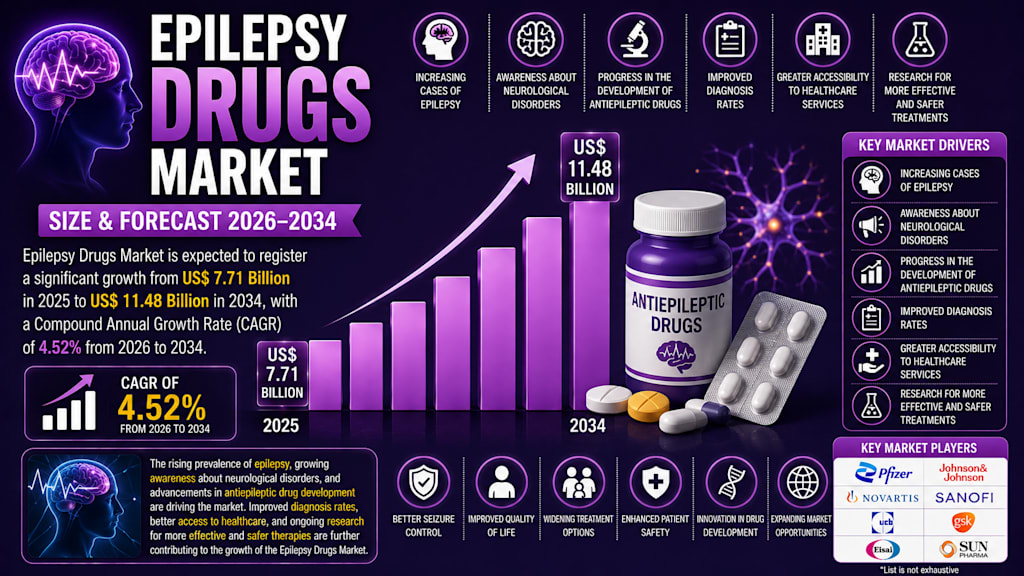
According to Renub Research, the global Epilepsy Drugs Market is projected to grow from US$ 7.71 billion in 2025 to US$ 11.48 billion by 2034, registering a compound annual growth rate (CAGR) of 4.52% between 2026 and 2034. Rising prevalence of epilepsy, increasing awareness of neurological disorders, ongoing pharmaceutical innovation, and expanding healthcare access are among the major factors driving market growth.
As research continues advancing and treatment options become increasingly personalized, the epilepsy drugs market is expected to remain a critical segment within the global pharmaceutical industry.

Understanding Epilepsy and Antiepileptic Drugs
Epilepsy is a chronic neurological condition characterized by recurrent seizures caused by abnormal electrical activity within the brain.
Seizures can vary significantly in severity and presentation, ranging from brief episodes of altered awareness to prolonged convulsions that affect the entire body.
Antiepileptic drugs are the primary treatment option for managing epilepsy and reducing seizure frequency. These medications work by regulating electrical activity in the brain and stabilizing communication between nerve cells.
Several classes of antiepileptic drugs are currently available, including sodium channel blockers, calcium channel modulators, and gamma-aminobutyric acid (GABA) enhancers.
The choice of medication depends on factors such as seizure type, patient age, medical history, treatment response, and safety considerations.
For many patients, epilepsy treatment involves lifelong therapy aimed at maintaining seizure control and preserving quality of life.
As understanding of neurological disorders continues improving, antiepileptic therapies are becoming increasingly sophisticated and effective.
Rising Global Epilepsy Burden Is Driving Demand
One of the strongest factors supporting growth in the epilepsy drugs market is the increasing global prevalence of epilepsy and other neurological disorders.
According to estimates referenced in the report, approximately 50 million people worldwide live with epilepsy, making it one of the most common neurological conditions globally. Active epilepsy affects an estimated 4 to 10 individuals per 1,000 people within the general population.
The condition can result from a variety of causes, including genetic factors, traumatic brain injuries, infections, tumors, developmental disorders, and age-related neurological diseases.
The growing incidence of stroke, dementia, and neurodegenerative conditions among aging populations is further contributing to epilepsy prevalence worldwide.
Improved diagnostic technologies and increased awareness among healthcare professionals have also resulted in more cases being identified and treated.
Because epilepsy often requires continuous long-term treatment, the growing patient population creates consistent demand for effective pharmaceutical therapies.
As neurological healthcare becomes a greater priority globally, the demand for epilepsy medications is expected to remain strong.
Aging Populations Are Creating Long-Term Growth Opportunities
Demographic changes are playing an increasingly important role in shaping the future of the epilepsy drugs market.
Older adults face higher risks of neurological disorders that can contribute to epilepsy development, including stroke, Alzheimer's disease, Parkinson's disease, and other neurodegenerative conditions.
As global populations continue aging, healthcare systems are experiencing rising demand for neurological care and chronic disease management services.
Elderly patients often require ongoing monitoring and long-term pharmaceutical treatment to manage seizures and associated health conditions.
This demographic trend is creating a larger patient base that depends on antiepileptic medications for disease management and quality-of-life improvement.
Healthcare providers are increasingly focusing on specialized neurological care programs tailored to aging populations, further supporting demand for epilepsy therapies.
As longevity continues increasing worldwide, aging-related neurological disorders are expected to remain an important growth driver for the market.
Pharmaceutical Innovation Is Transforming Treatment
One of the most exciting developments within the epilepsy drugs market is the rapid pace of pharmaceutical innovation.
Drug manufacturers are investing heavily in research and development aimed at creating next-generation antiepileptic medications that offer improved efficacy, enhanced safety profiles, and better patient tolerability.
Traditional antiepileptic drugs have been highly effective for many patients, but some therapies are associated with side effects that can affect adherence and quality of life.
Newer therapies focus on reducing adverse effects while maintaining strong seizure-control capabilities.
Advancements in targeted therapies, extended-release formulations, biologics, and precision medicine approaches are helping improve treatment outcomes for diverse patient populations.
Researchers are also exploring novel drug targets and treatment mechanisms to address drug-resistant epilepsy, a condition that affects patients whose seizures remain uncontrolled despite conventional therapy.
As pharmaceutical innovation continues accelerating, patients can expect broader treatment options and more personalized approaches to seizure management.
Artificial Intelligence Is Supporting Patient Care
Technology is increasingly influencing the management of neurological disorders, including epilepsy.
Artificial intelligence solutions are beginning to support patients, caregivers, and healthcare professionals through improved access to information, personalized guidance, and educational resources.
In August 2025, the Epilepsy Foundation of America launched Sage, an AI-powered assistant developed in collaboration with Amazon Web Services and powered by Anthropic's Claude technology. The initiative reflects growing efforts to leverage advanced digital tools to improve patient support and engagement.
Digital healthcare platforms are helping patients access information regarding treatment options, medication adherence, symptom management, and lifestyle considerations.
AI-powered technologies may eventually contribute to earlier diagnosis, improved treatment personalization, and more efficient healthcare delivery.
As digital innovation continues expanding across healthcare systems, technology is expected to play an increasingly important role in epilepsy management.
Emerging Markets Are Expanding Access to Treatment
The expansion of healthcare infrastructure in emerging markets is creating significant opportunities for growth within the epilepsy drugs industry.
Countries across Asia-Pacific, Latin America, Africa, and the Middle East are investing heavily in healthcare modernization initiatives designed to improve access to diagnosis, treatment, and specialist care.
Government programs focused on neurological healthcare, insurance coverage expansion, and public awareness campaigns are helping reduce treatment gaps among epilepsy patients.
Improved access to hospitals, specialty clinics, and neurological care centers is enabling more patients to receive timely diagnosis and appropriate treatment.
Pharmaceutical companies are also expanding their presence within emerging markets through partnerships, local manufacturing initiatives, and generic drug development programs.
As healthcare accessibility improves worldwide, demand for epilepsy medications is expected to increase steadily.
First-Line Antiepileptic Drugs Remain Essential
First-line antiepileptic medications continue to represent the foundation of epilepsy treatment.
These drugs are typically prescribed immediately following diagnosis and are selected based on seizure type, patient characteristics, efficacy, and safety considerations.
Common first-line therapies include sodium channel blockers and broad-spectrum antiepileptic medications capable of controlling a variety of seizure types.
These drugs have been extensively studied and remain widely trusted among healthcare professionals due to their established effectiveness.
The availability of generic formulations has also improved affordability and accessibility, particularly within cost-sensitive healthcare environments.
By providing effective seizure control for many patients, first-line therapies continue to play a central role within epilepsy treatment strategies worldwide.
Focal Seizure Treatments Continue Growing
Focal seizures, also known as partial seizures, represent the most common form of epilepsy and account for a significant portion of treatment demand.
These seizures originate within a specific region of the brain and may require specialized therapeutic approaches.
Modern diagnostic technologies, including MRI and EEG systems, have improved the ability to accurately identify focal seizure disorders and guide targeted treatment decisions.
Pharmaceutical companies continue developing therapies with enhanced safety profiles and improved tolerability for patients with focal epilepsy.
The aging population further contributes to demand because conditions such as stroke and neurological degeneration can increase susceptibility to focal seizures.
As diagnostic accuracy improves and treatment options expand, the focal seizure drug segment is expected to experience continued growth.
Generalized Seizure Therapies Are Benefiting from Innovation
Generalized seizures affect both sides of the brain simultaneously and require broad-spectrum antiepileptic medications capable of controlling widespread abnormal electrical activity.
These seizure types include tonic-clonic seizures, absence seizures, myoclonic seizures, and atonic seizures.
Researchers continue developing therapies designed specifically for generalized epilepsy syndromes while improving safety and treatment effectiveness.
Personalized medicine approaches are also gaining traction, allowing healthcare providers to select treatments based on individual patient characteristics and treatment responses.
The growing diagnosis of generalized epilepsy among children and adolescents is further supporting demand for specialized therapeutic options.
As research continues advancing, generalized seizure therapies are expected to benefit from ongoing innovation and expanded treatment possibilities.
Hospital Pharmacies Remain Critical Distribution Channels
Hospital pharmacies continue serving as one of the most important distribution channels within the epilepsy drugs market.
Hospitals play a central role in diagnosis, treatment initiation, medication management, and patient education.
Hospital pharmacies ensure access to a broad range of epilepsy medications, including emergency treatments, injectable formulations, and specialized therapies.
Neurologists and pharmacists work closely together to optimize medication regimens and monitor patient outcomes.
Hospital-based distribution is particularly important for patients requiring complex neurological care or ongoing treatment adjustments.
As healthcare systems continue expanding neurological services, hospital pharmacies are expected to maintain their dominant position within the market.
Online Providers Are Improving Accessibility
The rise of digital healthcare has significantly influenced pharmaceutical distribution models.
Online pharmacies and digital healthcare platforms increasingly allow patients to access epilepsy medications conveniently and efficiently.
These services provide advantages such as home delivery, prescription management, automatic refills, and access to both branded and generic products.
Telemedicine adoption has further strengthened online distribution by enabling patients to consult healthcare providers remotely and receive electronic prescriptions.
This approach is particularly beneficial for individuals living in rural or underserved regions where access to specialized neurological care may be limited.
As digital healthcare ecosystems continue evolving, online providers are expected to play an increasingly important role in supporting treatment continuity and medication accessibility.
Challenges Facing the Epilepsy Drugs Market
Despite positive growth prospects, the market continues facing several challenges.
One major concern involves the side effects associated with many antiepileptic medications.
Common adverse effects can include dizziness, fatigue, nausea, mood changes, confusion, and coordination difficulties. Long-term treatment may also be associated with more serious complications in certain patients.
These side effects can reduce treatment adherence and negatively affect patient outcomes.
Drug-resistant epilepsy presents another challenge. Some patients continue experiencing seizures despite receiving multiple medications, highlighting the need for continued therapeutic innovation.
Regulatory requirements for neurological drugs are also stringent, often resulting in lengthy development timelines and substantial research investments.
Treatment Costs Remain a Barrier
The cost of epilepsy treatment remains an important concern, particularly for patients requiring newer-generation therapies.
Advanced antiepileptic medications often involve substantial research and development costs that can contribute to higher prices.
Patients in lower-income regions may face difficulties accessing treatment due to financial limitations and limited healthcare coverage.
Even within developed markets, out-of-pocket expenses can create challenges for some individuals.
While generic medications improve affordability, not every patient responds equally to generic alternatives.
Addressing affordability and expanding healthcare access will remain critical priorities for policymakers, healthcare providers, and pharmaceutical companies.
Regional Market Insights
The United States remains the largest epilepsy drugs market globally due to advanced healthcare infrastructure, strong pharmaceutical innovation, and high diagnosis rates. In April 2025, Neurelis received FDA approval for VALTOCO (diazepam nasal spray) for the short-term treatment of seizure clusters in patients aged two years and older, further strengthening available treatment options.
The United Kingdom continues benefiting from its well-established healthcare system and strong neurological care capabilities. In March 2024, the Medicines and Healthcare products Regulatory Agency approved ganaxolone (Ztalmy) as the first anti-seizure medication for cyclin-dependent kinase-like 5 deficiency disorder in the country.
India represents a rapidly growing market due to increasing awareness, healthcare expansion, and strong generic pharmaceutical manufacturing capabilities. In January 2024, Akumentis Healthcare launched Clasepi, a prescription cannabidiol therapy approved for managing seizures associated with several severe neurological conditions.
Saudi Arabia continues strengthening neurological care through healthcare modernization initiatives and expanding specialized treatment centers. The King Faisal Specialist Hospital and Research Centre remains one of the leading epilepsy surgery centers in the Middle East.
Competitive Landscape
Competition within the epilepsy drugs market remains intense as pharmaceutical companies continue investing in innovation, clinical research, and advanced treatment development.
Major industry participants include Eisai Co., Ltd., UCB Inc., H. Lundbeck A/S, GW Pharmaceuticals Plc., Abbott Laboratories, Alkem Laboratories Limited, Bausch Health Companies Inc., GSK plc, Novartis AG, and Pfizer Inc.
These organizations focus on developing safer therapies, improving patient outcomes, expanding access to treatment, and addressing unmet needs among patients with difficult-to-treat forms of epilepsy.
Continued investment in research and development is expected to drive future innovation across the market.
Final Thoughts
The global epilepsy drugs market is evolving steadily as rising disease prevalence, pharmaceutical innovation, and improved healthcare accessibility create new opportunities for growth. Antiepileptic therapies remain essential for helping millions of patients manage seizures, maintain independence, and improve quality of life.
Advances in precision medicine, digital healthcare, targeted therapies, and next-generation drug development are transforming the treatment landscape while creating more personalized approaches to neurological care.
With the market projected to grow from US$ 7.71 billion in 2025 to US$ 11.48 billion by 2034, epilepsy drugs will continue playing a critical role in global healthcare. As awareness, diagnosis, and treatment capabilities improve worldwide, the industry is well positioned to support better outcomes for patients living with epilepsy and related neurological disorders.
About the Creator
Enjoyed the story? Support the Creator.
Subscribe for free to receive all their stories in your feed.
Comments
There are no comments for this story
Be the first to respond and start the conversation.