
Electric Vehicles Market Charges Ahead as Global Shift Toward Clean Mobility Accelerates
Government incentives, battery innovation, and rising fuel costs are expected to drive the electric vehicles market to US$ 1.77 Trillion by 2034

The global automotive industry is experiencing one of the biggest transformations in its history. Electric vehicles, once considered a futuristic alternative to gasoline-powered cars, are now becoming a central part of transportation systems worldwide. Governments, automakers, technology companies, and consumers are all contributing to the rapid expansion of the electric mobility ecosystem.
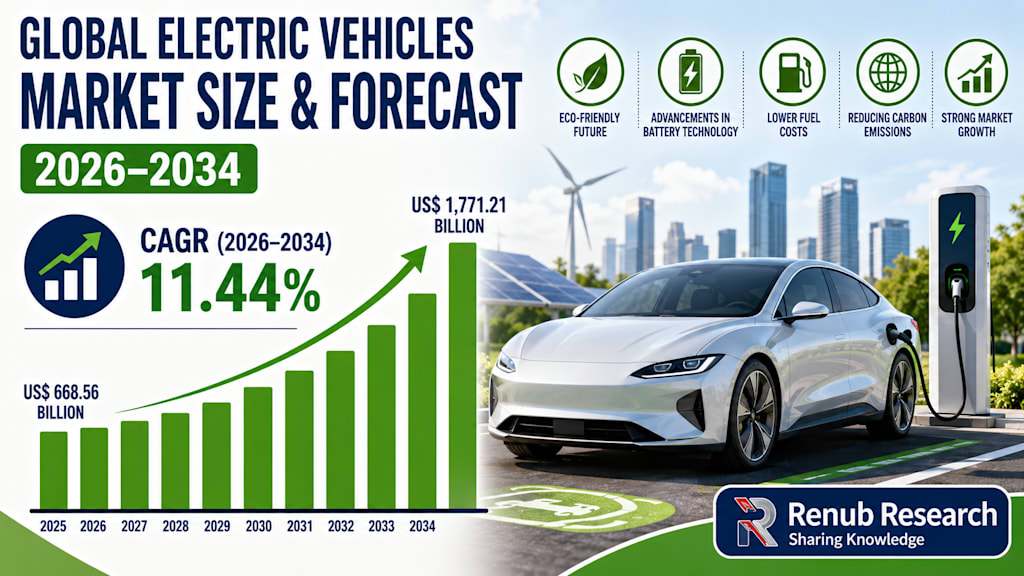
According to the Renub Research market brief provided, the global electric vehicles market is projected to grow from US$ 668.56 Billion in 2025 to US$ 1,771.21 Billion by 2034, expanding at a CAGR of 11.44% from 2026 to 2034.
This strong growth reflects rising environmental awareness, continuous improvements in battery technology, and increasing pressure to reduce greenhouse gas emissions. At the same time, fuel price volatility and supportive government policies are accelerating the transition away from traditional internal combustion engine vehicles.
The shift toward electric mobility is no longer limited to a few advanced economies. It has become a global movement reshaping transportation, energy systems, and industrial manufacturing.
Electric vehicles are moving into the mainstream
Electric vehicles, commonly called EVs, operate partially or entirely using electricity instead of conventional gasoline or diesel engines. Most EVs rely on rechargeable lithium-ion batteries that power electric motors, producing little or no tailpipe emissions.
The market mainly includes battery electric vehicles (BEVs), hybrid electric vehicles (HEVs), and plug-in hybrid electric vehicles (PHEVs). Each category serves different consumer needs, ranging from fully electric driving to hybrid systems that combine internal combustion engines with electric support.
What has changed dramatically in recent years is consumer perception. Electric vehicles are no longer viewed as niche technology products reserved for environmentally conscious buyers. Improvements in driving range, charging speed, design, and affordability have made EVs practical for mainstream transportation.
Automakers are now introducing electric models across nearly every vehicle category, including compact cars, SUVs, trucks, buses, luxury vehicles, and two-wheelers. This wider selection is helping consumers find EVs that fit both their budgets and lifestyle requirements.
Governments are pushing the transition aggressively
One of the biggest growth drivers behind the electric vehicles market is government policy support.
Countries worldwide are implementing stricter emissions regulations and setting ambitious climate targets. According to the Renub Research brief, more than 120 countries have pledged to achieve net-zero emissions by 2050 or earlier. Many governments are also planning to phase out internal combustion engine vehicles over the coming decades.
To accelerate adoption, governments are offering incentives such as tax credits, purchase subsidies, reduced registration fees, toll exemptions, and investment support for charging infrastructure.
These incentives are helping reduce the price gap between electric vehicles and conventional vehicles, making EVs more accessible to wider consumer groups.
The International Energy Agency reported that global electric car sales surpassed 17 million units in 2024, with year-over-year growth exceeding 25%. Remarkably, the increase in EV sales during 2024 alone was greater than total global EV sales recorded in 2020.
This demonstrates how quickly electric mobility is scaling worldwide.
Battery technology is improving rapidly
Battery innovation remains one of the most important factors shaping the future of electric vehicles.
Earlier generations of EVs faced major limitations related to short driving ranges, long charging times, and high battery costs. Those challenges slowed adoption for years. Today, however, advances in lithium-ion battery technology have significantly improved vehicle performance.
Modern EV batteries offer higher energy density, faster charging capabilities, improved safety systems, and longer operational life cycles. As battery manufacturing scales globally, production costs are also falling steadily. This is helping EV prices become more competitive compared to traditional gasoline-powered vehicles.
Research into next-generation battery technologies is also accelerating. Solid-state batteries, graphene-based systems, and alternative battery chemistries are expected to deliver further improvements in efficiency, range, and charging speed.
The report highlights a December 2025 development involving Graphene Manufacturing Group Ltd., which is working with the University of Queensland and Rio Tinto on Graphene Aluminium-Ion Battery technology. Projects like these illustrate the intense global effort to improve battery performance and strengthen the long-term future of electric mobility.
Battery technology is not just influencing vehicle performance. It is also shaping supply chains, manufacturing investments, and geopolitical competition.
Consumers are responding to rising fuel prices
Fuel prices have become another major reason behind the increasing popularity of electric vehicles.
In many regions, gasoline and diesel costs remain volatile, creating financial pressure for consumers and businesses. EVs offer lower operating and maintenance costs because electric motors are more energy-efficient and mechanically simpler than internal combustion engines.
Over time, many consumers view EV ownership as economically attractive despite the higher upfront purchase price.
Environmental awareness is also influencing buying behavior. Consumers increasingly want transportation options that reduce carbon emissions and support sustainability goals. This is particularly important among younger buyers and urban populations where climate concerns are more visible.
Corporate fleets and logistics companies are also electrifying operations to improve sustainability performance and reduce fuel expenses. Delivery vans, commercial fleets, and public transportation systems are increasingly adopting electric solutions as governments implement stricter emissions standards.
Charging infrastructure remains a major challenge
Despite rapid market growth, infrastructure limitations continue to slow EV adoption in many regions.
One of the biggest concerns among consumers is range anxiety — the fear that an electric vehicle may run out of battery power before reaching a charging station.
In developed markets, charging infrastructure is expanding quickly, especially along highways and urban centers. However, many developing economies still lack sufficient public charging networks to support large-scale EV adoption.
Charging time also remains a concern. Although fast-charging technologies have improved significantly, refueling a gasoline vehicle still takes far less time than charging most electric cars.
Infrastructure investment will therefore remain essential to sustaining long-term market growth. Governments, utilities, and private companies are investing heavily in public charging systems, ultra-fast charging networks, and home charging solutions.
The speed of infrastructure expansion may ultimately determine how quickly electric mobility can replace conventional transportation globally.
Supply chain risks continue to affect the industry
Another major challenge involves raw materials and battery supply chains.
Electric vehicle production depends heavily on materials such as lithium, cobalt, nickel, and rare earth minerals. These materials face supply risks related to mining capacity, geopolitical tensions, environmental concerns, and price volatility.
As global EV demand rises, securing stable battery supply chains has become a strategic priority for automakers and governments alike.
Countries are increasingly investing in domestic battery production facilities, recycling technologies, and alternative sourcing strategies to reduce dependence on foreign suppliers.
The battery supply chain has therefore become one of the most competitive and politically important areas within the global automotive industry.
Battery electric vehicles are leading the market
Among all EV categories, battery electric vehicles are currently the fastest-growing segment.
BEVs operate entirely on electricity and produce zero tailpipe emissions. They also offer lower maintenance requirements because they contain fewer moving mechanical parts compared to conventional vehicles.
Earlier challenges related to charging convenience and limited driving range restricted BEV adoption for many years. However, technological progress and infrastructure improvements are rapidly changing that reality.
Consumers increasingly view BEVs as practical long-term transportation solutions, particularly in urban and suburban areas where charging access is improving steadily.
Hybrid vehicles continue to play an important role
Hybrid electric vehicles also remain highly relevant, especially in countries where charging infrastructure is still developing.
HEVs combine internal combustion engines with electric motors, allowing consumers to reduce fuel consumption without relying entirely on charging stations.
For many buyers, hybrid systems provide a transitional solution between conventional vehicles and fully electric mobility. They offer improved fuel efficiency and lower emissions while avoiding some of the infrastructure concerns associated with full EV ownership.
This explains why hybrid vehicles continue to perform strongly in multiple international markets.
Two-wheelers and commercial EVs are growing rapidly
Electric mobility is not limited to passenger cars.
The two-wheeler EV market is growing rapidly, particularly in densely populated emerging economies. Electric scooters and motorcycles are becoming popular because they offer affordable, fuel-efficient, and environmentally friendly transportation solutions. They are also increasingly used for last-mile delivery services and urban commuting.
Commercial electric vehicles are another fast-growing segment. Electric buses, trucks, vans, and delivery vehicles are being adopted by logistics companies and public transportation systems seeking lower operating costs and reduced emissions.
As cities implement low-emission zones and sustainability regulations, demand for commercial EVs is expected to rise significantly.
Regional markets are developing at different speeds
The United States remains one of the world’s largest EV markets due to strong policy support, expanding charging infrastructure, and increasing environmental awareness.
Automakers are heavily investing in electric SUVs, trucks, and passenger cars to meet rising demand. The report highlights Kia America’s launch of the 2024 EV9, featuring fast-charging capabilities and three-row seating designed for mainstream family adoption.
Germany continues leading Europe’s EV transition with strict emissions standards, government subsidies, and strong automotive manufacturing capabilities. German automakers are rapidly expanding electric portfolios while investing heavily in battery innovation and renewable energy integration.
India represents one of the most promising emerging EV markets. Government incentives, rising fuel costs, and urban pollution concerns are supporting rapid growth, especially in two-wheelers and commercial transportation. VinFast’s investment in a major manufacturing facility in Tamil Nadu highlights growing international interest in India’s EV sector.
Saudi Arabia is also developing its EV ecosystem as part of broader economic diversification and sustainability initiatives. Investments in charging infrastructure, renewable energy, and domestic manufacturing are helping support market expansion. Lucid Motors’ manufacturing investment reflects the country’s ambition to become a regional EV production hub.
Competition among automakers is intensifying
The global EV market has become highly competitive, with traditional automakers and new entrants racing to secure market share.
The Renub Research brief identifies major companies including Tesla, BMW Group, BYD, Mercedes-Benz, Ford, General Motors, Nissan, and Toyota.
Competition now extends beyond vehicle design. Companies are competing on battery efficiency, software systems, autonomous driving technology, charging ecosystems, and manufacturing scale.
Chinese manufacturers in particular are becoming increasingly influential due to aggressive pricing strategies and strong battery technology capabilities. European and American automakers are responding with major investments in electrification and digital vehicle platforms.
The next decade is likely to determine which companies emerge as long-term leaders in the electric mobility era.
The future of transportation is increasingly electric
The electric vehicles market is no longer driven only by environmental concerns. It is now supported by economics, technology, government policy, and changing consumer behavior.
As charging infrastructure expands and battery technology improves further, electric mobility is expected to become more practical, affordable, and accessible worldwide.
The automotive industry is entering a period where software, energy systems, and digital connectivity will become just as important as mechanical engineering.
That shift will continue reshaping transportation, urban planning, energy consumption, and industrial supply chains globally.
Final Thoughts
The global electric vehicles market is growing rapidly because the world is moving toward cleaner, smarter, and more sustainable transportation systems.
With the market projected to rise from US$ 668.56 Billion in 2025 to US$ 1,771.21 Billion by 2034, electric vehicles are expected to remain one of the most transformative industries of the coming decade.
About the Creator
Enjoyed the story? Support the Creator.
Subscribe for free to receive all their stories in your feed.
Comments
There are no comments for this story
Be the first to respond and start the conversation.