
Dump Trucks & Mining Trucks Market to Reach US$ 48.39 Billion by 2034 as Global Infrastructure and Mining Projects Accelerate
Rising mineral demand, rapid urban development, and the transition toward electric and automated heavy vehicles are reshaping the future of the global dump trucks and mining trucks industry.

Introduction
The global construction and mining sectors are entering a new era of expansion, driven by infrastructure modernization, energy transition projects, and growing demand for critical minerals. At the center of this industrial transformation is the dump trucks and mining trucks market, a sector that plays a vital role in material transportation across construction sites, mines, and waste management systems.
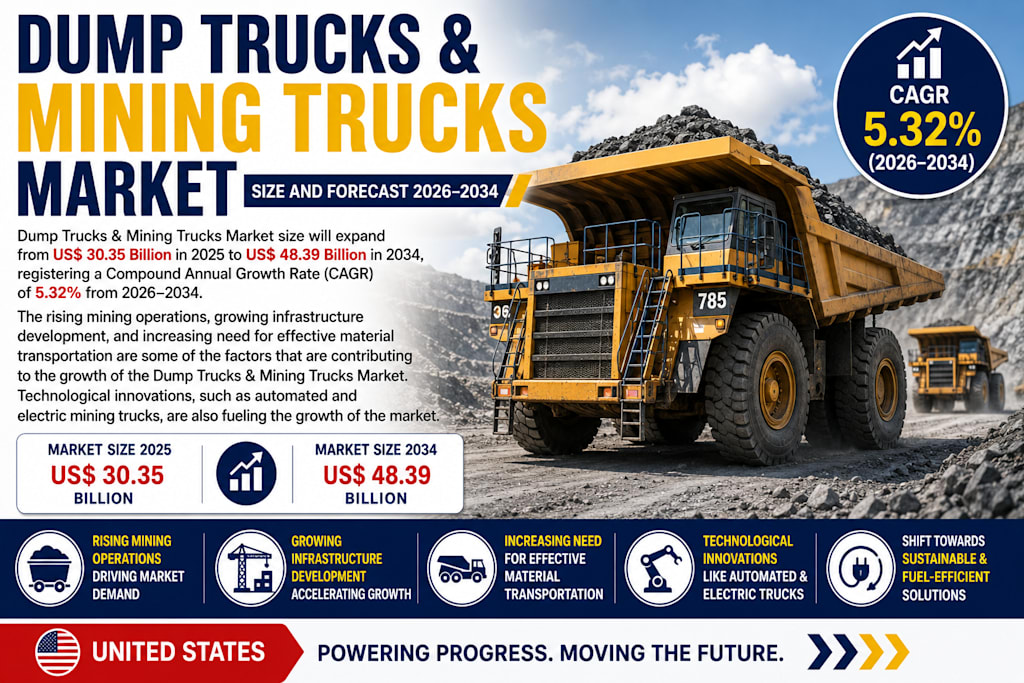
According to the provided Renub Research insights, the Dump Trucks & Mining Trucks Market is expected to grow from US$ 30.35 Billion in 2025 to US$ 48.39 Billion by 2034, registering a compound annual growth rate (CAGR) of 5.32% from 2026 to 2034. The market’s expansion is being fueled by rising mining operations, rapid infrastructure development, growing demand for efficient material transportation, and technological advancements such as automated and electric mining trucks.
As governments and industries invest heavily in roads, smart cities, renewable energy infrastructure, and mineral extraction, heavy-duty transportation equipment is becoming increasingly essential. Dump trucks and mining trucks are no longer viewed simply as industrial machines. They are now central to productivity, sustainability, and operational efficiency across multiple sectors worldwide.
Understanding Dump Trucks and Mining Trucks
Dump trucks and mining trucks are specialized heavy-duty vehicles designed to transport large volumes of materials such as sand, gravel, rocks, minerals, and construction debris.
Dump trucks are widely used in construction and infrastructure projects. These vehicles feature hydraulically operated open-box beds that can be raised for easy unloading of materials. They are commonly used for transporting construction materials across roads, bridges, railways, airports, and urban development projects.
Mining trucks, also known as haul trucks, are much larger and specifically engineered for mining environments. These trucks transport extracted minerals such as coal, iron ore, gold, copper, and lithium from mining sites to processing plants. Built for extreme conditions, mining trucks are capable of carrying massive payloads while operating in rugged terrain.
The increasing scale of construction and mining operations globally has made these vehicles indispensable. At the same time, technological innovation is rapidly improving truck efficiency, fuel economy, automation capabilities, and environmental performance.
Rising Demand for Minerals Is Driving Market Expansion
One of the strongest growth drivers for the market is the increasing global demand for minerals and natural resources. Industries such as electronics, renewable energy, manufacturing, and electric vehicle production require enormous quantities of minerals including lithium, copper, iron ore, coal, and gold.
As countries accelerate clean energy transitions and electric mobility adoption, mining activity is increasing worldwide. This has created strong demand for advanced mining trucks capable of transporting massive volumes of extracted materials efficiently.
Mining companies increasingly require high-capacity trucks to improve productivity and reduce operational downtime. Large-scale mining projects depend heavily on efficient haulage systems because transportation directly affects overall production output.
The report highlights an important development from February 2026, when Saudi Arabia launched the third round of its Mining Exploration Enablement Program to accelerate mineral exploration and attract global mining investment.
This reflects a broader international trend. Governments across multiple regions are investing heavily in mineral exploration to secure domestic supply chains for strategic resources.
Infrastructure Development Is Boosting Dump Truck Demand
Infrastructure expansion remains another major growth engine for the market. Governments worldwide are investing heavily in highways, railways, airports, bridges, ports, smart cities, and urban modernization projects.
Dump trucks are critical to these developments because they transport large quantities of construction materials including gravel, sand, cement, soil, and debris. Without efficient transportation systems, large-scale construction projects would face significant delays and operational inefficiencies.
Rapid urbanization is further accelerating demand. Expanding populations require improved transportation systems, housing projects, and public infrastructure, especially across developing economies.
Smart city initiatives are also contributing to heavy equipment demand. Construction companies increasingly rely on advanced dump trucks to manage complex urban development projects efficiently while minimizing project timelines.
The report notes that in September 2024, Hitachi Construction Machinery introduced the EH4000AC-5 rigid dump truck with enhanced payload capacity and durability. The company plans to commercialize the model following successful mining verification tests.
Such developments demonstrate how manufacturers are responding to rising industry expectations around productivity and performance.
Automation and Electric Trucks Are Transforming the Industry
Technological advancement is rapidly changing the dump trucks and mining trucks market. Automation, electrification, GPS integration, predictive maintenance systems, and advanced safety technologies are reshaping how fleets operate.
Autonomous mining trucks are becoming increasingly popular because they reduce labor dependency, improve operational consistency, and enhance worker safety in hazardous mining environments. Automated systems can optimize routes, minimize downtime, and improve fuel efficiency.
Electric mining trucks represent another major shift within the industry. Traditional diesel-powered vehicles contribute significantly to greenhouse gas emissions, leading mining and construction companies to explore cleaner alternatives.
Electric trucks offer multiple advantages beyond environmental benefits. They generally have lower fuel costs, reduced maintenance requirements, and quieter operation compared to diesel-powered vehicles.
The report highlights an important example from December 2025, when SANY launched the SKT110E — a 70-tonne fully electric mining dump truck designed for cleaner and more efficient mining operations in India.
Governments and corporations increasingly support sustainable industrial practices, and electric heavy vehicles are expected to become a major long-term growth area within the market.
High Costs Continue to Challenge Adoption
Despite strong growth potential, the industry faces several significant challenges.
One of the biggest barriers is the high cost of acquiring and maintaining dump trucks and mining trucks. Mining vehicles are especially expensive due to their size, engineering complexity, and advanced technological features.
For small and medium-sized companies, investing in modern fleets can be financially difficult. Maintenance costs are also substantial because these vehicles operate in harsh environments that place heavy stress on engines, tires, hydraulic systems, and structural components.
Companies must also invest in skilled technicians, maintenance facilities, and advanced monitoring systems to keep fleets operating efficiently.
These financial pressures can slow adoption in emerging economies where infrastructure investment is growing but financial resources may remain limited.
Environmental Regulations Are Reshaping the Market
Environmental regulations represent another major challenge for the industry. Diesel-powered mining and dump trucks generate significant greenhouse gas emissions and contribute to air pollution.
Governments and regulatory agencies are introducing stricter emissions standards, forcing manufacturers to develop cleaner technologies. Mining and construction companies are increasingly expected to reduce environmental impact and improve sustainability practices.
Transitioning toward electric or hybrid fleets requires major investment in charging infrastructure, battery systems, and operational redesign. However, environmental pressure is also accelerating innovation and creating opportunities for manufacturers specializing in low-emission technologies.
Sustainability is no longer optional in the heavy equipment industry. It is becoming a core business requirement.
Rear Dump Trucks Continue Dominating Operations
Rear dump trucks remain among the most widely used vehicle types in mining and construction due to their durability, simplicity, and ability to transport large material volumes efficiently.
These vehicles use hydraulic lifting systems to unload materials quickly, improving operational productivity. Rear dump trucks are heavily used in road construction, mining operations, infrastructure projects, and industrial transportation.
Technological improvements have enhanced fuel efficiency, payload capacity, safety systems, and structural durability, making these trucks even more valuable in demanding environments.
As infrastructure and mining activity continue expanding globally, rear dump trucks are expected to maintain strong market demand.
Demand for High Payload Trucks Is Rising
Trucks capable of carrying payloads above 100 tonnes are increasingly important in large-scale mining operations.
These high-capacity vehicles help mining companies reduce the number of transport trips required, improving operational efficiency while lowering fuel consumption and labor costs.
Large payload trucks are widely used in coal, iron ore, copper, and gold mining projects where enormous quantities of material must be transported continuously.
Modern high-payload vehicles are equipped with advanced engines, reinforced structures, monitoring systems, and safety technologies to support reliable operation under extreme conditions.
As global mineral extraction expands, demand for high-capacity trucks is expected to rise steadily.
Waste Management Is Emerging as an Important Segment
Beyond construction and mining, dump trucks are becoming increasingly important in waste management operations.
Urbanization and population growth are generating larger volumes of residential, commercial, and industrial waste. Municipalities and waste management companies rely on dump trucks to transport waste efficiently to disposal and recycling facilities.
Modern waste management trucks now incorporate advanced route optimization systems, fuel-efficient technologies, and monitoring tools to improve operational efficiency.
Growing focus on sustainability and recycling infrastructure is expected to support long-term growth in this segment.
Regional Markets Showing Strong Growth
The United States remains one of the leading markets for dump trucks and mining trucks due to large-scale mining activity and major infrastructure investment programs.
The report highlights that in September 2025, the U.S. Department of Energy launched new initiatives under its Mine of the Future program aimed at accelerating innovation in mining technologies and strengthening domestic mineral supply chains.
India is emerging as one of the fastest-growing markets because of rapid infrastructure development and expanding mining activity. Government initiatives focused on highways, railways, airports, and critical minerals are driving strong demand for advanced transportation equipment.
Saudi Arabia is also investing heavily in mining expansion and industrial diversification projects, creating new opportunities for heavy equipment manufacturers.
Meanwhile, the United Kingdom continues supporting infrastructure modernization and fuel-efficient vehicle adoption across the construction industry.
Competitive Landscape
The dump trucks and mining trucks market includes several major global equipment manufacturers competing through innovation, automation, fuel efficiency, and sustainability initiatives.
Key companies highlighted in the report include Caterpillar, Komatsu, Volvo Group, Deere & Company, Hitachi Construction Machinery, CNH Industrial, Doosan Corporation, and XCMG Group.
Competition increasingly focuses on autonomous operation, electric mobility, predictive maintenance technologies, payload optimization, and operational efficiency.
Manufacturers capable of balancing sustainability with high-performance engineering are expected to gain significant competitive advantages in the coming years.
Final Thoughts
The global dump trucks and mining trucks market is entering a new phase of industrial transformation driven by mining expansion, infrastructure modernization, automation, and sustainability goals.
The projected growth from US$ 30.35 Billion in 2025 to US$ 48.39 Billion by 2034 reflects rising global demand for efficient material transportation solutions across construction, mining, and waste management industries.
Technological innovation is fundamentally reshaping the market. Automated systems, electric trucks, advanced fleet monitoring, and high-capacity vehicles are improving productivity while supporting environmental goals.
About the Creator
Enjoyed the story? Support the Creator.
Subscribe for free to receive all their stories in your feed.
Comments
There are no comments for this story
Be the first to respond and start the conversation.