
Driving Into the Autonomous Age: How Self-Driving Vehicles Are Transforming Global Transportation
Artificial intelligence, advanced sensors, electric vehicles, smart-city infrastructure, and strategic partnerships are accelerating the rise of autonomous mobility worldwide.

For more than a century, driving has remained fundamentally the same: a human sits behind the wheel, makes decisions, controls speed, and navigates traffic. While automobiles have become faster, safer, and more technologically advanced, the driver has remained at the center of the transportation experience.
That reality is beginning to change.
Advances in artificial intelligence, machine learning, sensor technology, connectivity, and computing power are making it possible for vehicles to navigate roads with minimal—or even no—human intervention. What once seemed like science fiction is steadily becoming a commercial reality.
Autonomous vehicles, often referred to as self-driving cars, are poised to revolutionize transportation, logistics, ride-hailing, and urban mobility. By reducing human error, improving traffic efficiency, and increasing accessibility, autonomous technology has the potential to transform how people and goods move around the world.
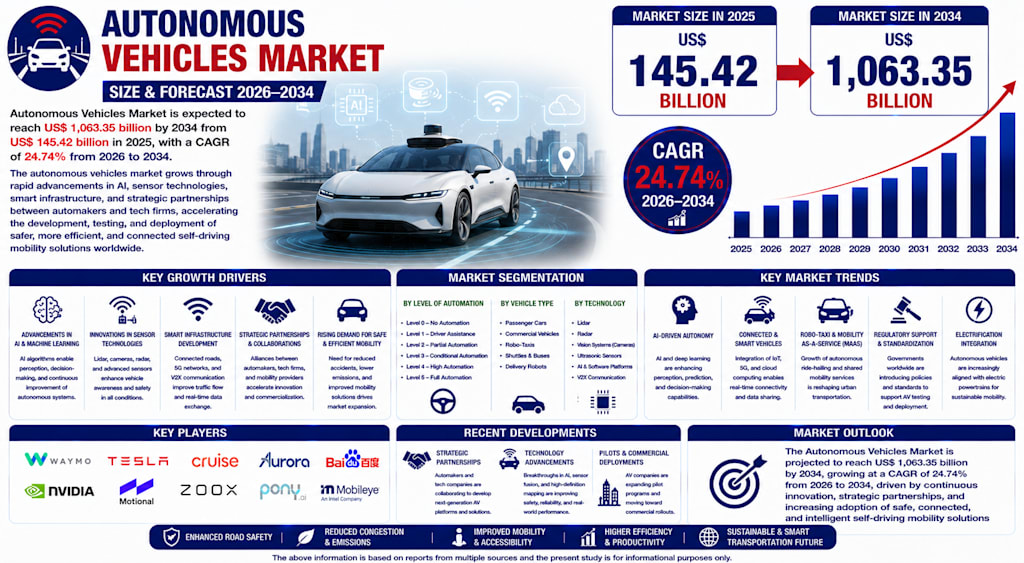
According to Renub Research, the Global Autonomous Vehicles Market is expected to expand from US$ 145.42 billion in 2025 to US$ 1,063.35 billion by 2034, growing at a remarkable compound annual growth rate (CAGR) of 24.74% from 2026 to 2034. Rapid advancements in AI, sensor technologies, smart infrastructure, and strategic collaborations between automotive and technology companies are fueling this extraordinary growth.
As innovation accelerates, autonomous mobility is emerging as one of the most transformative technological developments of the 21st century.
Understanding Autonomous Vehicles
Autonomous vehicles are transportation systems capable of sensing their environment, making driving decisions, and operating with limited or no human intervention.
These vehicles rely on a sophisticated combination of technologies, including:
Artificial intelligence, LiDAR, radar, cameras, ultrasonic sensors, GPS systems, real-time mapping, machine learning algorithms, and advanced computing platforms.
Together, these technologies allow autonomous systems to:
Detect obstacles, identify road signs, recognize pedestrians, interpret traffic conditions, and navigate safely through complex environments.
Autonomous driving capabilities are generally classified into multiple levels, ranging from driver-assistance technologies to fully autonomous systems capable of operating independently.
The ultimate goal is to create safer, more efficient, and more accessible transportation solutions for consumers, businesses, and governments worldwide.
Human Error Is Driving the Need for Automation
One of the strongest arguments for autonomous vehicles is safety.
Human error remains a leading cause of traffic accidents globally.
Factors such as distracted driving, fatigue, impaired driving, speeding, and poor decision-making contribute to millions of accidents every year.
Autonomous systems are designed to reduce these risks by relying on continuous monitoring, rapid decision-making, and consistent adherence to traffic regulations.
Unlike human drivers, autonomous systems do not become distracted, tired, or emotionally influenced.
While challenges remain before fully autonomous transportation becomes widespread, safety improvements remain one of the industry's most compelling value propositions.
As technology continues advancing, autonomous vehicles could significantly reduce accident rates and improve road safety worldwide.
Artificial Intelligence Is the Brain Behind Self-Driving Cars
Artificial intelligence serves as the foundation of autonomous mobility.
Every second, self-driving vehicles process enormous amounts of data collected from sensors and cameras.
AI algorithms analyze this information in real time to make critical driving decisions.
These systems can:
Recognize objects, predict movement patterns, assess risks, determine optimal routes, and respond to changing road conditions.
Machine learning continuously improves system performance by allowing vehicles to learn from vast datasets generated through real-world driving experiences and simulations.
The increasing sophistication of AI models is accelerating the industry's ability to move from driver-assistance systems toward higher levels of automation.
Without advances in artificial intelligence, autonomous vehicles would not be possible.
Strategic Partnerships Are Accelerating Innovation
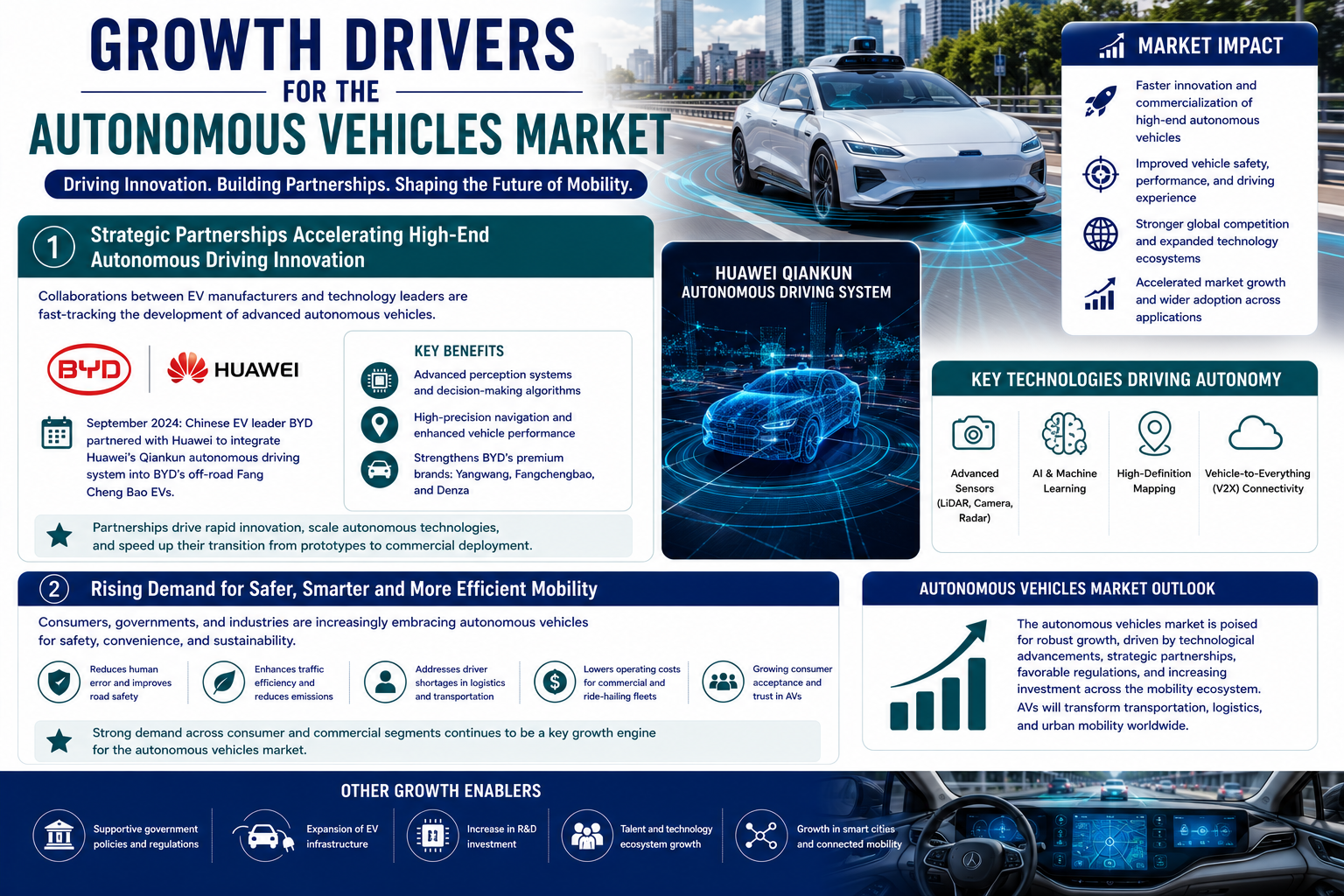
Collaboration between automakers and technology companies has become a major growth driver within the autonomous vehicle industry.
Developing self-driving technology requires expertise in software, hardware, artificial intelligence, sensors, and vehicle engineering.
Partnerships help companies combine strengths while reducing development timelines and costs.
A notable example occurred in September 2024 when BYD partnered with Huawei to integrate Huawei's Qiankun autonomous driving system into BYD's Fang Cheng Bao electric vehicles. The collaboration supports the development of advanced driving intelligence and enhanced autonomous capabilities across BYD's premium vehicle brands.
These strategic alliances continue accelerating innovation and commercialization throughout the industry.
Ride-Hailing Companies Are Embracing Autonomous Fleets
The future of ride-hailing may be autonomous.
Major transportation platforms increasingly view self-driving technology as a way to improve operational efficiency, reduce costs, and expand mobility services.
In July 2024, Uber and BYD announced a multi-year agreement to integrate 100,000 BYD electric vehicles into Uber's networks across Europe and Latin America. The companies also outlined plans to develop autonomous-capable vehicles designed specifically for future self-driving ride-hailing applications.
Autonomous ride-hailing fleets offer several potential advantages:
Lower operating costs, increased availability, reduced emissions, and enhanced accessibility.
As ride-sharing companies continue investing in automation, demand for autonomous driving technologies is expected to grow significantly.
Real-World Testing Is Accelerating Development
Extensive testing remains essential for improving safety, reliability, and regulatory acceptance.
Autonomous vehicles must navigate highly complex real-world environments involving unpredictable traffic conditions, pedestrians, weather variations, and road infrastructure differences.
Testing programs provide valuable data that helps refine machine learning algorithms and improve vehicle performance.
In July 2023, Audi launched its first autonomous vehicle test fleet in Austin, Texas, marking an important milestone in the company's automation strategy. The initiative supports the collection of real-world driving data and the continued development of advanced autonomous systems.
As testing expands globally, manufacturers gain critical insights necessary for commercial deployment.
Electric Vehicles and Autonomous Technology Are Converging
Electric vehicles and autonomous driving technologies are increasingly evolving together.
Many automakers view electrification and automation as complementary innovations that will define the future of transportation.
Electric vehicles provide ideal platforms for integrating advanced software, sensors, connectivity systems, and computing hardware.
The growing popularity of EVs is therefore accelerating investment in autonomous capabilities.
At the same time, autonomous ride-sharing and logistics services often prioritize electric platforms due to their lower operating costs and environmental benefits.
This convergence is creating powerful synergies that support market growth across both industries.
Smart Cities Are Building the Infrastructure for Autonomy
Governments and municipalities increasingly recognize the importance of intelligent transportation infrastructure.
Smart-city initiatives are creating environments better suited for autonomous mobility.
Key investments include:
Connected traffic systems, intelligent road networks, vehicle-to-everything (V2X) communication technologies, 5G connectivity, digital mapping infrastructure, and advanced traffic management platforms.
These systems improve communication between vehicles and their surrounding environments, enhancing safety and efficiency.
As urban centers continue modernizing transportation infrastructure, autonomous vehicle deployment becomes increasingly feasible.
Government support for smart-city development remains an important catalyst for long-term industry growth.
Software Is Becoming the Most Valuable Component
While hardware remains critical, software increasingly represents the true competitive advantage within the autonomous vehicle industry.
Advanced software platforms manage:
Perception systems, navigation, decision-making, mapping, cybersecurity, connectivity, and vehicle control functions.
Automakers are increasingly investing in software-defined vehicle architectures that enable continuous updates and performance improvements.
This shift allows vehicles to gain new capabilities throughout their operational lifetimes.
As autonomous technology evolves, software development is expected to become an even larger share of industry value creation.
Transportation and Logistics Lead Commercial Adoption
Among all applications, transportation and logistics represent some of the most promising opportunities for autonomous technology.
Autonomous systems can help address challenges such as:
Driver shortages, rising operating costs, delivery efficiency, and supply chain optimization.
Potential applications include:
Autonomous trucks, delivery vehicles, warehouse transportation systems, and last-mile logistics solutions.
The ability to operate continuously and optimize routing creates significant economic benefits.
As e-commerce continues expanding globally, logistics companies are increasingly exploring autonomous technologies to improve efficiency and competitiveness.
The United States Remains a Global Innovation Hub
The United States continues to play a leading role in autonomous vehicle development.
Strong research capabilities, extensive venture capital investment, advanced technology ecosystems, and supportive testing environments contribute to the country's leadership position.
Cities such as Phoenix, San Francisco, and Austin have become major centers for autonomous vehicle testing and deployment.
Collaboration between technology firms, automakers, and government agencies continues driving innovation.
The growing adoption of electric vehicles and smart infrastructure investments further strengthens long-term growth prospects within the U.S. market.
China Is Emerging as a Dominant Force
China has rapidly become one of the world's most important autonomous vehicle markets.
Government support, large-scale smart-city investments, strong electric vehicle adoption, and aggressive technological development have accelerated industry growth.
Companies including BYD, Huawei, Baidu, and XPeng are investing heavily in autonomous mobility solutions.
Large testing zones in major cities support commercialization efforts while helping manufacturers gather extensive operational data.
Strong domestic competition continues driving innovation and cost reductions across the sector.
Recent Developments Signal Industry Momentum
Several major developments have highlighted the accelerating pace of autonomous vehicle innovation.
In 2025, China introduced regulations enabling Level 3 autonomous driving for personal vehicles, creating a legal framework that supports mass-market deployment by manufacturers including XPeng, Li Auto, and Tesla.
In January 2025, Sony and Honda launched the Afeela electric vehicle, which incorporates advanced AI and next-generation autonomous driving technologies and is expected to enter Japanese and U.S. markets by 2026.
Additionally, Toyota and NTT announced a 500-billion-yen partnership in October 2024 to develop a Mobility AI Platform focused on intelligent transportation, software-defined vehicles, and enhanced road safety.
These developments underscore the industry's growing momentum toward commercialization.
Challenges Still Stand in the Way
Despite enormous potential, several challenges remain.
Regulatory fragmentation continues creating uncertainty.
Different countries and regions maintain varying requirements related to safety standards, cybersecurity, liability, data privacy, and operational approvals. This complexity increases costs and slows commercialization efforts.
High development costs also present significant obstacles.
Autonomous vehicles require expensive sensors, computing systems, mapping technologies, artificial intelligence platforms, and extensive testing programs.
Manufacturers must invest billions of dollars before achieving large-scale commercial deployment, creating financial pressure across the industry.
Overcoming these challenges will be essential for unlocking the full potential of autonomous mobility.
Final Thoughts
The autonomous vehicle industry is rapidly transforming from an ambitious technological vision into a global commercial reality.
Driven by advances in artificial intelligence, sensor technology, electric vehicles, connectivity, and smart infrastructure, self-driving mobility solutions are moving closer to widespread adoption.
Strategic partnerships, expanding pilot programs, and increasing government support continue accelerating innovation while improving system performance and safety.
With the market projected to grow from US$ 145.42 billion in 2025 to US$ 1,063.35 billion by 2034, autonomous vehicles represent one of the fastest-growing sectors within the global technology and transportation industries.
As autonomous capabilities continue evolving, the future of mobility will likely be safer, smarter, more connected, and increasingly independent from the human driver—reshaping transportation for generations to come.
About the Creator
Enjoyed the story? Support the Creator.
Subscribe for free to receive all their stories in your feed.
Comments
There are no comments for this story
Be the first to respond and start the conversation.