
Diesel Gensets Market Poised for Strong Growth as Global Demand for Reliable Backup Power Intensifies
Expanding infrastructure projects, rising data-center investments, and unreliable power grids are fueling worldwide demand for diesel generator sets despite growing renewable-energy competition.

The global diesel gensets market is entering a period of sustained expansion as industries, businesses, and households continue searching for dependable backup power solutions in an increasingly digital and electricity-dependent world. Rapid industrialization, infrastructure development, urbanization, and the growth of data centers are creating strong demand for reliable power systems capable of operating during outages and unstable grid conditions.
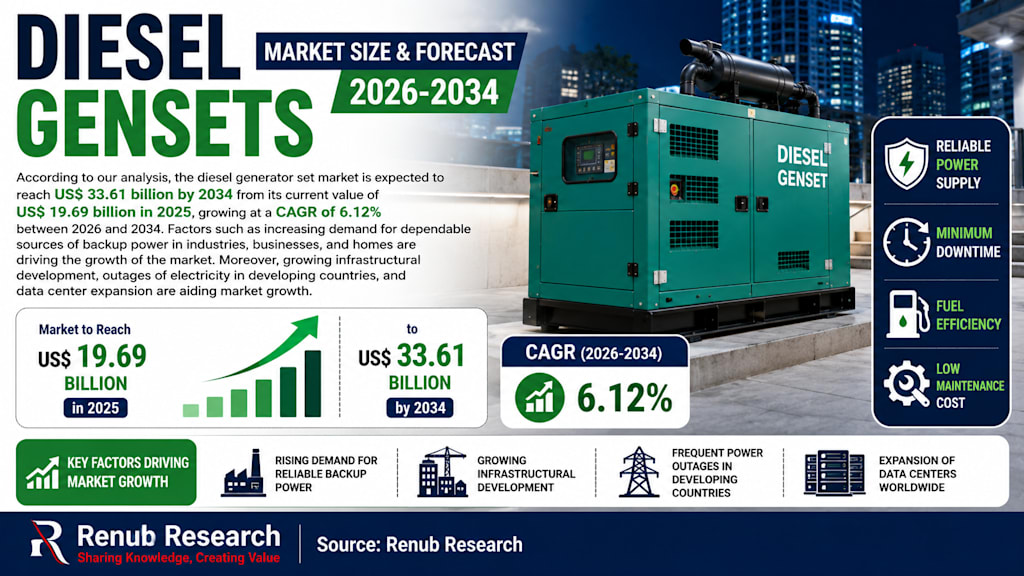
According to Renub Research, the diesel generator set market is projected to grow from US$ 19.69 billion in 2025 to US$ 33.61 billion by 2034, expanding at a compound annual growth rate (CAGR) of 6.12% between 2026 and 2034.
While renewable energy technologies continue gaining momentum globally, diesel gensets remain a critical part of energy infrastructure because of their reliability, fast response times, and ability to provide uninterrupted power during emergencies. From hospitals and telecom towers to industrial facilities and hyperscale data centers, diesel generators continue to play an essential role across multiple sectors.
Why diesel gensets remain highly relevant
A diesel generator set combines a diesel engine with an electrical generator to produce electricity. These systems are commonly used either as standby backup power during outages or as primary power sources in remote areas where grid connectivity is unavailable or unreliable.
Diesel gensets have become deeply integrated into industrial and commercial operations because downtime can be extremely costly. Manufacturing plants, healthcare facilities, banks, telecom operators, hotels, shopping complexes, and IT infrastructure providers all require uninterrupted electricity to maintain operations.
In many developing economies, frequent power interruptions and unstable electricity grids make diesel generators not just a backup option, but often a necessity. Even in advanced economies, natural disasters, grid failures, and rising energy demand continue to strengthen the importance of dependable emergency power systems.
Their durability, strong power output, operational efficiency, and ability to perform under demanding conditions continue to give diesel gensets a competitive advantage despite increasing environmental concerns.
Rising electricity dependence is driving market expansion
One of the most important factors fueling market growth is the world’s increasing dependence on electricity. As economies digitize and industries automate operations, continuous access to power has become more critical than ever before.
According to global energy trends, electricity consumption continues rising steadily across industries, households, and digital ecosystems. Businesses today rely heavily on cloud services, connected technologies, automation systems, and digital communication platforms that cannot tolerate prolonged interruptions.
This growing dependence creates strong demand for backup power systems capable of delivering immediate support during outages. Diesel gensets are particularly attractive because they can respond quickly and maintain stable energy output under emergency conditions.
Industries such as healthcare, telecommunications, manufacturing, and financial services are especially dependent on uninterrupted electricity. For these sectors, even short periods of downtime can result in operational disruptions, financial losses, and reputational damage.
As digital infrastructure expands globally, the need for reliable standby power solutions is expected to increase further.
Infrastructure development and urbanization support growth
Rapid urbanization and infrastructure expansion in emerging economies are also contributing significantly to market demand.
Governments around the world are investing heavily in transportation systems, airports, railways, smart cities, industrial zones, and energy infrastructure projects. Many of these projects are located in regions where stable grid access remains limited.
Construction sites, mining operations, and remote industrial facilities frequently rely on diesel generators as primary or temporary power sources. Their portability and reliability make them ideal for off-grid applications where continuous electricity is essential.
Urban population growth is also increasing energy demand in both residential and commercial sectors. As cities expand and industrial activity intensifies, businesses and households are becoming more conscious of power reliability.
Small and medium-sized enterprises, especially in developing markets, are increasingly adopting affordable portable generators to avoid operational disruptions caused by unstable electricity supply.
This combination of industrial growth, urban expansion, and infrastructure investment continues to strengthen long-term demand for diesel gensets worldwide.
Data centers are becoming a major growth engine
The rapid expansion of global data centers has emerged as one of the strongest drivers of the diesel gensets market.
Modern data centers cannot afford even brief interruptions in electricity supply because outages can lead to server failures, operational downtime, and massive financial losses. As a result, data-center operators invest heavily in reliable backup power systems capable of activating instantly during emergencies.
Diesel gensets remain the preferred standby power solution for many large data-center facilities because they provide high-capacity output and dependable performance under critical conditions.
The rise of cloud computing, artificial intelligence, streaming platforms, and digital businesses is accelerating data-center construction globally. Every new hyperscale facility increases demand for backup power infrastructure.
This trend is especially strong in fast-growing digital economies where governments and private investors are aggressively expanding technology infrastructure to support rising internet usage and cloud adoption.
As digital transformation accelerates across industries, diesel gensets are likely to remain a critical support system for the expanding global data-center ecosystem.
Portable generators are gaining popularity
Portable diesel generators represent another rapidly growing segment of the market. These systems are increasingly used across construction sites, agricultural operations, emergency services, and outdoor events because they offer mobility, flexibility, and dependable off-grid power.
Technological improvements are helping manufacturers develop quieter, more fuel-efficient, and lower-emission portable units. This has improved usability across residential, commercial, and industrial applications.
The increasing frequency of natural disasters and extreme weather events has also boosted consumer interest in portable backup systems. Homeowners and businesses alike are investing in portable generators to maintain access to electricity during emergencies.
As temporary and remote power requirements continue growing globally, the portable diesel generator segment is expected to remain highly attractive.
Standby generators remain essential for critical industries
Standby diesel generators continue to dominate applications requiring uninterrupted energy supply.
Hospitals, industrial facilities, telecom networks, airports, financial institutions, and emergency-response centers rely heavily on standby systems because operational interruptions can have serious consequences.
Modern standby generators are increasingly equipped with advanced monitoring systems, remote diagnostics, automated controls, and fuel-optimization technologies. These innovations improve reliability, maintenance efficiency, and operational performance.
The growing frequency of grid fluctuations, weather-related disruptions, and aging energy infrastructure in several countries has further strengthened demand for standby systems.
As businesses place greater emphasis on operational resilience and energy security, investment in standby power solutions is expected to continue rising.
Environmental concerns are creating industry pressure
Despite strong market growth, environmental concerns remain one of the biggest challenges facing the diesel gensets industry.
Diesel generators emit greenhouse gases, nitrogen oxides, and particulate matter that contribute to air pollution and climate concerns. Governments worldwide are implementing stricter emission standards and environmental regulations aimed at reducing pollution from diesel-powered systems.
Compliance with these regulations is increasing costs for manufacturers, who must invest heavily in cleaner technologies, advanced fuel systems, and emission-control solutions.
At the same time, growing public awareness regarding sustainability is encouraging businesses and consumers to explore alternative energy options such as solar generators, battery storage systems, and natural-gas-powered equipment.
The industry therefore faces the challenge of balancing reliability with environmental responsibility.
Renewable energy competition is intensifying
Renewable energy technologies are becoming a major competitive force within the power-generation market.
The falling cost of solar energy systems, battery storage technologies, and hybrid power solutions is encouraging businesses and households to reduce dependence on diesel generators in certain applications.
Governments in many countries are actively supporting renewable-energy adoption through subsidies, incentives, and policy reforms aimed at accelerating the transition toward cleaner energy systems.
Hybrid renewable systems combined with battery storage are increasingly being used in residential and commercial environments where emissions reduction is a priority.
However, diesel gensets still maintain a significant advantage in terms of reliability, scalability, and continuous high-load performance — especially in remote industrial operations and mission-critical infrastructure.
For many sectors, renewable technologies are complementing diesel generators rather than replacing them entirely.
India emerges as a high-growth market
India is experiencing rapid growth in diesel genset adoption because of industrialization, infrastructure expansion, and inconsistent electricity supply in several regions.
Industries including telecommunications, healthcare, construction, manufacturing, and agriculture rely heavily on diesel generators to ensure uninterrupted operations.
Rural electrification efforts and large-scale infrastructure projects are also increasing demand for backup and off-grid power solutions.
The country’s expanding digital economy and growing dependence on telecom infrastructure are further contributing to market growth. As India continues investing in economic development and industrial expansion, its role within the global diesel gensets market is expected to strengthen significantly.
Saudi Arabia’s mega-projects boost demand
Saudi Arabia’s diesel gensets market is benefiting strongly from major infrastructure and industrial projects linked to the country’s Vision 2030 transformation strategy.
Large developments such as NEOM and extensive oil-and-gas operations require dependable power systems capable of functioning in remote and demanding environments.
Harsh climatic conditions and limited grid access in certain areas further increase the importance of diesel generators throughout the country.
As Saudi Arabia continues investing in industrial diversification, smart-city projects, and infrastructure modernization, diesel genset demand is expected to remain strong despite growing environmental awareness.
The United States market remains highly important
The United States continues to represent one of the world’s largest diesel generator markets because of strong demand from data centers, healthcare systems, telecom networks, and industrial facilities.
Natural disasters such as hurricanes, storms, and wildfires frequently disrupt electricity supply, encouraging businesses and households to invest in reliable backup systems.
The aging electrical grid infrastructure in some regions is also driving greater adoption of standby generators across commercial and residential sectors.
Technological improvements involving intelligent monitoring systems and automated controls are helping operators improve fuel efficiency and performance reliability.
Competitive landscape remains highly dynamic
The market includes several major global manufacturers competing through innovation, fuel efficiency, product reliability, and technological upgrades.
Key companies operating in the industry include Aggreko, Atlas Copco AB, Ashok Leyland, Caterpillar, Cummins Inc., Cooper Corp., Greaves Cotton Limited, Deere & Company, and Kirloskar.
Manufacturers are focusing increasingly on lower emissions, digital monitoring technologies, hybrid systems, and advanced engine efficiency to maintain competitiveness in a changing energy environment.
Strategic investments in cleaner technologies and smart generator solutions are expected to shape the next phase of industry evolution.
Final thoughts
The global diesel gensets market continues to demonstrate strong resilience despite mounting environmental challenges and increasing competition from renewable-energy technologies.
The market’s projected growth from US$ 19.69 billion in 2025 to US$ 33.61 billion by 2034 highlights the continuing global need for dependable backup and off-grid power solutions.
As industries become more digital, infrastructure projects expand, and electricity demand rises worldwide, diesel generators are likely to remain an essential part of energy-security strategies for years to come.
About the Creator
Enjoyed the story? Support the Creator.
Subscribe for free to receive all their stories in your feed.
Comments
There are no comments for this story
Be the first to respond and start the conversation.