
Decoding the Future: How Molecular Diagnostics Is Revolutionizing Modern Healthcare
From cancer detection and infectious disease screening to personalized medicine and at-home testing, molecular diagnostics is transforming the way diseases are identified, monitored, and treated worldwide.

Modern medicine is undergoing a profound transformation. Traditional diagnostic methods that once relied heavily on symptoms, imaging, and laboratory cultures are increasingly being complemented—or even replaced—by technologies capable of detecting diseases at the molecular level.
At the heart of this transformation lies molecular diagnostics.
By analyzing DNA, RNA, proteins, and other biological markers, molecular diagnostic technologies provide highly accurate insights into diseases long before symptoms become severe. These tools are enabling earlier intervention, more precise treatments, and better patient outcomes across a wide range of medical conditions.
From identifying infectious diseases and genetic disorders to guiding cancer therapies and supporting personalized medicine, molecular diagnostics has become one of the most important pillars of modern healthcare.
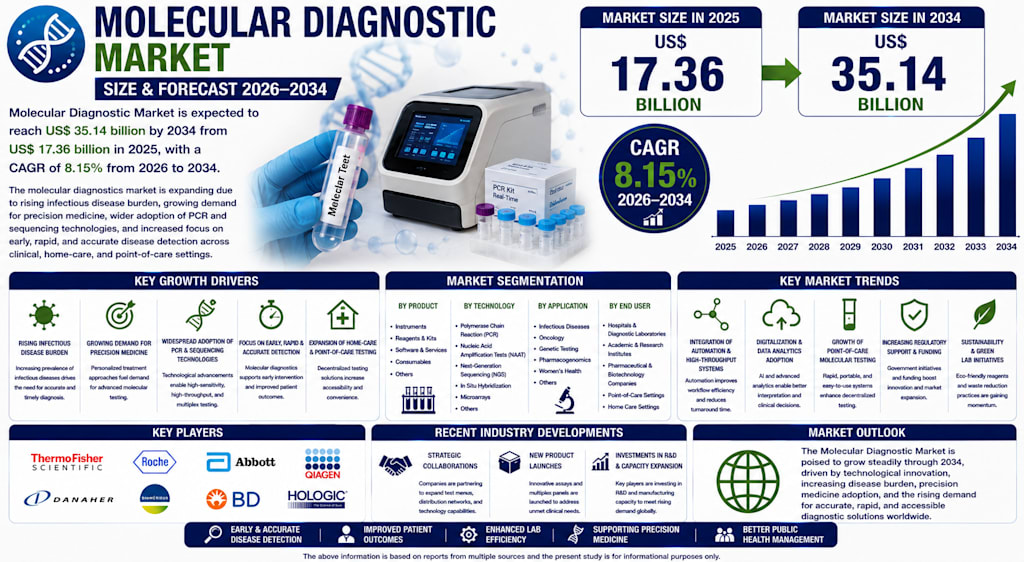
According to Renub Research, the Global Molecular Diagnostics Market is expected to grow from US$ 17.36 billion in 2025 to US$ 35.14 billion by 2034, expanding at a compound annual growth rate (CAGR) of 8.15% between 2026 and 2034. Rising infectious disease burdens, growing adoption of precision medicine, advances in PCR and sequencing technologies, and increasing demand for rapid, accurate disease detection are among the primary drivers supporting market expansion.
As healthcare systems increasingly prioritize early diagnosis and personalized treatment strategies, molecular diagnostics is becoming indispensable to clinical decision-making.
Understanding Molecular Diagnostics
Molecular diagnostics refers to the analysis of genetic and molecular information to identify diseases, infections, genetic mutations, and biological abnormalities.
Unlike conventional diagnostic approaches that often rely on visible symptoms or culture-based testing, molecular diagnostics examines biological markers directly at the cellular and molecular level.
Common technologies include:
Polymerase Chain Reaction (PCR), Next-Generation Sequencing (NGS), molecular imaging, microarrays, in situ hybridization, and mass spectrometry-based testing.
These methods can identify pathogens, detect cancer biomarkers, screen for hereditary disorders, and predict patient responses to specific therapies.
The ability to detect diseases earlier and with greater precision has made molecular diagnostics one of the fastest-growing sectors in healthcare.
Precision Medicine Is Driving Demand
One of the most significant drivers of molecular diagnostics growth is the increasing adoption of precision medicine.
Traditional treatments often apply a generalized approach to patient care. Precision medicine seeks to tailor therapies based on individual genetic profiles and disease characteristics.
Molecular diagnostics plays a critical role in this process.
By identifying specific genetic mutations, biomarkers, and molecular signatures, clinicians can select therapies that are more likely to be effective while minimizing unnecessary treatments.
This approach is particularly important in oncology, where targeted therapies increasingly depend on molecular testing results.
As healthcare providers move toward more personalized treatment strategies, demand for advanced diagnostic technologies continues to rise.
The integration of molecular testing into routine clinical workflows is expected to accelerate significantly over the coming years.
Infectious Disease Testing Remains a Major Growth Driver
The global burden of infectious diseases continues to create strong demand for molecular diagnostics.
Rapid identification of pathogens is essential for effective treatment, outbreak management, and public health surveillance.
PCR-based technologies have become the gold standard for detecting many viral, bacterial, and fungal infections because of their speed, sensitivity, and accuracy.
Molecular diagnostics allows healthcare providers to identify infections much earlier than traditional methods.
This capability improves treatment decisions, reduces disease transmission, and supports more effective patient management.
Recent global health emergencies demonstrated the critical importance of rapid molecular testing infrastructure.
As healthcare systems strengthen preparedness for future outbreaks, investment in molecular diagnostic capabilities is expected to remain a priority.
Automation Is Transforming Laboratory Efficiency
Automation has become one of the most influential trends within the molecular diagnostics industry.
Healthcare laboratories face increasing pressure to process larger testing volumes while maintaining accuracy and reducing turnaround times.
Automated molecular platforms help address these challenges by streamlining workflows and minimizing manual intervention.
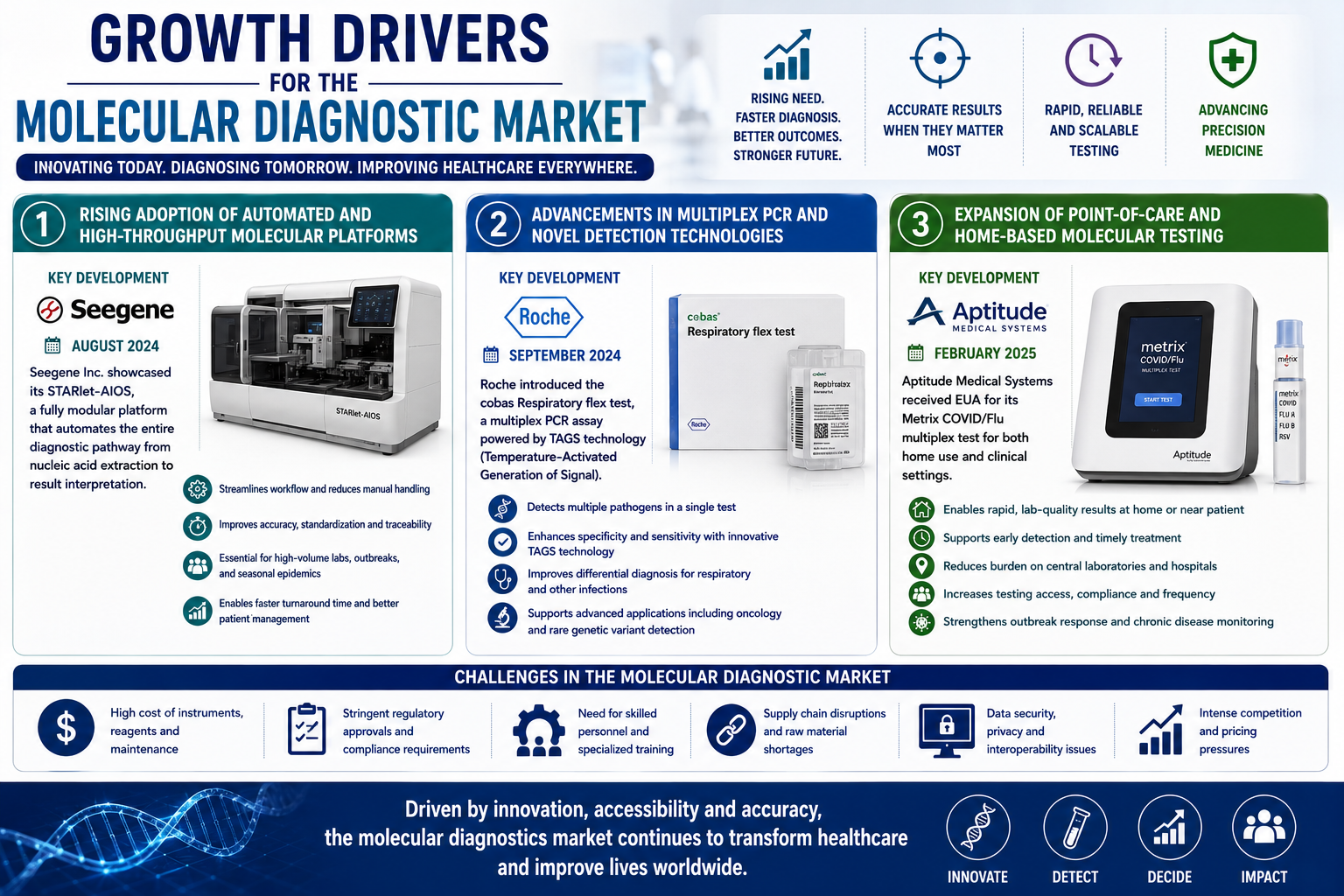
In August 2024, Seegene Inc. introduced its STARlet-AIOS platform, a fully modular system capable of automating the diagnostic process from nucleic acid extraction through result interpretation.
Automation offers several advantages:
Improved efficiency, greater consistency, reduced labor requirements, enhanced traceability, and faster reporting.
These benefits are particularly valuable during periods of increased testing demand, such as seasonal epidemics and public health emergencies.
As laboratories seek greater scalability and productivity, automated molecular systems are becoming increasingly essential.
Multiplex PCR Is Expanding Diagnostic Capabilities
Technological innovation continues to improve the power and versatility of molecular diagnostics.
One of the most important advancements involves multiplex PCR technology.
Traditional PCR tests often focus on detecting a single pathogen or biomarker.
Multiplex PCR allows clinicians to identify multiple targets simultaneously using a single sample.
This capability improves efficiency while reducing costs and accelerating diagnosis.
In September 2024, Roche introduced the cobas Respiratory flex test featuring Temperature-Activated Generation of Signal (TAGS) technology.
The multiplex assay enhances sensitivity and specificity while enabling simultaneous detection of multiple respiratory pathogens.
These innovations are particularly valuable for diseases that present similar symptoms but require different treatment approaches.
As multiplex testing becomes more sophisticated, its clinical utility is expected to expand significantly.
Home-Based Testing Is Changing Patient Access
Another major growth trend involves the expansion of decentralized diagnostics.
Consumers increasingly seek convenient healthcare solutions that reduce dependence on centralized laboratories and hospital visits.
Point-of-care and home-based molecular testing platforms are responding to this demand.
These systems provide laboratory-quality results while offering greater convenience and accessibility.
A significant example occurred in February 2025 when Aptitude Medical Systems received Emergency Use Authorization for its Metrix COVID/Flu multiplex test designed for both home and clinical use.
Home-based molecular diagnostics offer several advantages:
Rapid results, improved patient engagement, earlier detection, and reduced strain on healthcare infrastructure.
As technologies become more affordable and user-friendly, decentralized testing is expected to become an increasingly important segment of the market.
Oncology Represents a High-Growth Opportunity
Cancer diagnosis and treatment increasingly rely on molecular technologies.
Modern oncology depends heavily on identifying genetic mutations, biomarkers, and molecular pathways that influence tumor behavior.
Molecular diagnostics enables:
Early cancer detection, risk assessment, treatment selection, disease monitoring, and recurrence detection.
Companion diagnostics are particularly important because they help determine which patients are most likely to benefit from specific targeted therapies.
The growing emphasis on precision oncology continues driving substantial investment in molecular testing solutions.
As cancer incidence rises globally, oncology is expected to remain one of the most significant application areas within the market.
Sequencing Technologies Are Unlocking New Possibilities
Next-Generation Sequencing has emerged as one of the most transformative technologies in molecular diagnostics.
NGS allows simultaneous analysis of large volumes of genetic information with unprecedented speed and accuracy.
Applications include:
Cancer genomics, rare disease diagnosis, hereditary condition screening, pharmacogenomics, infectious disease surveillance, and population health research.
Declining sequencing costs have expanded accessibility while improving clinical adoption.
As sequencing technologies continue advancing, their role in routine healthcare is expected to grow substantially.
The ability to generate comprehensive genetic insights makes NGS a cornerstone of future diagnostic strategies.
Regional Markets Driving Growth
United States
The United States remains one of the largest and most technologically advanced molecular diagnostics markets globally.
Strong healthcare infrastructure, widespread adoption of PCR and sequencing technologies, extensive laboratory networks, and robust reimbursement systems support continued growth.
The country also serves as a global center for biotechnology innovation and precision medicine research. High acceptance of home-based testing further strengthens market expansion.
Germany
Germany benefits from advanced healthcare systems, strict quality standards, and strong emphasis on early disease detection.
High adoption of PCR, sequencing, and molecular screening technologies supports demand across infectious diseases, oncology, and genetic testing applications.
Collaborative research initiatives and favorable reimbursement policies further contribute to market growth.
China
China represents one of the fastest-growing molecular diagnostics markets worldwide.
Expanding healthcare infrastructure, rising disease burdens, increasing biotechnology investments, and strong government support are accelerating adoption.
Domestic manufacturers are introducing cost-effective molecular platforms that improve accessibility while supporting large-scale screening initiatives.
Saudi Arabia
Saudi Arabia is steadily expanding its molecular diagnostics capabilities through healthcare modernization initiatives and investments in laboratory infrastructure.
Growing awareness of genetic testing, infectious disease management, and personalized medicine supports increasing adoption.
Government healthcare reforms continue creating favorable conditions for market growth.
Recent Developments Highlight Industry Momentum
The molecular diagnostics sector continues experiencing rapid innovation and strategic investment.
In November 2025, Abbott announced a US$21 billion acquisition of Exact Sciences, significantly strengthening its capabilities in cancer diagnostics and precision oncology.
The same month, Roche partnered with Sapphiros to secure access to large-scale lateral flow testing capacity and future molecular point-of-care platforms, supporting expansion of decentralized diagnostics worldwide.
Additional advancements include Hologic's introduction of AI-powered 3DQuorum mammography technology and the World Health Organization's prequalification of the BD Onclarity HPV assay, both of which support broader access to advanced diagnostic solutions.
These developments demonstrate the industry's strong commitment to innovation and improved patient outcomes.
Challenges Continue to Affect Adoption
Despite strong growth prospects, several obstacles remain.
The high cost of molecular testing equipment, reagents, laboratory infrastructure, and skilled personnel limits adoption in many healthcare settings.
Smaller hospitals, community clinics, and low-resource regions often struggle to afford advanced molecular platforms. Operational expenses related to quality control, biosafety requirements, and maintenance further increase barriers to adoption.
Regulatory complexity also remains a challenge.
Molecular diagnostics often require extensive validation, clinical evidence, and regulatory approvals before commercialization.
Differences in regulatory requirements across countries can delay product launches and increase development costs. Rapidly evolving disease landscapes further complicate approval pathways.
Addressing these challenges will be critical to ensuring broader access to molecular testing worldwide.
Final Thoughts
Molecular diagnostics has become one of the most important technologies in modern healthcare.
By enabling earlier detection, greater diagnostic accuracy, personalized treatment selection, and improved disease monitoring, these technologies are transforming medical practice across virtually every specialty.
Advances in PCR, sequencing, automation, multiplex testing, artificial intelligence, and decentralized diagnostics continue expanding clinical possibilities while improving patient outcomes.
With the market projected to grow from US$ 17.36 billion in 2025 to US$ 35.14 billion by 2034, the future of molecular diagnostics appears exceptionally promising.
As healthcare systems increasingly embrace precision medicine and data-driven decision-making, molecular diagnostics will remain at the forefront of innovation—helping clinicians diagnose diseases earlier, treat patients more effectively, and ultimately improve the quality of care around the world.
About the Creator
Enjoyed the story? Support the Creator.
Subscribe for free to receive all their stories in your feed.
Comments
There are no comments for this story
Be the first to respond and start the conversation.