
Corn Starch Market Set to Nearly Double by 2034 as Demand Surges Across Food, Pharmaceutical, and Sustainable Packaging Industries
Growing consumption of processed foods, rising demand for biodegradable materials, and expanding industrial applications are driving strong growth across the global corn starch market.

Introduction: A Simple Ingredient Powering Multiple Global Industries
Corn starch may appear to be a simple kitchen ingredient, but its importance extends far beyond food preparation. From thickening sauces and soups to manufacturing pharmaceuticals, textiles, paper products, adhesives, and biodegradable plastics, corn starch has become an essential raw material across numerous industries worldwide.
As consumers increasingly embrace convenience foods and businesses seek sustainable alternatives to petroleum-based materials, the demand for versatile, plant-based ingredients continues to grow. Corn starch has emerged as one of the most valuable agricultural derivatives due to its affordability, functionality, and wide range of applications.
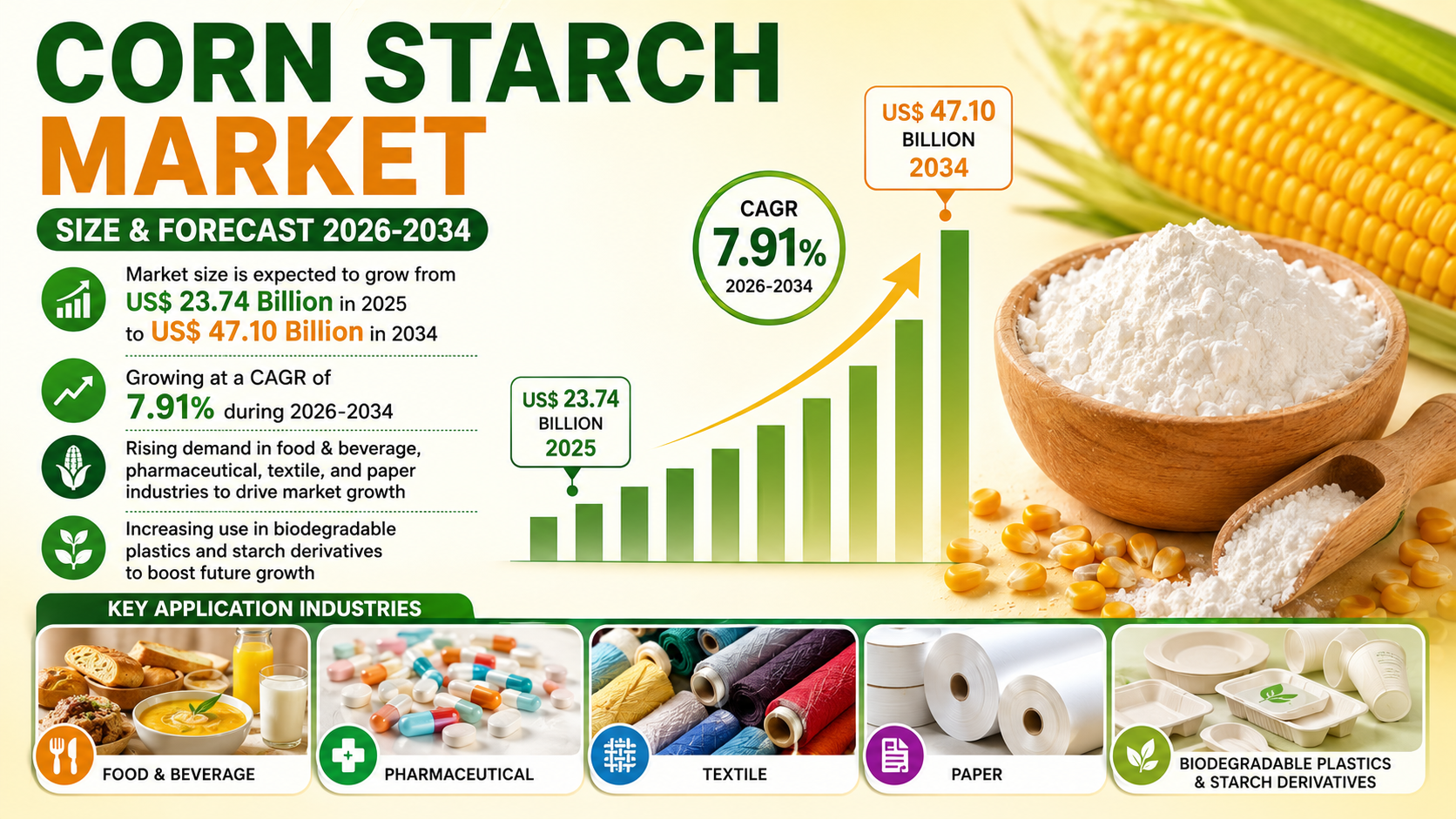
According to Renub Research, the Global Corn Starch Market is projected to grow from US$ 23.74 billion in 2025 to US$ 47.10 billion by 2034, registering a compound annual growth rate (CAGR) of 7.91% during 2026–2034. Market growth is being fueled by increasing demand from the food and beverage sector, pharmaceutical manufacturing, paper and textile industries, and the growing adoption of biodegradable products.
As industries continue prioritizing sustainability, efficiency, and innovation, corn starch is expected to play an increasingly important role in the global economy.
Understanding the Importance of Corn Starch
Corn starch is a fine white powder extracted from the endosperm of corn kernels through a wet milling process. It is widely recognized for its thickening, stabilizing, and binding properties, making it one of the most versatile ingredients used in both food and industrial applications.
In the food industry, corn starch is commonly used to improve texture and consistency in soups, sauces, gravies, puddings, bakery products, confectionery items, and snack foods. Beyond food production, it serves important functions in pharmaceutical manufacturing, cosmetics, paper production, textile processing, adhesives, and packaging materials.
Its plant-based nature, affordability, and adaptability have contributed to widespread global adoption.
As demand for processed foods and sustainable materials increases, the strategic importance of corn starch continues to expand.
Processed Food Consumption Is Driving Market Growth
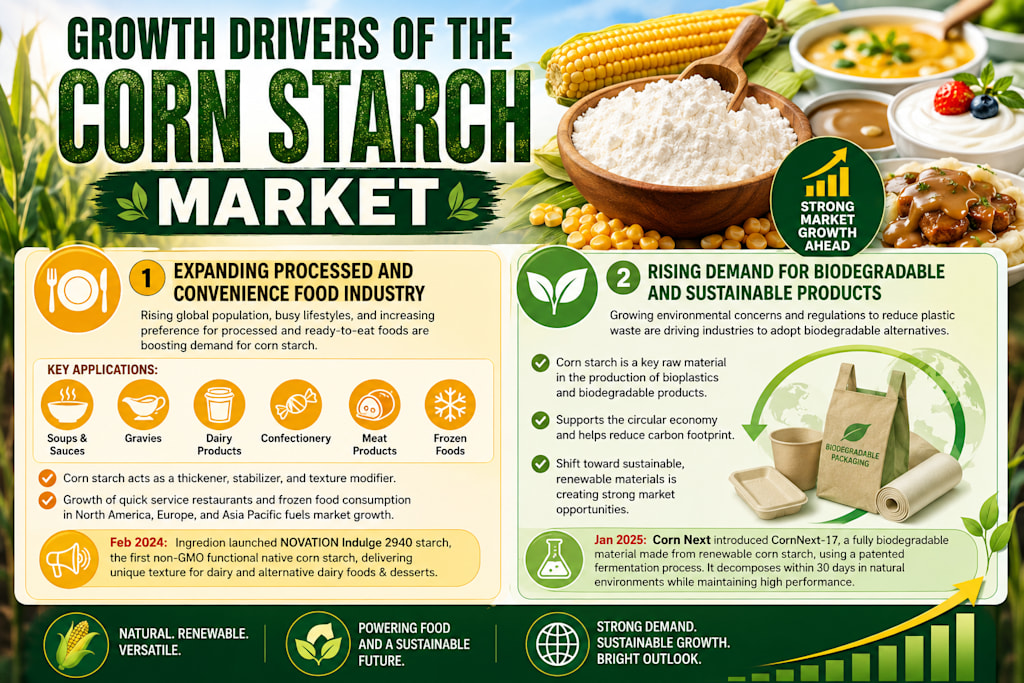
One of the strongest growth drivers for the corn starch market is the rapid expansion of the global processed and convenience food industry.
Consumers today increasingly seek ready-to-eat meals, frozen foods, packaged snacks, and quick-service restaurant options that offer convenience and consistency. Corn starch plays a critical role in these products by improving texture, stability, and shelf life.
Food manufacturers rely on corn starch as a thickening agent, stabilizer, binder, and texture enhancer across numerous applications.
Growing urbanization, rising disposable incomes, and changing lifestyles are encouraging greater consumption of convenience foods worldwide, particularly in North America, Europe, and Asia-Pacific.
The report highlights Ingredion's launch of NOVATION Indulge 2940 starch, a non-GMO functional native corn starch designed to improve texture in dairy and alternative dairy products, demonstrating the industry's continued focus on innovation and clean-label ingredients.
As food processing industries continue expanding globally, demand for corn starch is expected to remain strong.
Sustainability Trends Are Creating New Opportunities
The growing emphasis on sustainability and environmental responsibility has opened significant new opportunities for the corn starch market.
Governments, businesses, and consumers are increasingly seeking alternatives to traditional plastics due to concerns about pollution, waste management, and climate change. Corn starch has emerged as a key ingredient in the development of biodegradable plastics and environmentally friendly packaging materials.
Because corn starch is derived from renewable agricultural resources, it supports broader efforts to reduce dependence on fossil fuel-based materials.
The report highlights developments such as CornNext-17, a biodegradable material produced from renewable corn starch that reportedly decomposes within 30 days while maintaining strong mechanical properties suitable for industrial applications.
As regulations targeting single-use plastics continue strengthening worldwide, demand for corn starch-based sustainable materials is expected to increase substantially.
Pharmaceutical Applications Continue to Expand
The pharmaceutical industry represents another major growth area for corn starch.
Pharmaceutical manufacturers use corn starch as a binder, filler, and disintegrating agent in tablet production due to its safety, effectiveness, and compatibility with various formulations. As global healthcare spending rises and pharmaceutical production expands, demand for pharmaceutical-grade starch continues increasing.
The growth of generic drug manufacturing has further strengthened demand for starch-based excipients.
The report notes DFE Pharma's introduction of three starch-based excipient products designed to support nutraceutical and pharmaceutical manufacturing, reflecting ongoing innovation within this segment.
As healthcare systems continue expanding worldwide, pharmaceutical applications are expected to remain an important contributor to market growth.
Industrial Applications Are Supporting Long-Term Demand
Corn starch plays a critical role in multiple industrial sectors beyond food and pharmaceuticals.
Paper manufacturers use corn starch to improve paper strength, durability, and surface finish. Textile producers utilize it during fabric finishing processes, while adhesive manufacturers depend on starch for bonding applications.
The material's versatility and cost-effectiveness make it attractive across diverse industrial applications.
Rapid industrialization in emerging economies, particularly throughout Asia-Pacific and Latin America, is creating additional demand for starch-based products.
As manufacturers increasingly seek renewable and sustainable raw materials, corn starch is expected to maintain a strong presence across industrial markets.
Native Corn Starch Benefits from Clean-Label Trends
The native corn starch segment is experiencing steady growth due to increasing consumer preference for clean-label and minimally processed ingredients.
Native starch is extracted directly from corn without undergoing chemical modification, making it particularly attractive for food manufacturers focused on natural ingredient positioning.
Consumers increasingly favor products with simple ingredient lists and recognizable components, creating strong demand for native starch in food applications.
Native corn starch is widely used in soups, sauces, dairy products, bakery items, and confectionery products because of its effective thickening and stabilizing properties.
Its clean-label appeal is expected to remain a significant advantage as consumer preferences continue evolving toward transparency and natural ingredients.
Modified Corn Starch Continues to Gain Momentum
Modified corn starch represents one of the fastest-growing segments within the market.
Unlike native starch, modified starch undergoes chemical, physical, or enzymatic treatment to improve functionality and performance under demanding conditions. These enhancements allow modified starch to withstand heat, acidity, freezing, and mechanical stress more effectively.
Food manufacturers use modified starch extensively in frozen meals, ready-to-eat products, sauces, and processed foods where consistency and shelf stability are critical.
Industrial sectors also rely on modified starch for applications including coatings, adhesives, textiles, and biodegradable materials.
As industries increasingly require specialized performance characteristics, demand for modified starch products is expected to continue growing.
Food and Beverage Sector Remains the Largest End User
The food and beverage industry continues to account for the largest share of the global corn starch market.
Corn starch is used extensively as a thickening, binding, stabilizing, and texturizing agent in a wide range of food products. Its neutral flavor and smooth texture make it ideal for enhancing consistency without altering taste.
The growing popularity of gluten-free products has also contributed to increased demand because corn starch often serves as a substitute for wheat-based ingredients in baking applications.
In addition, expanding quick-service restaurant chains and rising consumption of ready-to-eat meals continue supporting strong market growth.
As food innovation accelerates, corn starch is expected to remain an essential ingredient across numerous product categories.
Animal Feed Applications Continue to Expand
Corn starch is also widely used within the animal feed industry.
As a carbohydrate-rich ingredient, it provides a valuable source of energy for livestock, poultry, and aquaculture operations. Feed manufacturers utilize corn starch to improve digestibility and nutritional performance.
Growing global demand for meat, dairy, and poultry products continues driving expansion within the animal feed sector.
Commercial farming operations in developing regions are further increasing starch consumption as agricultural production scales up to meet rising protein demand.
Despite occasional fluctuations in raw corn prices, long-term demand within the feed sector remains positive.
Paper and Packaging Industries Support Sustainable Growth
The paper and board industry remains a major industrial consumer of corn starch.
Manufacturers use starch for surface sizing, fiber bonding, and strengthening paper products. These applications improve durability, printability, and overall product quality.
The rapid growth of e-commerce and online retail has significantly increased demand for packaging materials, creating new opportunities for paper and board manufacturers.
At the same time, growing efforts to replace plastic packaging with renewable alternatives are supporting increased use of starch-based materials.
As sustainable packaging becomes a global priority, corn starch demand within this segment is expected to grow steadily.
Regional Markets Continue to Expand
United States
The United States remains one of the world's largest corn starch markets due to its strong agricultural base and extensive food processing industry.
As one of the leading corn-producing nations globally, the United States benefits from reliable raw material availability that supports large-scale starch production. Food manufacturing, pharmaceuticals, paper production, textiles, and biodegradable packaging applications continue driving market demand.
United Kingdom
The United Kingdom market is supported by growth in food processing, convenience foods, and clean-label product development.
Demand for native corn starch is increasing as manufacturers seek natural ingredients that align with evolving consumer preferences. Sustainable packaging initiatives are also contributing to market growth.
India
India represents one of the fastest-growing corn starch markets globally.
Urbanization, expanding food processing industries, growing pharmaceutical production, and rising industrial activity are driving strong demand across multiple sectors. The report highlights Cargill's new corn milling facility in Madhya Pradesh, developed to support growing demand from India's confectionery, infant formula, and dairy industries.
Saudi Arabia
Saudi Arabia's market is expanding due to increasing food processing activities, economic diversification initiatives, and growing demand for packaged foods.
Government efforts to strengthen domestic manufacturing and promote sustainable materials are creating favorable conditions for long-term growth despite reliance on imported corn supplies.
Challenges Continue to Affect the Market
Despite strong growth prospects, several challenges remain.
One major concern is volatility in raw corn prices. Weather conditions, climate change, crop diseases, biofuel demand, and international trade policies can all affect corn availability and pricing. These fluctuations directly impact production costs for starch manufacturers.
Another challenge comes from competition with alternative starches such as tapioca, potato, rice, and wheat starch. These substitutes often offer similar functionality and may be preferred in certain specialty applications, particularly within gluten-free and clean-label product categories.
To remain competitive, manufacturers must continue investing in innovation and specialty starch development.
Leading Companies Driving Industry Development
The global corn starch market includes several major agricultural and ingredient manufacturers focused on expanding production capacity, improving functionality, and developing sustainable solutions.
Key companies highlighted in the report include Cargill Inc., Ingredion Inc., Archer Daniels Midland Company, Tate & Lyle, Associated British Foods plc, Tereos Group, Südzucker AG, and Global Bio-Chem Technology Group Company Ltd.
These organizations continue investing in clean-label products, specialty starches, and environmentally responsible manufacturing processes to strengthen their market positions.
Final Thoughts
The global corn starch market is entering a period of strong and sustained growth as demand expands across food processing, pharmaceuticals, animal feed, industrial manufacturing, and sustainable packaging applications.
With the market projected to grow from US$ 23.74 billion in 2025 to US$ 47.10 billion by 2034, corn starch is becoming increasingly important as a versatile, renewable, and high-performance ingredient. Rising demand for processed foods, biodegradable materials, and industrial applications continues creating substantial opportunities for market participants worldwide.
Although challenges related to raw material price volatility and alternative starch competition remain, the long-term outlook remains highly positive. As industries continue prioritizing sustainability, functionality, and innovation, corn starch is expected to play an even greater role in shaping the future of food production, healthcare, packaging, and industrial manufacturing.
About the Creator
Enjoyed the story? Support the Creator.
Subscribe for free to receive all their stories in your feed.
Comments
There are no comments for this story
Be the first to respond and start the conversation.