
Convenience Food Market Expands Rapidly as Busy Lifestyles, Frozen Innovation, and Ready-to-Eat Demand Reshape Global Food Consumption
Advanced microwave-ready technologies, expanding frozen food portfolios, and rising demand for fast meal solutions are driving strong growth across the global convenience food industry.

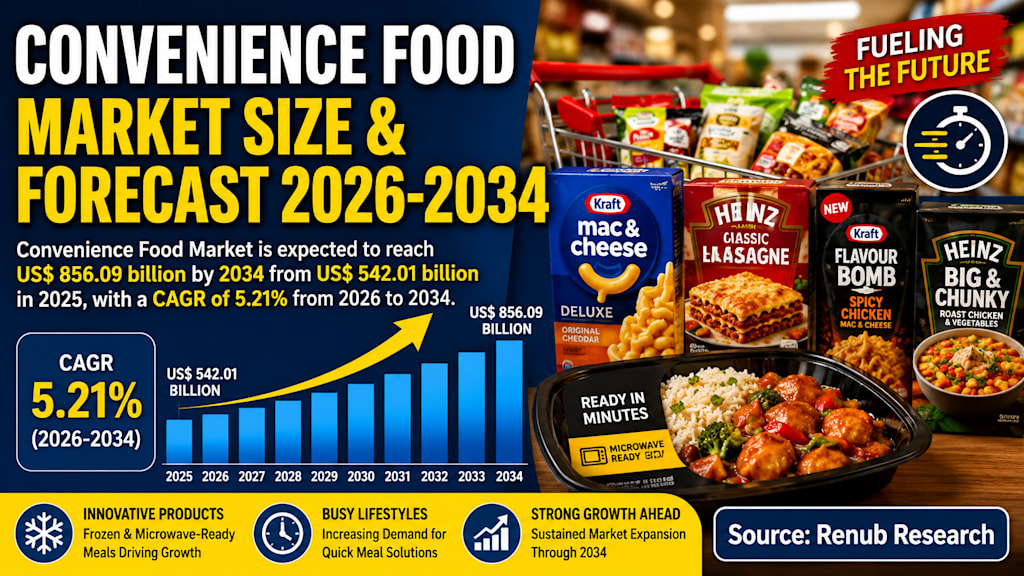
The global convenience food market is experiencing strong and sustained growth as modern consumers increasingly prioritize speed, accessibility, affordability, and time-saving meal solutions. According to Renub Research, the convenience food market is projected to grow from US$ 542.01 billion in 2025 to US$ 856.09 billion by 2034, expanding at a CAGR of 5.21% during the forecast period from 2026 to 2034. Product innovation, evolving lifestyles, busy schedules, and rising demand for ready-to-eat and microwaveable meals are among the major factors accelerating global market expansion.
Market Overview
Convenience foods are ready-to-eat, ready-to-cook, or minimally prepared food products designed to reduce cooking time, preparation effort, and kitchen complexity for consumers. These products include frozen meals, canned foods, packaged snacks, ready meals, instant beverages, microwaveable products, and heat-and-eat solutions.
Convenience foods have become increasingly important in modern lifestyles because consumers seek affordable, accessible, and efficient meal solutions that fit into busy daily schedules. Urbanization, dual-income households, long working hours, and changing eating habits continue driving strong demand globally.
Modern convenience foods increasingly feature healthier ingredients, clean-label formulations, improved packaging technologies, and premium product positioning. Manufacturers are heavily investing in frozen innovation, texture enhancement technologies, and nutritional upgrades to improve overall consumer experience.
As demand for on-the-go meals and time-saving food solutions continues growing, convenience foods remain central to the evolving global food ecosystem.
Innovation in Frozen and Heat-and-Eat Products Driving Growth
One of the strongest growth drivers within the convenience food market is continuous innovation in frozen and microwave-ready product categories. Manufacturers are increasingly introducing advanced technologies that improve taste, texture, quality, and convenience for consumers.
A major example highlighted in the report is Kraft Heinz’s September 2023 launch of Lunchables grilled cheese sandwiches, the company’s first frozen product line. The launch also introduced the company’s new 360Crisp microwave platform, designed to create crispy and crunchy textures directly from microwave heating.
Texture improvement has historically been one of the biggest consumer complaints regarding microwaveable foods. Innovations such as 360Crisp technology significantly improve eating quality and help convenience meals deliver more restaurant-style experiences with minimal preparation time.
Consumers increasingly expect premium-quality convenience foods that combine flavor, speed, and improved nutritional value. This shift is encouraging major manufacturers to invest heavily in research and development across frozen meals, packaging systems, and preservation technologies.
Expanding Product Portfolios Strengthening Market Competition
Aggressive product portfolio expansion by major food companies is another key factor accelerating convenience food market growth. Manufacturers are continuously introducing new products across frozen, grocery, snack, and ready-meal categories to address evolving consumer preferences and dietary trends.
In July 2023, Conagra Brands launched more than 50 new products across its frozen, grocery, and snacking divisions. These launches reflected the increasing pace of innovation within the convenience food industry as brands compete for shelf visibility and consumer attention.
Companies are expanding offerings to include premium frozen meals, healthier snack products, plant-based convenience foods, high-protein meals, and clean-label products designed for wellness-conscious consumers. Retailers also benefit from refreshed product assortments that increase category activity and consumer engagement.
The broadening of product portfolios helps brands target diverse consumer groups while strengthening category diversification and long-term market growth.
Strategic Partnerships and Market Positioning Accelerating Expansion
Strategic partnerships and joint ventures are becoming increasingly important in the convenience food industry as companies seek to improve operational efficiency, distribution reach, and innovation capabilities.
In April 2023, Nestlé partnered with private equity firm PAI Partners to establish a joint venture focused on Nestlé’s European frozen pizza business. This collaboration created a more specialized business entity capable of competing effectively within the fast-growing frozen food segment.
Strategic partnerships allow companies to combine production expertise, streamline supply chains, strengthen distribution networks, and accelerate innovation. These collaborations also help brands respond more efficiently to regional consumer preferences and regulatory requirements.
As competition intensifies globally, partnerships and acquisitions are expected to remain critical strategies for achieving scale, efficiency, and long-term market positioning.
Health Concerns and Nutritional Perceptions Remain Challenges
Despite strong growth momentum, the convenience food market continues facing criticism related to health and nutrition concerns. Traditional convenience products are often associated with high sodium levels, preservatives, saturated fats, artificial additives, and processed ingredients.
Consumers increasingly prioritize wellness, clean-label foods, and natural ingredients, creating pressure on manufacturers to reformulate products and improve nutritional transparency. Regulatory scrutiny and mandatory labeling requirements are also increasing operational complexity for food manufacturers.
Although healthier convenience food options are emerging rapidly, some consumers remain skeptical of highly processed foods overall. Balancing convenience, affordability, taste, and health remains one of the industry’s biggest long-term challenges.
Supply Chain Constraints and Cost Pressures Affecting the Industry
The convenience food industry also faces ongoing supply chain challenges and rising production costs. Ingredient price volatility, transportation disruptions, labor shortages, and fluctuating packaging costs continue impacting manufacturing efficiency and profitability.
Frozen and refrigerated convenience food categories are particularly vulnerable because they depend heavily on cold-chain logistics and energy-intensive storage infrastructure. Rising fuel, electricity, and labor costs are placing additional financial pressure on producers and retailers.
About the Creator
Enjoyed the story? Support the Creator.
Subscribe for free to receive all their stories in your feed.
Comments
There are no comments for this story
Be the first to respond and start the conversation.