
Continuous Glucose Monitoring Is Transforming Diabetes Care Through Real-Time Health Insights and Connected Technology
Rising Diabetes Rates, Smart Insulin Integration, and Expanding Access to Advanced Monitoring Devices Are Driving the Global CGM Market

The global healthcare industry is witnessing a major shift toward personalized, data-driven disease management, and Continuous Glucose Monitoring (CGM) technology is at the center of this transformation. For millions of people living with diabetes, CGM systems are replacing traditional finger-stick testing with real-time glucose tracking that provides deeper insights, greater convenience, and improved health outcomes.
As diabetes prevalence continues to rise worldwide, healthcare providers and patients increasingly recognize the importance of continuous monitoring in achieving better glycemic control. Modern CGM devices not only provide accurate glucose readings throughout the day but also help users identify trends, anticipate fluctuations, and make informed decisions about diet, exercise, and medication.
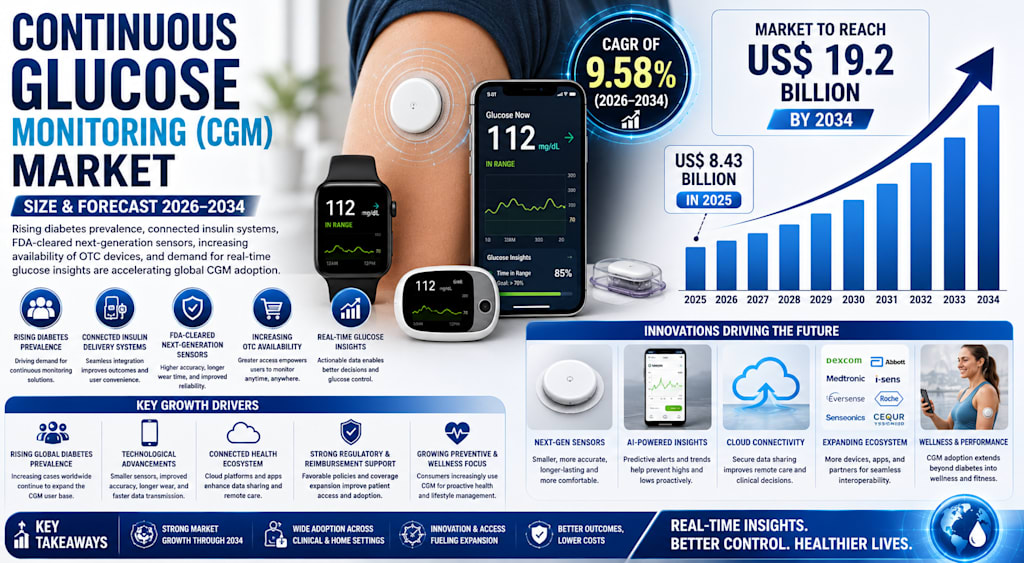
According to Renub Research, the Continuous Glucose Monitoring (CGM) Market is expected to grow from US$ 8.43 billion in 2025 to US$ 19.2 billion by 2034, expanding at a CAGR of 9.58% between 2026 and 2034. Rising diabetes prevalence, increasing adoption of connected insulin-delivery systems, FDA-cleared next-generation sensors, expanding OTC availability, and growing consumer demand for real-time health insights are key drivers fueling market growth.
As healthcare systems embrace digital technologies and patients seek more proactive approaches to disease management, CGM devices are becoming an essential component of modern diabetes care.

Understanding Continuous Glucose Monitoring Technology
Continuous Glucose Monitoring systems are wearable devices designed to track glucose levels around the clock.
Unlike traditional blood glucose meters that provide isolated readings through finger-stick testing, CGM devices continuously measure glucose levels in interstitial fluid using a small sensor placed beneath the skin.
The sensor transmits glucose data to smartphones, dedicated receivers, insulin pumps, or connected healthcare platforms. Users receive real-time updates on glucose trends, helping them identify patterns and respond quickly to fluctuations.
Modern systems can alert users when glucose levels become dangerously high or low, reducing the risk of severe complications while improving long-term diabetes management.
This constant flow of information empowers patients to make more informed decisions regarding nutrition, medication, physical activity, and lifestyle habits.
As sensor accuracy and wearability continue improving, CGM technology is rapidly becoming the preferred monitoring solution for both patients and healthcare providers.
Rising Diabetes Prevalence Is Driving Market Expansion
One of the strongest growth drivers behind the CGM market is the increasing global burden of diabetes.
The prevalence of both Type 1 and Type 2 diabetes continues to rise due to aging populations, sedentary lifestyles, obesity, poor dietary habits, and urbanization.
Healthcare systems worldwide face growing pressure to improve diabetes outcomes while reducing long-term complications and healthcare costs.
Continuous monitoring enables earlier intervention and more effective disease management by providing a detailed understanding of glucose behavior throughout the day.
Healthcare providers increasingly recommend CGM systems because they help patients achieve better glycemic control while reducing episodes of hypoglycemia and hyperglycemia.
As diabetes rates continue climbing globally, demand for advanced monitoring solutions is expected to grow steadily.
Smart Insulin Integration Is Revolutionizing Diabetes Care
One of the most significant developments in diabetes management is the integration of CGM devices with insulin-delivery systems.
Connected ecosystems allow glucose readings to communicate directly with insulin pumps, enabling automated or semi-automated insulin adjustments.
This approach reduces the burden of manual calculations and helps improve treatment precision.
In July 2024, Medtronic received FDA approval for its Simplera CGM, which was specifically designed to integrate seamlessly with the company's Smart Multiple Daily Injection System and InPen platform. This advancement reflects the growing trend toward connected diabetes-management ecosystems.
As interoperability improves, more patients are expected to adopt integrated systems that combine monitoring and insulin delivery into a unified treatment experience.
The movement toward automated diabetes management remains one of the most important drivers of future CGM adoption.
OTC Devices Are Expanding Market Accessibility
The expansion of over-the-counter CGM products is opening entirely new opportunities for market growth.
Traditionally, CGM devices required physician prescriptions and were primarily used by individuals with insulin-dependent diabetes.
Today, manufacturers are developing products that target broader consumer populations interested in metabolic health, wellness tracking, and preventive healthcare.
A major milestone occurred in March 2024 when DexCom received FDA approval for Stelo, the first over-the-counter CGM designed for adults who do not use insulin. The device features a 15-day sensor life and can be purchased without a prescription.
This development significantly expands the addressable market by making glucose monitoring more accessible to individuals seeking personalized health insights.
As awareness of metabolic health continues growing, OTC CGMs are expected to become an increasingly important segment of the market.
Hybrid Closed-Loop Systems Are Improving Outcomes
Hybrid closed-loop systems represent another major advancement in diabetes care.
These systems combine CGM technology with insulin pumps and intelligent algorithms that automatically adjust insulin delivery based on glucose readings.
The result is improved glucose control with reduced risk of dangerous fluctuations.
In January 2024, Abbott announced compatibility between its FreeStyle Libre 2 Plus sensor and Tandem Diabetes Care's t X2 insulin pump through the Control-IQ hybrid closed-loop algorithm. This integration allows automated insulin adjustments based on continuous glucose measurements.
Such innovations improve patient convenience while helping achieve better clinical outcomes.
As healthcare providers increasingly recommend automated management systems, hybrid closed-loop technology is expected to drive substantial CGM adoption worldwide.
Wearable Health Technology Is Creating New Opportunities
The growing popularity of wearable health devices is strengthening demand for CGM systems.
Consumers are increasingly interested in monitoring personal health metrics and utilizing data to optimize wellness, fitness, and lifestyle decisions.
CGM devices provide valuable insights into how food, exercise, sleep, and stress affect glucose levels.
Even individuals without diabetes are becoming interested in glucose monitoring as part of broader health optimization strategies.
This trend reflects a larger movement toward preventive healthcare and personalized wellness.
As wearable technology becomes more integrated into everyday life, CGMs are likely to play an increasingly important role beyond traditional diabetes management.
Sensor Technology Continues to Advance
Continuous innovation in sensor technology remains a critical factor supporting market growth.
Manufacturers are focusing on improving sensor accuracy, extending wear duration, reducing calibration requirements, and enhancing user comfort.
In April 2025, DexCom received FDA clearance for its Dexcom G7 15-Day system, extending sensor wear time and improving convenience for users.
Similarly, Senseonics received FDA approval in September 2024 for the Eversense 365, the first implantable CGM capable of providing glucose monitoring for up to one year.
These advancements help improve user satisfaction while reducing maintenance burdens associated with device replacement and calibration.
As technology evolves, future sensors are expected to become even smaller, more accurate, and more convenient.
Homecare Settings Are Driving Significant Growth
Homecare settings have become one of the fastest-growing end-user segments within the CGM market.
Patients increasingly prefer managing diabetes from home using connected monitoring technologies that provide real-time insights without requiring frequent clinic visits.
Remote monitoring capabilities allow healthcare providers to review patient data, identify trends, and make treatment recommendations through telehealth platforms.
This approach improves convenience while reducing healthcare costs and increasing accessibility.
The expansion of home-based diabetes management aligns closely with broader healthcare trends emphasizing patient empowerment and digital care delivery.
The United States Leads Global Adoption
The United States remains the largest and most advanced CGM market globally.
High diabetes prevalence, favorable reimbursement policies, strong regulatory support, and widespread adoption of connected insulin-delivery systems contribute to market leadership.
Major companies such as Abbott, DexCom, and Medtronic continue driving innovation through new product launches and integrated diabetes-management solutions.
The increasing popularity of telehealth, remote patient monitoring, and employer-sponsored wellness programs further strengthens market growth.
Germany Benefits From Strong Healthcare Infrastructure
Germany represents one of Europe's most important CGM markets.
Comprehensive healthcare coverage, advanced diabetes-management programs, and strong physician support contribute to widespread adoption.
Patients with Type 1 diabetes often receive reimbursement for CGM systems, while access is gradually expanding among individuals with Type 2 diabetes.
Germany's emphasis on data-driven healthcare and digital health solutions supports continued market expansion.
China Emerges as a High-Growth Opportunity
China is experiencing rapid CGM market growth due to rising diabetes prevalence, increasing health awareness, and expanding healthcare infrastructure.
Urbanization, lifestyle changes, and growing adoption of digital health technologies are encouraging greater use of glucose-monitoring devices.
Domestic manufacturers are also helping improve affordability and accessibility, supporting broader adoption across diverse patient populations.
Saudi Arabia Continues Investing in Diabetes Care
Saudi Arabia faces one of the world's highest diabetes burdens, making advanced monitoring technologies increasingly important.
Government investments in healthcare modernization under Vision 2030, coupled with rising awareness of diabetes complications, are driving demand for CGM systems.
Private healthcare providers and pharmacies continue expanding access to advanced glucose-monitoring solutions across the country.
Challenges Facing the Industry
Despite strong growth prospects, several challenges remain.
One of the most significant barriers involves cost and reimbursement limitations.
CGM devices require recurring purchases of sensors, transmitters, and accessories, creating financial challenges for many users. Coverage policies vary considerably across regions, limiting accessibility for some patient populations.
Data overload also presents challenges.
CGM systems generate large volumes of information that can overwhelm patients and complicate clinical interpretation. Alarm fatigue, connectivity issues, and difficulties integrating data into healthcare systems may reduce long-term adherence among some users.
Addressing affordability and usability concerns will be essential for supporting broader market adoption.
Recent Industry Developments Highlight Strong Momentum
The pace of innovation within the CGM industry remains impressive.
In June 2025, Tandem Diabetes Care and Abbott announced joint development efforts for an integrated glucose-ketone sensor designed to help reduce the risk of diabetic ketoacidosis through earlier detection and intervention.
In May 2025, Glucotrack received approval in Australia to begin clinical trials for its implantable CGM technology, reflecting ongoing investment in next-generation monitoring solutions.
These developments demonstrate the industry's commitment to improving patient outcomes through continuous innovation.
Final Thoughts
Continuous Glucose Monitoring technology is fundamentally changing how diabetes is managed by providing real-time, actionable insights that improve decision-making and health outcomes.
According to Renub Research, the CGM Market is expected to grow from US$ 8.43 billion in 2025 to US$ 19.2 billion by 2034, driven by rising diabetes prevalence, smart insulin integration, expanding OTC availability, and ongoing technological advancements.
As connected healthcare ecosystems continue evolving, CGM devices are becoming central components of personalized diabetes management and preventive health strategies.
About the Creator
Enjoyed the story? Support the Creator.
Subscribe for free to receive all their stories in your feed.
Comments
There are no comments for this story
Be the first to respond and start the conversation.