
Continuous Glucose Monitoring (CGM) Market to Reach US$ 19.2 Billion by 2034 as Real-Time Diabetes Monitoring Gains Global Momentum
Rising Diabetes Prevalence, OTC CGM Devices, and Connected Insulin Systems Accelerate Global Market Expansion

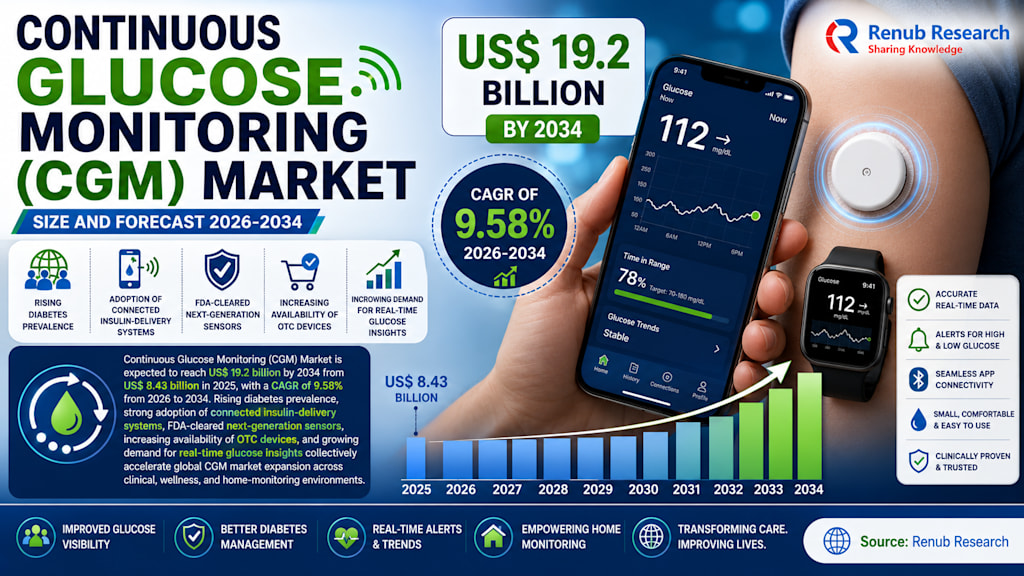
The global Continuous Glucose Monitoring (CGM) industry is experiencing rapid growth as rising diabetes prevalence, connected healthcare ecosystems, and wearable health technologies reshape modern disease management. According to Renub Research, the Continuous Glucose Monitoring (CGM) Market is projected to grow from US$ 8.43 billion in 2025 to US$ 19.2 billion by 2034, registering a CAGR of 9.58% from 2026 to 2034.
The increasing adoption of real-time glucose monitoring systems, FDA-cleared next-generation sensors, automated insulin-delivery platforms, and over-the-counter CGM devices is transforming diabetes care worldwide. Beyond traditional diabetes management, CGMs are also gaining popularity among wellness-focused consumers seeking metabolic health insights and preventative health monitoring.
Continuous Glucose Monitoring Is Revolutionizing Diabetes Management
Continuous Glucose Monitoring systems are wearable medical devices that track glucose levels in real time through a small sensor inserted under the skin. Unlike traditional finger-stick blood glucose tests that provide isolated readings, CGM systems continuously measure glucose trends throughout the day and night.
These systems transmit glucose readings to smartphones, insulin pumps, or dedicated receivers, allowing users to monitor blood sugar fluctuations more effectively.
CGM devices also provide alerts when glucose levels rise too high or fall dangerously low, helping users prevent severe complications and improve long-term glycemic control.
Initially adopted primarily by individuals with Type 1 diabetes, CGM technology is now increasingly used by Type 2 diabetics, wellness-focused consumers, athletes, and individuals interested in personalized metabolic health tracking.
The shift toward data-driven healthcare and connected medical ecosystems continues accelerating global demand for CGM technologies.
Rising Diabetes Prevalence Is Fueling Market Expansion
One of the strongest growth drivers behind the CGM market is the rapidly increasing global burden of diabetes.
Sedentary lifestyles, poor dietary habits, aging populations, obesity, and rising metabolic disorders are contributing to increasing cases of both Type 1 and Type 2 diabetes worldwide.
Healthcare providers increasingly recommend continuous monitoring solutions because they offer better glucose visibility and improved disease management compared to traditional testing methods.
Patients using CGM systems often experience better glycemic control, fewer hypoglycemic events, and improved quality of life.
The growing need for proactive diabetes management is pushing healthcare systems, insurers, and governments to expand support for advanced glucose-monitoring technologies.
Integration With Smart Insulin Delivery Systems Is Accelerating Adoption
The integration of CGM devices with connected insulin-delivery platforms has become one of the most important drivers of market growth.
Interoperable systems that combine glucose monitoring with automated insulin dosing are helping reduce manual intervention while improving treatment precision.
In July 2024, Medtronic received FDA approval for its Simplera CGM system, designed to integrate seamlessly with the company’s Smart Multiple Daily Injection System and InPen platform.
These connected ecosystems are supporting the development of closed-loop and hybrid insulin-delivery systems that automatically adjust insulin dosing based on real-time glucose readings.
The growing adoption of automated insulin-delivery technology is increasing demand for highly accurate, wearable, and interoperable CGM devices.
Patients and clinicians alike are increasingly embracing integrated diabetes-management ecosystems because they simplify care and improve long-term outcomes.
OTC and Wellness-Focused CGM Devices Are Expanding the Market
The CGM industry is rapidly evolving beyond traditional diabetes care and entering the broader wellness and preventative healthcare market.
Over-the-counter CGM devices are significantly expanding accessibility, particularly among individuals with Type 2 diabetes who are not insulin dependent.
In March 2024, DexCom received FDA approval for Stelo, an over-the-counter CGM system featuring a 15-day sensor that can be purchased without a prescription.
This milestone opened the market to millions of consumers interested in monitoring glucose responses for weight management, metabolic health, nutrition optimization, and preventative wellness.
The growing popularity of personalized health data and wearable health technology is creating substantial new opportunities for CGM manufacturers.
As consumers become more proactive about health management, OTC CGMs are expected to become increasingly mainstream.
Hybrid Closed-Loop Systems Are Enhancing Clinical Outcomes
Hybrid closed-loop diabetes systems are becoming increasingly important in modern diabetes management.
These systems combine CGM devices with insulin pumps and intelligent algorithms that automatically adjust insulin delivery based on continuous glucose readings.
In January 2024, Abbott announced that its FreeStyle Libre 2 Plus sensor became compatible with Tandem Diabetes Care’s t:slim X2 insulin pump through the Control-IQ hybrid closed-loop algorithm.
This integration helps users achieve better time-in-range performance while reducing episodes of hypoglycemia and hyperglycemia.
Hybrid closed-loop technologies are improving patient outcomes while reducing the burden of constant manual monitoring and insulin adjustments.
As interoperability improves across platforms, CGM systems are increasingly becoming central components of advanced digital diabetes ecosystems.
Wearable Health Technology Is Driving Broader Consumer Interest
The increasing popularity of wearable health devices is helping normalize continuous health monitoring among consumers.
People are becoming more interested in tracking biometric data related to sleep, heart rate, activity levels, stress management, and metabolic health.
CGM technology aligns perfectly with this broader shift toward preventative healthcare and personalized wellness.
Technology companies, healthcare providers, insurers, and employers are increasingly integrating wearable health solutions into broader wellness programs.
Government initiatives supporting preventative healthcare are also strengthening long-term market growth.
In June 2025, U.S. Health Secretary Robert F. Kennedy Jr. announced the “Making America Healthy Again” initiative encouraging broader adoption of wearable monitoring technologies including CGMs.
Challenges Continue to Impact the CGM Industry
Despite strong growth momentum, the CGM market still faces several important challenges.
High Costs and Uneven Reimbursement
The cost of CGM systems remains a major barrier for many users, particularly in low-income populations and developing countries.
Recurring expenses related to sensors, transmitters, receivers, and accessories can create significant financial burden. Insurance reimbursement policies also vary widely across countries and healthcare systems.
For many Type 2 diabetics and wellness users, reimbursement support remains limited or unavailable.
Manufacturers continue facing pressure to reduce costs while maintaining high accuracy, reliability, and regulatory compliance.
Data Overload and Integration Challenges
CGM systems generate large volumes of real-time health data that can sometimes overwhelm users and healthcare providers.
Some users struggle with alarm fatigue, sensor calibration issues, and interpreting continuous glucose trends. Healthcare systems also face challenges integrating CGM data into electronic health records and digital care platforms.
Improving interoperability, patient education, and clinical data management remains essential for long-term market sustainability.
United States Continuous Glucose Monitoring Market
The United States remains the largest CGM market globally due to high diabetes prevalence, strong insurance reimbursement, and widespread adoption of automated insulin-delivery systems.
Major companies including DexCom, Abbott, and Medtronic dominate the market with advanced interoperable systems and connected digital-health platforms.
Growing demand for telehealth, remote patient monitoring, and wellness-focused wearables continues supporting rapid market expansion.
Germany Continuous Glucose Monitoring Market
Germany’s CGM market benefits from advanced healthcare infrastructure, strong reimbursement systems, and early adoption of digital diabetes-management technologies.
German physicians strongly emphasize data-driven care, increasing demand for CGM trend analysis and remote monitoring tools.
The country’s aging population and rising diabetes prevalence are also contributing to steady market growth.
China Continuous Glucose Monitoring Market
China’s CGM market is expanding rapidly due to increasing Type 2 diabetes prevalence, urbanization, and growing consumer interest in smart healthcare technologies.
Domestic manufacturers are helping improve affordability while government healthcare initiatives are increasing diabetes awareness and early monitoring adoption.
The country’s strong mobile-health ecosystem further accelerates CGM integration among tech-savvy consumers.
Saudi Arabia Continuous Glucose Monitoring Market
Saudi Arabia’s CGM market is growing steadily due to high diabetes prevalence and increasing government investment in healthcare modernization under Vision 2030.
Physicians increasingly recommend CGM devices for improved glycemic control, while rising awareness of diabetes complications is encouraging adoption of advanced monitoring technologies.
Expanding insurance coverage and digital-health integration are further supporting market growth.
Recent Developments from Major Companies
Abbott Laboratories expanded integration capabilities for its FreeStyle Libre systems with hybrid closed-loop insulin-delivery platforms.
Roche continued investing in advanced digital diabetes-management technologies and connected glucose-monitoring ecosystems.
Tandem Diabetes Care partnered with Abbott in June 2025 to develop an integrated glucose-ketone monitoring sensor aimed at reducing diabetic ketoacidosis risk.
DexCom received FDA clearance in April 2025 for its Dexcom G7 15-Day CGM system designed for longer wear and improved convenience.
Senseonics obtained FDA approval in September 2024 for Eversense 365, the first implantable CGM with up to one year of wear.
Ypsomed Holding AG expanded its connected insulin-delivery ecosystem through advanced interoperability initiatives.
Medtronic received FDA approval in July 2024 for its Simplera CGM integrated with smart insulin-delivery systems.
i-Sens Inc. continued developing affordable CGM technologies targeting broader adoption across Asia-Pacific markets.
Glucotrack secured Australian HREC approval in May 2025 to begin clinical trials for its implantable CGM system.
DexCom launched the OTC-focused Stelo CGM system in March 2024, significantly expanding access to glucose monitoring without prescription requirements.
Product Segmentation Highlights
The CGM market includes components such as sensors, transmitters, and receivers.
End-user segments include hospitals, homecare settings, and other healthcare environments.
Home-based monitoring continues witnessing especially strong growth due to rising adoption of telehealth, remote patient management, and connected wearable devices.
The market is also increasingly expanding into wellness-focused applications beyond traditional diabetes management.
Final Thoughts
The Continuous Glucose Monitoring industry is rapidly transforming modern diabetes care through real-time data, connected healthcare ecosystems, and wearable technology innovation. Rising diabetes prevalence, growing interest in preventative health monitoring, and advances in automated insulin delivery are driving strong global demand for CGM solutions.
The emergence of OTC devices, implantable sensors, hybrid closed-loop systems, and wellness-focused glucose monitoring is significantly expanding the market beyond traditional insulin-dependent patients.
As healthcare systems increasingly prioritize personalized medicine, remote monitoring, and digital health integration, CGM devices are expected to become central tools in long-term metabolic health management.
With continuous technological innovation, broader accessibility, and expanding consumer awareness, the global CGM market is well-positioned for substantial long-term growth over the next decade.
About the Creator
Enjoyed the story? Support the Creator.
Subscribe for free to receive all their stories in your feed.
Comments
There are no comments for this story
Be the first to respond and start the conversation.