
Contact Lenses Market to Reach US$ 15.95 Billion by 2034 as Smart Lens Innovation and Myopia Control Drive Industry Growth
Rising Myopia Rates, FDA-Approved Specialty Lenses, and AR-Integrated Wearables Accelerate Global Contact Lens Adoption

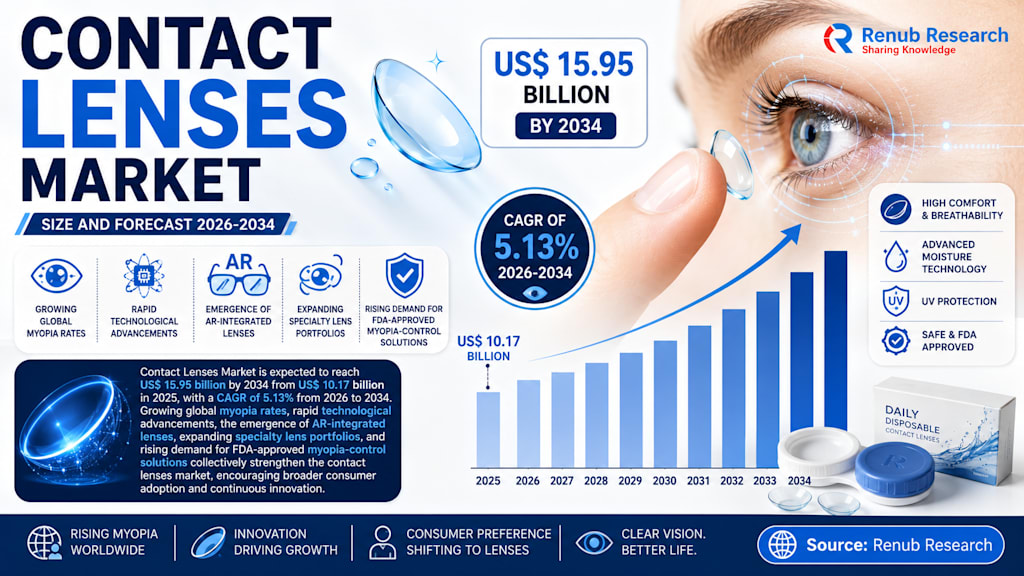
The global contact lenses industry is entering a new era of technological transformation as rising vision disorders, smart wearable innovation, and advanced specialty lenses reshape the future of eye care. According to Renub Research, the Contact Lenses Market is projected to grow from US$ 10.17 billion in 2025 to US$ 15.95 billion by 2034, registering a CAGR of 5.13% from 2026 to 2034.
Growing rates of myopia, increasing digital screen exposure, expanding use of daily disposable lenses, and breakthroughs in augmented reality-enabled smart lenses are strengthening global demand. Technological innovation, FDA approvals, and rising consumer preference for comfortable vision correction solutions are positioning contact lenses as one of the most dynamic segments within the vision-care industry.
Contact Lenses Continue to Evolve Beyond Traditional Vision Correction
Contact lenses are thin optical devices placed directly on the eye to correct refractive conditions such as myopia, hyperopia, astigmatism, and presbyopia. Manufactured primarily from hydrogel and silicone-hydrogel materials, modern lenses provide improved oxygen permeability and enhanced wearer comfort.
The market has evolved significantly from basic corrective lenses into a sophisticated technology-driven industry. Today’s contact lenses include daily disposables, toric lenses, multifocal designs, cosmetic lenses, and specialty products designed for complex corneal conditions.
Recent advancements are extending contact lenses far beyond simple vision correction. Smart lenses integrated with sensors, augmented reality features, and health-monitoring capabilities are opening entirely new applications within healthcare and wearable technology.
Consumers increasingly prefer contact lenses because they offer a natural field of vision, convenience, and improved comfort compared to traditional eyeglasses.
Rising Global Myopia Rates Are Fueling Market Expansion
One of the strongest drivers behind contact lens demand is the rapidly increasing incidence of myopia worldwide, especially among children and younger adults.
Excessive digital device usage, prolonged screen exposure, reduced outdoor activity, and changing lifestyle habits are contributing to a global rise in vision disorders. Eye-care professionals are increasingly recommending contact lenses as effective long-term corrective solutions.
The growing focus on childhood myopia management has also accelerated demand for specialty contact lenses specifically designed to slow myopia progression.
In January 2024, CooperVision introduced MiSight 1 day, the first FDA-approved soft contact lens specifically developed for myopia control in children.
This milestone significantly strengthened market confidence in clinically validated specialty lenses and reinforced the industry’s shift toward advanced vision-care solutions.
Technological Innovation Is Transforming the Industry
Technology is reshaping the contact lens market through major improvements in material science, optical engineering, and wearable electronics.
Modern silicone hydrogel lenses now provide higher oxygen transmission and superior moisture retention, improving comfort for long-duration wear. Manufacturers are also developing highly customized lenses designed for astigmatism, presbyopia, and irregular corneal conditions.
Advanced optical engineering is enabling greater precision and personalization, helping eye-care professionals deliver improved visual outcomes for patients.
At the same time, companies are exploring futuristic applications that integrate digital technology directly into contact lenses.
AR-Enabled Smart Lenses Open New Growth Opportunities
The rise of wearable technology is creating a new frontier for the contact lens industry. Augmented reality (AR)-enabled smart lenses are attracting increasing investment from both technology firms and vision-care companies.
In October 2023, XPANCEO secured US$ 40 million in seed funding from Opportunity Ventures (Asia) to accelerate development of multifunctional AR-integrated contact lenses.
These next-generation lenses aim to combine visual displays, sensors, navigation systems, and digital interfaces into compact wearable devices.
Potential applications extend far beyond vision correction and include healthcare monitoring, navigation, immersive entertainment, industrial training, and real-time digital communication.
The growing convergence between wearable electronics and vision-care technology is expected to transform contact lenses into multifunctional digital platforms over the coming decade.
Strategic Acquisitions Are Expanding Specialty Lens Capabilities
Corporate acquisitions are becoming increasingly important as companies strengthen specialty lens portfolios and technical expertise.
In January 2023, CooperVision completed its acquisition of SynergEyes, a company known for hybrid and scleral lens technologies including the Onefit lens series.
This acquisition expanded CooperVision’s ability to serve patients with complex corneal conditions such as keratoconus, severe dry eye, and post-surgical irregularities.
Specialty lenses are gaining popularity because they address increasingly complex eye-care needs while offering improved visual performance and patient comfort.
Acquisitions also help manufacturers accelerate product innovation, strengthen distribution networks, and enhance practitioner training programs.
Convenience and Comfort Are Driving Consumer Preferences
Consumer preference is steadily shifting toward daily disposable lenses due to convenience, hygiene benefits, and reduced infection risk.
Daily disposables eliminate the need for cleaning solutions and storage cases while minimizing exposure to bacteria and contaminants. These advantages make them especially attractive to younger consumers and busy professionals.
Comfort-enhancing technologies such as moisture-lock materials, thinner lens profiles, and breathable silicone hydrogel structures are also supporting market growth.
Subscription-based delivery services and e-commerce platforms are further improving accessibility and convenience for consumers purchasing contact lenses online.
Challenges Continue to Impact Market Growth
Despite strong industry momentum, the contact lenses market still faces several operational and healthcare-related challenges.
Compliance Issues and Infection Risks
Improper lens handling and poor hygiene practices remain major concerns in the contact lens industry. Many users fail to follow cleaning instructions, overwear reusable lenses, or continue using outdated lens solutions.
These behaviors can increase the risk of infections such as microbial keratitis, corneal irritation, and long-term eye complications.
Although daily disposable lenses reduce these risks, their higher cost can discourage long-term use among budget-conscious consumers.
High Costs and Limited Access in Developing Regions
Premium lenses, specialty designs, and regular replacement schedules can create affordability challenges in developing countries. Limited access to trained optometrists and advanced diagnostic equipment further restricts adoption, especially for complex specialty lenses.
In many emerging markets, eyeglasses remain the dominant vision-correction solution due to lower costs and wider availability.
Improving supply chains, expanding practitioner training, and reducing product costs remain essential for broader global market penetration.
United States Contact Lenses Market
The United States remains one of the world’s most technologically advanced contact lens markets due to strong demand for daily disposables, myopia-control products, and specialty lenses.
Major manufacturers such as CooperVision and Johnson & Johnson Vision continue driving innovation in premium lens technologies. High digital-device usage and advanced optometry infrastructure further support market growth.
The expansion of subscription-based lens delivery services and e-commerce platforms is also improving consumer convenience.
Germany Contact Lenses Market
Germany’s contact lens market benefits from a strong healthcare system, high optometric standards, and growing demand for premium-quality vision products. Consumers increasingly prefer silicone hydrogel and daily disposable lenses for comfort and safety.
Germany’s aging population is also contributing to demand for multifocal and specialty lenses designed for presbyopia and complex corneal conditions.
China Contact Lenses Market
China represents one of the fastest-growing contact lens markets globally due to exceptionally high myopia rates among children and young adults. Demand for both corrective and cosmetic lenses is expanding rapidly alongside urbanization and rising disposable income.
Government efforts to address childhood myopia are also increasing adoption of advanced myopia-management solutions and specialty lenses.
Saudi Arabia Contact Lenses Market
Saudi Arabia’s contact lens market is growing steadily due to rising awareness of vision care, increased digital-device use, and strong interest in cosmetic lenses among younger consumers.
Healthcare modernization initiatives under Vision 2030 are improving access to optometrists, premium optical products, and advanced eye-care services across the country.
Recent Developments from Major Companies
Bausch & Lomb Incorporated expanded its premium soft lens portfolio with advanced comfort-enhancing technologies and daily disposable solutions.
Alcon partnered with Google in March 2024 to develop smart contact lenses equipped with wireless sensors and health-monitoring capabilities.
Carl Zeiss Meditec AG strengthened its specialty vision-care solutions through advanced optical technologies and precision diagnostics.
The Cooper Companies Inc. introduced MiSight 1 day, the first FDA-approved soft contact lens for myopia control in children.
Hoya Corporation continued expanding customized vision solutions for patients with astigmatism and presbyopia.
EssilorLuxottica increased investment in premium contact lens technologies and omnichannel vision-care distribution networks.
Menicon Co. Ltd. received FDA authorization in May 2025 for its Prostora Toric II lens designed to improve astigmatism correction.
Seed Co. Ltd. expanded its daily disposable lens offerings across Asia-Pacific markets to address rising myopia prevalence.
Johnson & Johnson Vision introduced its first daily disposable multifocal toric lens in June 2025, targeting patients with both astigmatism and presbyopia.
Johnson & Johnson Vision strengthened its specialty lens portfolio in April 2025 through acquisition of the European contact lens manufacturer Euclidian Group.
Product Segmentation Highlights
The contact lenses market includes multiple material categories such as gas permeable, silicone hydrogel, and hybrid lenses.
Product usage segments include daily disposable, disposable, frequently disposable, and reusable traditional lenses. Lens designs include spherical, toric, and multifocal options.
Applications span vision correction, cosmetic enhancement, and emerging healthcare monitoring functions.
Distribution channels continue expanding through retail optical stores, hospitals, and online platforms that offer convenient subscription-based purchasing options.
Final Thoughts
The global contact lenses industry is rapidly evolving from a traditional vision-correction market into a technology-driven healthcare and wearable innovation sector. Rising myopia prevalence, growing digital screen exposure, and increasing consumer demand for convenience are driving strong long-term growth.
Advancements in silicone hydrogel materials, specialty lenses, AR-enabled smart wearables, and FDA-approved myopia-control products are reshaping the future of vision care.
At the same time, strategic acquisitions, digital health integration, and smart wearable development are opening entirely new opportunities for manufacturers and healthcare providers.
As innovation continues accelerating and access improves across emerging markets, the contact lenses market is expected to experience sustained global expansion over the coming decade.
About the Creator
Enjoyed the story? Support the Creator.
Subscribe for free to receive all their stories in your feed.
Comments
There are no comments for this story
Be the first to respond and start the conversation.