
Contact Lenses Are Evolving Beyond Vision Correction Into Smart, Personalized Eye Care Solutions
Rising Myopia Rates, FDA-Approved Innovations, and Smart Lens Technologies Are Driving the Global Contact Lenses Market

The global vision care industry is undergoing a remarkable transformation as contact lenses evolve from simple corrective devices into advanced tools capable of improving eye health, managing vision disorders, and even supporting future digital experiences. Growing rates of myopia, increasing screen exposure, and rapid technological innovation are creating unprecedented opportunities for the contact lens market worldwide.
For decades, contact lenses have provided a convenient alternative to eyeglasses, offering users a natural field of vision, enhanced comfort, and greater flexibility during daily activities. Today, however, the industry is expanding far beyond traditional vision correction. Advances in lens materials, oxygen permeability, moisture retention, and optical engineering have significantly improved performance, while emerging smart lens technologies are opening entirely new possibilities.
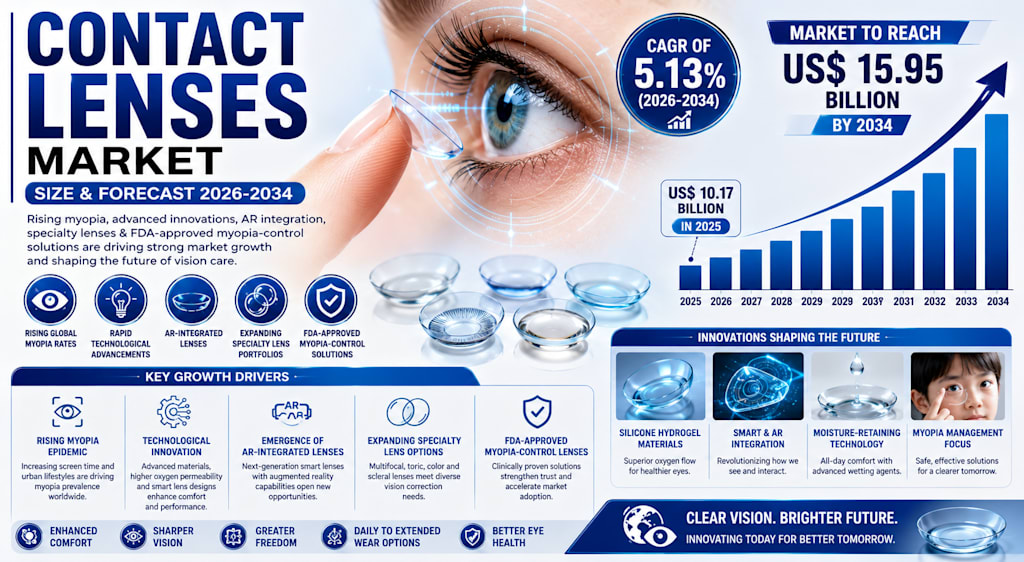
According to Renub Research, the Contact Lenses Market is expected to reach US$ 15.95 billion by 2034, growing from US$ 10.17 billion in 2025, at a CAGR of 5.13% from 2026 to 2034. Rising global myopia rates, technological advancements, FDA-approved myopia-control solutions, specialty lens innovations, and increasing consumer demand for comfortable vision correction continue to support market expansion.
As consumers seek greater convenience and healthcare providers embrace more advanced vision management solutions, contact lenses are becoming a cornerstone of modern eye care.
Contact Lenses Continue to Transform Vision Care
Contact lenses are thin optical devices placed directly on the eye's surface to correct refractive errors such as nearsightedness, farsightedness, astigmatism, and presbyopia.
Modern lenses are typically manufactured from hydrogel or silicone hydrogel materials that allow oxygen to reach the cornea while maintaining comfort throughout the day.
Consumers can choose from various lens categories, including daily disposable lenses, monthly replacement lenses, toric lenses for astigmatism, multifocal lenses for presbyopia, and specialty lenses designed for complex corneal conditions.
The convenience, cosmetic appeal, and broad field of vision offered by contact lenses have made them a preferred option for millions of individuals worldwide.
Recent innovations are further expanding their role beyond correction to include eye-health monitoring, myopia management, cosmetic enhancement, and wearable digital technologies.
Rising Myopia Rates Are Driving Market Growth
One of the strongest drivers of the contact lens market is the increasing prevalence of myopia around the world.
Myopia, commonly known as nearsightedness, has become particularly widespread among children, adolescents, and young adults due to changing lifestyles and increased screen exposure.
Extended use of smartphones, tablets, computers, and other digital devices has significantly contributed to vision-related challenges across many populations.
Healthcare professionals are increasingly emphasizing early intervention and effective management strategies to reduce the long-term impact of myopia.
As awareness grows regarding the importance of proactive vision care, demand for advanced corrective lenses continues to increase.
The growing prevalence of myopia is expected to remain one of the most significant long-term drivers of industry expansion.
FDA-Approved Myopia-Control Solutions Are Strengthening Confidence
The development of clinically validated myopia-control lenses has created new opportunities for both manufacturers and eye-care professionals.
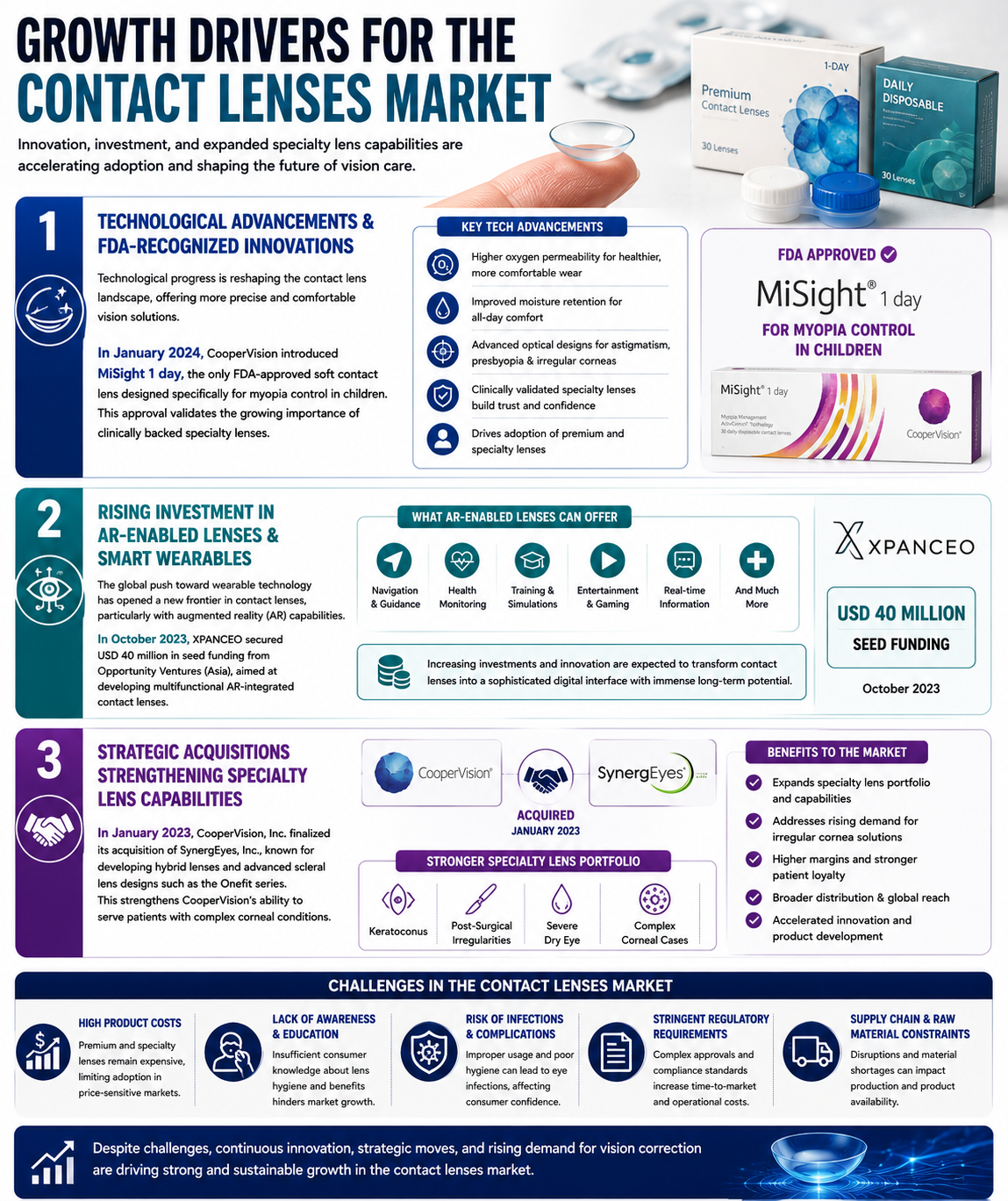
A major milestone occurred in January 2024 when CooperVision introduced MiSight 1 day, the only FDA-approved soft contact lens specifically designed for myopia control in children. The approval strengthened confidence among practitioners and parents while highlighting the growing importance of evidence-based vision management solutions.
Myopia-control products address an increasingly urgent healthcare challenge as childhood myopia rates continue rising globally.
These specialized lenses help slow myopia progression while providing effective vision correction.
As more healthcare providers incorporate myopia management into routine eye care, demand for specialty contact lenses is expected to accelerate significantly.
Smart Contact Lenses Are Creating New Possibilities
One of the most exciting developments within the industry involves the emergence of smart contact lens technologies.
Researchers and technology companies are exploring ways to integrate sensors, wireless communication systems, augmented reality features, and health-monitoring capabilities directly into contact lenses.
These innovations could transform lenses into multifunctional wearable devices capable of supporting healthcare, navigation, communication, and digital interaction.
A notable example occurred in March 2024 when Alcon partnered with Google to develop smart contact lenses equipped with sensors and wireless technologies for next-generation health-monitoring applications.
Although many smart lens technologies remain in development, their potential applications continue generating strong interest among investors and industry participants.
The convergence of healthcare and wearable technology may redefine the future role of contact lenses.
Investment in Augmented Reality Lenses Is Accelerating
The growing popularity of wearable technology is also driving investment in augmented reality contact lenses.
Unlike traditional smart glasses, AR-enabled contact lenses offer the possibility of delivering digital information directly within a user's field of vision without bulky external hardware.
Potential applications include navigation guidance, medical monitoring, industrial training, gaming, and immersive entertainment experiences.
In October 2023, XPANCEO secured US$ 40 million in seed funding to support development of multifunctional AR-integrated contact lenses. The investment reflects increasing confidence in the long-term commercial potential of wearable optical technologies.
As technology continues advancing, AR-enabled contact lenses could emerge as one of the most transformative innovations in the broader wearable technology sector.
Specialty Lenses Are Expanding Patient Options
Specialty contact lenses are becoming increasingly important as eye-care professionals address more complex vision conditions.
Patients suffering from irregular corneas, keratoconus, post-surgical complications, severe dry-eye syndrome, and other challenging conditions often require specialized lens designs that go beyond conventional products.
Scleral lenses, hybrid lenses, and custom-designed specialty lenses provide enhanced comfort and improved visual outcomes for these patients.
Industry consolidation is supporting growth within this segment.
In January 2023, CooperVision completed its acquisition of SynergEyes, a company recognized for hybrid and scleral lens technologies. The acquisition expanded CooperVision's capabilities in addressing complex corneal conditions and specialty vision care needs.
As diagnosis rates increase and practitioner expertise expands, specialty lenses are expected to become an increasingly important segment of the market.
Daily Disposable Lenses Continue Gaining Popularity
Daily disposable contact lenses remain one of the fastest-growing product categories within the industry.
Consumers increasingly prefer daily disposables because they offer convenience, hygiene benefits, and reduced maintenance requirements.
Unlike reusable lenses, daily disposables eliminate the need for cleaning solutions and storage cases, reducing the risk of contamination and improper handling.
Many eye-care professionals recommend daily disposable lenses because they support healthier lens-wearing habits and lower infection risks.
Advancements in lens materials have also improved comfort and moisture retention, making daily disposable products attractive to a broader range of users.
As convenience becomes increasingly important, this category is expected to maintain strong growth momentum.
Silicone Hydrogel Materials Continue Advancing Comfort
Material innovation remains a key focus area for manufacturers.
Silicone hydrogel lenses have become particularly popular because they allow significantly greater oxygen transmission compared to traditional hydrogel materials.
Improved oxygen permeability helps maintain corneal health while enhancing comfort during extended wear.
Manufacturers continue refining material technologies to improve moisture retention, reduce dryness, and enhance overall user experience.
These advancements have contributed to higher consumer satisfaction and greater willingness to adopt premium lens products.
As material science continues progressing, future generations of contact lenses are expected to provide even greater comfort and performance.
Online Retail Channels Are Expanding Accessibility
Digital commerce is transforming how consumers purchase contact lenses.
Online platforms offer convenient ordering, subscription services, automatic replenishment programs, and home delivery options that simplify lens management.
Consumers increasingly appreciate the flexibility of ordering products online while maintaining access to a broad range of brands and specialty options.
Subscription-based services have become particularly popular because they help ensure consistent lens replacement schedules.
The growth of e-commerce is expected to continue expanding market accessibility while improving consumer convenience worldwide.
United States Leads Global Innovation
The United States remains one of the most advanced contact lens markets globally.
Strong adoption of daily disposables, specialty lenses, and myopia-control products contributes to sustained growth.
The presence of major industry leaders such as CooperVision and Johnson & Johnson Vision supports continuous innovation and product development.
High digital-device usage has also increased awareness of vision-related issues, creating strong demand for advanced corrective solutions.
Extensive optometry networks, sophisticated diagnostic technologies, and convenient purchasing channels further strengthen the market.
Germany Maintains Strong Premium Lens Demand
Germany's contact lens market benefits from high healthcare standards, strong consumer awareness, and widespread preference for premium vision-care products.
Daily disposable lenses and silicone hydrogel products remain particularly popular due to their comfort and safety advantages.
The country's aging population contributes to growing demand for multifocal lenses and specialty products designed to address age-related vision changes.
Professional fitting services and strong regulatory oversight help maintain consumer confidence in advanced lens technologies.
China Emerges as a High-Growth Market
China represents one of the fastest-growing contact lens markets globally.
Extremely high myopia rates among children and young adults are creating substantial demand for corrective and myopia-management solutions.
Urbanization, increasing disposable income, and strong e-commerce adoption continue supporting market growth.
Government initiatives focused on childhood myopia prevention are further encouraging adoption of advanced vision-care products.
The combination of a large population and evolving lifestyle habits positions China as a major contributor to future industry expansion.
Saudi Arabia Shows Strong Market Potential
Saudi Arabia's contact lens market continues expanding as awareness regarding vision care increases.
A young population, rising digital-device usage, and growing interest in cosmetic and corrective lenses are contributing to market development.
Healthcare modernization initiatives under Vision 2030 are improving access to optometric services and advanced optical products.
Growing middle-class purchasing power and increasing preference for premium vision-care solutions further support market growth.
Challenges Continue to Affect Market Adoption
Despite strong growth prospects, several challenges remain.
One major concern involves user compliance and hygiene practices.
Improper cleaning routines, extended wear beyond recommended schedules, and poor handling habits can increase the risk of infections, corneal irritation, and complications such as microbial keratitis. These risks require ongoing patient education and professional guidance.
Affordability also remains a challenge in many developing regions.
Premium lenses, specialty products, and regular replacement schedules can create financial barriers for some consumers. Limited access to trained eye-care professionals and fitting services further restricts adoption in certain markets.
Addressing these challenges will be essential for ensuring broader access to advanced vision-care solutions.
Final Thoughts
The contact lens industry is entering an exciting period of innovation driven by advances in vision science, wearable technology, and personalized healthcare.
According to Renub Research, the Contact Lenses Market is expected to grow from US$ 10.17 billion in 2025 to US$ 15.95 billion by 2034, supported by rising myopia rates, FDA-approved specialty products, smart lens technologies, and expanding consumer demand for comfortable vision correction solutions.
From daily disposable lenses and specialty vision care products to augmented reality interfaces and health-monitoring wearables, contact lenses are evolving into sophisticated tools that extend far beyond traditional eyesight correction.
The future of vision care is becoming smarter, more personalized, and increasingly connected—and contact lenses are at the center of that transformation.
About the Creator
Enjoyed the story? Support the Creator.
Subscribe for free to receive all their stories in your feed.
Comments
There are no comments for this story
Be the first to respond and start the conversation.