
Commercial Greenhouse Market Set for Strong Growth as Controlled Farming Gains Global Momentum
From year-round crop production to smart greenhouse technologies, the market is moving from a niche agricultural solution to a mainstream strategy for food security, sustainability, and higher farm productivity.

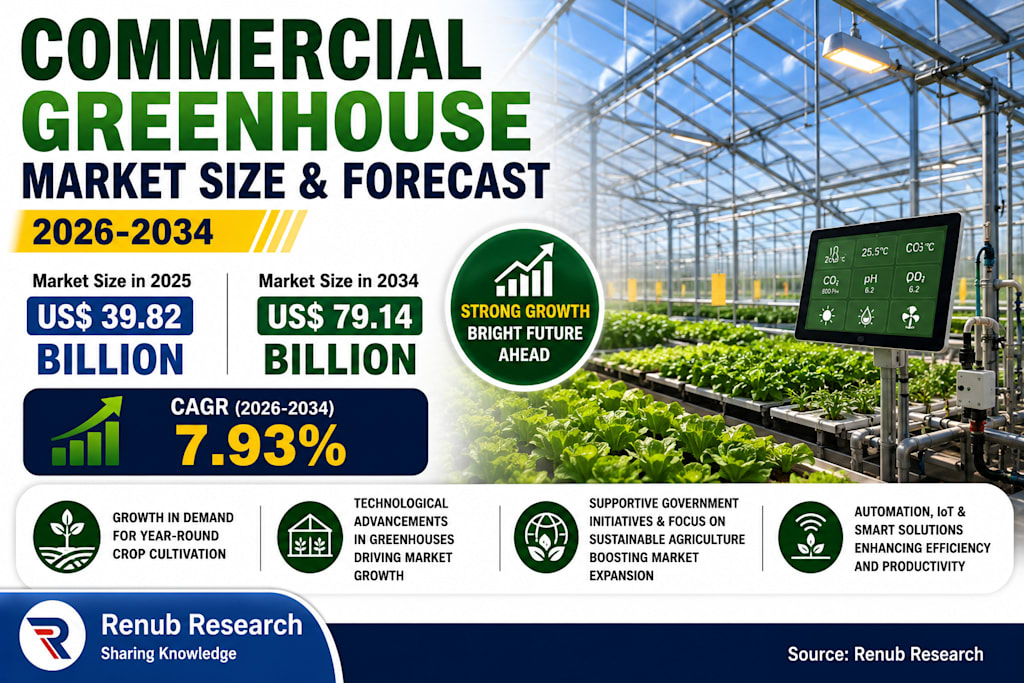
Commercial Greenhouse Market: A Modern Answer to an Age-Old Farming Problem
Agriculture has always depended on nature, but nature does not always cooperate. Droughts, heat waves, cold spells, unpredictable rainfall, and shrinking farmland have made crop production more challenging than ever. In that environment, commercial greenhouses have emerged as one of the most practical and future-ready solutions in modern farming.
According to Renub Research, the Commercial Greenhouse Market is expected to grow from US$ 39.82 billion in 2025 to US$ 79.14 billion by 2034, registering a CAGR of 7.93% from 2026 to 2034. That kind of growth is not happening by accident. It reflects a larger shift in how the world thinks about food production, agricultural efficiency, and sustainability.
Commercial greenhouses are no longer limited to experimental farms or high-end agricultural projects. They are becoming a serious part of the global food chain, helping growers produce vegetables, fruits, flowers, nursery crops, and other high-value plants in controlled environments. With rising food demand, climate pressure, and advances in technology, greenhouse farming is moving from an alternative method to a strategic necessity.
Why Commercial Greenhouses Are Gaining Attention
At the heart of the market’s expansion is one simple reality: the world needs more food, but it has less reliable land and water to grow it on. Greenhouses allow farmers to grow crops in a protected environment where temperature, humidity, irrigation, and light can be managed much more precisely than in open-field farming.
This control makes production more stable. Farmers are no longer fully at the mercy of seasonal disruptions. Instead, they can grow crops throughout the year, improve yield consistency, and reduce losses caused by weather-related damage. For retailers, distributors, and consumers, that means a more dependable supply of fresh produce. For farmers, it means better planning, greater productivity, and often higher profit potential.
Another reason for the market’s growth is the rising demand for local and fresh produce. In many countries, consumers want fruits and vegetables that are grown closer to home, with fewer pesticides and more transparency in the production process. Commercial greenhouses support that demand by making intensive cultivation possible in or near urban and suburban areas.
The Push for Year-Round Crop Production
One of the strongest drivers behind the commercial greenhouse market is the growing need for year-round cultivation. Traditional farming depends heavily on climate conditions, which means production can fall sharply when weather turns extreme or seasons change abruptly. Greenhouses solve that problem by creating a protected environment where crops can grow more consistently.
This is especially important for vegetables, fruits, and flowers, which often face high market demand throughout the year. When supply is disrupted by weather or seasonal cycles, prices rise and quality can suffer. Greenhouses help smooth out that volatility by enabling multiple crop cycles and reducing dependence on natural rainfall and temperature patterns.
In many countries, this approach has become especially valuable as agricultural land becomes more limited and as population growth places more pressure on food supply chains. Greenhouse farming gives growers a way to produce more from less land, which is a compelling advantage in regions where farmland is shrinking or expensive.
Technology Is Changing the Greenhouse Business
The modern commercial greenhouse looks very different from the simple glass structures of the past. Today’s operations often include climate control systems, automated irrigation, hydroponics, sensors, artificial lighting, and data-driven monitoring tools. These technologies have transformed greenhouse farming into a much more precise and efficient business.
Climate control systems help maintain ideal growing conditions. Drip irrigation systems deliver water more efficiently. Hydroponic systems reduce soil dependency and can dramatically improve water use. LED lighting extends growing capacity and improves plant development. Sensors can monitor temperature, humidity, and nutrient levels in real time, allowing growers to respond quickly when conditions shift.
This technological progress is one of the biggest reasons investors and agricultural companies are paying closer attention to the sector. Better technology means better productivity, lower waste, and more consistent results. It also makes greenhouse farming more attractive in regions where land is limited and water is scarce.
In practical terms, this is what makes commercial greenhouse farming so relevant today. It is not just about protecting plants. It is about improving the economics of agriculture.
Sustainability Is No Longer Optional
Sustainability has become a defining issue in agriculture. Traditional farming can require large amounts of land, water, fertilizer, and pesticides. That creates environmental pressure and, in some cases, long-term soil and ecosystem damage. Commercial greenhouses offer a more resource-efficient model.
Because greenhouse production takes place in a controlled setting, growers can use water more carefully and reduce exposure to pests and diseases. In many cases, that means less pesticide use and more efficient irrigation. Some greenhouse systems also support soil-less methods such as hydroponics and aeroponics, which can reduce erosion and improve resource management.
That matters because agriculture is being asked to do more with less. The global population is rising, urbanization is accelerating, and climate stress is making food production less predictable. Controlled environment agriculture offers a way to respond to these pressures without expanding farmland endlessly.
Greenhouses also fit well into the broader sustainability conversation because they can help produce food closer to where people live. Shorter supply chains can reduce transportation needs, improve freshness, and strengthen local food resilience. In that sense, greenhouse farming is not only a production strategy; it is also a logistics strategy.
Market Challenges Remain Real
Even with strong growth prospects, the commercial greenhouse market still faces important barriers. The first is cost. Setting up a modern greenhouse can require significant capital investment in land preparation, structural materials, climate systems, irrigation equipment, lighting, and monitoring software. For small and medium-scale farmers, that cost can be difficult to absorb.
Operational costs also matter. Greenhouses often require constant electricity, regular maintenance, specialized inputs, and technical management. In extreme climates, these expenses can rise quickly. That makes profitability highly dependent on crop selection, system efficiency, and good management.
The second major challenge is technical complexity. Greenhouse farming is not just traditional agriculture under a roof. It requires knowledge of environmental control, nutrient management, pest prevention, and technology operation. Farmers who are unfamiliar with advanced systems may struggle to get the best yield from their investment.
Skilled labor is another issue. As greenhouses become more automated and digitally connected, the industry needs workers who can manage systems, interpret data, and respond quickly to plant health issues. In many markets, that talent pool is still developing.
These barriers do not weaken the market story, but they do shape it. The next phase of growth will likely favor companies, growers, and regions that can combine capital, training, and technology effectively.
Segments That Are Driving Opportunity
The market is not uniform. Different greenhouse types and crop categories are creating different kinds of opportunities.
Plastic greenhouses are popular because they are relatively cost-effective and flexible. They are widely used in modern farming, especially where farmers need a practical and scalable option. Glass greenhouses, on the other hand, are often associated with more advanced or high-value operations where durability and light transmission are important.
In terms of crop use, fruits and vegetables remain a major category because consumers increasingly want fresh, high-quality produce all year round. Crops like tomatoes, cucumbers, strawberries, lettuce, and peppers are often grown in greenhouse systems because they respond well to controlled conditions.
Nursery crops also represent an important part of the market. Greenhouses are ideal for seedlings, young plants, ornamentals, and landscaping crops because they help protect sensitive plants during their early growth stages. That makes greenhouse systems valuable not only for food production but also for horticulture and commercial landscaping.
Tunnel greenhouses, sometimes known as hoop houses or high tunnels, are also gaining popularity. They are simpler and more affordable than advanced high-tech systems, which makes them attractive to small and medium-scale growers. Their ability to extend growing seasons and protect crops from harsh weather gives them broad practical value.
Hybrid greenhouse systems are another interesting segment. By combining the strengths of different greenhouse types and technologies, they aim to balance cost, performance, and flexibility. As the market matures, hybrid solutions may become even more important for growers who want efficiency without sacrificing adaptability.
Regional Markets Show Different Growth Patterns
Regional adoption of commercial greenhouse systems is expanding, but the reasons vary.
In the United States, greenhouse farming is supported by strong demand for fresh produce, advanced agricultural technology, and growing interest in local food systems. The country has become one of the most technologically mature greenhouse markets, with widespread use of hydroponics, climate control, and LED systems.
In the United Kingdom, greenhouse farming is closely linked to food security and the need to reduce dependence on imports. Short growing seasons and cooler weather make controlled agriculture especially useful. The region is also seeing greater interest in sustainable and urban greenhouse projects.
India is another fast-growing market, where greenhouse adoption is being driven by the need to improve productivity, conserve water, and protect crops from changing weather patterns. Farmers are increasingly using polyhouse structures, drip irrigation, and shade nets to grow high-value crops.
Saudi Arabia presents a different but equally important story. Because of the harsh climate and limited arable land, greenhouse farming is helping support food security and reduce reliance on imports. In this environment, protected cultivation is not simply a growth trend; it is a strategic necessity.
Across these markets, the common pattern is clear: commercial greenhouse farming is expanding wherever climate pressure, food demand, or resource scarcity creates a need for more controlled production.
What the Future Looks Like
The future of the commercial greenhouse market looks strong because the need behind it is not temporary. Climate change, land scarcity, and global food demand are long-term forces. As technology becomes more accessible and cost-efficient, greenhouse farming should become even more practical for a wider range of growers.
Expect to see more automation, more precise environmental control, better lighting systems, smarter irrigation, and stronger use of data analytics. Expect also to see greater interest from governments, agri-tech firms, and investors looking for solutions that improve both productivity and sustainability.
The commercial greenhouse is no longer a symbol of niche farming. It is becoming part of the infrastructure of modern agriculture.
Final Thoughts
The Commercial Greenhouse Market is entering a new phase of growth, shaped by the world’s need for more reliable food production and more efficient use of land and water. With the market projected to rise from US$ 39.82 billion in 2025 to US$ 79.14 billion by 2034, the opportunity is substantial, but so is the responsibility to build systems that are scalable, affordable, and sustainable.
For farmers, investors, and policymakers, the message is clear: controlled environment agriculture is not a passing trend. It is one of the most important tools available for feeding a growing world with greater consistency and less waste. In that sense, commercial greenhouses are helping shape the future of farming one crop cycle at a time.
About the Creator
Enjoyed the story? Support the Creator.
Subscribe for free to receive all their stories in your feed.
Comments
There are no comments for this story
Be the first to respond and start the conversation.