
Colonoscopy Devices Market Expands as AI Imaging, Single-Use Technologies, and Rising Screening Awareness Transform Gastrointestinal Care
Growing colorectal cancer screening participation, AI-assisted imaging innovation, and advanced single-use colonoscopy technologies are accelerating global market growth.

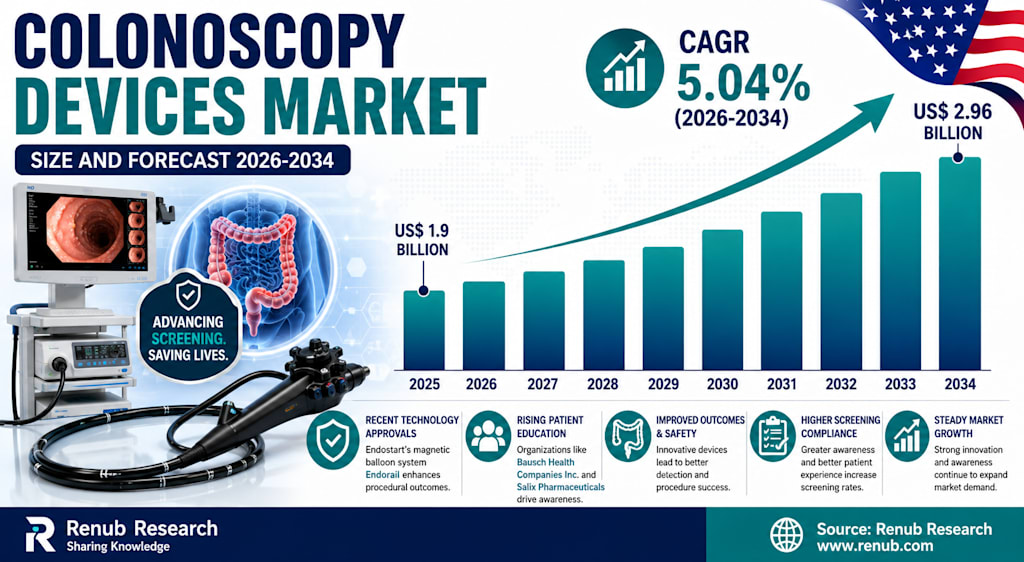
The global colonoscopy devices market is experiencing strong and steady growth as healthcare systems increasingly prioritize early colorectal cancer detection, minimally invasive diagnostics, and advanced gastrointestinal screening technologies. According to Renub Research, the colonoscopy devices market is projected to grow from US$ 1.9 billion in 2025 to US$ 2.96 billion by 2034, expanding at a CAGR of 5.04% during the forecast period from 2026 to 2034. Technological innovation, rising awareness campaigns, and increasing regulatory approvals for next-generation colonoscopy solutions are among the major factors driving industry expansion worldwide.
Market Overview
Colonoscopy devices are advanced medical systems used to visualize, evaluate, and treat conditions affecting the colon and rectum. These systems typically include flexible colonoscopes equipped with imaging cameras, light sources, irrigation channels, insufflation systems, and instruments designed for biopsy collection or polyp removal.
Modern colonoscopy devices increasingly integrate high-definition digital imaging, enhanced optics, magnetic navigation technologies, and artificial intelligence-assisted imaging systems that improve diagnostic precision and procedural efficiency. Innovations such as single-use colonoscopes and AI-powered detection platforms are also helping reduce contamination risks and improve patient safety.
Colonoscopy procedures play a critical role in colorectal cancer prevention and gastrointestinal disease management because they allow physicians to identify abnormalities, detect cancer at earlier stages, and remove precancerous polyps before they progress into severe disease.
Technological Advancements and Regulatory Clearances Driving Growth
One of the strongest growth drivers in the colonoscopy devices market is rapid technological innovation combined with increasing regulatory approvals for advanced systems. Manufacturers are developing technologies that improve navigation, imaging quality, workflow efficiency, and procedural outcomes for both clinicians and patients.
A major example highlighted in the report is Endostart’s March 2024 FDA 510(k) clearance for Endorail, a magnetic balloon system designed to improve scope advancement and reduce colonoscopy procedure time. Innovations such as magnetic guidance systems, AI-assisted imaging, and enhanced maneuverability are significantly improving clinician confidence and procedural efficiency.
Healthcare providers increasingly favor technologies capable of reducing staff burden, minimizing patient discomfort, and improving diagnostic accuracy. Regulatory clearances also help accelerate commercialization and strengthen manufacturer competitiveness within both developed and emerging markets.
As more next-generation systems enter the market, hospitals and ambulatory surgical centers continue investing heavily in upgraded endoscopy platforms that support better workflow integration and safer procedures.
Rising Awareness and Screening Participation Supporting Demand
Growing awareness regarding colorectal cancer prevention is another major factor driving demand for colonoscopy devices globally. Public awareness campaigns, healthcare education initiatives, and physician outreach programs are encouraging more individuals to undergo preventive screening procedures.
The report notes that in March 2024, a nationwide survey conducted by Bausch Health Companies Inc. and Salix Pharmaceuticals in collaboration with The Harris Poll revealed that 78% of U.S. adults aged 45 and older rely on healthcare providers for colonoscopy-related information. This demonstrates the growing importance of professional medical guidance and awareness campaigns in improving screening compliance.
Increasing willingness among patients to undergo colonoscopy screening is directly expanding procedure volumes and driving demand for colonoscopes, imaging systems, accessories, and disposable components. Healthcare systems globally are also investing more heavily in early detection programs because colorectal cancer remains one of the leading causes of cancer-related deaths worldwide.
As awareness initiatives continue expanding globally, demand for advanced diagnostic capacity and efficient screening technologies is expected to rise steadily over the coming years.
Single-Use Colonoscopy Technologies Transforming the Industry
The increasing adoption of single-use colonoscopy technologies is reshaping the market by addressing infection-control concerns associated with reusable endoscopes. Hospitals and healthcare providers are increasingly prioritizing patient safety and contamination prevention within endoscopy procedures.
In September 2023, Ambu received FDA 510(k) clearance for its Ambu aScope Colon and aBox 2 endoscopy system, strengthening its position within the single-use colonoscopy segment. Single-use systems eliminate cross-contamination risks, reduce sterilization complexity, and improve clinical workflow efficiency.
These technologies are especially valuable for smaller healthcare facilities and ambulatory centers that may lack large-scale sterilization infrastructure. Regulatory emphasis on hygiene standards and infection prevention is further accelerating adoption of disposable endoscopy solutions globally.
As healthcare providers increasingly prioritize operational efficiency and patient safety, competition among manufacturers developing single-use imaging systems and integrated visualization platforms is expected to intensify significantly.
High Costs and Limited Access Creating Challenges
Despite promising growth opportunities, the colonoscopy devices market continues facing important cost-related challenges. Advanced imaging systems, reusable scopes, AI-enhanced technologies, and specialized accessories require significant capital investment from healthcare facilities.
Hospitals must also manage ongoing maintenance, repair, and sterilization expenses associated with sophisticated endoscopic equipment. Smaller healthcare centers and rural clinics often lack sufficient financial resources to adopt state-of-the-art technologies, limiting access to high-quality colorectal screening in certain regions.
Although single-use colonoscopes reduce sterilization requirements, disposable components can still increase overall procedure costs. These economic barriers continue slowing market penetration in lower-income and underserved healthcare systems.
Workforce Shortages and Training Gaps Slowing Adoption
Another major challenge affecting the colonoscopy devices market is the shortage of trained gastroenterologists and endoscopy professionals. As colorectal cancer screening volumes continue rising, healthcare systems increasingly struggle to meet growing patient demand.
Advanced technologies such as AI-assisted imaging systems and magnetic navigation tools require specialized training and ongoing clinician education. Healthcare facilities must invest heavily in workforce development to ensure safe and effective technology adoption.
Insufficient staffing can lead to longer patient wait times, delayed diagnoses, and reduced hospital throughput. Regions with aging healthcare workforces and limited medical training infrastructure face particularly severe workforce challenges.
Despite these challenges, ongoing technological simplification and workflow automation may help reduce operational pressure on healthcare providers over time.
Colonoscope Segment Maintaining Market Leadership
The colonoscope segment continues dominating the market because colonoscopes remain the core devices used in colorectal screening and gastrointestinal diagnostics. Improvements in flexibility, imaging quality, ergonomic design, and navigation systems are helping physicians perform procedures more accurately and comfortably.
Manufacturers are increasingly integrating AI-supported imaging systems and enhanced visualization capabilities into colonoscope platforms to improve polyp detection and reduce missed abnormalities.
The rising incidence of colorectal cancer and growing adoption of preventive healthcare programs continue strengthening demand for advanced colonoscope systems globally.
Visualization Systems Becoming Increasingly Important
Visualization systems represent another rapidly growing segment within the colonoscopy devices market. High-definition imaging systems, advanced optics, and enhanced digital visualization technologies are significantly improving diagnostic precision and procedural efficiency.
AI-enhanced visualization platforms are especially gaining momentum because they support real-time polyp detection and improve clinician decision-making during colonoscopy procedures. These systems can help reduce diagnostic errors while increasing procedural confidence.
Healthcare facilities increasingly view advanced visualization systems as essential investments capable of improving patient outcomes and operational efficiency simultaneously.
Hospitals Remain the Largest End-User Segment
Hospitals continue representing the largest end-user segment within the colonoscopy devices market because they perform high volumes of gastrointestinal procedures and maintain advanced diagnostic infrastructure.
Large hospitals increasingly invest in AI-powered imaging systems, advanced colonoscopes, and disposable endoscopy technologies to improve patient outcomes and comply with infection-control standards.
Hospitals also benefit from stronger reimbursement systems and larger budgets compared to smaller clinics, allowing faster adoption of premium colonoscopy technologies.
United States Colonoscopy Devices Market
The United States remains one of the world’s largest and most technologically advanced colonoscopy devices markets. Strong colorectal cancer screening programs, favorable reimbursement structures, and rapid FDA clearances continue supporting strong market growth.
Hospitals and ambulatory surgical centers are increasingly adopting single-use colonoscopes, AI-enhanced imaging systems, and advanced visualization platforms to improve diagnostic accuracy and infection control.
Public awareness campaigns and healthcare provider education efforts continue strengthening screening participation among adults aged 45 and older.
Germany Colonoscopy Devices Market
Germany’s colonoscopy devices market benefits from strong healthcare infrastructure, high colorectal screening participation rates, and early adoption of advanced medical technologies. Hospitals increasingly prioritize ergonomic equipment, superior imaging quality, and improved patient comfort.
Interest in single-use devices and workflow optimization technologies is also growing because of infection-control priorities and efficiency improvements within healthcare systems.
China Colonoscopy Devices Market
China’s colonoscopy devices market is expanding rapidly because of rising colorectal cancer incidence, growing healthcare investments, and government-supported screening initiatives. Urban hospitals are increasingly adopting AI-assisted imaging systems and advanced diagnostic platforms.
International manufacturers are strengthening partnerships and local production operations to expand their presence in the country’s rapidly growing healthcare market.
Saudi Arabia Colonoscopy Devices Market
Saudi Arabia’s colonoscopy devices market is supported by healthcare modernization efforts under Vision 2030, growing awareness regarding gastrointestinal disorders, and expanding preventive healthcare programs.
Hospitals are increasingly adopting high-definition colonoscopy systems and advanced imaging technologies, although workforce shortages and dependence on imported medical equipment remain important challenges.
Recent Company Developments and Industry Updates
Fujifilm received European Commission marketing authorization in February 2025 for its ELUXEO colonoscopy system featuring advanced blue-light imaging technology.
Odin Medical Ltd., a subsidiary of Olympus, received FDA 510(k) clearance in September 2024 for its cloud-based AI-assisted CADDIE device for colorectal polyp detection.
Medtronic launched the upgraded ColonPRO software enhancement in April 2024 for its AI-powered GI Genius platform.
Endostart received FDA 510(k) clearance in March 2024 for its Endorail magnetic balloon colonoscopy system.
Ambu received FDA clearance in September 2023 for its single-use Ambu aScope Colon and aBox 2 system.
Boston Scientific is expected to benefit from increasing demand for AI-assisted gastrointestinal imaging systems. This is an editorial market inference.
Olympus Corporation may strengthen its market leadership through cloud-based AI diagnostic technologies. This is an editorial market inference.
Stryker Corporation is likely to benefit from growing hospital investment in minimally invasive diagnostic systems. This is an editorial market inference.
Steris Corp. may gain from rising infection-control requirements and endoscopy workflow optimization trends. This is an editorial market inference.
Getinge AB is expected to benefit from growing demand for advanced hospital sterilization and endoscopy support systems. This is an editorial market inference.
Final Thoughts
The global colonoscopy devices market is evolving rapidly as healthcare systems prioritize early cancer detection, minimally invasive diagnostics, infection prevention, and AI-assisted medical imaging. Technological innovation, growing awareness campaigns, and increasing screening participation are collectively driving long-term market expansion worldwide.
At the same time, hospitals and manufacturers must address challenges related to workforce shortages, high technology costs, and unequal healthcare access. Companies capable of combining advanced imaging capabilities, workflow efficiency, patient safety, and AI-driven diagnostics are expected to emerge as long-term leaders within the future colonoscopy devices industry.
About the Creator
Enjoyed the story? Support the Creator.
Subscribe for free to receive all their stories in your feed.
Comments
There are no comments for this story
Be the first to respond and start the conversation.