
Clinical Trial Supplies Market Set for Strong Growth as Global Drug Development Accelerates
From personalized medicine to multinational clinical studies, the demand for efficient clinical trial supply chains is reshaping the future of healthcare innovation.

The global healthcare industry is entering a transformative era, and behind every groundbreaking treatment, vaccine, or innovative therapy lies a critical but often overlooked component: clinical trial supplies.
As pharmaceutical companies race to develop new medicines and biotechnology firms push the boundaries of personalized healthcare, the systems that support clinical research have become more important than ever. Clinical trial supplies—including investigational medicines, packaging materials, logistics services, storage solutions, and regulatory-compliant distribution networks—form the backbone of modern clinical research.
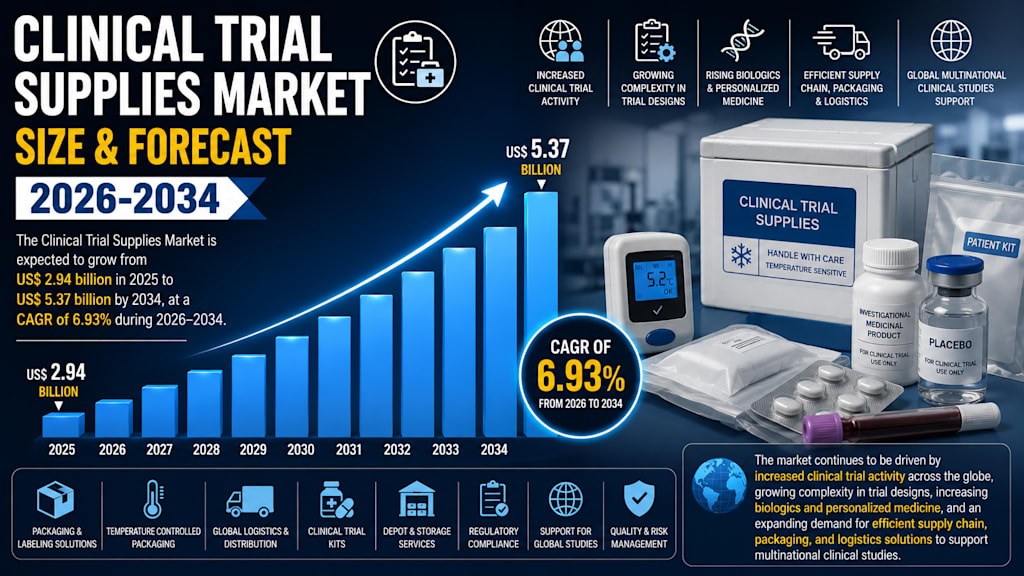
According to Renub Research, the Clinical Trial Supplies Market is projected to grow from US$ 2.94 billion in 2025 to US$ 5.37 billion by 2034, expanding at a compound annual growth rate (CAGR) of 6.93% during 2026–2034. This impressive growth highlights the increasing importance of efficient supply chain management in the global drug development ecosystem.
As clinical trials become larger, more complex, and increasingly global, organizations are investing heavily in specialized supply solutions to ensure that studies run smoothly, safely, and in compliance with regulatory standards.
The Invisible Engine Behind Medical Breakthroughs
Most people associate clinical trials with researchers, physicians, and patients. However, every successful trial depends on a carefully coordinated network of products and services working behind the scenes.
Clinical trial supplies encompass everything needed to conduct research effectively. This includes investigational medicinal products, comparator drugs, placebos, packaging and labeling materials, diagnostic kits, storage solutions, and transportation services.
The primary goal is simple but challenging: ensuring that the right product reaches the right patient at the right time while maintaining quality, safety, and regulatory compliance.
A delay in supply delivery can disrupt an entire study. A labeling error can trigger regulatory complications. Temperature fluctuations during transportation can compromise sensitive biologic products. As a result, supply management has evolved into a specialized field that plays a critical role in clinical research success.
Rising Research Investment Fuels Market Expansion
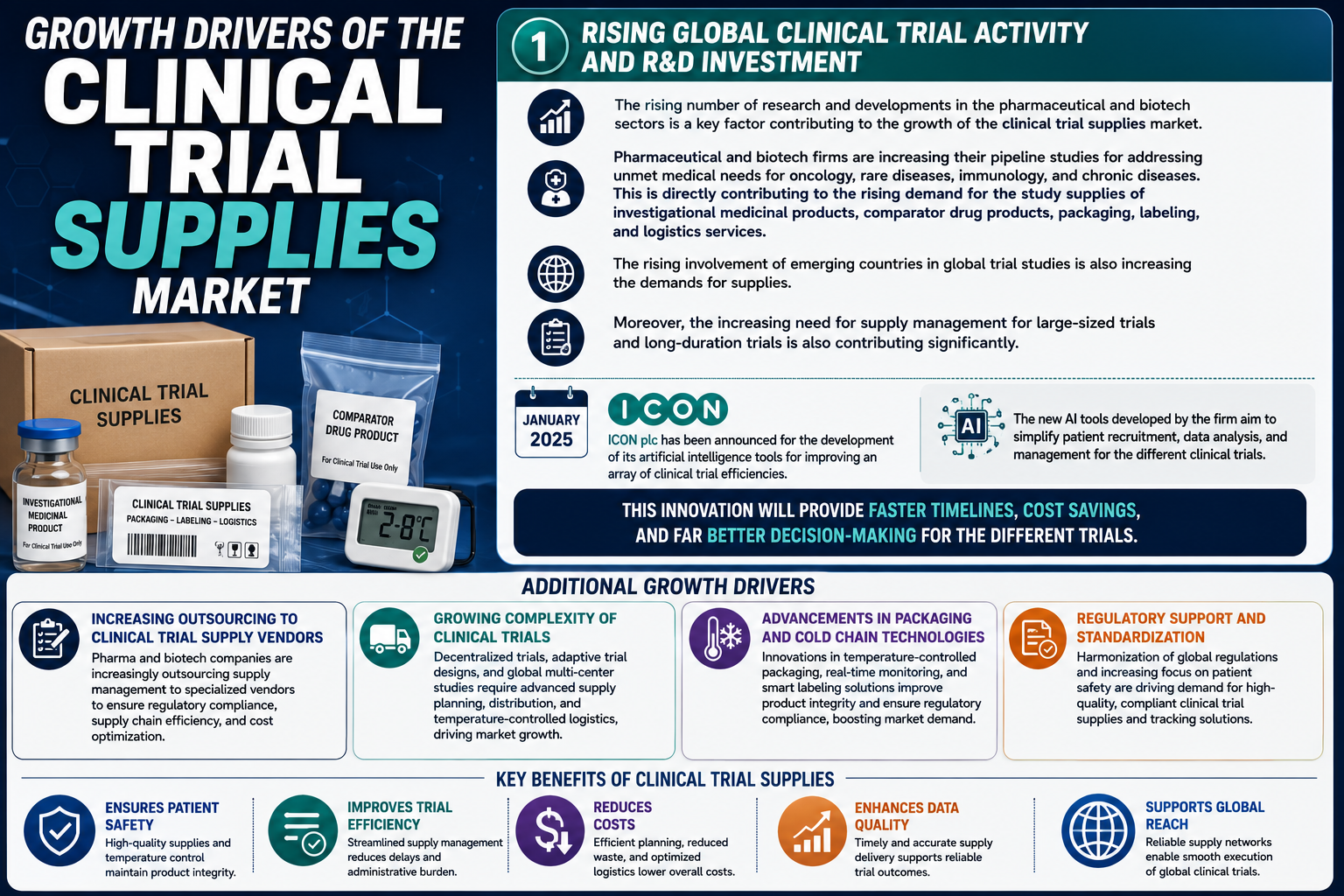
One of the biggest drivers behind market growth is the substantial increase in research and development spending across the pharmaceutical and biotechnology sectors.
Companies are aggressively investing in treatments for cancer, rare diseases, autoimmune disorders, neurological conditions, and chronic illnesses. Every new drug candidate entering clinical testing creates demand for manufacturing, packaging, storage, and distribution services.
The global race to discover innovative therapies has intensified over the past decade. Drug developers are not only pursuing traditional pharmaceutical products but also advanced biologics, gene therapies, and cell-based treatments.
These therapies often require specialized handling procedures, creating additional opportunities for clinical trial supply providers.
The growing number of clinical studies worldwide means sponsors must coordinate increasingly complex logistics operations. From patient enrollment to trial completion, supply management has become a strategic necessity rather than a simple operational task.
Personalized Medicine Is Changing the Rules
Healthcare is moving away from the traditional one-size-fits-all model and toward personalized medicine.
This shift represents one of the most significant trends influencing the clinical trial supplies industry.
Personalized treatments are designed for specific patient populations and often require customized dosing, unique packaging configurations, and precise distribution strategies. As a result, supply chains must become more flexible and responsive.
Unlike conventional medicines produced in large quantities, personalized therapies frequently involve smaller production batches and patient-specific manufacturing processes. This creates new logistical challenges and increases the need for specialized expertise.
Companies capable of managing individualized treatment distribution are becoming increasingly valuable partners for pharmaceutical and biotechnology organizations.
The rise of personalized medicine is not merely a healthcare trend—it is reshaping the entire clinical research infrastructure.
The Growing Complexity of Modern Clinical Trials
Clinical trials today are dramatically different from those conducted just a decade ago.
Traditional study designs are increasingly being replaced by adaptive trials, decentralized models, and hybrid approaches that rely on digital technologies and remote participation.
These innovations improve patient accessibility and accelerate recruitment, but they also introduce additional supply chain complexity.
Trial participants may now receive medications at home rather than at centralized research sites. Investigational products often need to be delivered directly to patients while maintaining strict temperature controls and regulatory compliance.
This evolution requires sophisticated inventory management systems, real-time tracking capabilities, and advanced forecasting tools.
The growing complexity of trial protocols has increased demand for service providers capable of handling dynamic supply requirements across multiple locations and patient groups.
Global Clinical Research Creates New Opportunities
Clinical trials are no longer concentrated in a handful of developed countries.
Today, sponsors routinely conduct multinational studies to accelerate patient recruitment, improve diversity, and satisfy regulatory requirements in multiple regions simultaneously.
This globalization trend has created enormous opportunities for clinical trial supply providers.
Managing supplies across international borders involves navigating import and export regulations, language-specific labeling requirements, customs procedures, and varying storage standards.
A trial spanning North America, Europe, Asia, and the Middle East requires careful coordination to ensure consistency and compliance across every participating region.
Organizations with established global distribution networks and regulatory expertise are increasingly becoming preferred partners for multinational pharmaceutical companies.
As clinical research continues expanding internationally, demand for sophisticated global supply solutions is expected to rise significantly.
Regulatory Compliance Remains a Major Challenge
While market opportunities continue to grow, regulatory complexity remains one of the industry's most significant challenges.
Clinical trial supplies must comply with Good Manufacturing Practice (GMP), Good Distribution Practice (GDP), and numerous country-specific regulations.
Every region has unique documentation requirements, labeling standards, and import procedures.
Maintaining compliance across multiple jurisdictions requires extensive planning and ongoing monitoring.
Failure to meet regulatory requirements can result in shipment delays, supply shortages, or even trial disruptions.
For sponsors, such setbacks can translate into substantial financial losses and extended development timelines.
Consequently, regulatory expertise has become one of the most valuable capabilities within the clinical trial supply sector.
Supply Chain Disruptions Highlight Industry Vulnerabilities
Recent global events have exposed vulnerabilities in healthcare supply chains.
Transportation bottlenecks, geopolitical tensions, raw material shortages, and manufacturing disruptions have affected industries worldwide, including clinical research.
Forecasting demand within clinical trials is particularly difficult because enrollment rates, patient retention, and protocol amendments can change unexpectedly.
Overestimating demand results in wasted inventory and higher costs. Underestimating demand risks shortages that may delay critical studies.
To address these challenges, organizations are investing in advanced forecasting technologies, predictive analytics, and digital inventory management systems.
Supply chain resilience is rapidly becoming a competitive advantage within the clinical trial supplies market.
Oncology Leads Market Demand
Among therapeutic areas, oncology continues to represent one of the largest and fastest-growing segments.
Cancer research remains a top priority for pharmaceutical companies and healthcare organizations worldwide. The number of oncology clinical trials has expanded significantly as researchers pursue targeted therapies, immunotherapies, and precision medicine approaches.
These studies often involve highly specialized products requiring strict temperature control and patient-specific handling procedures.
Additionally, oncology trials frequently operate across multiple countries and include complex protocol structures, creating substantial logistical challenges.
As cancer research continues advancing, demand for flexible, compliant, and technologically sophisticated supply solutions is expected to remain strong.
Cardiovascular Research Continues to Drive Activity
Cardiovascular disease remains one of the leading causes of death globally, ensuring continued investment in clinical research within this therapeutic area.
Unlike oncology studies, cardiovascular trials often involve large patient populations and extended durations.
These characteristics create unique supply requirements centered around consistency, scalability, and long-term inventory planning.
Large-scale cardiovascular studies frequently span multiple regions, requiring reliable manufacturing and distribution networks capable of supporting years of research activity.
The persistent global burden of cardiovascular disease ensures that this segment will remain an important contributor to clinical trial supply demand.
Medical Devices Expand the Scope of Clinical Supply Services
The clinical trial landscape is no longer limited to pharmaceuticals.
Medical device studies are becoming increasingly important as healthcare organizations develop innovative diagnostic tools, wearable technologies, implants, and digital therapeutics.
Device trials require specialized supply support, including equipment distribution, software updates, accessories, maintenance services, and training materials.
Because medical devices often undergo design modifications during development, supply providers must maintain flexibility and adaptability throughout the study lifecycle.
As healthcare technology continues evolving, the medical device segment is expected to generate additional growth opportunities for clinical trial supply companies.
Regional Markets Shape the Industry's Future
The United States remains the world's largest clinical trial supplies market, supported by robust research infrastructure, extensive pharmaceutical investment, and a high volume of ongoing studies.
Strong regulatory oversight and increasing adoption of decentralized trial models continue driving demand for advanced supply solutions.
The United Kingdom also plays a significant role due to its established clinical research environment and expertise in early-stage studies. Regulatory modernization and the integration of digital technologies are helping strengthen the country's position in global clinical research.
India is emerging as one of the most promising growth markets. With a large patient population, competitive operating costs, and increasing regulatory alignment with international standards, the country continues attracting multinational clinical studies.
Meanwhile, Saudi Arabia is steadily strengthening its clinical research ecosystem through healthcare investments and research-focused initiatives. Although still developing compared to established markets, the country offers considerable long-term potential.
Looking Ahead
The future of the Clinical Trial Supplies Market appears exceptionally promising.
As pharmaceutical innovation accelerates, clinical trials become more global, and personalized medicine gains momentum, the need for efficient, compliant, and technologically advanced supply solutions will continue growing.
The industry is no longer simply about moving products from one location to another. It is about enabling medical innovation, supporting patient access, maintaining regulatory compliance, and ensuring that potentially life-saving therapies reach study participants safely and efficiently.
Organizations that successfully combine logistics expertise, regulatory knowledge, digital technologies, and global infrastructure will be best positioned to capitalize on future opportunities.
In an era where scientific breakthroughs are transforming healthcare at an unprecedented pace, clinical trial supplies have emerged as one of the most critical enablers of progress.
Final Thoughts
The Clinical Trial Supplies Market may operate behind the scenes, but its impact on healthcare innovation is impossible to ignore. As drug development becomes increasingly sophisticated and globalized, supply chain excellence will be essential to the success of future therapies. With strong market growth projected through 2034, the sector is poised to play an even greater role in bringing the next generation of medical breakthroughs to patients around the world.
About the Creator
Enjoyed the story? Support the Creator.
Subscribe for free to receive all their stories in your feed.
Comments
There are no comments for this story
Be the first to respond and start the conversation.