
Circuit Breakers Are Becoming the Backbone of the Modern Power Grid
Renewable Energy Expansion, Smart Infrastructure, and Grid Modernization Are Transforming the Global Circuit Breaker Market

Electricity powers nearly every aspect of modern life, from homes and hospitals to factories, transportation systems, and digital infrastructure. Yet behind the seamless flow of electricity lies a network of critical safety devices that protect equipment, prevent failures, and ensure reliable power delivery. Among these essential components, circuit breakers stand as one of the most important safeguards in modern electrical systems.
As global energy demand continues to rise and power networks become increasingly complex, circuit breakers are evolving from simple protective devices into intelligent components of modern electrical infrastructure. Driven by renewable energy integration, digital transformation, and large-scale grid modernization projects, the global circuit breaker market is entering a new phase of growth and innovation.
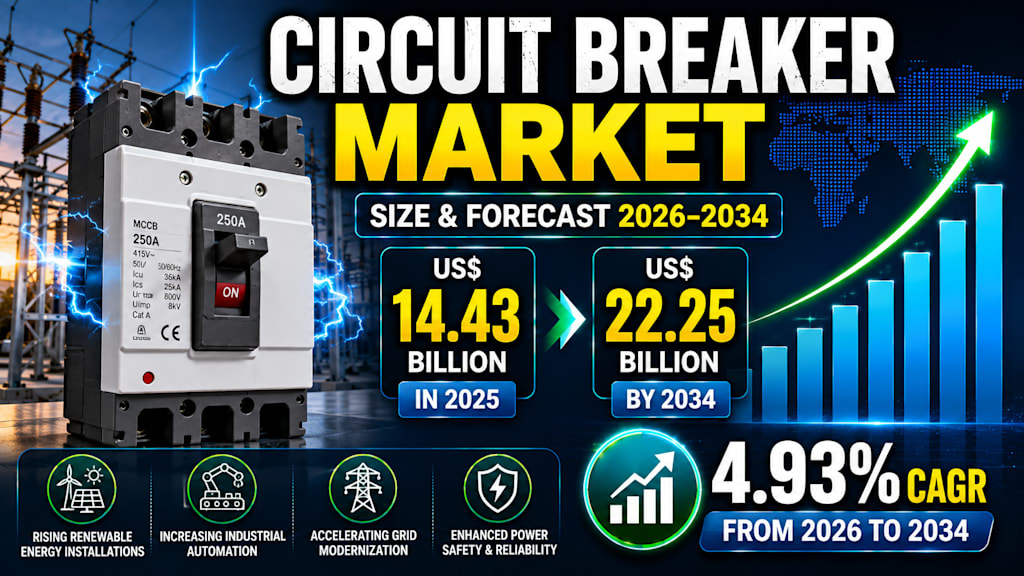
According to Renub Research, the Circuit Breaker Market is expected to increase from US$ 14.43 billion in 2025 to US$ 22.25 billion by 2034, expanding at a compound annual growth rate (CAGR) of 4.93% between 2026 and 2034. Rising renewable energy installations, accelerating industrial automation, and extensive investments in smart grids are among the major factors driving demand worldwide.
As countries invest heavily in energy security, electrification, and sustainable power systems, circuit breakers are becoming more important than ever before.
Why Circuit Breakers Are Essential to Modern Electrical Systems
Circuit breakers are protective electrical devices designed to automatically interrupt current flow when faults occur. These faults may include short circuits, overloads, abnormal voltage fluctuations, or equipment failures.
Their primary function is simple but critical: protect people, equipment, and infrastructure from damage.
Unlike traditional fuses, which must be replaced after activation, circuit breakers can be reset and reused. This capability makes them more practical, cost-effective, and reliable for a wide range of applications.
Circuit breakers are used throughout residential buildings, commercial facilities, industrial plants, power stations, renewable energy installations, and transmission networks. They play a crucial role in maintaining electrical stability and preventing catastrophic failures.
As electrical systems become more interconnected and technologically advanced, the importance of reliable circuit protection continues to increase.
Renewable Energy Is Creating New Demand
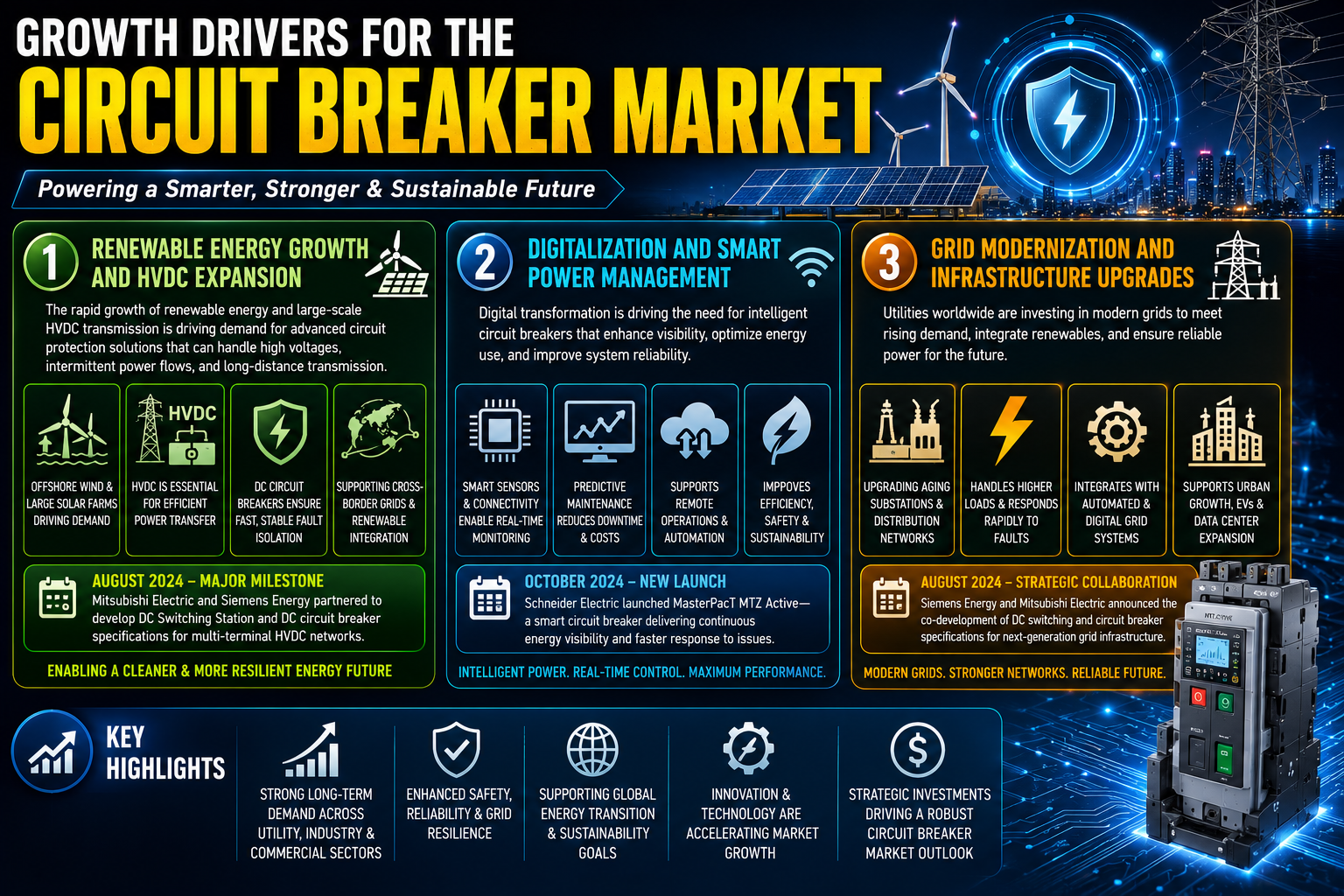
One of the most powerful drivers of growth in the circuit breaker market is the rapid expansion of renewable energy.
Countries around the world are investing heavily in solar farms, offshore wind projects, battery storage facilities, and hybrid energy systems as they pursue decarbonization goals and energy independence.
While renewable energy offers substantial environmental benefits, integrating these resources into existing electrical grids presents unique technical challenges. Renewable generation can be intermittent, creating fluctuations in power flow that require sophisticated protection systems.
High-voltage direct current (HVDC) technology has become increasingly important for transmitting renewable energy over long distances. HVDC systems enable efficient transport of electricity from offshore wind farms, remote solar installations, and cross-border energy networks.
These systems require advanced DC circuit breakers capable of isolating faults rapidly without disrupting overall grid stability.
As renewable energy capacity continues to expand globally, demand for high-performance circuit breakers is expected to rise significantly.
HVDC Networks Are Transforming Power Transmission
Traditional alternating current (AC) transmission systems have served the energy industry for decades. However, modern power networks increasingly rely on HVDC technology to meet growing transmission requirements.
HVDC systems offer several advantages, including lower transmission losses, improved efficiency, and enhanced control over long-distance power flows.
These benefits make HVDC particularly attractive for renewable energy projects and international grid interconnections.
However, protecting HVDC systems requires specialized circuit breaker technologies capable of handling complex fault conditions. Unlike AC systems, DC faults are more challenging to interrupt because current does not naturally pass through zero.
As a result, manufacturers are investing heavily in advanced DC breaker development.
Collaborations between major industry players are accelerating innovation in this field, helping create the next generation of protection systems needed for future power networks.
Digital Transformation Is Reshaping Circuit Protection
The digitalization of electrical infrastructure is fundamentally changing how circuit breakers operate.
Modern facilities increasingly demand intelligent systems capable of monitoring performance, predicting failures, and providing real-time operational insights. Traditional circuit breakers are therefore evolving into connected devices equipped with sensors, communication modules, and analytics capabilities.
Smart circuit breakers can continuously monitor electrical conditions, detect anomalies, and transmit performance data to centralized management systems.
These capabilities enable predictive maintenance, allowing operators to identify potential issues before failures occur. This approach reduces downtime, improves safety, and lowers maintenance costs.
Digital breakers also support remote operation, which is particularly valuable for utilities, industrial facilities, data centers, and critical infrastructure.
As organizations pursue greater operational efficiency and automation, intelligent circuit protection solutions are becoming increasingly attractive.
Smart Grids Are Driving Market Expansion
Smart grid development represents another major growth opportunity for the circuit breaker industry.
Governments and utility companies worldwide are modernizing aging power networks to improve reliability, efficiency, and resilience. Smart grids use digital technologies to monitor and manage electricity flows more effectively.
These advanced systems require circuit breakers capable of integrating seamlessly with automated control platforms.
Smart circuit breakers contribute to grid stability by responding quickly to faults, communicating with control systems, and supporting real-time decision-making.
As power networks become more complex due to renewable energy integration and distributed generation, advanced protection systems are becoming indispensable.
The global transition toward intelligent energy infrastructure is expected to generate sustained demand for modern circuit breaker technologies throughout the forecast period.
Industrial Automation Is Increasing Protection Requirements
Manufacturing facilities and industrial operations are becoming increasingly automated.
Modern factories rely on robotics, advanced machinery, automated production lines, and sophisticated control systems. These technologies require highly reliable electrical infrastructure capable of supporting continuous operations.
Circuit breakers play a critical role in protecting industrial equipment from electrical faults that could disrupt production or damage expensive assets.
As industrial automation expands, facilities are adopting more advanced protection systems that provide enhanced monitoring and diagnostics.
Digital circuit breakers help operators improve equipment reliability while minimizing downtime and maintenance costs.
The growing focus on operational efficiency and predictive maintenance is creating new opportunities for manufacturers offering intelligent circuit protection solutions.
Data Centers Are Emerging as a Key Market
The rapid growth of cloud computing, artificial intelligence, and digital services has fueled unprecedented demand for data centers.
These facilities consume enormous amounts of electricity and require exceptionally reliable power systems. Even brief outages can result in significant financial losses and operational disruptions.
Circuit breakers are therefore essential components within data center electrical infrastructure.
Modern data centers increasingly rely on smart circuit breakers capable of providing detailed energy monitoring, fault detection, and remote management capabilities.
As digital transformation accelerates across industries, demand for reliable power protection in data centers is expected to continue growing rapidly.
Environmental Sustainability Is Influencing Product Development
Sustainability concerns are shaping innovation throughout the circuit breaker industry.
Traditional high-voltage circuit breakers often utilize sulfur hexafluoride (SF₆), a powerful greenhouse gas commonly used as an insulating medium.
Growing environmental awareness and stricter regulations are encouraging manufacturers to develop environmentally friendly alternatives.
New generations of circuit breakers use alternative insulating technologies that significantly reduce environmental impact while maintaining performance and reliability.
These innovations align with broader industry efforts to support sustainable energy systems and reduce carbon emissions.
As environmental regulations become more stringent, demand for eco-friendly circuit breaker solutions is expected to increase substantially.
Challenges Facing the Market
Despite strong growth prospects, the circuit breaker market faces several challenges.
High Capital Costs
Advanced circuit breakers, particularly digital models and HVDC variants, require substantial upfront investment. Utilities and industrial operators often face budget constraints that delay modernization projects.
Installation costs can be significant because upgrading protection systems frequently requires modifications to existing infrastructure.
Supply Chain Volatility
The industry depends heavily on raw materials such as copper, steel, semiconductors, and specialized insulating components.
Global supply chain disruptions, geopolitical tensions, and fluctuations in commodity prices can affect manufacturing schedules and increase production costs.
Smart circuit breakers are particularly vulnerable to semiconductor shortages due to their reliance on advanced electronic components.
Managing these challenges remains a key priority for manufacturers worldwide.
Regional Markets Show Strong Potential
United States
The United States continues to invest heavily in grid modernization, renewable energy deployment, and industrial automation. Aging infrastructure and growing electricity demand are creating strong opportunities for advanced circuit protection technologies.
Germany
Germany's commitment to renewable energy, industrial innovation, and grid modernization supports robust demand for next-generation circuit breakers. The country's focus on HVDC transmission and energy transition initiatives further strengthens market growth.
China
China remains one of the world's largest infrastructure and energy markets. Massive investments in renewable energy, ultra-high-voltage transmission networks, and industrial expansion are driving substantial demand for circuit breakers across all voltage levels.
Saudi Arabia
Saudi Arabia is investing heavily in power infrastructure, renewable energy projects, and smart city developments under Vision 2030. These initiatives are creating significant opportunities for modern circuit protection solutions throughout the Kingdom.
The Future of Circuit Protection
The future of circuit breakers extends far beyond simple fault interruption.
Artificial intelligence, predictive analytics, digital monitoring, and advanced communication technologies are transforming circuit breakers into intelligent assets that contribute directly to operational efficiency and grid stability.
As renewable energy penetration increases and power systems become more decentralized, protection technologies will play an even greater role in maintaining reliability.
Manufacturers are expected to continue investing in digitalization, sustainability, and high-voltage innovation to meet evolving industry requirements.
The circuit breaker of the future will not merely react to faults—it will actively help prevent them.
Final Thoughts
Circuit breakers have long served as the silent guardians of electrical systems, protecting infrastructure from faults and ensuring safe operation. Today, their role is expanding dramatically as renewable energy, smart grids, industrial automation, and digital infrastructure reshape the global energy landscape.
According to Renub Research, the Circuit Breaker Market is forecast to grow from US$ 14.43 billion in 2025 to US$ 22.25 billion by 2034, reflecting the increasing importance of advanced electrical protection technologies.
As governments, utilities, and industries invest in cleaner, smarter, and more resilient energy systems, circuit breakers will remain indispensable. They are no longer simply protective devices—they are becoming intelligent building blocks of the modern power grid and critical enablers of the world's energy future.
About the Creator
Enjoyed the story? Support the Creator.
Subscribe for free to receive all their stories in your feed.
Comments
There are no comments for this story
Be the first to respond and start the conversation.