
Chronic Obstructive Pulmonary Disease (COPD) Market Expands with Smart Inhalers, AI Diagnostics, and Advanced Respiratory Therapies
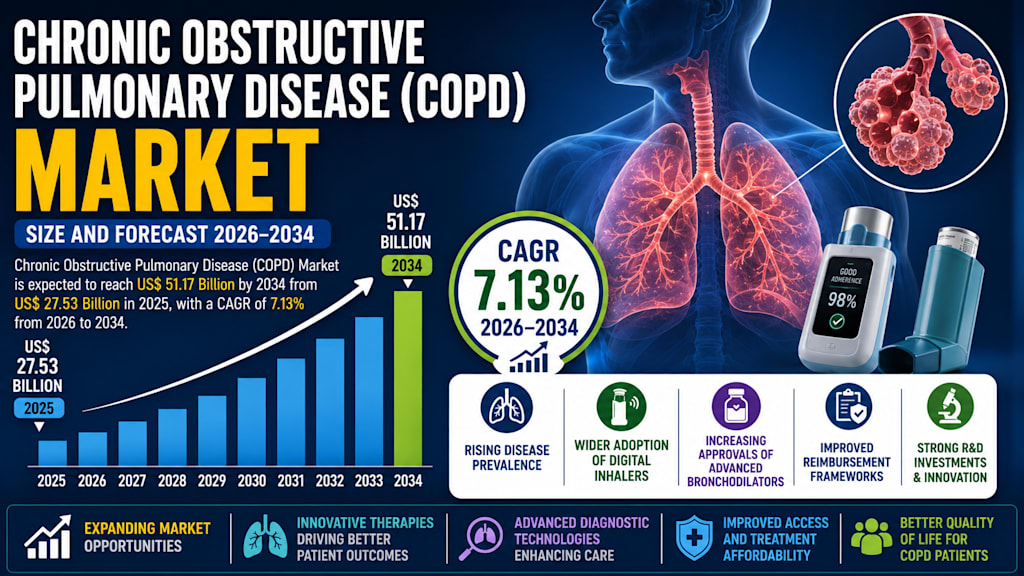
The Chronic Obstructive Pulmonary Disease (COPD) Market is projected to grow from US$ 27.53 billion in 2025 to US$ 51.17 billion by 2034, driven by rising disease prevalence, increasing adoption of digital inhalers, broader access to advanced bronchodilator therapies, and rapid innovation in AI-enabled respiratory diagnostics.

Chronic Obstructive Pulmonary Disease (COPD) Market Overview
The global Chronic Obstructive Pulmonary Disease (COPD) market is witnessing strong growth as healthcare systems increasingly prioritize long-term respiratory disease management, early diagnosis, and digital patient monitoring. COPD is a progressive respiratory condition characterized by airflow limitation, chronic bronchitis, emphysema, breathlessness, persistent cough, and reduced lung function. The disease is primarily associated with cigarette smoking, air pollution, occupational exposure to irritants, and environmental risk factors.
According to the market outlook, the COPD market is expected to expand from US$ 27.53 billion in 2025 to US$ 51.17 billion by 2034, growing at a CAGR of 7.13% during the forecast period. Increasing prevalence of respiratory disorders, rising hospitalization rates, and growing use of digital respiratory technologies are all contributing to market expansion.
Although COPD cannot currently be cured, treatment options such as bronchodilators, inhaled corticosteroids, pulmonary rehabilitation, oxygen therapy, and lifestyle modifications significantly improve disease management and patient quality of life. The industry is also benefiting from advances in AI-driven diagnostics, smart inhalers, adherence-tracking systems, and remote respiratory monitoring technologies.
Smart Inhalers and Digital Respiratory Management
One of the most transformative developments in the COPD market is the growing adoption of smart inhalers and digital adherence systems. Poor medication adherence and incorrect inhaler technique are major contributors to COPD exacerbations and hospitalizations. As a result, healthcare providers and insurers are increasingly supporting connected respiratory devices that can monitor medication usage and improve treatment compliance.
Digital inhalers allow clinicians to track patient adherence in real time and adjust treatment strategies earlier, improving disease control and reducing emergency care utilization. These systems are becoming particularly important within value-based healthcare models where treatment outcomes and adherence metrics are closely monitored.
A major milestone occurred in January 2025 when Teva and Propeller Health launched the connected ProAir RespiClick inhaler across U.S. managed-care networks. The rollout introduced one of the first large-scale respiratory rebate models directly tied to verified patient adherence, strengthening confidence in digital respiratory management solutions.
Expansion of Affordable Dual-Bronchodilator Therapies
Affordability remains a major factor shaping long-term COPD treatment adoption. High prices for branded inhalers and maintenance therapies often limit treatment continuity, especially in lower-income populations and emerging markets. The increasing availability of cost-efficient dual-bronchodilator therapies is helping address this challenge by expanding access to maintenance treatment.
Combination therapies such as LAMA/LABA inhalers are becoming central to modern COPD management because they improve lung function, reduce exacerbations, and support long-term disease control. Governments, insurers, and healthcare systems are increasingly favoring value-based respiratory treatments that maintain effectiveness while reducing overall healthcare expenditure.
In November 2024, Cipla received regulatory approval for its generic tiotropium/olodaterol combination inhaler in India, significantly improving access to dual-bronchodilator therapy across public and private healthcare channels. Similar launches worldwide are expected to improve treatment continuity and reduce healthcare disparities in COPD care.
AI-Enhanced Diagnostics and Advanced Spirometry
Diagnostic technologies are rapidly evolving within respiratory care as healthcare providers seek faster and more accurate COPD detection tools. Traditional spirometry often produces inconsistent results due to patient technique errors, making AI-supported pulmonary diagnostics increasingly valuable.
AI-enabled spirometry systems can instantly identify poor-quality tests, reduce retesting requirements, and improve clinical decision-making. Hospitals and pulmonary clinics are increasingly adopting these technologies to support earlier diagnosis, particularly among high-risk populations such as smokers and elderly patients.
A major innovation occurred in October 2024 when Vyaire Medical introduced its AI-supported Vyntus SPIRO system. Equipped with real-time quality-control algorithms, the device received CE marking and is pursuing FDA 510(k) clearance. The technology improves test reliability by detecting inadequate patient effort and enhancing pulmonary testing accuracy.
Market Challenges
Despite technological advancements, the COPD market continues to face significant challenges. COPD treatment often involves long-term therapy, repeated hospitalizations, and continuous disease monitoring, creating a substantial economic burden for patients and healthcare systems.
Many patients struggle to afford advanced bronchodilator therapies, smart inhalers, pulmonary rehabilitation, and digital monitoring systems. Limited insurance coverage in certain regions further reduces treatment adherence and increases hospitalization rates. Healthcare systems also face rising costs associated with chronic disease management and emergency respiratory care.
Underdiagnosis remains another major challenge. Many patients are diagnosed only after severe exacerbations occur because symptoms overlap with asthma and access to spirometry testing remains limited in rural and low-resource settings. Shortages of trained respiratory technicians and inconsistent screening practices further delay diagnosis and treatment initiation.
United States COPD Market
The United States remains one of the most influential COPD markets globally due to advanced healthcare infrastructure, strong digital-health adoption, and high disease prevalence. According to the CDC, more than 16 million Americans have been diagnosed with COPD, while millions of additional cases remain undiagnosed.
The country is also leading adoption of AI-assisted spirometry systems, connected inhalers, biologics, and remote respiratory monitoring technologies. Strong reimbursement support for digital respiratory management continues to encourage innovation across hospitals, pulmonary clinics, and outpatient care settings.
Germany COPD Market
Germany’s COPD market is supported by comprehensive insurance coverage, strong screening programs, and widespread use of evidence-based respiratory care pathways. Pulmonary rehabilitation, long-acting bronchodilator therapies, AI-enabled diagnostics, and remote monitoring systems are increasingly integrated into routine patient management.
The country’s aging population and ongoing smoking-related disease burden are expected to sustain demand for advanced COPD therapies and respiratory diagnostic technologies over the long term.
China COPD Market
China represents one of the largest growth opportunities within the global COPD market due to its high disease burden and expanding healthcare infrastructure. A systematic review published in 2025 estimated COPD prevalence among Chinese adults aged 40 and older at approximately 12.1% through 2024.
Rapid urbanization, elevated smoking rates, and air pollution continue to contribute to respiratory disease prevalence across the country. Chinese healthcare authorities are strengthening early diagnosis capabilities, spirometry access, pulmonary rehabilitation programs, and long-term disease management systems to improve patient outcomes.
Saudi Arabia COPD Market
Saudi Arabia is increasingly focusing on respiratory disease management as part of broader healthcare modernization under Vision 2030. National awareness campaigns, smoking-cessation programs, and environmental health initiatives are supporting earlier COPD detection and more consistent treatment adoption.
Hospitals and specialty clinics across the Kingdom are increasingly implementing modern spirometry systems, AI-enabled respiratory diagnostics, and connected inhalers to improve disease management and clinical outcomes.
Chronic Bronchitis Market
The chronic bronchitis segment continues to represent a major component of the COPD market. Rising smoking prevalence, occupational exposure to pollutants, and increasing diagnosis rates among aging populations are all contributing to segment growth.
Long-acting bronchodilators, inhaled corticosteroids, fixed-dose combinations, digital spirometry systems, and remote respiratory monitoring technologies are helping improve disease management and reduce exacerbation frequency. Pharmaceutical companies are also investing in anti-inflammatory agents and mucolytics targeting airway obstruction more effectively.
COPD Drugs Market
The COPD drugs market remains one of the most important segments within respiratory therapeutics. Long-acting muscarinic antagonists (LAMAs), LABA/LAMA combinations, inhaled corticosteroids, and next-generation biologics continue to shape modern COPD treatment protocols.
Pharmaceutical companies are increasingly investing in smart inhalers, AI-supported respiratory diagnostics, biologic therapies, and oral maintenance treatments targeting inflammatory pathways. Expanding formulary access and stronger community pharmacy distribution are also improving patient access to respiratory medications.
Hospital Pharmacies Market for COPD Treatments
Hospital pharmacies play a critical role in COPD care by ensuring continuous availability of bronchodilators, rescue medications, nebulized therapies, and biologics for acute and chronic disease management.
Increasing hospitalization rates linked to severe COPD exacerbations are driving higher demand for respiratory medications and advanced inhalation devices. Hospitals are also adopting evidence-based COPD treatment pathways that improve patient outcomes and reduce readmission rates.
Digital inventory systems, automated dispensing technologies, and pharmacist-led patient counseling are strengthening operational efficiency within hospital respiratory-care programs.
Competitive Landscape
The COPD market includes several major pharmaceutical and healthcare companies actively investing in respiratory therapies, biologics, inhalation technologies, and digital respiratory-care platforms. Key companies operating in the market include AstraZeneca, Pfizer Inc., GlaxoSmithKline plc., Novartis AG, Astellas Pharma Inc., Abbott Laboratories, Boehringer Ingelheim International GmbH, and Almirall.
Competition is intensifying as companies expand respiratory pipelines, pursue biologic therapies, strengthen distribution networks, and integrate AI-enabled respiratory management technologies into COPD care ecosystems.
Final Thoughts
The COPD market is evolving rapidly as respiratory care shifts toward digital management, AI-assisted diagnostics, smart inhalers, and personalized maintenance therapy. Rising disease prevalence, aging populations, smoking-related respiratory disorders, and increasing healthcare investments continue to support strong long-term market growth.
Although affordability challenges and underdiagnosis remain significant concerns, advancements in connected respiratory devices, pulmonary diagnostics, biologics, and value-based care models are improving treatment outcomes and patient engagement worldwide. The industry is expected to remain one of the most innovative and fast-growing segments within chronic disease management over the coming decade.
Recent Developments by Companies
Merck & Co. finalized the acquisition of a clinical-stage biotech company focused on respiratory anti-inflammatory therapies in May 2025 through a deal valued at approximately $1.2 billion.
GlaxoSmithKline accelerated integration of its latest respiratory biologics into European hospital formularies in February 2025 to improve inpatient access for severe respiratory disease treatment.
Verona Pharma received FDA approval in October 2024 for its dual phosphodiesterase 3/4 inhibitor, introducing a novel oral maintenance therapy for chronic respiratory conditions.
AstraZeneca announced plans in September 2024 to expand distribution of next-generation inhaled therapies to more than ten thousand additional pharmacies across emerging markets.
Teva and Propeller Health launched the connected ProAir RespiClick inhaler in January 2025 across U.S. managed-care networks with adherence-linked reimbursement models.
Cipla received approval in November 2024 for its generic tiotropium/olodaterol combination inhaler, expanding affordable dual-bronchodilator access within India’s respiratory-care market.
Vyaire Medical introduced the AI-supported Vyntus SPIRO system in October 2024 with real-time spirometry quality-control algorithms and CE certification.
Healthcare systems globally accelerated adoption of AI-assisted spirometry and remote respiratory monitoring technologies to improve COPD diagnosis and disease management during 2025.
Pharmaceutical companies expanded investments in smart inhalers, biologic respiratory therapies, and connected pulmonary care ecosystems to improve long-term adherence and treatment outcomes.
Hospitals and pulmonary clinics increasingly adopted evidence-based COPD treatment pathways, digital pharmacy systems, and automated respiratory medication management technologies throughout 2025.
About the Creator
Enjoyed the story? Support the Creator.
Subscribe for free to receive all their stories in your feed.
Comments
There are no comments for this story
Be the first to respond and start the conversation.