
China’s 4.6% GDP Looks Calm. The Quarterly Curve Tells a Different Story
Front-loaded spending, a mid-year pause, and exports carrying the third quarter explain why Beijing is holding back the big stimulus.
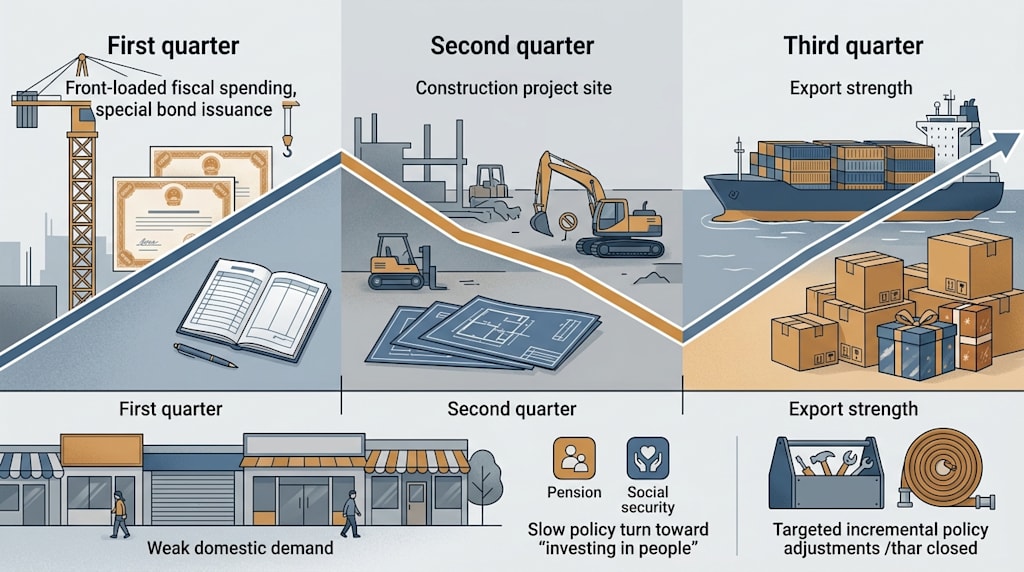
In the first three quarters of 2026, China’s GDP reached 107.1071 trillion yuan, up 4.6% from a year earlier at constant prices. Quarterly growth was 5.0%, 4.3%, and 4.5%. The three numbers together say more than the cumulative 4.6%. The path is uneven because policy made it uneven. Fiscal spending and special bond issuance moved early and pushed the first quarter to 5.0%. Project reserves thinned and bond issuance slowed, so the second quarter fell to 4.3%. Exports then took over in the third quarter and pulled growth back to 4.5%. The shape of the line shows what is holding the year up, where policy has pulled back, and how far down the list domestic demand sits.
1. The quarterly path mirrors the policy calendar
“Front-loading at the start of the year” left hard numbers. New special bonds issued in the first quarter totaled 1.1599 trillion yuan, up 20.8% from a year earlier and about 26.4% of the annual quota. That pace was 4.6 percentage points faster than the same period in 2025. Local government bond issuance reached about 3.1 trillion yuan in the first quarter, a record for the period, and fiscal spending ran at the fastest pace in nearly five years. The logic is simple. Budgets and bond quotas are fixed at the start of the year. Money spent early becomes site work early, and government purchases enter the economy early. The size of that purchase channel in China makes the early push a growth impulse.
“Steadying the middle” also left traces. In the second quarter, new special bond issuance slowed. In the first half, issuance progress for treasury bonds, new general bonds, and new special bonds ran 11, 10, and 3 percentage points behind the same period in 2025. Project reserves and approvals entered a handover period. Fiscal spending weakened. Infrastructure investment slowed. GDP growth fell from 5.0% to 4.3%. This drop does not need a story about a sudden collapse in domestic demand. Domestic demand was weak before the drop, so it added no extra drag at the margin. Government investment and purchases are simply uneven across quarters. The mid-year slowdown is a rhythm effect, not a trend break.
The third quarter returned to 4.5% on export strength. Exports rose 16.4% in the first three quarters. In the third quarter alone, export value passed 8 trillion yuan for the first time and grew 22%. The General Administration of Customs said after the release that export fundamentals in the fourth quarter “have not changed.” Christmas goods and other holiday products kept growing. Yiwu’s Christmas product exports rose 10.9% from January to August. Mechanical and electrical products rose 23.7% and made up 64.3% of exports. Exports filled the gap left by slower government investment and pushed quarterly growth back to 4.5%.
2. The fourth quarter does not need a sprint
Cumulative growth of 4.6% leaves a low bar for the year. If the full-year target is around 4.5%, fourth-quarter growth of about 4.2% would reach the lower bound. Luo Zhiheng of Yuekai Securities put the number at 4.2% for the fourth quarter to support about 4.5% for the year. UOB Kay Hian raised its full-year forecast from 4.2% to 4.5% after the release and noted that third-quarter growth of 4.5% came in slightly above the 4.4% market expectation.
That setting differs from 2024. In 2024, growth was 4.6% in the third quarter and 4.7% in the second, two quarters below the 5% line. The September 24 package followed. In 2026, cumulative growth of 4.6% leaves the target within reach of normal momentum. The case for a repeat of the “924” package is weak on the data.
3. Incremental policy exists, but it is targeted and stock-based
“No extraordinary aggregate stimulus” is often read as “no policy.” That reading misses the list. After the State Council executive meeting in late September promised “a set of pragmatic and effective incremental policies,” several tools landed. The central bank cut the PSL rate from 1.75% to 1.5%, added construction of the “six networks” to PSL support, and raised relending for technology innovation by 200 billion yuan and for agriculture and small business by 500 billion yuan. The Ministry of Finance used 550 billion yuan of unused local government debt limits. Of that, 300 billion yuan of general bonds went to counties and districts for basic needs, and 250 billion yuan of special bonds went to projects under construction and the “six networks.”
Take the tools one by one. The PSL cut lowers funding costs for projects in selected areas. The relending increase adds targeted quotas. The carryover limits use money already approved but not spent. None of the three changes the aggregate policy stance. Each uses existing room. That fits the “leave room for next year’s early push” logic. Using quotas and cutting structural rates provides a floor for tail-end growth without opening a new round of aggregate expansion. Policy has not stopped. It has narrowed its channel.
4. Domestic demand is weak, and policy is moving slowly
The domestic demand numbers are worse than the commentary. Retail sales rose 1.1% in the first three quarters. Goods retail rose 1.0%. Services retail rose 5.0%. Fixed-asset investment fell 7.2%. Infrastructure investment fell 4.2%. Real estate development investment fell 20.6%. The National Bureau of Statistics spokesperson said at the press conference that “the problem of insufficient domestic demand remains prominent.” Demand is weaker than supply. Officials and the market agree on that.
Exports at 16.4% growth and a stable fourth-quarter export outlook gave domestic demand policy room to move slowly. External demand replaced the growth momentum domestic demand would normally provide. Meeting the aggregate target did not depend on a fast recovery in consumption and private investment. That is the direct reason domestic demand policy sits lower on the list. No deeper motive is needed.
The claim that “almost nothing will be done on domestic demand” needs a correction. In 2026, the policy language shifted from “subsidizing consumption” to “investing in people.” A 250 billion yuan ultra-long special treasury bond, 10 billion yuan in special funds to boost domestic demand, an income growth plan for urban and rural residents, a higher minimum pension, and social security improvements were rolled out together. The aim is not to buy a short consumption bump. The aim is to reduce precautionary saving for pension, medical care, and education and to lower uncertainty about future spending. Galaxy Securities noted that a broad consumption recovery still depends on household willingness to spend and that household balance sheets need time to repair. Policy is moving. It is moving through slow variables. The speed and scale are small next to infrastructure or exports. Calling it “completely shelved” misses the turn in direction.
5. The trigger for domestic demand may be slow, not a crisis
The usual sequence says domestic demand reform waits for external demand to weaken, growth to fall, and monetary and fiscal policy to fail. The 2026 data point to another path. If weak domestic demand persists as a chronic drag, slow repair in income expectations and consumer confidence can build pressure to move domestic demand up the list without waiting for an external rupture.
Retail sales near 1% and fixed-asset investment falling for several months do limited damage to the aggregate target. Exports and government investment fill the gap. Those numbers still act on employment quality, small business vitality, and the tax base. Those channels do not show up in quarterly headline GDP. They are the base for growth that lasts. Policymakers do not need to wait for monetary and fiscal policy to fail before turning to domestic demand. Low income expectations already act as a gradual forcing mechanism. It does not arrive as a crisis. It accumulates as a slow variable. The 2026 shift toward “investing in people” reads as an early signal that the accumulation has crossed a threshold. The force is small. The direction has changed.
6. What 4.6% actually says
The meaning of 4.6% is not in the phrase “target met.” It sits in the quarterly path. Fiscal front-loading lifted the first quarter. A slower rhythm pulled the second quarter down. Exports lifted the third. The path shows a structural fact. Exports and government purchases can hold the floor under the aggregate target. They cannot yet replace domestic demand as the base for growth that lasts. Until that changes, the fourth-quarter stance will likely use existing room, target increments, and keep options for next year. A faster domestic demand policy is more likely to come from slow accumulation of insecurity in income and social protection than from a dramatic external shock. Slow variables do not promise to stay mild. They also do not publish quarterly.
About the Creator
Jin
Writer of reamstories
https://reamstories.com/jin
Enjoyed the story? Support the Creator.
Subscribe for free to receive all their stories in your feed. You could also become a paid subscriber, letting them know you appreciate their work.
Comments
There are no comments for this story
Be the first to respond and start the conversation.