
China’s Toys Market Is Growing Up Fast — And Becoming Smarter Than Ever
Educational toys, smart play products, and e-commerce are reshaping one of the world’s largest toy industries.

China’s toy industry is entering a new era
China has long been recognized as one of the world’s biggest toy manufacturing hubs, but the country is now becoming something even more important: one of the fastest-evolving consumer toy markets globally. What was once dominated by low-cost production and traditional play products is rapidly transforming into a highly competitive market driven by educational value, technology integration, digital retail, and changing parenting priorities.
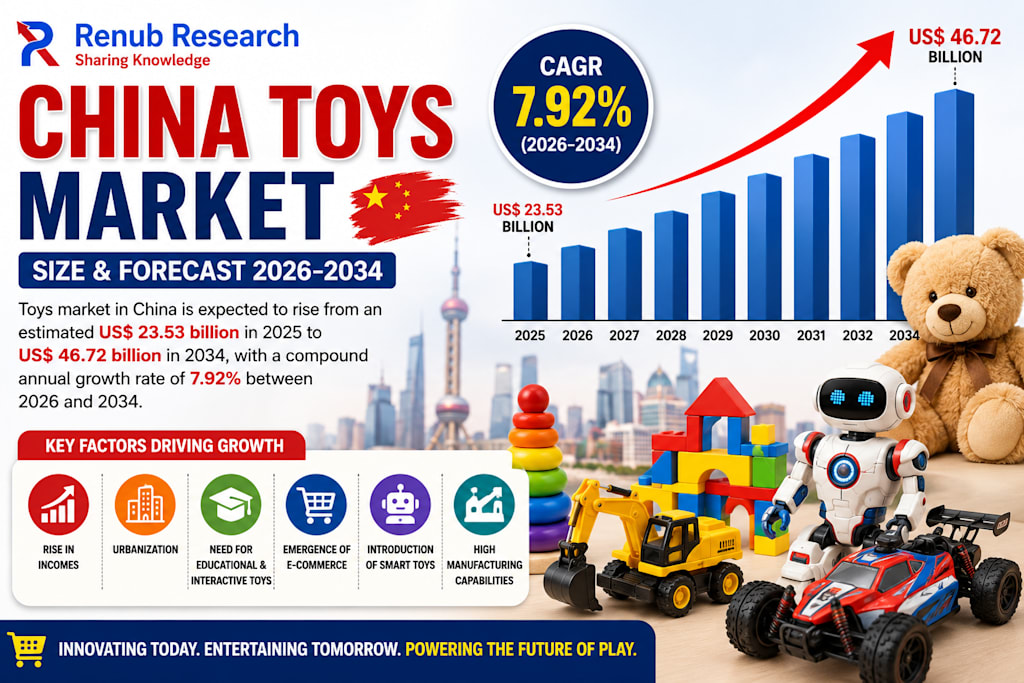
According to Renub Research, the China Toys Market is expected to grow from US$ 23.53 billion in 2025 to US$ 46.72 billion by 2034, expanding at a compound annual growth rate of 7.92% from 2026 to 2034. Rising incomes, rapid urbanization, growing interest in educational toys, and the expansion of e-commerce are all contributing to the market’s strong momentum.
The industry’s evolution says a lot about broader changes happening in Chinese society. Parents today are not only buying toys for entertainment. Increasingly, they are searching for products that support learning, creativity, emotional development, and digital engagement. As a result, toys are becoming smarter, more interactive, and more closely tied to educational outcomes.
Toys are becoming part of child development strategies
The toy category in China has expanded far beyond simple playthings. The market now includes action figures, dolls, puzzles, board games, educational products, construction sets, STEM kits, and technology-enabled smart toys. Toys are increasingly viewed as tools that can help children improve creativity, problem-solving, cognitive abilities, and social interaction.
This shift is closely connected to changing parenting attitudes. As disposable incomes rise and family structures evolve, parents are spending more on products that support child development. The report notes that Chinese consumers are increasingly interested in toys that combine learning and entertainment, reflecting a larger trend toward “play-based education.”
The decline in the number of children per family has also increased spending per child. Many parents are willing to pay higher prices for premium or educational products if they believe those products contribute positively to development and learning.
In urban areas especially, parents are becoming more selective about the kinds of toys they purchase. Rather than buying large quantities of inexpensive toys, many families are focusing on fewer but higher-quality items that deliver educational or developmental value.
Urbanization and rising incomes are reshaping consumer behavior
One of the strongest drivers behind China’s toy market growth is the country’s ongoing urbanization and expanding middle class. The report highlights that China’s urbanization rate reached 67% in 2024, reflecting decades of continuous growth supported by national policy initiatives.
Urban households generally have greater purchasing power, better access to modern retail formats, and stronger exposure to global consumer trends. This creates a favorable environment for premium and innovative toy products.
As incomes rise, parents are increasingly prioritizing spending on children’s products, including toys designed for education, creativity, and skill development. Urban consumers also have easier access to specialty stores, department stores, shopping malls, and digital marketplaces offering a wide variety of local and international toy brands.
The report notes that changing consumer behavior continues to fuel demand for innovative and differentiated products. This is especially important because Chinese parents are becoming more aware of the importance of early childhood development and interactive learning experiences.
Educational and smart toys are becoming major growth engines
One of the most important changes in the market is the rapid rise of educational and smart toys. Parents increasingly want products that improve cognitive skills, imagination, creativity, and problem-solving abilities. STEM toys, puzzles, building kits, and learning-focused games are gaining strong traction, particularly among urban families.
Technology is also transforming the category. Smart toys powered by artificial intelligence, augmented reality, sensors, and interactive features are becoming increasingly popular. These products blend entertainment with learning, creating highly engaging experiences for children.
The report highlights Huawei Technologies’ launch of Smart Hanhan, an artificial intelligence toy that reportedly sold more than 10,000 units in its first week. This reflects growing consumer interest in technology-integrated toys and demonstrates how quickly the smart toy segment is expanding.
Educational competition also plays a role in driving this demand. Chinese parents often place strong emphasis on academic achievement and early learning, making educational toys particularly attractive. Government support for education-focused initiatives further reinforces this trend.
The result is a market where toys are increasingly positioned not just as entertainment products, but as developmental investments.
E-commerce is changing how toys are discovered and sold
China’s highly advanced e-commerce ecosystem is another major factor transforming the toy market. Online retail platforms have made it easier for parents to explore, compare, and purchase products from both domestic and international brands.
Detailed product descriptions, customer reviews, livestream marketing, influencer recommendations, and fast delivery services are helping consumers make more informed purchasing decisions. Smaller toy brands are also benefiting because digital retail allows them to reach nationwide audiences without relying heavily on traditional retail infrastructure.
The report notes that e-commerce growth is helping expand toy sales even in remote areas of the country. This broader accessibility is increasing overall market penetration and creating opportunities for specialized and niche products.
Digital marketing has become especially influential in the toy industry. Social media campaigns, online video content, and influencer-driven promotions are now major tools for driving product awareness among parents and children alike.
The increasing integration of entertainment media with toy marketing is also important. In March 2026, Bonkers Toys announced plans to launch products based on the popular educational YouTube channel “Genevieve’s Playhouse,” showing how digital content is directly influencing toy demand.
Board games and puzzles are making a comeback
While smart toys are growing rapidly, traditional categories are also evolving. Board games, puzzles, and educational tabletop products are experiencing renewed popularity in China. Parents increasingly view these products as healthier alternatives to excessive screen time.
Board games are valued for helping children develop strategic thinking, communication skills, and problem-solving abilities. Schools and educational institutions are also incorporating board games into early learning programs, further supporting demand.
International board game brands and traditional Chinese games are both contributing to market diversity. Manufacturers are responding with more innovative and varied product offerings designed to appeal to broader audiences.
This revival of traditional play reflects an interesting balance within the market. Even as technology-based toys expand, many parents are still searching for products that encourage face-to-face interaction, creativity, and hands-on learning.
Action figures and collectibles are attracting older consumers too
Another important trend is the growth of the action figures and collectibles segment. Toys are no longer aimed exclusively at children. Teenagers, collectors, and adult fans are becoming increasingly important consumer groups.
The popularity of movies, television series, gaming franchises, anime, and digital entertainment has boosted demand for character-based products. Licensed action figures tied to global entertainment brands are especially popular.
Collectors are also contributing to premiumization within the market. Limited-edition products, branded collectibles, and high-quality figures often command higher prices and stronger brand loyalty.
However, counterfeit products remain a challenge in this segment. Authenticity and licensing rights are becoming increasingly important competitive factors for established brands.
Safety and regulation remain major industry challenges
Despite strong growth, the Chinese toy market faces significant challenges, particularly around product safety and regulatory compliance. Parents are increasingly concerned about issues such as harmful chemicals, choking hazards, durability, and overall product quality.
To address these concerns, the Chinese government has introduced stricter safety standards and quality regulations. While these measures improve consumer confidence, they also increase compliance costs for manufacturers.
Smaller companies may struggle to meet these standards consistently, potentially leading to greater market consolidation over time. Companies must invest heavily in testing, quality control, and certification processes to maintain compliance and protect brand reputation.
Competition is another major challenge. The market includes numerous local and international brands competing across price, innovation, quality, and branding. Domestic companies often compete aggressively on price, while international players focus on premium positioning and product differentiation.
Maintaining profitability in such a competitive environment requires continuous innovation and strong marketing strategies.
Regional markets across China are evolving differently
China’s toy market is highly diverse geographically, with different cities and regions showing unique consumer patterns.
Beijing is characterized by strong purchasing power and high demand for educational and premium toys. Parents in the capital place significant emphasis on safety, quality, and learning-focused products. International brands also perform strongly due to global exposure and higher household incomes.
Shanghai’s market is heavily influenced by premiumization and international trends. Consumers in Shanghai are known for seeking innovative, branded, and high-quality products. The city’s advanced retail infrastructure and strong digital adoption make it an important market for premium toy brands.
Tianjin represents a more value-oriented market with growing demand for educational toys and affordable mid-range products. Meanwhile, Guangdong remains one of China’s most important toy hubs because of its manufacturing strength, large population base, and strong integration into global trade networks.
These regional differences highlight how diverse and segmented China’s toy industry has become.
Global brands and local companies are competing aggressively
The competitive landscape includes some of the world’s biggest toy companies, including Mattel, Hasbro, LEGO, Spin Master, VTech, Funko, and JAKKS Pacific.
Global brands bring strong intellectual property, licensed characters, and premium brand recognition. At the same time, domestic companies often move faster in responding to local consumer trends and pricing pressures.
Success in China increasingly depends on combining product innovation, strong digital marketing, localization strategies, and e-commerce capabilities.
The market is also seeing increasing integration between toys, entertainment, education, and technology. Companies that successfully combine these elements are likely to gain significant long-term advantages.
Final thoughts
China’s toy market is evolving far beyond traditional play products. It is becoming a sophisticated industry shaped by education, technology, urbanization, digital commerce, and changing parenting values.
Renub Research’s projection that the market could reach US$ 46.72 billion by 2034 reflects both the scale of consumer demand and the rapid transformation happening within the industry.
The future of the market will likely belong to companies that can deliver safe, engaging, educational, and technology-enhanced products while adapting quickly to changing consumer expectations.
In many ways, the evolution of China’s toy market mirrors broader shifts in modern parenting itself. Toys are no longer viewed simply as entertainment. Increasingly, they are becoming tools for learning, creativity, emotional development, and digital interaction — all packaged inside play.
About the Creator
Enjoyed the story? Support the Creator.
Subscribe for free to receive all their stories in your feed.
Comments
There are no comments for this story
Be the first to respond and start the conversation.