
China Just Halved Another Gas Price Hike. Here’s Why That Matters for Inflation.
Four times in six months, Beijing has cut the formula’s fuel-price increase. The reason runs from the Strait of Hormuz to the price of fertilizer.
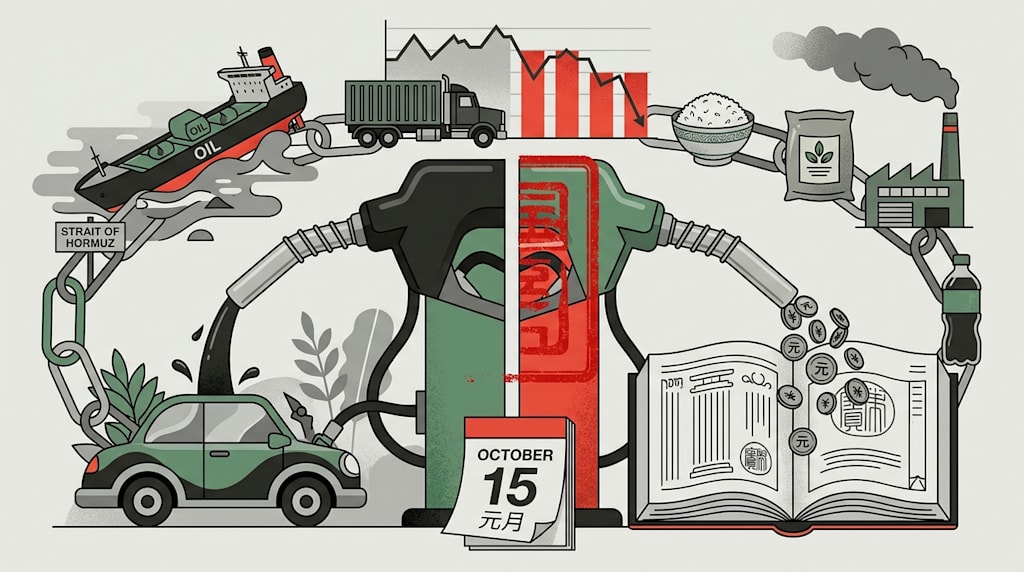
China Halves Another Fuel-Price Increase: Four Cuts in Six Months
The pricing formula called for an 830 yuan-per-ton rise in gasoline. Retail stations will get 395. The gap is a policy choice.
At midnight on Sept. 24, China’s retail gasoline and diesel prices rise again. The National Development and Reform Commission said gasoline should go up by 830 yuan per ton and diesel by 800 yuan under the current pricing formula. The actual increases are 395 yuan and 385 yuan. At the pump, 92-grade gasoline rises by 0.31 yuan per liter, 95-grade by 0.33 yuan, and No. 0 diesel by 0.33 yuan.
The cut is large. Gasoline’s increase was reduced by roughly half. Diesel’s was reduced by roughly half. It is the fourth time in about six months that Beijing has stepped in to compress a fuel-price increase. The commission gave the same reason each time: geopolitical shocks in the Middle East have made international crude prices unusually volatile, and the state wants to slow the pass-through to domestic users.
Four Cuts in Six Months
The sequence matters.
On Feb. 28, the United States and Israel launched military strikes on Iran. Iran closed the Strait of Hormuz, the world’s most important energy chokepoint. Global oil and gas prices jumped.
On March 23, the National Development and Reform Commission announced the first temporary control since China’s current pricing mechanism took effect in 2013. The formula called for gasoline to rise by 2,205 yuan per ton and diesel by 2,120 yuan. The actual increases were 1,160 yuan and 1,115 yuan.
On April 7, the formula called for gasoline to rise by 800 yuan per ton and diesel by 770 yuan. The actual increases were 420 yuan and 400 yuan.
On Sept. 11, the formula called for gasoline to rise by 435 yuan per ton and diesel by 420 yuan. The actual increases were 260 yuan and 250 yuan.
On Sept. 24, the formula called for gasoline to rise by 830 yuan per ton and diesel by 800 yuan. The actual increases were 395 yuan and 385 yuan.
Each time, the state allowed an increase. Each time, it allowed less than the formula required.
For consumers, the difference is visible. A 50-liter tank of 92-grade gasoline costs about 15.5 yuan more than before this adjustment. Without the control, the same fill-up would cost about 15.5 yuan more. A car driven 2,000 kilometers a month at 8 liters per 100 kilometers will pay about 35 yuan more before the next pricing window on Oct. 15. A heavy truck running 10,000 kilometers a month at 38 liters per 100 kilometers will pay about 878 yuan more. Drivers pay these costs. The policy makes them smaller. It does not make them zero.
Why Fight Inflation When CPI Is Near Zero?
China’s consumer price index has hovered near zero. A little inflation can look welcome. The commission’s interventions point the other way. The two kinds of inflation explain the apparent contradiction.
Good inflation comes from demand. Households spend, firms invest, wages rise, and prices move up with growth. Bad inflation comes from a supply shock. An outside force raises costs, firms cannot fully pass them on, profits fall, hiring slows, and consumption weakens. That is the path to stagflation.
The current risk is imported inflation, mainly through cost. Crude oil is the starting point.
Gasoline and diesel are the visible end of the oil chain. They are not the whole chain. Oil products include fuels, solvents, chemical feedstocks, lubricants, paraffin, asphalt, and petroleum coke. The list reaches plastics, synthetic fibers, fertilizer, pesticides, asphalt, and lubricants. Fertilizer matters because its price feeds into grain prices. People can postpone a new phone. They cannot postpone food. When oil rises, the cost of many goods rises with it.
Diesel matters through logistics. Electric trucks are growing, but diesel heavy trucks still carry most road freight, express delivery, and cold chain traffic. At some express companies, diesel heavy trucks account for more than 75% of vehicles at transfer warehouses. Higher diesel prices raise transport costs. Those costs move into goods prices.
Then firms face a choice. If a firm holds its selling price, profit falls. If it raises the price to protect margin, volume falls, and total profit still falls. Falling profit can lead to wage cuts or layoffs. Weaker wages weaken consumption. That is cost-push inflation plus weak demand.
Two data points show the tension. China’s CPI in 2026 is mild. In 2025 it was weaker. Retail sales growth has slid through the year. In May, it turned negative, a rare reading. Adjust for inflation, and more months would be negative. The economy needs demand-driven reflation. A cost shock that raises prices while cutting purchasing power does the opposite.
The Buffer and Its Cost
The commission’s tool is a partial pass-through. The formula produces a number. The state then reduces it. In this round, gasoline’s increase was cut by 435 yuan per ton, diesel’s by 415 yuan. On Sept. 11, the gasoline cut was about 175 yuan per ton. The buffer is now roughly 2.5 times larger. The state is absorbing more of the shock.
Refiners buy crude at international prices and sell refined products at controlled domestic prices. When the buffer grows, their margin is squeezed. The state protects downstream users, including drivers, truck fleets, factories, and households, from the full impact of the shock. Refiners or the budget absorb the cost. Sometimes both do.
What Happens If Prices Float
One answer is to let domestic prices follow the market. The U.S. case shows the difficulty. Washington would like to cut rates. High rates have weighed on the government and households. Oil-driven inflation has pushed prices back up. The Federal Reserve recently chose to hike instead. With inflation from energy, cutting and hiking both hurt.
Japan, after decades near zero rates, has also begun to hike as imported inflation pressures prices. If China followed with higher rates, mortgage payments would rise. Consumption would be squeezed further. The government, which needs to borrow for debt resolution and stimulus, would pay more to borrow. A fully market-priced fuel system would give cleaner price signals. It would also remove a buffer at the moment when the external shock is strongest. The fuel-price control mechanism is one of the few parts of the imported-inflation chain that can be managed directly.
The Next Window
Several analysts expect the next adjustment to be a cut.
Wang Xueqin of Zhuochuang Information said the current cycle began with Middle East tension: the Strait of Hormuz remained tense, Saudi Arabia’s Red Sea crude pipeline was disrupted, and oil hit a four-month high. Later, expectations of a Federal Reserve rate hike and hopes for de-escalation pulled oil back. The domestic crude change rate stayed positive, so retail prices still rose this round. For the next cycle, the fall in oil prices will be counted.
Li Yan of Longzhong Information said the next cycle starts with a downward bias. The U.S. and Iran have not reached a deal, but multiple parties are pushing for de-escalation. Before the U.S. midterm elections, violent geopolitical swings are less likely. He expects the next retail adjustment to be a cut.
Wang Yanting of JLC said the change rate will turn negative, around -4% on the first working day, pointing to a cut of about 210 yuan per ton. Zhuochuang analysts noted that Iran is attending the UN General Assembly. Its tone remains tough, but it has signaled that diplomacy is possible. One round of talks has taken place. President Trump has said a second round may be arranged soon. Crude prices face downward pressure. On current prices, the new change rate starts negative, and retail fuel prices are expected to fall.
The next window opens on Oct. 15. A cut is likely. The larger picture is less certain. The Strait of Hormuz is not fully open. The global supply gap has narrowed from about 700,000 barrels per day in March to about 100,000 barrels per day in the third quarter, but the risk has not disappeared. Oil is more likely to stay in a wide, high band than to fall back to pre-conflict levels.
The Next Test
The four interventions slow the increase. They do not block it. A full pass-through would send higher costs through truck fleets, factories, and food. A full freeze would squeeze refiners and risk supply. Halving the increase splits the difference. It uses a measurable buffer to slow the transmission chain from crude oil to retail prices.
That buffer has limits. It depends on how long the Strait of Hormuz stays disrupted and whether the U.S. and Iran move from talks to a deal. For now, the state has delayed the full pass-through. The next test comes on Oct. 15. Early estimates point down. The Strait of Hormuz will decide how long that lasts.
About the Creator
Jin
Writer of reamstories
https://reamstories.com/jin
Enjoyed the story? Support the Creator.
Subscribe for free to receive all their stories in your feed. You could also become a paid subscriber, letting them know you appreciate their work.
Comments
There are no comments for this story
Be the first to respond and start the conversation.