
China In Vitro Fertilization Market Outlook 2026–2034: How Changing Demographics and Advanced Reproductive Technologies Are Driving Growth
Rising infertility rates, delayed parenthood, supportive fertility policies, and cutting-edge reproductive innovations are transforming China's IVF industry and creating significant opportunities for long-term market expansion.

China is undergoing a profound demographic transformation. Declining birth rates, delayed marriages, changing family structures, and increasing infertility rates are creating new challenges for both policymakers and healthcare providers. As more couples face difficulties conceiving naturally, assisted reproductive technologies are becoming an increasingly important part of the country's healthcare landscape.
Among these technologies, In Vitro Fertilization (IVF) has emerged as one of the most effective and widely adopted fertility treatments. Once considered a specialized medical procedure accessible to only a limited number of patients, IVF is now becoming a mainstream solution for couples seeking to overcome infertility and achieve parenthood.
Growing awareness of reproductive health, expanding fertility infrastructure, supportive government policies, and continuous technological innovation are accelerating market growth throughout the country.
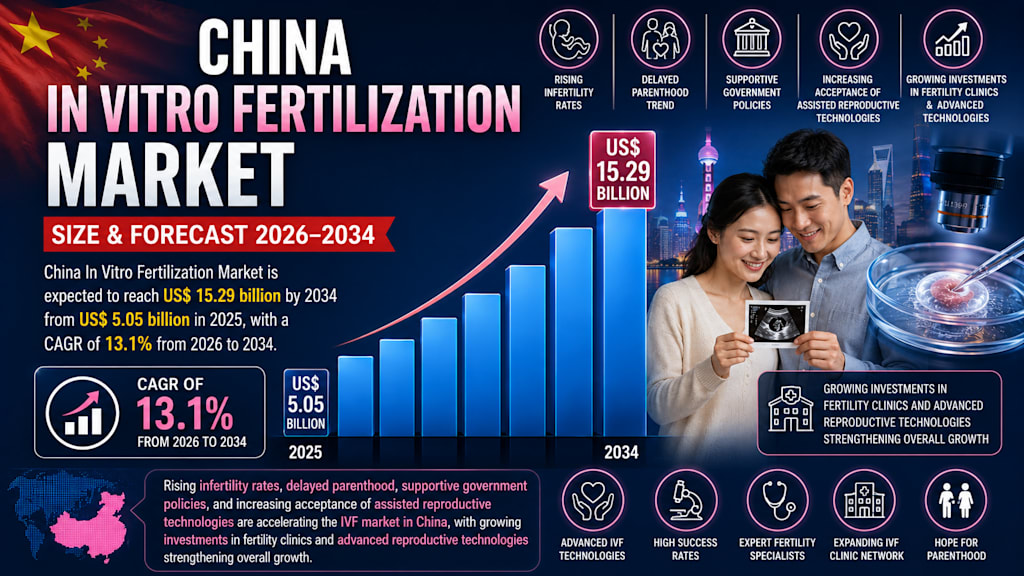
According to Renub Research, the China In Vitro Fertilization Market is expected to grow from US$ 5.05 billion in 2025 to US$ 15.29 billion by 2034, registering an impressive compound annual growth rate (CAGR) of 13.1% from 2026 to 2034. Rising infertility rates, delayed parenthood, favorable demographic policies, and increasing acceptance of assisted reproductive technologies continue to drive this rapid expansion.
As China seeks solutions to demographic challenges while improving access to advanced reproductive care, the IVF market is positioned for substantial growth over the coming decade.
Understanding IVF and Its Growing Role in Modern Healthcare
In Vitro Fertilization, commonly known as IVF, is an assisted reproductive technology that involves combining an egg and sperm outside the body within a laboratory environment. Once fertilization occurs and embryos begin developing, selected embryos are transferred into the uterus with the goal of achieving a successful pregnancy.
IVF is commonly used to address a wide range of infertility conditions. These may include blocked fallopian tubes, ovulation disorders, low sperm count, unexplained infertility, genetic disorders, and age-related fertility decline.
The IVF process typically includes ovarian stimulation, egg retrieval, laboratory fertilization, embryo culture, and embryo transfer. Over time, advances in reproductive medicine have significantly improved both treatment outcomes and patient experiences.
Technologies such as preimplantation genetic testing (PGT), frozen embryo transfer, embryo cryopreservation, and time-lapse embryo monitoring have increased success rates while helping physicians identify healthier embryos for implantation.
These innovations have transformed IVF from an experimental procedure into a highly sophisticated medical solution capable of helping millions of individuals achieve their reproductive goals.
Rising Infertility Rates Are Increasing Demand
One of the strongest drivers of China's IVF market is the growing prevalence of infertility among both men and women.
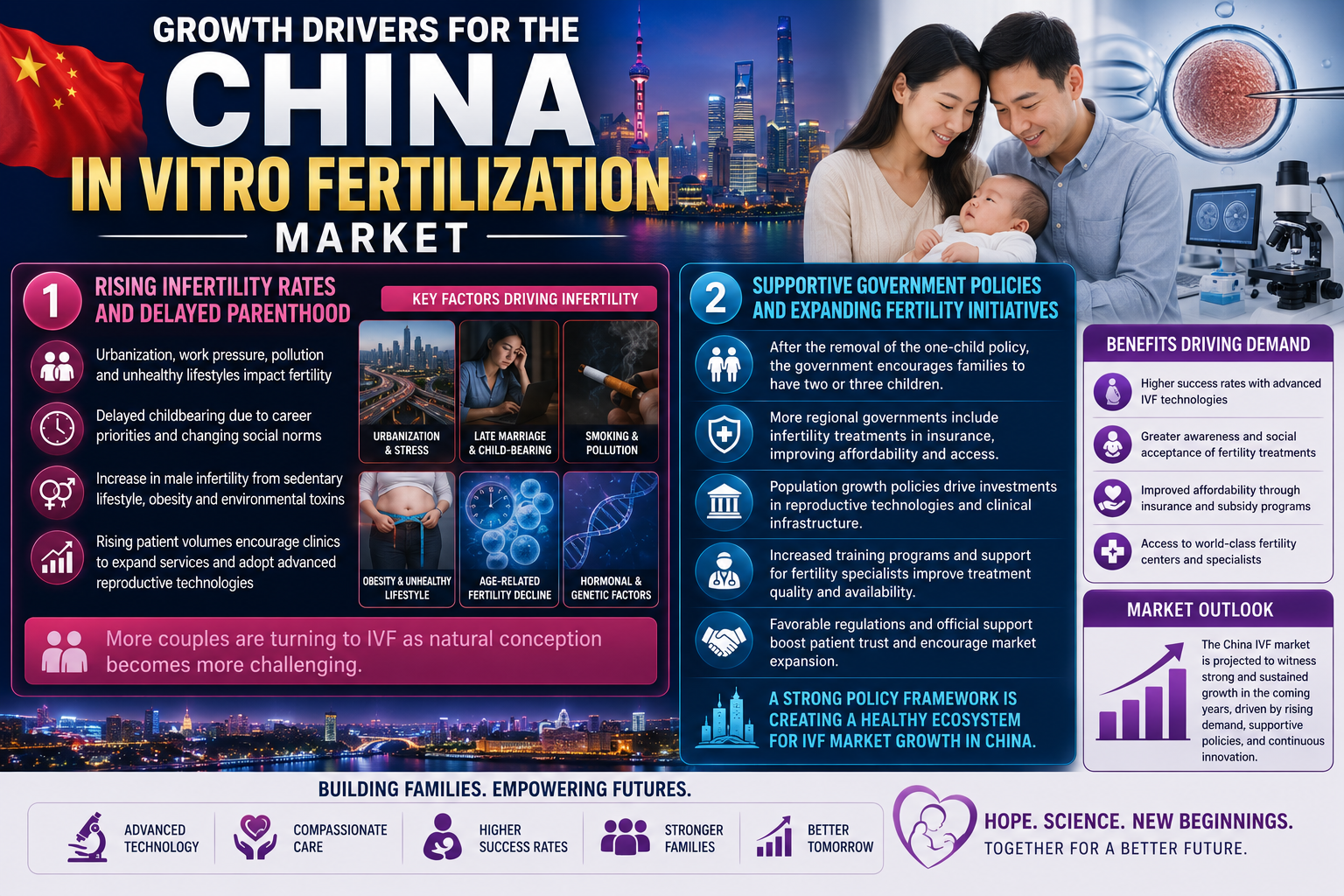
Rapid urbanization, demanding work schedules, environmental pollution, lifestyle changes, and increasing stress levels have contributed to declining reproductive health across the country. Many couples are now facing fertility challenges that were less common in previous generations.
Delayed parenthood has become particularly influential. As educational attainment rises and career priorities become more important, many individuals choose to start families later in life. Unfortunately, fertility naturally declines with age, increasing the likelihood that couples will require medical assistance to conceive.
Male infertility has also become a growing concern. Sedentary lifestyles, obesity, smoking, environmental toxins, and stress-related health issues are contributing to declining sperm quality and reproductive performance.
These demographic and lifestyle trends continue generating substantial demand for fertility treatments and reproductive healthcare services throughout China. Fertility clinics across the country are reporting increasing patient volumes, encouraging healthcare providers to expand services and invest in advanced reproductive technologies.
Government Policies Are Supporting Market Expansion
Government policy has become another important factor supporting growth within China's IVF market.
For decades, population-control measures significantly shaped China's demographic structure. However, concerns regarding declining birth rates and an aging population have prompted major policy changes.
The removal of the one-child policy and subsequent encouragement of two-child and three-child families have increased public discussion surrounding fertility and reproductive health. These changes have also contributed to greater acceptance of assisted reproductive technologies.
Several regional governments have introduced initiatives designed to improve access to fertility treatments. In some areas, infertility-related services have been incorporated into healthcare reimbursement programs, helping reduce financial barriers for patients.
Public support for population growth has also encouraged investments in reproductive healthcare infrastructure, fertility research, and professional training programs for reproductive specialists.
As policymakers continue seeking ways to address demographic challenges, supportive regulations and fertility-focused initiatives are expected to remain important contributors to market growth.
Technological Innovation Is Improving IVF Outcomes
Technology continues to play a transformative role within the IVF industry.
Modern fertility clinics increasingly utilize advanced laboratory systems, artificial intelligence, genetic testing technologies, and automated monitoring tools to improve treatment effectiveness.
Preimplantation genetic testing allows specialists to screen embryos for certain genetic abnormalities before implantation, helping improve success rates and reduce the risk of inherited disorders.
Time-lapse embryo monitoring systems provide continuous observation of embryo development without disrupting laboratory conditions. These systems generate valuable data that assists embryologists in selecting the most viable embryos for transfer.
Artificial intelligence is also becoming increasingly important within fertility medicine. AI-powered algorithms can analyze embryo development patterns, predict implantation potential, and support clinical decision-making.
Cryopreservation technologies have improved dramatically as well, enabling safe storage of eggs, sperm, and embryos for future use. Frozen embryo transfers now play a major role in IVF treatment strategies and contribute significantly to improved patient outcomes.
As technological innovation continues accelerating, Chinese fertility clinics are increasingly adopting advanced solutions that enhance efficiency, safety, and success rates.
Expanding Fertility Infrastructure Is Strengthening Access
China's fertility treatment infrastructure has expanded considerably in recent years.
The number of specialized fertility hospitals, reproductive medicine centers, and IVF clinics continues growing as demand increases across the country. Public and private healthcare providers alike are investing in modern facilities equipped with advanced laboratory technologies and highly trained specialists.
Many clinics now offer comprehensive reproductive health services that include fertility assessments, IVF procedures, genetic screening, fertility preservation, and counseling programs.
International collaborations are also helping improve standards of care. Partnerships with global reproductive technology companies provide Chinese clinics with access to advanced equipment, laboratory protocols, and innovative treatment methodologies.
As fertility infrastructure continues expanding, patients gain greater access to high-quality reproductive healthcare services throughout the country.
Challenges Facing the China IVF Market
Despite strong growth prospects, the industry faces several important challenges.
One of the most significant barriers remains the high cost of treatment. IVF procedures require specialized laboratory facilities, advanced technologies, medications, and highly trained medical professionals, all of which contribute to substantial expenses.
Many patients require multiple treatment cycles before achieving a successful pregnancy, increasing financial burdens further. Although some regions have expanded insurance coverage for fertility treatments, many patients continue facing significant out-of-pocket costs.
Economic pressures and rising living expenses in major urban centers can make treatment difficult for middle-income families, limiting broader market accessibility.
These affordability concerns remain one of the primary obstacles to wider adoption of IVF services across China.
Regional Access Remains Uneven
Another challenge involves disparities in access to fertility care between different regions.
Major metropolitan areas such as Beijing, Shanghai, and Shenzhen are home to advanced fertility hospitals and highly experienced reproductive specialists. However, many rural and less-developed regions still lack access to specialized IVF services.
As a result, patients often travel long distances to receive treatment, increasing costs and creating additional emotional and logistical challenges.
High patient demand at leading fertility centers can also result in longer waiting times for consultations and procedures.
Addressing these disparities will require continued investment in healthcare infrastructure, professional training programs, and regional fertility-care expansion initiatives.
Shanghai: A Leading IVF Hub
Shanghai represents one of China's most advanced IVF markets.
The city benefits from world-class healthcare infrastructure, high household incomes, and strong demand for reproductive technologies. Delayed parenthood among highly educated professionals has contributed significantly to increasing fertility-treatment demand.
Shanghai's fertility centers are known for adopting advanced technologies and maintaining high clinical standards. The city also attracts patients from neighboring provinces seeking specialized reproductive care.
Government support, ongoing technological investment, and growing public awareness continue strengthening Shanghai's position as a leading IVF destination.
Beijing: Driving Innovation in Reproductive Medicine
Beijing remains one of China's most influential centers for reproductive healthcare and fertility research.
The city hosts many of the country's leading medical institutions, research organizations, and specialized fertility clinics. Advanced services such as preimplantation genetic testing, embryo cryopreservation, and AI-assisted embryo assessment are widely available.
Strong government support for healthcare innovation and growing awareness of fertility treatment options continue driving market growth throughout the capital region.
Patients from across northern China frequently travel to Beijing to access specialized reproductive services and expert medical care.
Shenzhen: Technology and Fertility Care Converge
Shenzhen's IVF market has expanded rapidly alongside the city's broader technological and economic development.
As one of China's leading innovation centers, Shenzhen integrates advanced digital health technologies into fertility treatment programs. Artificial intelligence, laboratory automation, and data-driven reproductive medicine are increasingly common within the city's fertility clinics.
A young professional workforce, high urbanization levels, and delayed childbearing patterns contribute significantly to treatment demand.
Private healthcare providers continue investing heavily in reproductive services, making Shenzhen an increasingly important market within China's fertility landscape.
Market Segmentation and Industry Structure
The China IVF market encompasses various treatment approaches and technologies designed to address diverse fertility needs.
Treatment categories include fresh embryo transfers, frozen embryo transfers, donor egg programs, and other specialized fertility procedures. Instrument segments include culture media, disposable devices, and advanced laboratory equipment used throughout the IVF process.
Procedural categories primarily include Intracytoplasmic Sperm Injection (ICSI IVF), conventional non-ICSI IVF, and related assisted reproductive techniques.
Fertility clinics remain the dominant end-user segment due to their specialized expertise and dedicated reproductive-care services, although hospitals and other healthcare providers also contribute significantly to market activity.
Competitive Landscape
Competition within China's IVF market continues intensifying as both domestic and international organizations expand their presence.
Major industry participants include Vitrolife, Cloudnine, Nova IVI Fertility, Monash IVF, Maria Fertility Hospital, Bangkok Fertility Center, and EMD Serono. These organizations focus on improving clinical outcomes, expanding treatment accessibility, and introducing advanced reproductive technologies that enhance patient experiences.
Investments in laboratory innovation, genetic testing, artificial intelligence, and fertility preservation technologies continue shaping the competitive environment and supporting long-term industry growth.
Final Thoughts
China's IVF market is experiencing rapid growth as changing demographics, rising infertility rates, supportive government policies, and technological innovation reshape the reproductive healthcare landscape. Assisted reproductive technologies are becoming increasingly important as more couples seek solutions to fertility challenges while pursuing family-building goals.
With advanced technologies improving treatment outcomes and continued investment strengthening healthcare infrastructure, the industry is well positioned for long-term expansion. As awareness grows and accessibility improves, IVF is expected to play an increasingly vital role in addressing China's evolving demographic and healthcare needs.
With the market projected to rise from US$ 5.05 billion in 2025 to US$ 15.29 billion by 2034, China's IVF industry represents one of the fastest-growing segments within the country's healthcare sector and a significant opportunity for future innovation and investment.
About the Creator
Enjoyed the story? Support the Creator.
Subscribe for free to receive all their stories in your feed.
Comments
There are no comments for this story
Be the first to respond and start the conversation.