
Ceiling Fans Market Is Quietly Reinventing Itself as Smart Homes, Energy Savings, and Urban Growth Take Center Stage
From affordable cooling to stylish, connected home design, ceiling fans are no longer a basic utility item—they are becoming a smarter, more efficient part of modern living.

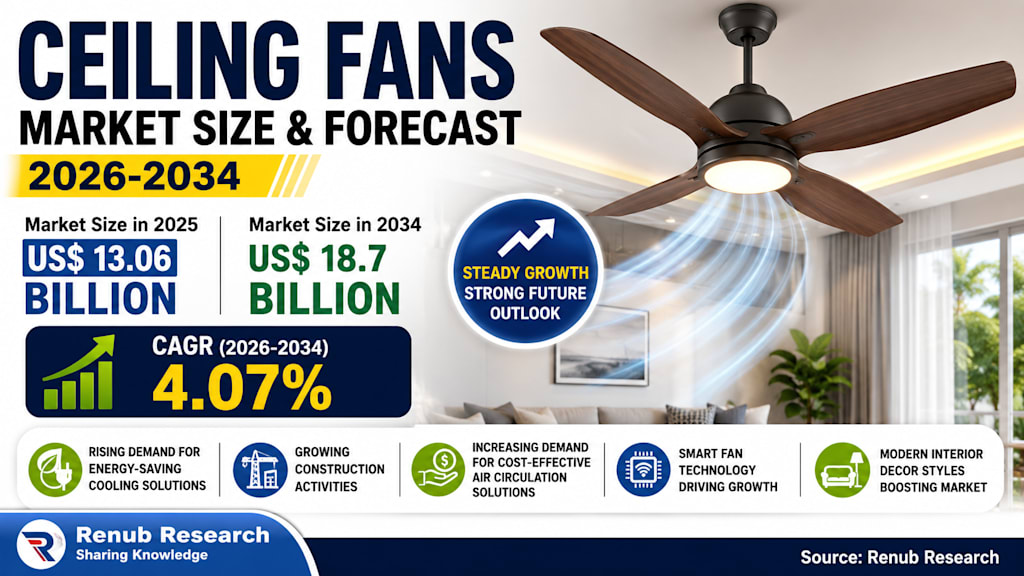
The global ceiling fans market is entering a fresh growth phase. What was once seen as a simple household appliance is now being reshaped by changing consumer preferences, rising electricity costs, expanding construction activity, and a growing appetite for smart home products. According to Renub Research, the global ceiling fans market is expected to rise from US$ 13.06 billion in 2025 to US$ 18.7 billion by 2034, expanding at a CAGR of 4.07% from 2026 to 2034.
That growth story makes sense when you look at how people live today. In hot climates, ceiling fans remain a practical necessity. In urban homes, they are part of everyday comfort. In design-conscious households, they are also becoming décor elements. And in energy-aware markets, they are increasingly being chosen as a lower-cost alternative to air conditioning.
A product that still matters in a changing world
The ceiling fan has survived wave after wave of home technology because it solves a timeless problem: keeping indoor spaces comfortable without consuming too much power. Unlike an air conditioner, a fan does not reduce room temperature. Instead, it improves air circulation and creates a cooling sensation through wind chill. That basic function is exactly what keeps it relevant in homes, schools, offices, restaurants, and commercial spaces.
This simplicity is part of the product’s strength. Ceiling fans are affordable, relatively easy to install, and widely available in different sizes and designs. In countries with warm weather for much of the year, they are not just backup appliances—they are everyday essentials. Even in milder climates, they remain useful for ventilation and comfort, especially when energy bills are high and consumers are looking for practical alternatives to intensive cooling systems.
What is changing is the way people judge value. The buyer today is not just asking whether a fan moves air. The buyer is asking whether it saves electricity, matches interior style, runs quietly, connects to smart devices, and offers better long-term performance. That shift is transforming the market from a commodity segment into a more innovation-driven category.
Energy efficiency is becoming a buying decision
One of the strongest forces behind market growth is the rising demand for energy-efficient cooling solutions. Electricity prices have climbed in many regions, and households are becoming more sensitive to monthly power costs. In that environment, ceiling fans offer a clear advantage: they consume far less electricity than air conditioners while still improving comfort.
This is where the category has a strong narrative advantage. Energy-efficient ceiling fans, especially those using brushless DC motor technology, are becoming increasingly attractive because they can deliver high airflow with lower power use. Many of these models also produce less heat and operate more quietly, which adds to the user experience.
This matters at a time when consumers are thinking more carefully about energy use and environmental impact. Governments and environmental organizations are also encouraging the adoption of efficient appliances. That combination of financial and environmental motivation is giving the ceiling fans market a strong tailwind.
The appeal is especially visible in warm regions where fans are used for long periods throughout the year. In such markets, even a small improvement in power efficiency can translate into meaningful savings. That is why energy-saving ceiling fans are no longer a niche product line; they are becoming a central growth driver.
Construction activity is creating a steady base of demand
Another major reason the market is expanding is the rise in residential and commercial construction. Whenever new homes, apartments, office buildings, hotels, restaurants, or public facilities are developed, ceiling fans often remain part of the basic furnishing package. They are installed not only for comfort, but also because they provide a dependable and economical form of cooling.
Urbanization is accelerating construction across many countries. As more people move into cities, the demand for new housing and supporting infrastructure rises as well. That creates a dependable installed base for ceiling fans. Unlike many consumer products that depend heavily on replacement cycles, ceiling fans benefit from both new construction and ongoing renovation.
Large-scale infrastructure and data center development also reinforce this trend. New buildings require ventilation solutions, and ceiling fans often remain a practical choice in spaces where steady air movement is needed. In commercial environments, they can help reduce strain on air-conditioning systems by circulating cooler air more effectively.
For manufacturers, this means the market is not driven by one single buying reason. It is supported by a mix of new construction, replacement demand, and modernization trends. That makes the category more resilient than it may appear at first glance.
Smart ceiling fans are redefining the category
The most important shift in the ceiling fan market may be the rise of smart technology. Modern fans are no longer limited to wall switches and manual speed settings. Today’s products can include remote control, app-based operation, voice assistant compatibility, lighting integration, timers, and automatic speed adjustment based on room temperature.
This is changing how consumers think about the product. A smart ceiling fan is not just a cooling device; it is part of a connected home ecosystem. For homeowners investing in smart speakers, smart lighting, and automated climate control, a ceiling fan with connectivity features feels like a natural extension of the household.
Motor innovation is also improving the category. Brushless DC motors are becoming more common because they are energy efficient and quieter than traditional alternatives. That is an important upgrade for consumers who want comfort without the hum and energy waste associated with older fans.
Design is playing a bigger role too. People increasingly want products that match their interiors. That has led to more decorative fans, customized finishes, premium blade shapes, and a greater range of style-led options. In the past, ceiling fans were often treated as purely functional. Today, many shoppers expect them to contribute to the look of a room.
This blend of technology and aesthetics is one of the most interesting changes in the market. It opens the door to higher-value products and gives manufacturers more room to differentiate.
Decorative and energy-saving segments are growing in importance
As the market matures, specific product categories are gaining momentum. Decorative ceiling fans are becoming popular in homes, hotels, restaurants, and luxury spaces where appearance matters as much as performance. These fans often feature elegant finishes, unique blade designs, and integrated lighting that makes them feel closer to décor items than simple appliances.
The energy-saving segment is another major opportunity. Consumers who are worried about rising electricity costs are increasingly willing to pay for fans that consume less power over time. In many households, the purchase decision is now based on total cost of ownership rather than just the upfront price.
This is a meaningful shift. A low-cost fan may seem attractive at first, but if a more efficient model can cut electricity use and operate more quietly, many consumers will consider the higher initial investment worthwhile. That logic is especially strong in markets where fans run for long hours each day.
Size also matters. Medium ceiling fans remain a practical choice for bedrooms, living rooms, dining spaces, and offices because they balance coverage with compact design. Small and large formats also have their place, but the middle of the market tends to be the most versatile. That versatility helps keep the category broad and stable.
Residential demand continues to anchor the market
Residential use remains one of the biggest pillars of the ceiling fans market. In homes, fans are valued for being affordable, dependable, and easy to use. They are commonly installed in living rooms, bedrooms, kitchens, and common spaces where air circulation matters.
What makes residential demand especially strong is the way consumer expectations have evolved. Homeowners no longer want plain, utilitarian fixtures. They want fans that are efficient, visually appealing, and equipped with useful features such as remote controls, dimmable lights, and smart functions.
This is particularly visible in renovation activity. As people upgrade older homes or furnish new apartments, ceiling fans are often part of the decision-making process. In many cases, they are chosen before more expensive cooling systems because they offer comfort at a lower operating cost.
Residential growth also benefits from broader social trends. Rising disposable income, urban expansion, and increasing awareness of energy savings all support consumer spending on better appliances. In this sense, ceiling fans remain a classic example of a product that is simple in function but highly responsive to lifestyle changes.
Regional markets show different patterns of demand
The global ceiling fans market is diverse, and regional conditions shape buying behavior in important ways.
In the United States, the market is well established and continues to benefit from demand for energy-saving, stylish, and smart home-compatible products. Ceiling fans are widely used in homes, restaurants, offices, and hospitality settings, especially in warmer states where air circulation helps reduce dependence on air conditioning.
In the United Kingdom, demand is more gradual but still growing. Although the climate is generally milder, hotter summers and occasional heatwaves are making cooling solutions more relevant. Decorative fans are also becoming popular because they combine design and function, especially in modern homes and renovated spaces.
In India, the market is especially strong because of the climate. Ceiling fans are a household staple and are commonly used in homes, schools, offices, and shops. The combination of hot weather, urbanization, and rising purchasing power keeps demand high. BLDC motor adoption and decorative styles are adding a new premium layer to a traditionally mass-market category.
In Saudi Arabia, ceiling fans are often used alongside air conditioners to improve air circulation and reduce cooling load. They are also finding a place in homes, warehouses, restaurants, and outdoor spaces. As construction continues and interior design trends evolve, the market is gaining more room to grow.
These regional differences matter because they show that the market is not dependent on a single use case. In some places, fans are primary cooling devices. In others, they are complementary comfort products. In both cases, they remain relevant.
The market still faces real challenges
Even with positive growth signals, the ceiling fans market is not without pressure. The most obvious challenge is competition from air conditioning systems. Air conditioners can lower indoor temperatures more effectively, which makes them attractive in many urban and premium settings.
That competition is especially intense in markets where AC prices have fallen or where consumers increasingly view cooling as a lifestyle purchase rather than a basic utility. Ceiling fans must therefore compete on cost, efficiency, and design rather than on raw cooling power.
Seasonality is another limitation. Fans are most useful in warm weather and less relevant in colder regions or colder seasons. That creates demand fluctuations and can affect sales patterns throughout the year. Humid climates may also reduce the perceived effectiveness of fans compared with other cooling methods.
Still, these challenges do not erase the category’s value. Instead, they explain why manufacturers are focusing so heavily on innovation. Better motors, smarter controls, and more attractive designs are helping ceiling fans stay competitive in a market that is much more demanding than it used to be.
Final Thoughts
The ceiling fans market is no longer just about spinning blades and basic air circulation. It is evolving into a category shaped by energy efficiency, smart technology, interior design, and urban growth. The Renub Research outlook points to solid expansion ahead, with the market expected to reach US$ 18.7 billion by 2034 from US$ 13.06 billion in 2025.
What makes this market interesting is its balance of tradition and transformation. Ceiling fans have been around for generations, yet they are still adapting to modern expectations. They are becoming quieter, smarter, more efficient, and more stylish. That combination gives the category durability.
For consumers, the message is simple: the ceiling fan is still one of the most practical comfort products in the home. For manufacturers, the opportunity is equally clear: the future belongs to products that offer more than airflow. It belongs to products that save energy, fit contemporary lifestyles, and bring value into everyday living.
If the next chapter in home cooling is about doing more with less, ceiling fans are well positioned to remain part of the story.
About the Creator
Enjoyed the story? Support the Creator.
Subscribe for free to receive all their stories in your feed.
Comments
There are no comments for this story
Be the first to respond and start the conversation.