
Ceiling Fans Market Growth Accelerates as Energy Efficiency and Smart Home Trends Drive Global Demand
Rising demand for cost-effective cooling solutions, increasing construction activities, and advancements in smart fan technology are reshaping the global ceiling fans industry.

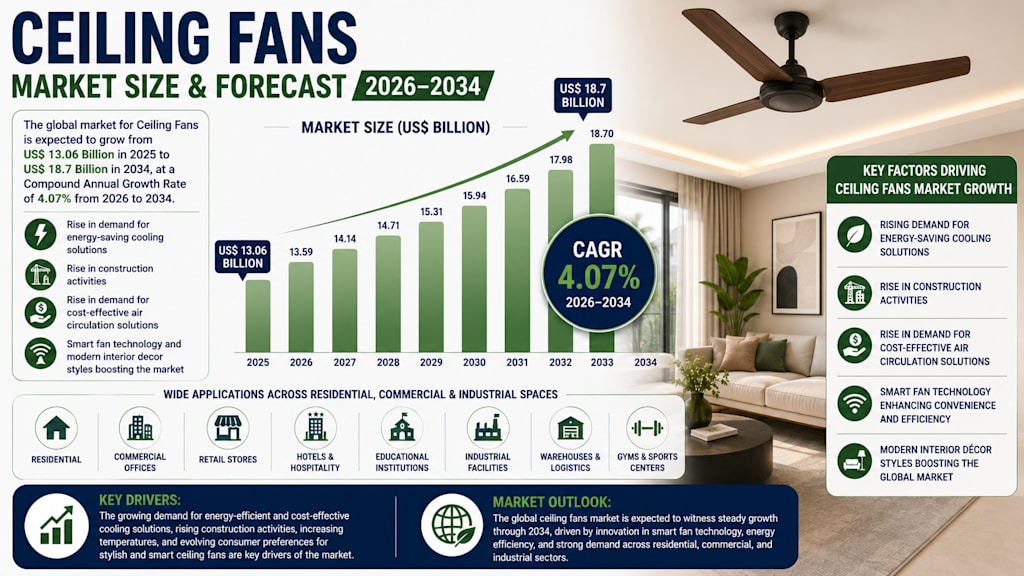
As consumers worldwide seek affordable and energy-efficient ways to stay comfortable, ceiling fans continue to play a crucial role in residential and commercial cooling solutions. While air conditioning systems remain widely used, ceiling fans offer a practical, economical, and environmentally friendly alternative that helps improve air circulation while reducing energy consumption.
The ceiling fan industry has evolved significantly over the years. What was once considered a simple household appliance has transformed into a sophisticated product category featuring smart connectivity, energy-saving motors, stylish designs, and advanced automation capabilities. Today’s ceiling fans not only provide comfort but also serve as decorative elements that complement modern interior design trends.
Growing urbanization, rising electricity costs, increasing environmental awareness, and the expansion of smart home ecosystems are creating strong opportunities for market growth. According to Renub Research, the global Ceiling Fans Market is projected to grow from US$ 13.06 billion in 2025 to US$ 18.70 billion by 2034, registering a compound annual growth rate (CAGR) of 4.07% between 2026 and 2034. This steady expansion highlights the continued importance of ceiling fans in both developed and emerging economies.

Ceiling Fans Remain a Popular Cooling Solution Worldwide
A ceiling fan is an electrically powered device installed on the ceiling of a room that uses rotating blades to circulate air. Unlike air conditioners, ceiling fans do not lower room temperature directly. Instead, they create a wind-chill effect by moving air, making occupants feel cooler and more comfortable.
Ceiling fans are commonly found in homes, offices, schools, restaurants, hotels, retail stores, and commercial facilities. Their ability to improve airflow while consuming relatively little electricity has made them one of the most widely used cooling appliances globally.
In tropical and subtropical regions, ceiling fans are often used year-round due to consistently warm weather. In other areas, they serve as supplementary cooling devices that help reduce reliance on air-conditioning systems.
Modern ceiling fans are available in a wide range of sizes, styles, colors, and finishes, enabling consumers to select models that align with both functional and aesthetic preferences.
Energy Efficiency Is Driving Market Growth
One of the strongest factors supporting the growth of the ceiling fans market is the increasing demand for energy-efficient cooling solutions.
As electricity costs continue rising worldwide, consumers are actively searching for appliances that can help reduce utility expenses. Ceiling fans offer a highly attractive solution because they consume significantly less energy than air-conditioning systems.
According to the U.S. Environmental Protection Agency’s ENERGY STAR Most Efficient 2025 program, qualifying ceiling fans deliver exceptional energy savings while maintaining strong performance standards. Products recognized under this initiative use substantially less energy than federal minimum requirements, highlighting the industry's ongoing commitment to efficiency and environmental protection.
Many households use ceiling fans as primary cooling devices, particularly in warm climates. Others combine ceiling fans with air conditioners to improve air circulation and reduce overall cooling costs.
As governments and environmental organizations continue promoting energy conservation, demand for energy-efficient ceiling fans is expected to remain strong.
Construction Activity Is Expanding Market Opportunities
The growth of residential and commercial construction is another major factor driving demand for ceiling fans.
Rapid urbanization is increasing the need for housing, office buildings, hotels, educational institutions, healthcare facilities, and retail centers. Newly constructed buildings typically require ventilation and cooling solutions, making ceiling fans an essential component of many projects.
Living rooms, bedrooms, offices, conference rooms, restaurants, and commercial spaces frequently incorporate ceiling fans to improve occupant comfort and airflow.
Major infrastructure investments around the world continue creating opportunities for appliance manufacturers. Large-scale commercial developments, data centers, residential complexes, and mixed-use projects all contribute to increasing demand for ceiling fans and related products.
As urban populations continue growing, construction activity is expected to remain a significant source of market expansion.
Smart Technology Is Transforming Ceiling Fans
Technological innovation is reshaping the ceiling fan industry by introducing advanced features that improve convenience, efficiency, and user experience.
Modern smart ceiling fans can connect to home automation systems, smartphones, and voice assistants. Users can control fan speed, lighting, operating schedules, and other settings remotely through mobile applications or smart home platforms.
Advanced features include:
, Remote control functionality
, Voice assistant compatibility
, Automated temperature-based speed adjustments
, Energy-efficient brushless DC motors
, Smart scheduling capabilities
, Integrated LED lighting systems
These innovations appeal to consumers who value convenience, customization, and energy management. Smart home adoption continues growing globally, creating favorable conditions for increased demand for connected ceiling fan solutions.
Manufacturers are also investing in quieter motors, improved airflow designs, and aesthetically appealing finishes that enhance both performance and visual appeal.
Energy-Saving Ceiling Fans Gain Popularity
Energy-saving ceiling fans represent one of the fastest-growing segments within the industry.
These products utilize advanced technologies such as brushless direct current (BLDC) motors, which consume substantially less electricity than conventional motors while maintaining excellent airflow performance.
Consumers increasingly choose energy-saving models because they help reduce electricity bills and support environmental sustainability goals. These fans also tend to operate more quietly and generate less heat during operation.
As awareness of energy efficiency grows and electricity prices continue rising, energy-saving ceiling fans are expected to capture an increasing share of the market.
Decorative Fans Blend Functionality and Design
Modern consumers increasingly view ceiling fans as both practical appliances and decorative design elements.
Decorative ceiling fans incorporate premium materials, unique blade designs, sophisticated finishes, and integrated lighting systems. These products are particularly popular in luxury homes, hotels, restaurants, and upscale commercial environments.
Interior designers and homeowners often select decorative fans to complement furniture, lighting fixtures, and architectural styles. The growing emphasis on home aesthetics and personalized living spaces continues driving demand within this segment.
As consumers invest more in home improvement and interior design, decorative ceiling fans are becoming increasingly important contributors to industry growth.
Smart Ceiling Fans Represent the Future of the Industry
The smart ceiling fan segment continues expanding rapidly as consumers embrace connected living environments.
Smart fans offer capabilities beyond traditional air circulation, including integration with broader smart home ecosystems. These systems can automatically adjust settings based on room temperature, occupancy, time of day, or user preferences.
The convenience provided by app-based controls and voice activation is attracting technology-focused consumers seeking modern home solutions.
As smart homes become increasingly common worldwide, demand for intelligent ceiling fan systems is expected to accelerate significantly throughout the forecast period.
Medium-Sized Ceiling Fans Remain Highly Popular
The medium-sized ceiling fan category, typically ranging between 42 and 52 inches in blade span, remains one of the most widely used product segments.
These fans are well suited for bedrooms, living rooms, dining areas, offices, and medium-sized commercial spaces. Their balance of performance, versatility, and compact dimensions makes them attractive to a broad range of consumers.
Manufacturers offer medium-sized fans in numerous styles, finishes, and configurations, further enhancing their appeal across residential and commercial applications.
As demand for versatile cooling solutions continues growing, this segment is expected to maintain strong market performance.
Residential Applications Dominate Market Demand
The residential sector remains the largest application segment within the global ceiling fans market.
Homeowners rely on ceiling fans to improve comfort while minimizing cooling expenses. Fans are commonly installed in bedrooms, living rooms, kitchens, family rooms, and covered outdoor spaces.
The availability of advanced features such as remote controls, integrated lighting, smart connectivity, and energy-efficient motors has further increased their appeal among residential consumers.
Growth in housing construction, home renovation projects, and consumer spending on home improvement continues supporting demand within this segment.
Regional Markets Continue Expanding
United States
The United States remains a significant market driven by growing interest in energy-efficient appliances and smart home technologies. Ceiling fans are widely used in homes, restaurants, offices, and hospitality environments to improve comfort while reducing cooling costs. Consumer demand for stylish and connected products continues supporting innovation within the market.
United Kingdom
Although the United Kingdom experiences relatively moderate temperatures, rising summer heat and increasing awareness of energy-efficient cooling solutions are contributing to growing ceiling fan adoption. Decorative and quiet-operation models are particularly popular among homeowners.
India
India represents one of the largest ceiling fan markets globally due to its warm climate and widespread reliance on ceiling fans for daily comfort. Urbanization, residential construction growth, rising incomes, and advances in BLDC motor technology continue driving strong market demand.
Saudi Arabia
Saudi Arabia's market continues expanding as ceiling fans are increasingly used alongside air-conditioning systems to improve airflow and reduce energy consumption. Ongoing infrastructure development and growing interest in modern interior design are supporting market growth.
Challenges Facing the Industry
Despite positive growth prospects, the ceiling fans market faces several challenges.
One major challenge is increasing competition from air-conditioning systems. As air conditioners become more affordable and technologically advanced, some consumers may prefer solutions that actively lower room temperatures rather than simply circulate air.
Climate limitations also affect market demand. Ceiling fans perform best in warm and dry conditions but may be less effective in extremely humid environments where air conditioners provide superior comfort.
Seasonal fluctuations can also impact sales, particularly in regions that experience long periods of cold weather.
Manufacturers must continue innovating to maintain competitiveness and address evolving consumer expectations.
Market Forecast: Steady Growth Through 2034
According to Renub Research, the global Ceiling Fans Market is expected to grow from US$ 13.06 billion in 2025 to US$ 18.70 billion by 2034, reflecting a CAGR of 4.07% during the forecast period from 2026 to 2034. Growth will be driven by rising demand for energy-efficient appliances, increasing construction activity, smart home adoption, and continuous product innovation.
The market's outlook demonstrates the enduring relevance of ceiling fans as affordable, sustainable, and versatile cooling solutions.
Final Thoughts
The global ceiling fans industry continues evolving as consumers seek products that combine comfort, energy efficiency, technology, and design. Once viewed simply as functional appliances, ceiling fans are now integrated into smart home ecosystems and modern interior décor strategies.
With Renub Research forecasting growth from US$ 13.06 billion in 2025 to US$ 18.70 billion by 2034, the market remains positioned for steady expansion. Innovations in energy-saving motors, smart connectivity, and decorative designs will continue enhancing product value and consumer appeal.
As energy efficiency and sustainability become increasingly important priorities worldwide, ceiling fans will remain essential components of residential and commercial cooling solutions for years to come.
About the Creator
Enjoyed the story? Support the Creator.
Subscribe for free to receive all their stories in your feed.
Comments
There are no comments for this story
Be the first to respond and start the conversation.