
Cardiovascular Surgical Devices Market Expands as Heart Disease Cases and Minimally Invasive Procedures Drive Global Demand
Rising cardiovascular disease rates, robotic-assisted surgeries, and healthcare infrastructure investments are reshaping the future of cardiovascular surgical devices across hospitals and cardiac care centers worldwide.

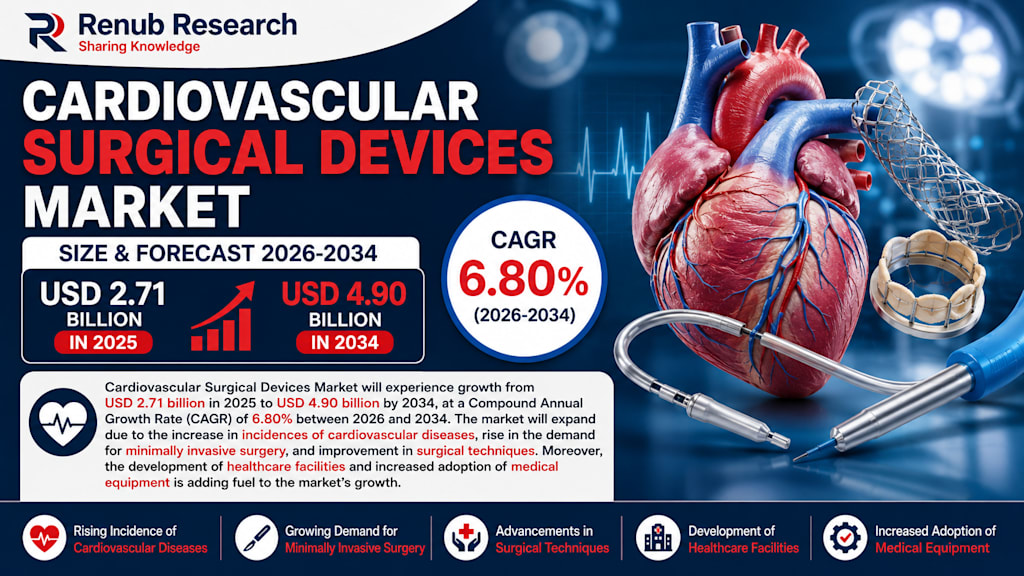
Cardiovascular Surgical Devices Market Overview
The global cardiovascular surgical devices market is witnessing significant growth as healthcare systems worldwide focus on improving heart disease diagnosis, treatment, and surgical outcomes. According to Renub Research, the cardiovascular surgical devices market is expected to grow from USD 2.71 billion in 2025 to USD 4.90 billion by 2034, expanding at a compound annual growth rate (CAGR) of 6.80% between 2026 and 2034. The market is being driven by the increasing burden of cardiovascular diseases, rising demand for minimally invasive surgeries, technological advancements, and expanding healthcare infrastructure worldwide.
Cardiovascular surgical devices include a wide range of specialized medical tools used in the diagnosis, monitoring, and treatment of heart-related disorders. These devices include heart valves, stents, pacemakers, catheters, grafts, bypass systems, and robotic-assisted surgical equipment used in procedures such as angioplasty, valve replacement, coronary artery bypass grafting, and arrhythmia management.
The growing popularity of these devices reflects a larger transformation happening across the healthcare sector. Hospitals and cardiac centers are increasingly investing in advanced surgical technologies that improve precision, reduce complications, and shorten patient recovery time. As cardiovascular diseases continue to remain one of the leading causes of death worldwide, demand for advanced surgical devices is expected to remain strong for years ahead.
Rising Cardiovascular Disease Cases Are Fueling Market Growth
One of the biggest factors driving the cardiovascular surgical devices market is the increasing prevalence of cardiovascular diseases globally. Conditions such as coronary artery disease, heart failure, congenital heart defects, and cardiac arrhythmias continue to affect millions of people every year.
Sedentary lifestyles, obesity, diabetes, smoking habits, stress, and unhealthy diets are contributing heavily to rising heart disease cases across both developed and developing economies. Aging populations are also playing a critical role because elderly individuals are more vulnerable to cardiovascular complications that often require surgical intervention.
According to the data referenced in the report, cardiovascular diseases accounted for approximately 19.8 million deaths in 2022, representing nearly 32% of total global deaths. A significant percentage of these deaths were linked to heart attacks and strokes. This growing disease burden is increasing demand for surgical procedures involving cardiovascular devices.
The rising number of patients requiring heart surgeries has directly boosted the need for technologies such as stents, bypass grafts, heart valves, cardiac monitoring systems, and minimally invasive surgical devices. Healthcare providers are under pressure to improve treatment efficiency while ensuring safer and more effective procedures.
Minimally Invasive and Robotic Surgeries Are Changing Cardiac Care
The cardiovascular surgical devices market is also benefiting from the global shift toward minimally invasive and robotic-assisted surgeries. Traditional open-heart procedures are increasingly being replaced or complemented by advanced surgical approaches that require smaller incisions, reduce blood loss, and shorten recovery periods.
Patients today prefer procedures that involve less pain, reduced hospitalization time, and lower risks of complications. Healthcare providers are equally interested in technologies that improve surgical precision and overall patient outcomes.
Robotic-assisted surgical systems have become one of the most promising innovations in cardiac surgery. These systems enable surgeons to perform highly complex procedures with greater control and precision while minimizing surgical trauma.
Advanced imaging systems, catheter technologies, and navigation tools are also improving procedural accuracy. Real-time visualization during surgery allows physicians to make better decisions and improve treatment success rates.
Medical device manufacturers continue investing heavily in research and development to launch next-generation surgical technologies that support minimally invasive procedures. This ongoing innovation is expected to remain one of the strongest long-term growth drivers for the industry.
Expanding Healthcare Infrastructure Is Supporting Device Adoption
Another major factor accelerating the cardiovascular surgical devices market is the expansion of healthcare infrastructure worldwide. Governments and private healthcare organizations are investing heavily in hospitals, specialty cardiac centers, surgical units, and advanced diagnostic facilities.
Emerging economies are especially important in this context. Countries across Asia-Pacific, the Middle East, and Latin America are rapidly improving healthcare access and increasing investments in modern medical technologies.
The expansion of healthcare facilities is helping more patients gain access to advanced cardiac surgeries that were previously unavailable or unaffordable in many regions.
Insurance coverage and reimbursement policies are also improving in several countries, making expensive cardiovascular procedures more accessible to broader populations. Healthcare providers are increasingly prioritizing quality care, early diagnosis, and improved patient outcomes, which supports adoption of innovative surgical devices.
Medical tourism is another contributor to market expansion. Countries offering affordable and high-quality cardiac care are attracting international patients, further increasing demand for cardiovascular surgical technologies.
High Costs Continue to Challenge Market Accessibility
Despite the strong growth outlook, the cardiovascular surgical devices market still faces several important challenges. One of the biggest barriers is the high cost associated with advanced cardiac surgeries and specialized devices.
Robotic-assisted systems, implantable devices, and minimally invasive surgical technologies require substantial investment from hospitals and healthcare providers. In addition to procurement costs, training, maintenance, and operational expenses add financial pressure.
For patients, cardiovascular surgeries can be extremely expensive, especially in countries where insurance coverage is limited. This creates accessibility challenges in low-income and middle-income regions where many individuals cannot afford advanced procedures.
Hospitals may also struggle with budget constraints when investing in sophisticated surgical equipment. Smaller healthcare facilities often face difficulties adopting advanced technologies due to limited financial resources.
Regulatory Requirements Slow Product Commercialization
The cardiovascular surgical devices industry also operates under strict regulatory oversight. Medical devices used in heart procedures must undergo extensive testing, clinical trials, and safety evaluations before receiving approval for commercial use.
While these regulations are essential for ensuring patient safety, they can delay product launches and increase development costs for manufacturers.
Different countries also have varying regulatory standards, making global commercialization more complicated for device manufacturers operating across multiple markets.
Frequent changes in healthcare regulations further increase compliance challenges, particularly for smaller companies that may lack sufficient resources to navigate complex approval processes.
Cardiopulmonary Bypass Equipment Market Remains Essential
Cardiopulmonary bypass equipment remains a critical segment within the cardiovascular surgical devices industry. These machines temporarily take over the function of the heart and lungs during complex cardiac surgeries, enabling surgeons to perform procedures with greater precision and control.
Open-heart surgeries, valve replacements, and bypass procedures rely heavily on cardiopulmonary bypass systems. As the number of cardiac surgeries continues increasing globally, demand for these devices is expected to remain strong.
Technological improvements have enhanced the reliability, safety, and efficiency of bypass equipment, helping healthcare providers improve surgical outcomes and reduce complications.
Cardiac Ablation Devices Market Is Growing Rapidly
The cardiac ablation devices market is expanding significantly due to rising cases of cardiac arrhythmias and growing demand for minimally invasive treatment solutions.
Cardiac ablation procedures involve destroying or isolating abnormal heart tissue responsible for irregular heartbeats. Techniques such as radiofrequency ablation and cryoablation are increasingly preferred because they offer high precision and shorter recovery periods.
Advancements in mapping and imaging technologies are further improving procedural success rates. As the aging population grows and lifestyle-related heart disorders become more common, demand for cardiac ablation devices is expected to rise steadily.
Cardiac Arrhythmia Devices Are Becoming More Advanced
Cardiac arrhythmia devices such as pacemakers, implantable cardioverter defibrillators, and cardiac monitors play a vital role in maintaining proper heart rhythm and preventing life-threatening complications.
Technological advancements are significantly improving these devices. Modern cardiac monitoring systems are becoming smaller, more comfortable, and more connected through wireless capabilities and remote monitoring technologies.
Remote patient monitoring is becoming increasingly important because it enables healthcare providers to monitor patient conditions continuously while reducing the need for frequent hospital visits.
Improved battery life and enhanced device performance are also contributing to better patient experiences and long-term treatment outcomes.
Coronary Heart Disease Devices Continue to See Strong Demand
The coronary heart disease devices market remains one of the largest segments within the cardiovascular surgical devices industry. Coronary artery disease continues to be a leading cause of mortality worldwide, driving demand for stents, guidewires, angioplasty balloons, and related devices.
The growing popularity of minimally invasive procedures such as percutaneous coronary intervention (PCI) is significantly contributing to market growth.
Drug-eluting stents and advanced imaging technologies are improving treatment effectiveness and reducing the risk of complications. Greater awareness about early diagnosis and preventive treatment is also encouraging more patients to seek medical care before conditions become severe.
Hospitals Remain the Leading End-User Segment
Hospitals continue to dominate the cardiovascular surgical devices market because they possess the advanced infrastructure, intensive care facilities, and specialized expertise required for complex heart surgeries.
Dedicated cardiac centers within hospitals are expanding rapidly to accommodate growing patient demand. Investments in surgical equipment, imaging systems, and robotic technologies are helping hospitals strengthen their cardiac care capabilities.
Hospitals also benefit from favorable reimbursement systems and insurance support, making them the primary destination for advanced cardiovascular procedures.
As healthcare systems continue focusing on specialized cardiac treatment, hospitals are expected to remain the largest consumers of cardiovascular surgical devices globally.
United States Market Leads Through Innovation and Technology
The United States represents one of the largest and most technologically advanced cardiovascular surgical devices markets in the world. High healthcare spending, strong research and development activity, and rapid adoption of innovative technologies contribute significantly to market leadership.
The country faces a substantial burden of cardiovascular diseases, creating consistent demand for advanced procedures such as valve replacement surgeries, bypass surgeries, and minimally invasive interventions.
Robotic-assisted surgeries and transcatheter procedures are increasingly common in the United States, supported by advanced hospitals and specialized cardiac centers.
Continuous product innovation remains a defining feature of the U.S. market, where companies frequently launch next-generation cardiovascular technologies supported by strong regulatory approvals and clinical research.
United Kingdom Market Benefits from Public Healthcare Support
The United Kingdom cardiovascular surgical devices market is supported by the National Health Service and rising awareness regarding cardiovascular health.
Increasing obesity rates, sedentary lifestyles, and aging demographics are driving higher demand for cardiac surgeries and specialized devices across the country.
Healthcare providers in the UK are increasingly adopting minimally invasive technologies and advanced imaging systems to improve patient recovery outcomes and reduce hospital stays.
Government initiatives focused on preventive healthcare and early diagnosis are also contributing to market expansion.
India Emerges as a Fast-Growing Market
India’s cardiovascular surgical devices market is growing rapidly due to increasing heart disease cases, improving healthcare infrastructure, and expanding access to medical services.
Urbanization, dietary changes, and rising diabetes and hypertension rates are contributing heavily to the growing number of cardiovascular patients.
Government health programs and insurance initiatives are improving access to cardiac treatment for broader population groups. At the same time, private hospitals and medical tourism are creating strong demand for advanced cardiovascular surgical technologies.
India is becoming an increasingly important growth market for global medical device manufacturers seeking expansion opportunities in emerging economies.
Saudi Arabia Focuses on Healthcare Modernization
Saudi Arabia is steadily strengthening its cardiovascular healthcare capabilities through major investments aligned with the country’s Vision 2030 strategy.
Rising obesity levels and lifestyle-related heart diseases are increasing demand for bypass surgeries, valve replacement procedures, and angioplasty interventions.
The country continues investing in modern hospitals, advanced surgical technologies, and digital healthcare systems. Partnerships between international medical technology companies and regional healthcare providers are helping accelerate adoption of innovative cardiovascular devices.
Competitive Landscape
The cardiovascular surgical devices market includes several major global healthcare and medical device companies competing through innovation, technological advancement, and strategic partnerships.
Key players mentioned in the market include Abbott Laboratories, Boston Scientific Corporation, Edwards Lifesciences, Cardinal Health Inc., Medtronic PLC, GE Healthcare, LivaNova PLC, and Terumo Corporation.
These companies continue investing heavily in robotic surgery systems, minimally invasive technologies, cardiac monitoring devices, and AI-powered diagnostic solutions to strengthen their competitive positions.
Future Outlook for the Cardiovascular Surgical Devices Industry
The future of the cardiovascular surgical devices market appears highly promising as the healthcare industry continues prioritizing precision medicine, minimally invasive procedures, and advanced patient care.
Artificial intelligence, robotic-assisted surgery, remote patient monitoring, and connected medical devices are expected to reshape cardiovascular treatment approaches over the next decade.
Emerging economies will likely play a larger role in market expansion as healthcare infrastructure improves and access to advanced treatments increases.
At the same time, manufacturers will continue focusing on device miniaturization, procedural efficiency, and enhanced patient outcomes to remain competitive in an increasingly technology-driven healthcare environment.
Final Thoughts
The cardiovascular surgical devices market is evolving rapidly as healthcare providers seek safer, faster, and more effective solutions for managing heart disease. With the market projected to grow from USD 2.71 billion in 2025 to USD 4.90 billion by 2034, at a 6.80% CAGR between 2026 and 2034, the industry presents significant long-term growth opportunities.
Rising cardiovascular disease prevalence, expanding healthcare infrastructure, robotic-assisted surgeries, and continuous technological innovation are all contributing to the market’s strong momentum. As healthcare systems worldwide continue modernizing cardiac care, cardiovascular surgical devices are expected to remain at the center of future medical advancement.
About the Creator
Enjoyed the story? Support the Creator.
Subscribe for free to receive all their stories in your feed.
Comments
There are no comments for this story
Be the first to respond and start the conversation.