
Cardiac Holter Monitor Market to Reach US$1.62 Billion by 2034 as Wearable Cardiac Monitoring Transforms Heart Care
The increasing prevalence of cardiovascular diseases, rapid advances in wearable healthcare technology, and rising demand for remote patient monitoring are driving strong growth in the global cardiac Holter monitor market.

Wearable Cardiac Monitoring Is Transforming Modern Heart Care
Cardiovascular disease remains one of the leading causes of death worldwide, making early diagnosis and continuous heart monitoring more important than ever. While traditional electrocardiograms (ECGs) provide only a brief snapshot of heart activity, many cardiac abnormalities occur intermittently and may remain undetected during a routine examination. This challenge has increased the importance of wearable cardiac monitoring devices, particularly Holter monitors, which continuously record heart activity over an extended period.
Cardiac Holter monitors have become indispensable tools for cardiologists because they enable continuous monitoring while patients carry out their normal daily activities. These devices help physicians identify irregular heart rhythms, evaluate treatment effectiveness, and detect cardiac conditions that might otherwise remain unnoticed.
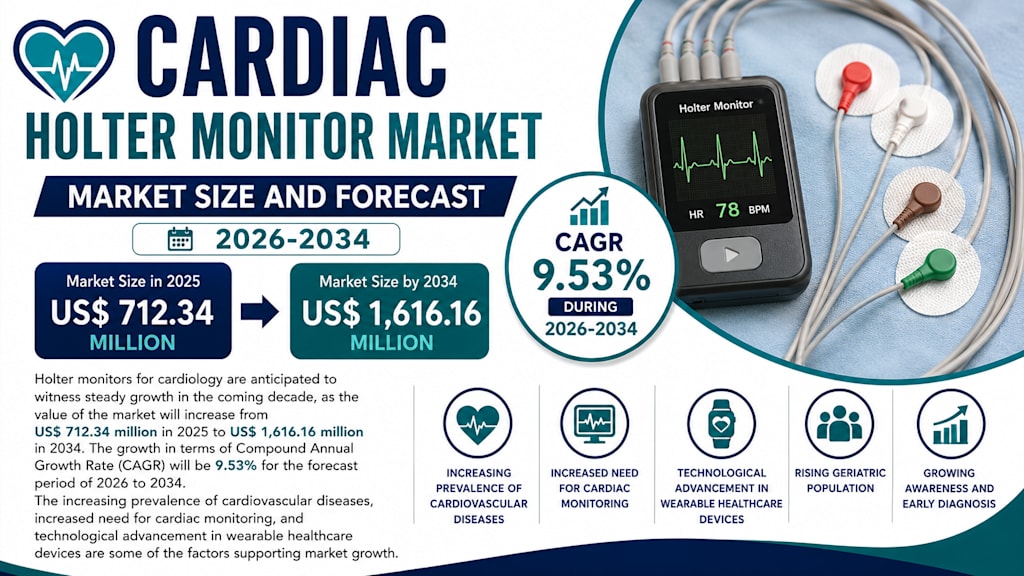
According to the latest market outlook, the Global Cardiac Holter Monitor Market is expected to grow from US$712.34 million in 2025 to US$1,616.16 million by 2034, registering a compound annual growth rate (CAGR) of 9.53% during 2026–2034. The rising burden of cardiovascular diseases, expanding adoption of wearable healthcare technologies, and growing demand for remote patient monitoring continue to drive market expansion.
Understanding Cardiac Holter Monitors
A cardiac Holter monitor is a portable, wearable medical device that continuously records the electrical activity of the heart for 24 to 48 hours or even longer.
Unlike a standard ECG, which captures heart activity for only a few seconds, a Holter monitor records thousands of heartbeats during normal daily activities, providing physicians with a more comprehensive picture of cardiac function.
Electrodes attached to the patient's chest collect electrical signals that are stored for later analysis or transmitted wirelessly to healthcare professionals. Holter monitoring plays a critical role in diagnosing arrhythmias, atrial fibrillation, unexplained dizziness, palpitations, fainting episodes, and chest discomfort while also evaluating the effectiveness of cardiac medications.
As preventive healthcare becomes increasingly important, continuous cardiac monitoring is becoming an essential component of modern cardiovascular care.
Rising Cardiovascular Disease Burden Drives Market Growth
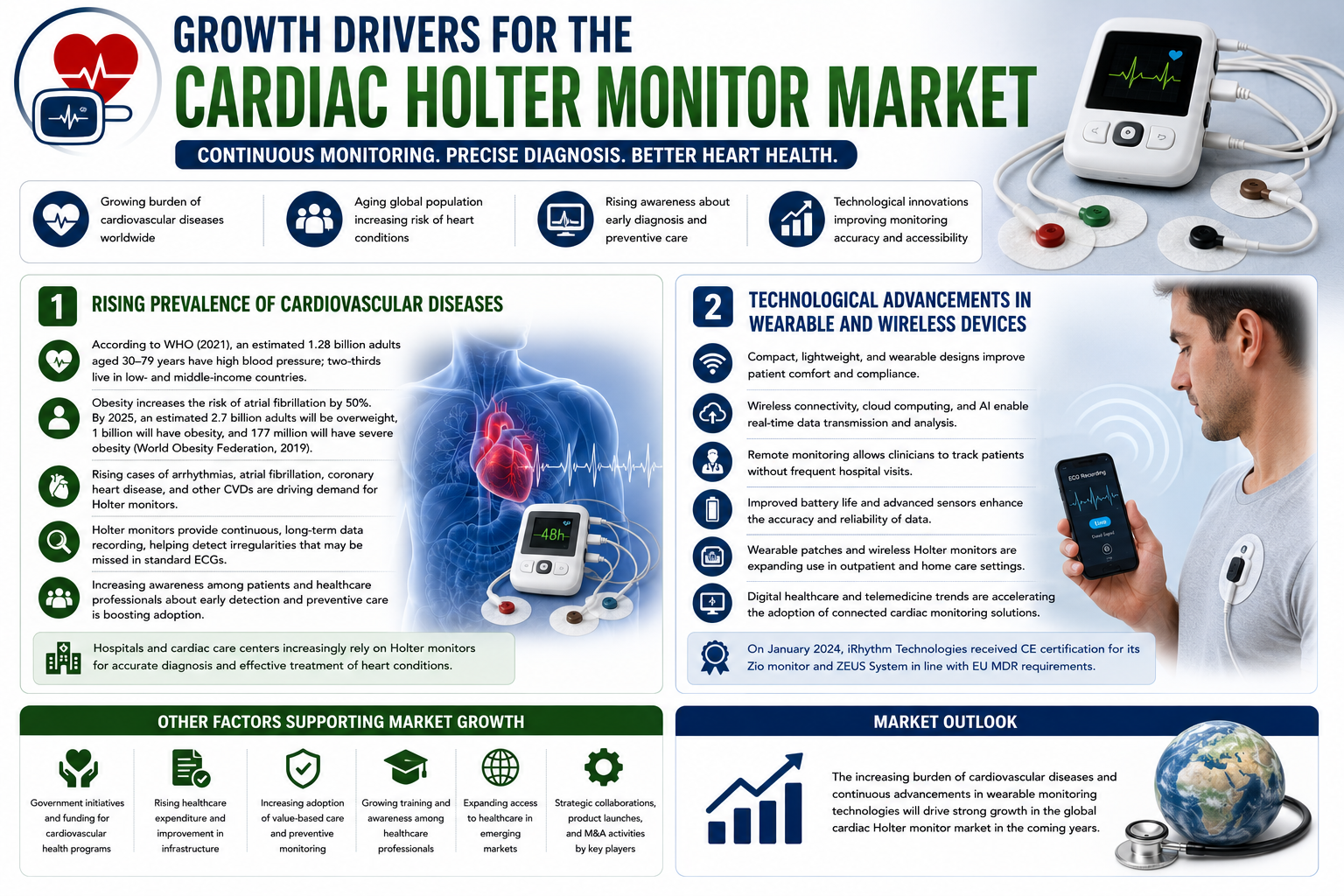
One of the strongest drivers supporting market expansion is the increasing prevalence of cardiovascular disease worldwide.
Heart rhythm disorders, hypertension, coronary artery disease, obesity-related cardiac complications, and atrial fibrillation continue rising due to aging populations, sedentary lifestyles, poor dietary habits, diabetes, and chronic stress.
Because many heart rhythm abnormalities occur sporadically, continuous monitoring often provides significantly more diagnostic value than conventional ECG examinations.
Healthcare providers increasingly recommend Holter monitoring for patients at risk of developing serious cardiac conditions, allowing physicians to identify abnormalities earlier and initiate appropriate treatment before complications develop.
Growing awareness of preventive cardiology is expected to further strengthen market demand.
Wearable and Wireless Technologies Are Revolutionizing Cardiac Monitoring
Rapid technological innovation has significantly improved the capabilities of modern Holter monitors.
Traditional bulky recording devices have evolved into lightweight, compact, and comfortable wearable systems that improve patient compliance while maintaining highly accurate monitoring.
Wireless connectivity enables cardiac data to be transmitted securely through cloud-based platforms, allowing physicians to review patient information remotely without requiring frequent hospital visits.
Artificial intelligence is also enhancing diagnostic accuracy by automatically identifying abnormal heart rhythms, reducing manual analysis time, and improving clinical decision-making.
Longer battery life, advanced sensors, and smartphone connectivity continue making modern Holter monitors more practical for both patients and healthcare professionals.
Preventive Healthcare Supports Market Expansion
Healthcare systems worldwide are increasingly shifting from reactive treatment toward preventive care.
Early detection of cardiovascular abnormalities helps reduce hospital admissions, improve treatment outcomes, and lower long-term healthcare costs.
Holter monitors provide clinicians with valuable diagnostic information that enables earlier intervention before serious cardiac events occur.
Patients also benefit from improved convenience because monitoring can be completed during routine daily activities without prolonged hospitalization.
As preventive healthcare continues receiving greater attention from governments and healthcare providers, demand for continuous cardiac monitoring devices is expected to increase steadily.
Home Healthcare and Telemedicine Continue Growing
The rapid expansion of home healthcare services has created new opportunities for cardiac Holter monitoring.
Many patients—particularly older adults—prefer receiving healthcare services at home whenever possible.
Remote monitoring technologies enable physicians to observe cardiac activity without requiring repeated clinic visits, improving patient comfort while reducing pressure on healthcare facilities.
The growing adoption of telemedicine has further strengthened demand for wearable Holter monitors that integrate seamlessly with digital healthcare platforms.
Hospitals increasingly utilize connected monitoring systems that allow physicians to review patient data from virtually any location.
Wireless Holter Monitors Gain Popularity
Wireless cardiac Holter monitors represent one of the fastest-growing product categories within the market.
Unlike conventional wired systems, wireless devices provide greater freedom of movement while maintaining continuous monitoring accuracy.
Bluetooth connectivity, cloud computing, Internet of Things (IoT) technologies, and artificial intelligence allow physicians to receive cardiac information in real time.
Patients benefit from greater comfort during extended monitoring periods, improving diagnostic quality by minimizing disruptions to normal daily routines.
As healthcare providers continue emphasizing remote patient monitoring, wireless Holter systems are expected to experience strong adoption worldwide.
AI-Powered Software Improves Diagnostic Accuracy
Software has become an increasingly important component of modern cardiac monitoring systems.
Advanced analytical platforms automatically identify arrhythmias, irregular heart rhythms, and other cardiac abnormalities while reducing the workload of healthcare professionals.
Machine learning algorithms continuously improve diagnostic accuracy by analyzing enormous volumes of ECG data.
Cloud-based software platforms also enable cardiologists to access patient records remotely, accelerating diagnosis and supporting collaborative healthcare delivery.
The integration of artificial intelligence into cardiac diagnostics continues improving efficiency while reducing the likelihood of human error.
Hospitals Remain the Largest End Users
Hospitals continue representing the largest end-user segment within the cardiac Holter monitor market.
Cardiology departments rely extensively on Holter monitoring for diagnosing arrhythmias, evaluating chest pain, monitoring postoperative recovery, and assessing treatment effectiveness.
Large hospitals also benefit from integrated digital healthcare systems that simplify data storage, analysis, and patient management.
Growing investment in specialized cardiac care centers and preventive cardiology programs continues strengthening demand for advanced monitoring technologies.
Cost Remains a Key Challenge
Despite significant technological progress, advanced Holter monitoring systems remain relatively expensive.
Wireless connectivity, artificial intelligence, cloud storage, and advanced analytical software increase manufacturing and implementation costs.
Healthcare providers must also invest in software maintenance, staff training, cybersecurity, and digital infrastructure.
Smaller hospitals and clinics, particularly within developing countries, may face financial barriers that limit widespread adoption.
As manufacturing scales increase and technology matures, equipment costs are expected to decline gradually.
Data Privacy Requires Continuous Attention
The increasing use of connected healthcare devices introduces important cybersecurity challenges.
Wireless Holter monitors collect sensitive patient information that must be protected against unauthorized access and cyber threats.
Manufacturers continue investing heavily in encryption technologies, secure cloud platforms, and regulatory compliance to ensure patient privacy.
Healthcare organizations must also comply with increasingly stringent medical device regulations governing digital health technologies and personal health information.
Maintaining patient trust remains essential as remote monitoring becomes more widespread.
Regional Markets Continue Expanding
The United States remains the largest cardiac Holter monitor market due to its advanced healthcare infrastructure, favorable reimbursement policies, and widespread adoption of digital healthcare technologies.
Germany continues strengthening market growth through its emphasis on preventive cardiology, medical innovation, and increasing adoption of wearable diagnostic technologies.
India has emerged as one of the fastest-growing markets as cardiovascular disease prevalence rises alongside healthcare infrastructure improvements and expanding diagnostic services.
Saudi Arabia is also witnessing strong market growth, supported by healthcare modernization initiatives, increasing cardiovascular disease awareness, government investment in digital health, and expanding use of wearable monitoring devices.
Together, these regional markets continue driving global demand for advanced cardiac monitoring solutions.
The Future of Cardiac Monitoring
The future of cardiac Holter monitoring will be defined by artificial intelligence, wearable innovation, cloud computing, and personalized healthcare.
Next-generation devices are expected to become smaller, lighter, and more comfortable while offering longer battery life and even greater diagnostic accuracy.
Artificial intelligence will continue improving automated arrhythmia detection, predictive analytics, and personalized treatment planning.
The integration of Holter monitors with smartphones, electronic health records, and telemedicine platforms will further strengthen remote patient management.
As healthcare increasingly shifts toward digital and preventive models, continuous cardiac monitoring will become an even more important component of cardiovascular care.
Final Thoughts
The global cardiac Holter monitor market is entering a period of sustained expansion as healthcare providers increasingly prioritize early diagnosis, preventive cardiology, and remote patient monitoring.
The projected growth from US$712.34 million in 2025 to US$1,616.16 million by 2034, supported by a 9.53% CAGR, reflects rising demand for wearable healthcare technologies capable of improving patient outcomes while reducing healthcare costs.
Although equipment costs, cybersecurity concerns, and regulatory requirements remain important challenges, continuous advances in wireless technology, artificial intelligence, cloud-based diagnostics, and digital healthcare are expected to position cardiac Holter monitors as an essential tool in the future of cardiovascular medicine.
About the Creator
Enjoyed the story? Support the Creator.
Subscribe for free to receive all their stories in your feed.
Comments
There are no comments for this story
Be the first to respond and start the conversation.