
Cancer Diagnostic Market Accelerates as Precision Medicine and Liquid Biopsy Technologies Transform Oncology
Rising cancer prevalence, molecular diagnostics, and AI-powered testing solutions are driving rapid expansion in global cancer diagnostics

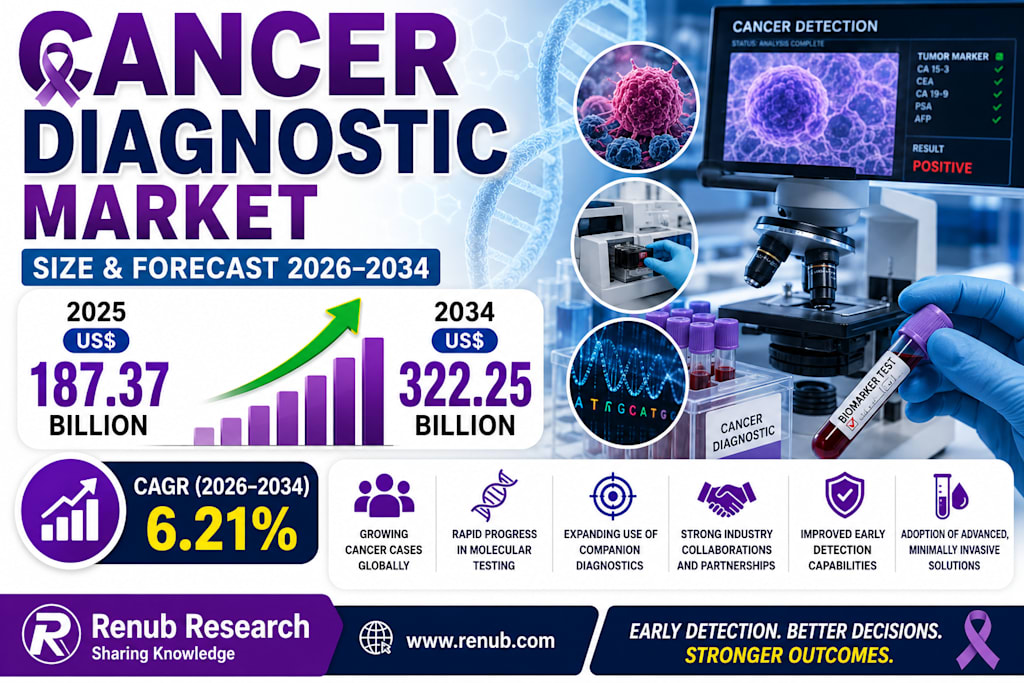
The global fight against cancer is entering a new era powered by advanced diagnostics, molecular medicine, and personalized treatment strategies. As healthcare systems place greater emphasis on early detection and precision oncology, the cancer diagnostics industry is becoming one of the most critical pillars of modern healthcare.
According to Renub Research, the Cancer Diagnostic Market is projected to grow from US$ 187.37 Billion in 2025 to US$ 322.25 Billion by 2034, expanding at a Compound Annual Growth Rate (CAGR) of 6.21% during 2026–2034. Increasing cancer incidence, rapid progress in molecular testing, expanding use of companion diagnostics, and growing adoption of minimally invasive technologies are among the key factors accelerating market growth.
As precision medicine continues reshaping oncology care, cancer diagnostics are becoming increasingly sophisticated, accurate, and patient-focused. From liquid biopsies and genomic sequencing to AI-powered imaging and digital pathology, innovation is transforming how cancer is detected and treated worldwide.
Cancer Diagnostics Are Central to Modern Oncology
Cancer diagnostics refer to the technologies and clinical processes used to identify, confirm, classify, and monitor cancer in patients. These diagnostic methods include imaging technologies, molecular assays, tissue biopsies, laboratory analyses, and genetic testing platforms.
Modern cancer diagnostics help physicians determine the type of cancer, disease stage, genetic mutations, and potential treatment pathways. Technologies such as MRI, CT scans, PET imaging, PCR testing, histopathology, immunohistochemistry, and next-generation sequencing are now essential components of oncology care.
Accurate and early diagnosis significantly improves survival rates by enabling faster treatment decisions and more targeted therapeutic strategies. This growing focus on precision treatment is one of the biggest reasons why advanced diagnostics are becoming increasingly important across healthcare systems globally.
Rising Cancer Cases Continue Driving Demand
One of the strongest growth drivers for the cancer diagnostics market is the increasing global burden of cancer. Lifestyle changes, aging populations, environmental factors, and growing rates of chronic diseases are contributing to rising cancer incidence worldwide.
Healthcare systems are therefore placing greater emphasis on early screening and preventive oncology to improve patient outcomes and reduce long-term treatment costs.
Awareness campaigns and public health initiatives are also encouraging individuals to undergo regular cancer screening, increasing demand for reliable and accessible diagnostic solutions.
As healthcare providers seek faster and more accurate detection methods, demand for molecular testing, liquid biopsies, and advanced imaging technologies continues to expand rapidly.
Liquid Biopsy and MRD Technologies Are Reshaping Cancer Detection
One of the most transformative developments within oncology diagnostics is the growing adoption of liquid biopsy and minimal residual disease (MRD) testing technologies. These advanced molecular techniques allow clinicians to detect cancer-related biomarkers using blood samples instead of traditional invasive tissue biopsies.
Liquid biopsy technologies are increasingly valued because they improve patient comfort, support continuous monitoring, and help detect cancer recurrence earlier than conventional imaging in some cases.
The report highlights Quest Diagnostics’ April 2023 acquisition of Haystack Oncology, which strengthened its capabilities in highly sensitive MRD testing for colorectal, breast, and lung cancer patients.
MRD technologies are becoming particularly important after cancer treatment because they help clinicians identify remaining cancer cells and evaluate relapse risk more effectively.
As physicians integrate liquid biopsy and MRD testing into routine cancer management, investment in next-generation molecular diagnostics is accelerating worldwide.
Companion Diagnostics Are Fueling Precision Medicine
Companion diagnostics have become one of the fastest-growing segments within the cancer diagnostics market. These tests are specifically designed to identify patients most likely to benefit from targeted therapies based on genetic or molecular characteristics.
As pharmaceutical companies develop more personalized cancer drugs, the need for precise diagnostic tools is increasing dramatically.
The report highlights QIAGEN’s March 2023 collaboration with Servier to develop a PCR-based companion diagnostic test for detecting IDH1 gene mutations in acute myeloid leukemia patients eligible for TIBSOVO treatment.
Companion diagnostics improve treatment precision, reduce unnecessary therapies, and help physicians make more informed clinical decisions.
Regulatory agencies are also increasingly supporting co-developed drug-diagnostic solutions, accelerating adoption across oncology care.
Personalized Healthcare Is Driving Diagnostic Innovation
The broader shift toward personalized healthcare is fundamentally reshaping the cancer diagnostics industry. Clinicians now rely heavily on molecular and genomic information to create patient-specific treatment plans.
As oncology becomes more precision-oriented, healthcare providers require increasingly advanced diagnostic platforms capable of analyzing biomarkers, mutations, and genetic profiles in detail.
The report notes that F. Hoffmann-La Roche expanded its collaboration with Janssen in February 2023 to advance companion diagnostic development and support personalized treatment strategies.
Artificial intelligence, digital pathology, and integrated genomic data systems are also becoming more common within cancer diagnostics workflows. These technologies improve speed, accuracy, and clinical decision-making.
As healthcare systems continue adopting personalized medicine models, demand for advanced diagnostic technologies is expected to rise substantially.
AI and Digital Pathology Are Enhancing Accuracy
Artificial intelligence is becoming increasingly important in modern oncology diagnostics. AI-powered imaging platforms and digital pathology tools can analyze medical images, tissue samples, and molecular data with greater speed and consistency.
These technologies help physicians identify abnormalities more efficiently while reducing diagnostic variability and improving workflow productivity.
AI also supports earlier disease detection, predictive analytics, and treatment planning by identifying patterns that may not always be immediately visible through traditional interpretation methods.
As healthcare providers seek greater efficiency and diagnostic accuracy, AI integration is expected to become a defining trend across the oncology diagnostics landscape.
High Costs Continue Limiting Accessibility
Despite rapid technological progress, cost remains one of the biggest barriers within the cancer diagnostics market. Advanced technologies such as genomic sequencing, molecular assays, and high-resolution imaging systems often require substantial financial investment.
In many lower-income regions, hospitals and diagnostic centers lack access to specialized equipment, trained personnel, and reimbursement support necessary for widespread adoption.
Even in developed markets, insurance limitations and patient cost-sharing can discourage early screening or advanced testing.
Infrastructure disparities between urban and rural healthcare systems also contribute to unequal access to innovative diagnostic solutions.
These financial and structural challenges continue to slow broader market penetration despite growing global demand.
Regulatory Complexity Remains a Major Challenge
Cancer diagnostic developers also face strict regulatory requirements because these tests directly influence critical clinical decisions. Regulatory agencies demand extensive validation for diagnostic accuracy, safety, and clinical performance.
Meeting these standards often requires large-scale clinical trials, extensive documentation, and substantial financial investment.
Smaller biotechnology companies may struggle to navigate lengthy approval processes, slowing innovation and commercialization timelines.
Global regulatory variations further complicate market expansion because manufacturers must adapt products and compliance strategies for different regions.
While these regulations help maintain patient safety and diagnostic reliability, they can delay access to new technologies.
United States Leads Global Cancer Diagnostics Innovation
The United States remains one of the world’s most advanced cancer diagnostics markets due to strong healthcare infrastructure, significant research funding, and widespread adoption of precision medicine technologies.
The country leads in next-generation sequencing, digital pathology, AI-powered imaging, and MRD testing adoption.
Strong reimbursement frameworks, large clinical trial networks, and collaboration between pharmaceutical and diagnostic companies continue driving innovation.
Rising cancer incidence and increased awareness about early detection are also supporting sustained growth across the U.S. market.
Germany Strengthens Europe’s Precision Diagnostics Leadership
Germany represents one of Europe’s strongest cancer diagnostics markets due to its advanced healthcare system and focus on molecular medicine. The country has invested heavily in digital pathology, PCR-based diagnostics, and sequencing technologies.
Germany’s early screening initiatives and strong reimbursement systems support widespread adoption of innovative cancer diagnostic solutions.
Collaboration between hospitals, research institutions, and biotechnology companies also accelerates development and integration of advanced oncology testing platforms.
As personalized medicine continues growing across Europe, Germany is expected to remain a major innovation hub.
China Emerges as a Rapidly Expanding Market
China’s cancer diagnostics market is expanding rapidly due to rising cancer prevalence, healthcare modernization, and increased government support for early screening initiatives.
Investments in molecular laboratories, genomic sequencing, and AI-powered imaging are strengthening the country’s diagnostic infrastructure.
Local biotechnology firms are also making significant progress in liquid biopsy and precision oncology technologies.
Although disparities between urban and rural healthcare access still exist, improvements in hospital infrastructure and reimbursement coverage are increasing accessibility to advanced cancer diagnostics.
China is expected to remain one of the fastest-growing markets globally throughout the forecast period.
Saudi Arabia Advances Oncology Infrastructure
Saudi Arabia’s cancer diagnostics market is growing steadily under the country’s Vision 2030 healthcare transformation initiatives. Investments in molecular laboratories, imaging systems, and preventive healthcare programs are improving early cancer detection capabilities.
Partnerships with international diagnostic companies are also strengthening local expertise and expanding access to advanced technologies.
While workforce shortages and regional disparities remain challenges, healthcare modernization efforts are steadily improving oncology services across the country.
As awareness of preventive healthcare increases, demand for precision diagnostics is expected to continue rising.
Recent Developments Highlight Strong Industry Momentum
The cancer diagnostics market continues evolving rapidly through strategic collaborations, regulatory approvals, and technological innovation.
The report highlights several major recent developments:
In March 2025, Daiichi Sankyo introduced DATROWAY in Japan for hormone receptor-positive and HER2-negative unresectable or recurrent breast cancer patients previously treated with chemotherapy.
In September 2025, Roche secured CE-IVDR approval for its VENTANA HER2 assay to identify HER2-ultralow metastatic breast cancer patients eligible for ENHERTU therapy.
In December 2024, Guardant Health partnered with Boehringer Ingelheim to commercialize the Guardant360 CDx liquid biopsy as a companion diagnostic for investigational lung cancer therapies.
In November 2024, Danaher announced plans to establish Centers of Innovation in Diagnostics focused on advancing precision medicine research.
In June 2023, Blue Earth Diagnostics received FDA approval for POSLUMA, a PSMA-targeted PET imaging agent for prostate cancer detection.
These developments demonstrate how rapidly oncology diagnostics are evolving toward more precise, personalized, and minimally invasive solutions.
Market Segmentation Reflects Broad Clinical Applications
The cancer diagnostics market spans multiple cancer types including breast cancer, colorectal cancer, lung cancer, prostate cancer, ovarian cancer, blood cancer, and liver cancer.
Key diagnostic methods include imaging, liquid biopsy, immunohistochemistry, tumor biomarker testing, tissue biopsy, and in situ hybridization.
Hospitals, diagnostic centers, research institutes, and specialty clinics continue serving as major end users.
As oncology care becomes increasingly personalized, demand across all diagnostic segments is expected to rise significantly.
Leading Companies Continue Expanding Innovation Efforts
The competitive landscape includes several major healthcare and biotechnology companies investing heavily in molecular testing, AI diagnostics, and precision oncology technologies. Key players include Illumina, Abbott Laboratories, Thermo Fisher Scientific, QIAGEN, Roche Holding AG, Pfizer, Koninklijke Philips, and bioMérieux.
These companies continue pursuing partnerships, acquisitions, and research investments to strengthen product portfolios and accelerate innovation.
Competition within the market is increasingly centered around genomic testing, liquid biopsy development, AI integration, and personalized treatment support.
Final Thoughts
The cancer diagnostics market is entering a transformative growth phase driven by precision medicine, molecular testing, and advanced imaging technologies.
Healthcare systems worldwide are prioritizing earlier detection, patient-specific therapies, and minimally invasive testing approaches to improve cancer outcomes and reduce long-term treatment burdens.
According to Renub Research, the market is expected to grow from US$ 187.37 Billion in 2025 to US$ 322.25 Billion by 2034, highlighting the growing global importance of advanced oncology diagnostics.
As liquid biopsy, AI diagnostics, companion testing, and genomic medicine continue evolving, cancer diagnostics will remain at the center of the future of personalized healthcare.
About the Creator
Enjoyed the story? Support the Creator.
Subscribe for free to receive all their stories in your feed.
Comments
There are no comments for this story
Be the first to respond and start the conversation.