
Canada Tire Market Size Growth Share Trends Demand & Forecast 2034
The Canada tire market reached USD 3,623.8 million in 2025 and is projected to grow to USD 5,219.8 million by 2034.

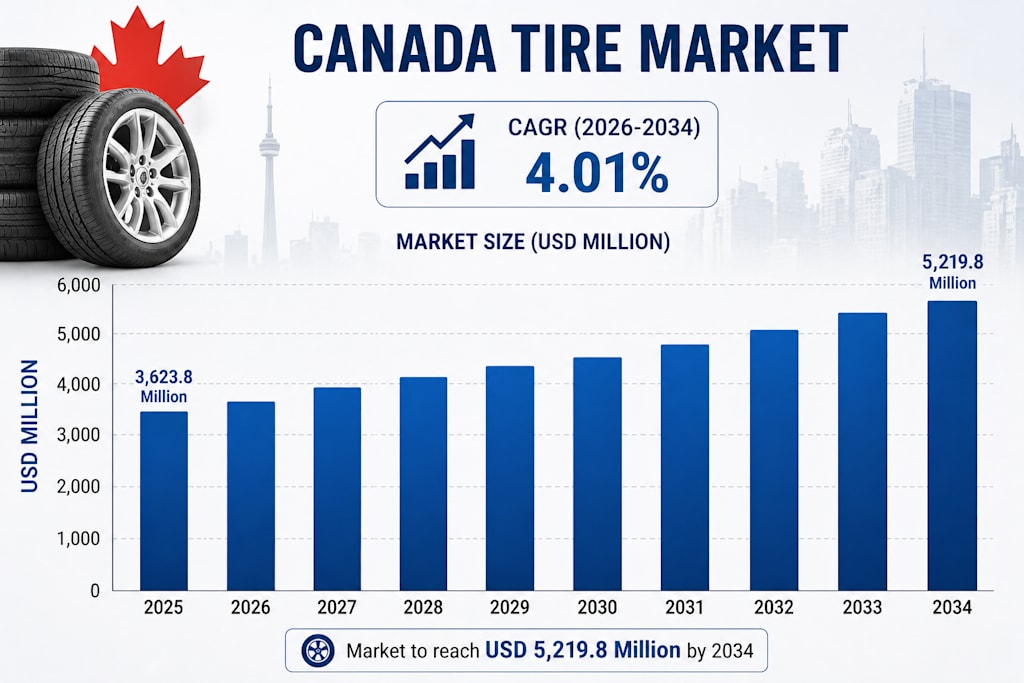
Canada Tire Market Size, Share, and Growth Forecast (2026–2034)
The Canada tire market is positioned for steady growth, supported by consistent vehicle demand, an active aftermarket, and ongoing product innovation. The market reached USD 3,623.8 million in 2025 and is projected to grow to USD 5,219.8 million by 2034, reflecting a CAGR of 4.01% during 2026–2034.
For manufacturers, distributors, and automotive stakeholders, this growth is not only volume-driven but also influenced by shifts in product mix and replacement cycles. The aftermarket segment remains a key revenue contributor, as tire replacement is recurring and less sensitive to new vehicle sales fluctuations. At the same time, advancements in tire design and materials are enabling companies to introduce higher-value products, improving margins and differentiation.
From a B2B perspective, the market offers a balanced combination of stability and innovation, making it attractive for long-term investment and operational expansion.
Demand Trends in the Canada Tire Market Across Passenger, Commercial, and Off-the-Road Segments
Demand in the Canada tire market varies across key segments, each with distinct drivers. The passenger vehicle segment continues to dominate, supported by a large vehicle base and regular replacement needs. Consumers are increasingly opting for tires that offer durability, fuel efficiency, and all-season performance.
The commercial vehicle segment is also contributing to market growth, driven by logistics, construction, and infrastructure activities. Fleet operators are focusing on cost efficiency, leading to demand for long-lasting tires with lower maintenance requirements. Retreading and bulk procurement strategies are commonly used to manage operational costs.
Off-the-road (OTR) tires, used in industries such as mining and agriculture, represent a smaller but high-value segment. Demand in this category is closely tied to industrial activity and large-scale projects. For suppliers, these segments provide opportunities to offer specialized, high-margin products tailored to specific operational needs.
Pricing, Raw Material Costs, and Margin Dynamics in the Canada Tire Industry
Pricing in the tire industry is heavily influenced by raw material costs, particularly natural rubber, synthetic rubber, and petroleum-based inputs. Fluctuations in these inputs directly impact production costs and, in turn, pricing strategies.
Manufacturers are increasingly focusing on cost optimization through supply chain efficiency and material innovation. The use of alternative materials and improved manufacturing processes is helping reduce dependency on volatile raw materials.
From a margin perspective, premium and specialized tires offer better profitability compared to standard products. As a result, companies are shifting their focus toward value-added offerings such as fuel-efficient and high-performance tires. For distributors and retailers, balancing competitive pricing with margin protection remains a key challenge.
Supply Chain and Distribution Channels in the Canada Tire Market
The supply chain in the Canada tire market involves a mix of domestic production and imports, supported by a network of distributors, wholesalers, and retailers. Efficient logistics and inventory management are critical, given the seasonal nature of demand, particularly for winter tires.
Traditional distribution channels, including dealerships and independent retailers, continue to play a major role in sales. However, digital channels are gaining importance, allowing businesses to reach customers directly and improve pricing transparency.
For B2B stakeholders, strengthening distribution networks is essential to ensure timely product availability and maintain customer relationships. Strategic partnerships between manufacturers and distributors are also helping improve market reach and operational efficiency.
Technological Advancements in Tire Manufacturing: Smart Tires, Sustainability, and Performance Innovations
Technology is becoming a key differentiator in the tire market. Manufacturers are investing in smart tire solutions that can monitor pressure, temperature, and wear in real time. These features are particularly valuable for fleet operators, as they help improve safety and reduce maintenance costs.
Sustainability is another important focus area. Companies are developing eco-friendly tires using recyclable materials and energy-efficient manufacturing processes. Fuel-efficient tires that reduce rolling resistance are also gaining popularity, as they contribute to lower vehicle emissions.
Performance innovations, including advanced tread designs and run-flat technologies, are enhancing product reliability and safety. These advancements allow manufacturers to target premium segments and differentiate their offerings in a competitive market.
Investment Opportunities in the Canada Tire Market for Manufacturers, Distributors, and Automotive Players
The Canada tire market presents multiple investment opportunities across the value chain. For manufacturers, expanding production capabilities and investing in advanced technologies can support long-term growth. There is also potential in developing specialized products for commercial and industrial applications.
Distributors and retailers can benefit from strengthening omnichannel strategies, combining physical presence with digital platforms to improve customer engagement and sales efficiency. Inventory optimization and data-driven demand forecasting are becoming important tools in this space.
Automotive players, including fleet operators and service providers, have opportunities to integrate tire management solutions into their operations. This includes predictive maintenance and performance monitoring, which can reduce costs and improve operational efficiency.
Overall, the market favors businesses that can align product innovation with efficient distribution and cost management. As demand continues to evolve, companies that focus on value-added solutions and strategic partnerships are likely to capture the most growth.
About the Creator
Kim Soo hyun
My name is Kim Soo hyun, and I am a research analyst at IMARC Group, specializing in market trends and data analysis to provide insights and support strategic decision-making.
Enjoyed the story? Support the Creator.
Subscribe for free to receive all their stories in your feed.
Comments
There are no comments for this story
Be the first to respond and start the conversation.