
Canada Meat Market Size, Share | Forecast 2034
The Canada meat market size reached USD 29.3 Billion in 2025. The market is projected to reach USD 34.7 Billion by 2034, exhibiting a growth rate (CAGR) of 1.82% during 2026-2034.

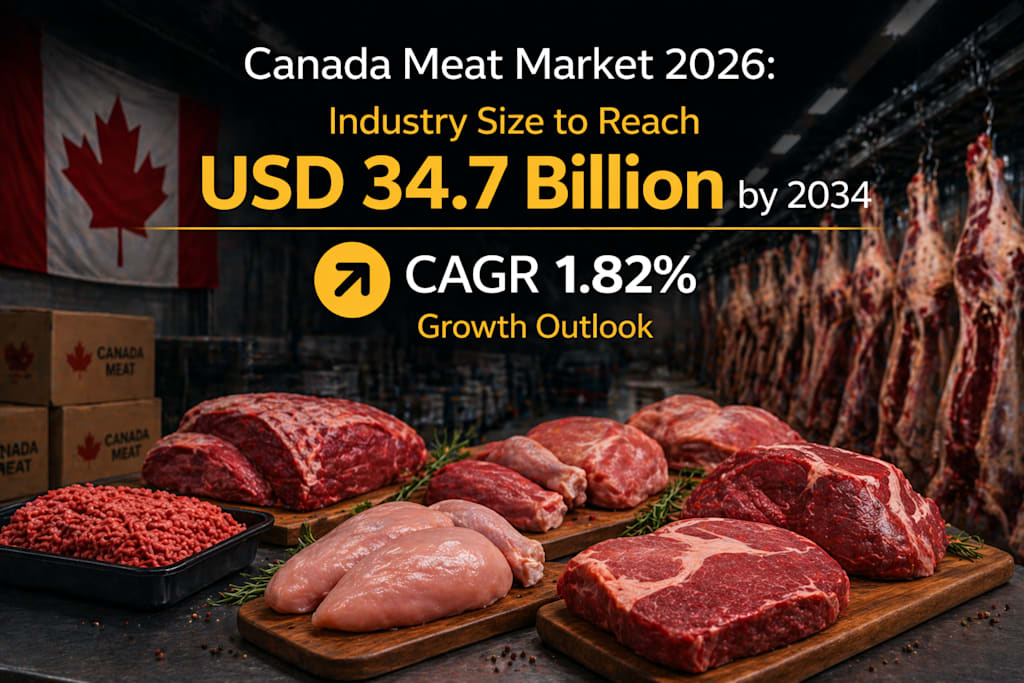
Canada Meat Market Size, Growth, and Forecast (2026–2034)
The Canada meat market continues to play a significant role in the country’s food industry, supported by consistent consumer demand and evolving dietary habits. In 2026, the market reflects a balance between traditional consumption patterns and emerging preferences for healthier and sustainable options.
The market reached a value of USD 29.3 Billion in 2025 and is projected to grow to USD 34.7 Billion by 2034, expanding at a compound annual growth rate (CAGR) of 1.82% during 2026–2034. This moderate growth indicates a stable market shaped by both demand and changing consumption trends.
The meat market includes products such as poultry, beef, pork, and processed meat. These products remain a staple in many households, although preferences are gradually shifting.
Request a Sample Report with Latest 2026 Data & Forecasts:
Key Trends Shaping the Canada Meat Market
Several important trends are influencing the development of the meat industry:
• Increasing demand for high-quality and ethically sourced meat products
• Growing interest in organic and hormone-free options
• Rising awareness of health and nutrition
• Expansion of alternative protein options alongside traditional meat
• Increasing focus on sustainable and environmentally responsible practices
These trends reflect a shift toward more conscious consumption.
Major Growth Drivers in the Canada Meat Industry
The growth of the market is supported by several key factors.
One of the primary drivers is the steady demand for protein-rich food products, which continues to support meat consumption across various demographics.
Another important factor is the expansion of food service and retail sectors, which increases product availability and variety.
The growing preference for premium and value-added meat products is also contributing to market growth.
Additionally, improvements in supply chain efficiency and food processing technologies are enhancing product quality and distribution.
Population growth and urbanization further support consistent demand.
Role of Sustainability and Consumer Awareness
Sustainability is becoming an increasingly important factor in the meat market.
Consumers are showing greater interest in how products are sourced and produced. This includes concerns related to animal welfare, environmental impact, and food safety.
Producers are adopting more sustainable practices, such as improved resource management and transparent supply chains.
Labeling and certification programs are helping consumers make informed choices.
These developments are shaping purchasing behavior and industry practices.
Investment Opportunities in the Canada Meat Market
The steady nature of the market creates various investment opportunities.
Companies are investing in processing technologies, product innovation, and supply chain improvements to remain competitive. There is also growing interest in premium and specialty meat products.
Investments in sustainable production methods and quality assurance systems are becoming more important.
Collaborations between producers, retailers, and distributors are enhancing market efficiency.
With continued demand expected through 2034, the market offers stable long-term potential.
Challenges Impacting the Canada Meat Industry
Despite stability, the market faces several challenges.
One of the key issues is fluctuating feed and production costs, which can impact pricing.
Another challenge is changing consumer preferences, including the rise of plant-based alternatives.
Regulatory requirements and food safety standards also play a significant role in shaping operations.
Additionally, environmental concerns and sustainability pressures are influencing industry practices.
Future Outlook (2026–2034)
Looking ahead, the Canada meat market is expected to maintain steady growth as consumer preferences continue to evolve.
Between 2026 and 2034, the demand for high-quality, safe, and sustainably produced meat products is likely to increase. Consumers will continue to seek transparency and quality assurance.
Technological advancements in processing, packaging, and distribution will further enhance efficiency.
The coexistence of traditional meat products and alternative proteins will shape the market landscape.
Overall, the market is poised for stable growth, driven by consistent demand, innovation, and evolving consumer awareness.
Conclusion
The Canada meat market is evolving steadily, supported by consistent demand, advancements in production, and increasing focus on sustainability. With projected growth from 2026 to 2034, the market is expected to remain a key segment of the food industry.
While challenges such as cost fluctuations and changing preferences persist, ongoing innovation and investment are likely to support long-term stability. As consumer expectations continue to evolve, the market will adapt to meet new demands and priorities.
About the Creator
Jackson Watson
I'm a market research analyst at Imarc group company delivering data-driven insights, industry analysis, and customized research solutions. We support businesses with market sizing, competitive analysis, and strategic decision-making.
Enjoyed the story? Support the Creator.
Subscribe for free to receive all their stories in your feed.
Comments
There are no comments for this story
Be the first to respond and start the conversation.