
Can Oman’s Fertilizer Market Reach US$ 529 Million as Modern Farming and Food Security Goals Transform Agriculture?
Government investments, sustainable farming practices, and agricultural modernization are driving steady growth in Oman’s fertilizer industry.

Agriculture has never been an easy undertaking in Oman. The country’s arid climate, limited rainfall, and restricted availability of arable land create significant challenges for farmers seeking to improve crop productivity. Yet despite these obstacles, Oman has made remarkable progress in strengthening its agricultural sector through modernization, infrastructure investments, and innovative farming practices.
At the heart of this transformation lies a critical agricultural input: fertilizer.
Fertilizers play an essential role in improving soil fertility, enhancing crop yields, and supporting sustainable agricultural development. As Oman continues to prioritize food security and reduce dependence on imported agricultural products, demand for fertilizers is steadily increasing across the country.
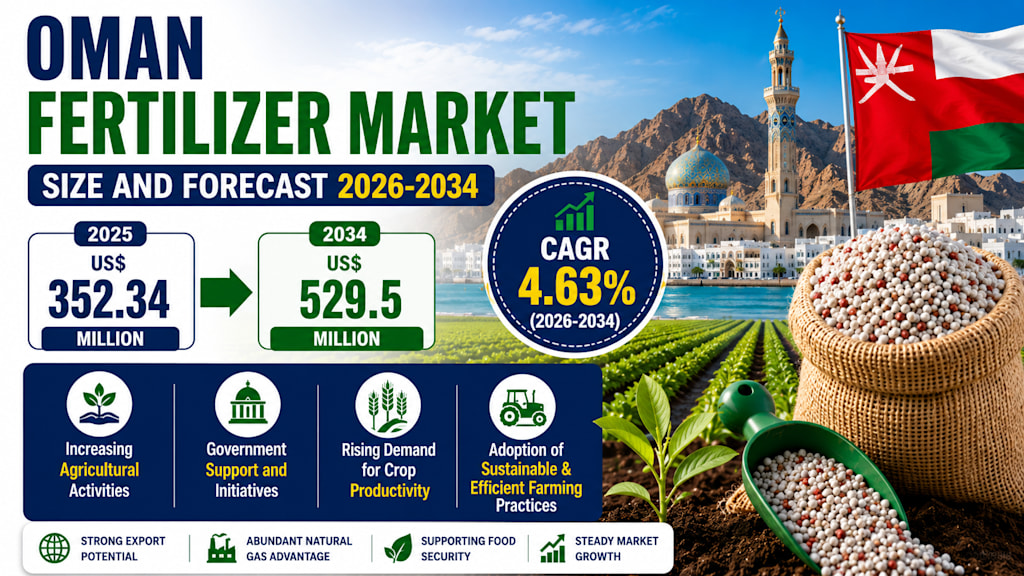
According to Renub Research, the Oman Fertilizer Market is expected to grow from US$ 352.34 million in 2025 to US$ 529.5 million by 2034, expanding at a CAGR of 4.63% between 2026 and 2034. This growth reflects increasing agricultural activities, rising investments in farming infrastructure, growing awareness of soil health, and the adoption of sustainable agricultural practices.
The projected expansion highlights how fertilizers are becoming increasingly important to Oman’s broader agricultural development strategy. As the country seeks to improve food production while conserving valuable resources, fertilizers are emerging as a vital tool for achieving long-term agricultural sustainability.
Agriculture's Evolving Role in Oman
Historically, Oman has faced significant agricultural constraints due to its harsh environmental conditions. Water scarcity and limited fertile land have often restricted farming activities, making food imports an important component of the nation's supply chain.
However, changing economic priorities and growing concerns about food security have encouraged greater investment in domestic agricultural production.
Government initiatives focused on improving irrigation systems, promoting efficient farming methods, and supporting local food production have created new opportunities for agricultural growth. Farmers are increasingly adopting modern cultivation techniques that help maximize yields while making more efficient use of available resources.
As agricultural productivity becomes a national priority, fertilizers are playing a central role in helping farmers overcome environmental challenges and improve crop performance.
Why Fertilizers Matter in Oman
The importance of fertilizers in Oman is closely linked to the country's natural environment.
Soils in arid regions often lack the nutrient levels required to support intensive agricultural production. Without proper nutrient management, crops struggle to achieve optimal growth, resulting in lower yields and reduced profitability.
Fertilizers provide essential nutrients such as nitrogen, phosphorus, and potassium that plants need to develop healthy roots, strong stems, and productive harvests.
By improving nutrient availability, fertilizers help farmers achieve higher crop yields while maintaining soil fertility over time. This is particularly important in Oman, where maximizing productivity from limited agricultural land is crucial for long-term food security.
As farmers seek to improve efficiency and profitability, fertilizer usage continues to increase across various agricultural segments.
Modern Farming Practices Are Driving Growth
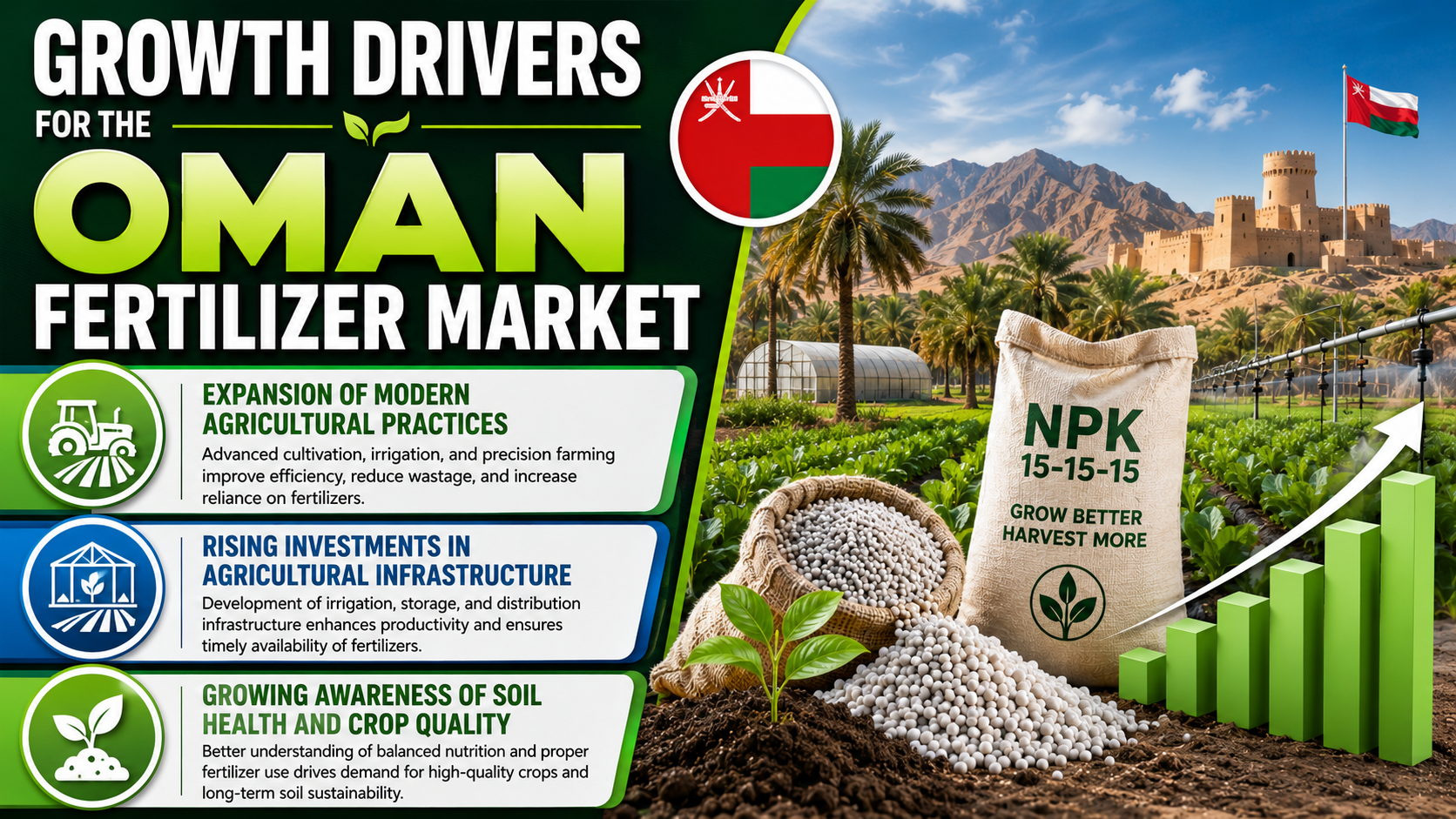
One of the most important factors supporting the growth of the Oman fertilizer market is the increasing adoption of modern agricultural practices.
Traditional farming methods are gradually being replaced by more advanced cultivation systems designed to improve productivity and resource efficiency. Farmers are increasingly utilizing precision agriculture technologies, advanced irrigation methods, and scientific nutrient management techniques.
These innovations enable growers to apply fertilizers more accurately and efficiently, reducing waste while maximizing crop performance.
Modern farming practices also encourage the use of specialized fertilizers tailored to specific crop requirements and environmental conditions. This shift toward technology-driven agriculture is expected to remain a major driver of fertilizer demand throughout the forecast period.
As farming becomes more sophisticated, fertilizers will continue to play a critical role in supporting agricultural success.
Agricultural Infrastructure Investments Support Expansion
Investment in agricultural infrastructure is another significant factor contributing to market growth.
Both public and private sector organizations are investing in projects designed to strengthen Oman’s agricultural capabilities. These initiatives include irrigation system development, storage facility construction, transportation improvements, and enhanced distribution networks.
Improved infrastructure ensures that fertilizers are available to farmers across different regions of the country. Efficient logistics systems help reduce supply disruptions while improving accessibility to agricultural inputs.
Enhanced infrastructure also supports the expansion of farming activities by enabling growers to adopt more productive cultivation methods.
As these investments continue, fertilizer demand is expected to increase alongside agricultural development.
Growing Awareness of Soil Health
Farmers are becoming increasingly aware of the importance of soil health in achieving sustainable agricultural productivity.
Healthy soils are essential for maintaining crop yields, preserving environmental quality, and supporting long-term farming success. Over time, agricultural production depletes important nutrients from the soil, making nutrient replacement necessary.
Fertilizers help restore these nutrients and maintain balanced soil fertility.
Educational programs, agricultural training initiatives, and extension services are helping farmers better understand nutrient management practices and fertilizer application techniques. This growing awareness is encouraging more effective fertilizer use while supporting improvements in crop quality and productivity.
As knowledge about soil health continues to expand, fertilizer adoption is expected to grow across Oman’s agricultural sector.
Sustainable Agriculture Is Reshaping the Industry
Environmental sustainability has become a key priority for the fertilizer industry.
Farmers, policymakers, and agricultural organizations increasingly recognize the need to balance productivity with responsible resource management. This has led to growing interest in sustainable fertilizer solutions that improve efficiency while minimizing environmental impact.
Organic fertilizers, bio-based fertilizers, controlled-release fertilizers, water-soluble nutrient formulations, and environmentally friendly crop nutrition products are becoming more popular throughout the market.
Controlled-release fertilizers help reduce nutrient losses by gradually supplying nutrients over time. Water-soluble fertilizers work effectively with advanced irrigation systems, allowing precise nutrient delivery while conserving water resources.
Organic and bio-based fertilizers offer environmentally responsible alternatives that support soil health and reduce dependence on synthetic chemicals.
These innovations are helping transform the fertilizer industry while supporting Oman’s sustainability objectives.
Technology and Irrigation Systems Improve Efficiency
Efficient water management is one of the most important challenges facing agriculture in Oman.
To address this issue, farmers are increasingly adopting advanced irrigation technologies that improve water utilization and enhance crop productivity. Drip irrigation systems have become particularly important because they deliver water directly to plant roots while minimizing evaporation losses.
These irrigation systems also improve fertilizer application efficiency.
Fertigation, which involves applying fertilizers through irrigation systems, allows nutrients to be delivered directly to crops with remarkable precision. This approach reduces waste, improves nutrient uptake, and supports better crop performance.
The integration of fertilizer management with modern irrigation technologies is creating new opportunities for productivity improvements throughout Oman's agricultural sector.
Nitrogen Fertilizers Continue to Lead the Market
Among various fertilizer categories, nitrogen fertilizers remain the most widely used.
Nitrogen is essential for plant growth because it supports photosynthesis, leaf development, and overall crop productivity. Consequently, nitrogen-based products account for a significant share of fertilizer demand.
Popular nitrogen fertilizer products include ammonia, ammonium nitrate, ammonium phosphate, ammonium sulphate, calcium ammonium nitrate, potassium nitrate, urea, urea ammonium nitrate, NK fertilizers, NP fertilizers, and NPK fertilizers.
These products are used across a wide range of agricultural applications including vegetable cultivation, fruit production, cereal crops, horticulture, and landscaping.
Their proven effectiveness in improving crop performance ensures continued demand throughout the forecast period.
Organic and Inorganic Fertilizers Both Serve Important Functions
The Oman fertilizer market consists of both organic and inorganic fertilizer categories.
Inorganic fertilizers continue to dominate due to their ability to provide immediate nutrient availability and predictable crop responses. Commercial farming operations often depend on these products to maximize productivity and achieve consistent results.
However, organic fertilizers are experiencing increasing demand as sustainability becomes a greater priority.
Many farmers are adopting integrated nutrient management approaches that combine organic and inorganic products. This strategy helps maintain soil fertility while ensuring crops receive sufficient nutrients for optimal growth.
The growing popularity of sustainable farming practices is expected to support continued expansion of the organic fertilizer segment.
Regional Markets Shape Demand Patterns
Fertilizer demand varies across Oman depending on local agricultural activities and economic conditions.
Muscat serves as an important distribution and administrative center. Demand is supported by landscaping projects, horticulture activities, urban farming initiatives, and controlled agricultural environments.
Seeb benefits from growing residential development and expanding agricultural activities. Modern irrigation systems and improved access to distribution networks contribute to increasing fertilizer usage.
Salalah represents one of the country's most important agricultural regions. Favorable climatic conditions, higher rainfall levels, and fertile agricultural land support significant fertilizer demand across crop cultivation and plantation activities.
Bawshar experiences growing demand driven by landscaping projects, residential developments, commercial green spaces, and horticultural activities. The increasing adoption of eco-friendly fertilizer products is also influencing regional market trends.
Challenges Facing the Market
Despite strong growth prospects, the fertilizer industry faces several challenges.
Water scarcity remains one of the most significant obstacles to agricultural expansion. Limited water resources restrict cultivation activities and require farmers to adopt efficient irrigation and nutrient management practices.
Dependence on imported raw materials and fertilizer products also creates vulnerabilities within the supply chain. Global price fluctuations, transportation disruptions, and international market uncertainties can affect product availability and pricing.
Additionally, environmental concerns surrounding fertilizer usage require careful management. Excessive application can contribute to soil degradation and environmental damage if not properly controlled.
Addressing these challenges will require continued investment in innovation, infrastructure, and sustainable agricultural practices.
Competitive Landscape
The Oman fertilizer market includes several major international companies competing through product innovation, research investments, and distribution capabilities.
Key market participants include Yara International ASA, K+S AG, CF Industries Holdings, Grupa Azoty S.A., ICL Group, OCI N.V., Sociedad Química y Minera de Chile SA, BASF SA, and PhosAgro.
These companies continue to invest in advanced fertilizer technologies, sustainable product development, and agricultural solutions designed to improve nutrient efficiency and crop performance.
As demand for environmentally friendly fertilizers increases, innovation will remain a major competitive advantage within the market.
Final Thoughts
Oman’s fertilizer market is entering a period of steady and sustainable growth driven by agricultural modernization, government support, infrastructure investments, and increasing awareness of soil health. As the nation works to strengthen food security and improve agricultural productivity, fertilizers will remain essential tools for overcoming environmental challenges and maximizing crop yields.
With the market projected to grow from US$ 352.34 million in 2025 to US$ 529.5 million by 2034, the industry is positioned to play a critical role in Oman’s agricultural future. Sustainable farming practices, advanced irrigation systems, precision nutrient management, and ongoing innovation are expected to shape the next chapter of growth.
For farmers, businesses, and policymakers alike, the fertilizer industry represents far more than agricultural inputs. It serves as a foundation for building a more resilient, productive, and sustainable agricultural sector capable of supporting Oman’s long-term economic and food security goals.
About the Creator
Enjoyed the story? Support the Creator.
Subscribe for free to receive all their stories in your feed.
Comments
There are no comments for this story
Be the first to respond and start the conversation.