
Building Management System Market Booms as Smart Buildings and Energy Efficiency Become Global Priorities
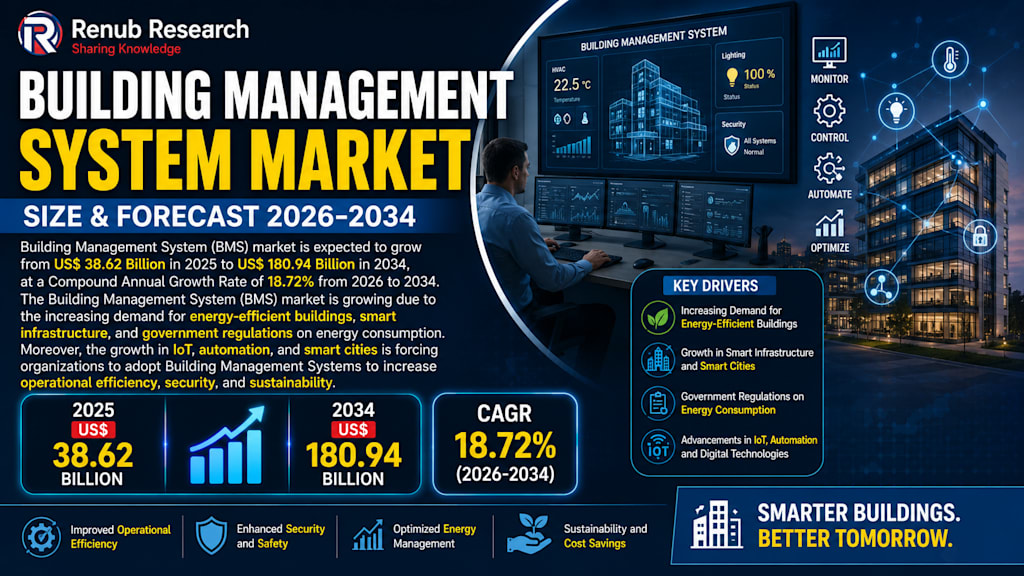
Renub Research forecasts the Building Management System Market to surge from US$ 38.62 billion in 2025 to US$ 180.94 billion by 2034, fueled by rising demand for smart infrastructure, sustainability, and IoT-enabled building automation.

Smart Buildings Are Reshaping the Future of Infrastructure
Buildings around the world are becoming more intelligent, connected, and energy-efficient. From office towers and airports to hospitals and shopping malls, organizations are increasingly investing in advanced technologies that can automate building operations, reduce energy consumption, improve security, and enhance occupant comfort.
At the center of this transformation is the Building Management System (BMS), also known as a Building Automation System (BAS). These systems are rapidly becoming essential tools for managing modern infrastructure efficiently in an era increasingly focused on sustainability and digitalization.
According to the uploaded Renub Research report, the Building Management System Market is expected to grow from US$ 38.62 billion in 2025 to US$ 180.94 billion by 2034, expanding at a CAGR of 18.72% during 2026–2034. The report attributes this rapid growth to increasing demand for energy-efficient buildings, smart city development, IoT adoption, automation technologies, and stricter government regulations on energy consumption.
As urbanization accelerates globally and sustainability targets become more aggressive, building management systems are evolving into a critical component of future-ready infrastructure.
What Is a Building Management System?
A Building Management System is an integrated technology platform designed to monitor, control, and optimize various building functions from a centralized interface. These systems manage operations such as:
- Heating, ventilation, and air conditioning (HVAC)
- Lighting control
- Energy management
- Security and surveillance
- Fire safety systems
- Access control
- Power distribution
- Facility monitoring
Building management systems collect data from sensors, controllers, and connected devices installed throughout a building. This data helps facility managers improve operational efficiency, reduce energy waste, automate maintenance, and ensure optimal performance across infrastructure systems.
The growing integration of cloud computing, IoT sensors, artificial intelligence, and automation technologies is making modern BMS platforms far more intelligent and capable than earlier generations of building automation systems.
Energy Efficiency Is Driving Massive Demand
One of the strongest growth drivers behind the building management system market is the increasing global emphasis on energy efficiency and sustainability.
Buildings account for a substantial portion of worldwide energy consumption and carbon emissions. Governments, businesses, and environmental organizations are under increasing pressure to reduce operational emissions and improve resource efficiency.
The report notes that buildings contribute approximately 37% of global carbon dioxide emissions, according to the UN Environment Programme. This has accelerated the demand for digital energy management technologies capable of optimizing electricity usage, HVAC performance, lighting systems, and resource consumption.
Building management systems help organizations monitor and adjust building operations in real time, reducing unnecessary energy consumption while lowering operational costs.
The report also highlights Schneider Electric’s estimate that its building management solutions can reduce operational carbon emissions in commercial office buildings by as much as 42%.
As energy prices continue rising and environmental regulations become stricter, demand for intelligent building management solutions is expected to increase significantly.
Smart Buildings and Smart Cities Are Expanding Rapidly
The rapid growth of smart buildings and smart city projects worldwide is another major force driving the BMS market.
Smart buildings rely on interconnected systems that communicate with each other to improve efficiency, occupant comfort, and infrastructure performance. Building management systems serve as the central intelligence layer that integrates and coordinates these operations.
At the city level, smart infrastructure projects increasingly depend on connected buildings that can optimize energy use, integrate with transportation systems, and support broader urban sustainability goals.
The report explains that modern BMS platforms are increasingly incorporating technologies such as:
- IoT sensors
- Artificial intelligence
- Cloud computing
- Predictive analytics
- Real-time monitoring systems
A notable example highlighted in the report is Hitachi’s September 2024 launch of a new BuilMirai IoT-based building solution for small and medium-sized buildings under its Lumada portfolio. The system focuses on improving operational efficiency, user comfort, and green building management.
As cities worldwide continue modernizing infrastructure, building management systems are expected to become even more central to urban planning and digital transformation strategies.
Organizations Want Better Operational Efficiency
Organizations across industries are increasingly adopting building management systems to improve facility management and operational performance.
Large buildings such as airports, hospitals, universities, hotels, and commercial offices involve highly complex infrastructure systems that require constant monitoring and optimization. Managing HVAC systems, lighting, maintenance schedules, security operations, and energy consumption manually can be highly inefficient and expensive.
Building management systems solve this challenge by providing centralized visibility and automated control over multiple systems simultaneously.
The report notes that BMS platforms also support predictive maintenance by identifying potential equipment failures before they become major operational problems. This helps organizations reduce downtime, extend equipment lifespan, and lower maintenance costs.
Honeywell’s June 2025 announcement regarding its AI-enabled Honeywell Connected Solutions platform further illustrates this trend. The platform combines multiple building technologies under a unified interface to improve operational efficiency and reduce labor costs.
As organizations focus more heavily on sustainability, automation, and cost optimization, intelligent facility management is becoming a business priority rather than an optional upgrade.
HVAC Systems Remain One of the Most Important Segments
HVAC management represents one of the most important application areas within the building management system market.
Heating, ventilation, and air conditioning systems are among the largest energy-consuming components in both residential and commercial buildings. BMS platforms help optimize HVAC performance by using sensors and analytics to automatically adjust temperature, humidity, airflow, and ventilation settings based on real-time occupancy and environmental conditions.
The report highlights how predictive maintenance capabilities can identify HVAC issues before major failures occur, helping organizations improve reliability while reducing operational expenses.
As climate control requirements grow more sophisticated and energy efficiency becomes increasingly important, HVAC-focused building management systems are expected to remain one of the market’s fastest-growing segments.
Security and Access Control Systems Are Becoming Smarter
Security and access control management is another rapidly expanding area within the BMS market.
Modern buildings require advanced security systems capable of managing surveillance cameras, biometric access systems, electronic cards, alarms, and restricted-access areas. Building management systems integrate these technologies into centralized monitoring platforms that improve real-time response capabilities and strengthen building security.
Organizations increasingly use these systems to secure sensitive areas such as research facilities, corporate offices, data centers, and healthcare institutions.
The report also notes that cloud-based security integration and mobile monitoring applications are becoming increasingly important as businesses seek greater flexibility and remote access capabilities.
Fire and Safety Integration Is Growing in Importance
Fire and safety management has become another critical component of modern building management systems.
BMS platforms increasingly integrate smoke detectors, fire alarms, emergency lighting, sprinkler systems, and evacuation systems into unified emergency response networks.
During emergencies, these systems can automatically trigger alerts, activate safety equipment, guide occupants toward escape routes, and notify emergency personnel.
As governments worldwide strengthen building safety regulations and organizations place greater emphasis on risk management, demand for integrated fire and safety solutions is expected to rise steadily.
High Installation Costs Remain a Major Challenge
Despite strong growth potential, the building management system market still faces several obstacles. One of the most significant is the high upfront cost of installation and implementation.
Deploying a modern BMS requires substantial investment in hardware, sensors, software platforms, controllers, communication infrastructure, and networking technologies.
For many small and medium-sized enterprises, the initial investment remains difficult to justify despite the potential long-term savings in energy and maintenance costs.
The report explains that installation complexity and financial limitations continue slowing adoption among budget-sensitive organizations.
Cybersecurity Risks Are Becoming More Serious
Cybersecurity has emerged as another major concern within the building management system market.
Modern BMS platforms increasingly rely on internet connectivity, cloud systems, and IoT networks. While this improves automation and monitoring capabilities, it also creates potential vulnerabilities for cyberattacks and unauthorized access.
Security breaches could disrupt building operations, compromise sensitive facility data, or even impact occupant safety.
The report notes that integrating multiple building technologies using different communication protocols adds additional complexity to system security management. As a result, organizations must increasingly invest in encryption, secure communication systems, and software updates to protect building infrastructure.
The United States Remains a Leading Market
The United States continues to dominate the global building management system market due to its strong adoption of smart building technologies, energy regulations, and advanced digital infrastructure.
Commercial offices, hospitals, educational institutions, and corporate facilities across the country are actively implementing building management systems to improve sustainability and operational efficiency.
The report highlights Honeywell’s July 2025 launch of its AI-based Honeywell Connected Solutions platform in the United States, enabling organizations to integrate building systems, software, and devices through a unified management platform.
The country’s leadership in IoT, cloud computing, and AI innovation continues driving market growth.
India Is Emerging as a Fast-Growing Opportunity
India’s building management system market is expanding rapidly due to urbanization, infrastructure development, and growing smart city investments.
Commercial properties, airports, shopping malls, hospitals, and residential complexes are increasingly adopting building management systems to optimize energy use and improve operational performance.
Government smart city initiatives and rising electricity costs are also encouraging organizations to adopt energy-efficient infrastructure technologies.
The report highlights Honeywell’s November 2025 building automation Xpress roadshow across India focused on showcasing advanced fire detection, surveillance, access control, and BMS solutions.
India’s rapid digital transformation and infrastructure growth position the country as one of the most important emerging BMS markets globally.
Saudi Arabia Continues Investing in Smart Infrastructure
Saudi Arabia’s BMS market is growing strongly due to major investments in smart cities, commercial infrastructure, and large-scale construction projects.
Extreme climate conditions are also increasing demand for efficient HVAC management solutions in commercial and residential buildings.
The report notes Honeywell’s May 2024 launch of its first assembly line in Saudi Arabia for manufacturing fire alarm and building management solutions, highlighting the region’s growing importance within the global smart infrastructure market.
As Saudi Arabia continues expanding smart city projects and digital infrastructure initiatives, BMS adoption is expected to accelerate further.
Final Thoughts
The building management system market is entering a period of rapid transformation driven by smart infrastructure development, energy efficiency demands, and the growing need for connected building operations.
Organizations worldwide are increasingly recognizing that intelligent building management is not simply about automation—it is about sustainability, operational resilience, cost optimization, and long-term infrastructure performance.
As IoT, artificial intelligence, cloud computing, and predictive analytics continue advancing, building management systems are becoming smarter, more integrated, and more essential to modern infrastructure.
Although challenges related to cybersecurity, integration complexity, and installation costs remain important, the long-term outlook for the industry remains exceptionally strong.
According to the Renub Research forecast, building management systems are set to become a foundational technology in the future of smart buildings, sustainable cities, and digitally connected infrastructure worldwide.
About the Creator
Enjoyed the story? Support the Creator.
Subscribe for free to receive all their stories in your feed.
Comments
There are no comments for this story
Be the first to respond and start the conversation.