
Buffett Gave Away $140 Billion. That’s Why Berkshire Will Outlast Him.
Most empires crumble when the founder exits. Buffett spent 50 years making sure his wouldn’t.
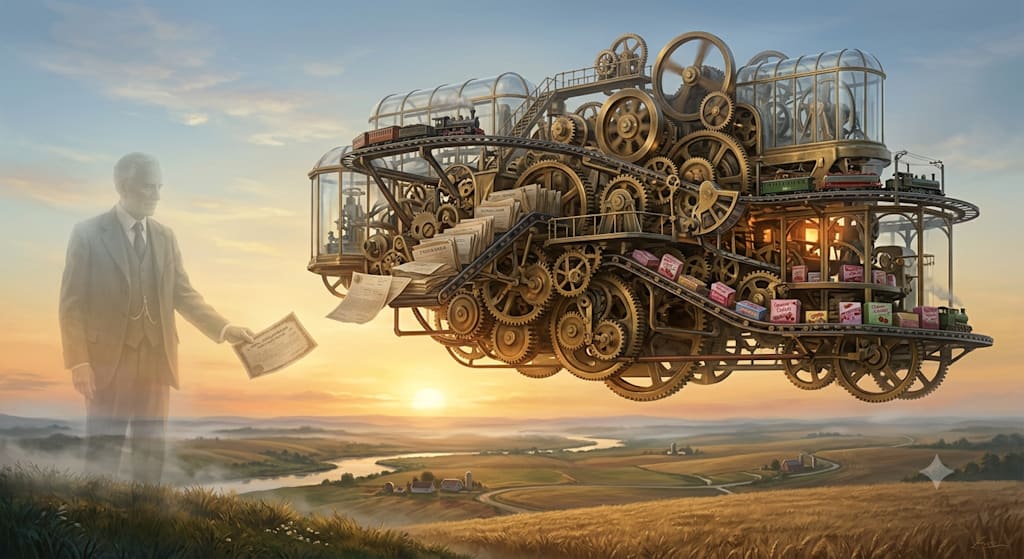
The headline is eye‑catching: Warren Buffett is donating $140 billion in stock. Cue the predictable chorus: “Berkshire will lose its way once he’s gone.”
I see it the opposite way.
This company has prepared for the day without Buffett longer and more carefully than for any investment in its history. He gave away the stock, but he kept the company in the grip of institutions. And he separated those two things, piece by piece, decades ago.
Here are three points, all in his own words from his letters.
One: He turned the company’s values into a contract renewed every single year.
In 1962, Buffett first bought Berkshire shares. Not out of grand vision. It was pure “cigar‑butt” investing: a failing textile mill, its stock so cheap it was like a discarded cigar stub with one free puff left.
He later got annoyed by a one‑eighth‑of‑a‑dollar price quote from the then‑owner, Stanton, and bought the whole company out of spite. He later joked he was “the dog that chased the car and actually caught it.”
Out of that mess, he spent twenty years building a system.
In 1983, he distilled Berkshire’s way of doing business into 13 Owner‑Related Business Principles. Since then, every annual report has reprinted those 13 principles verbatim. The very first one reads:
“Although our form is corporate, our attitude is partnership. Charlie Munger and I think of our shareholders as owner‑partners, and of ourselves as managing partners.”
In 2014, in his letter reviewing Berkshire’s first fifty years, he drove the point home:
“No other company is as stockholder‑oriented as Berkshire. For over 30 years we have annually reiterated our Owner‑Related Business Principles, beginning with the sentence: ‘Although our form is corporate, our attitude is partnership.’ That promise to you is chiseled in stone.”
Think about the difference: whether a set of values survives its founder depends entirely on whether it’s embodied in a person or welded into an institution. Buffett did the latter.
He even drew the red lines for his successors: Berkshire’s CEO must forever watch for the three diseases of corporate decline: arrogance, bureaucracy and complacency. When these corporate cancers metastasize, even the mightiest companies can falter.
General Motors, IBM, Sears, U.S. Steel—all giants in their day, all felled by those three words. Buffett copied their epitaphs into the handbook he left behind.
Two: The company’s engine stopped depending on one man’s foot on the accelerator long ago.
Values are software. Organizational structure is hardware.
In that same 2014 letter, Buffett laid bare Berkshire’s unusual anatomy:
“Operationally, Berkshire is not a giant company but a collection of large companies. Headquarters has never had a committee and has never asked subsidiaries for budgets … We have no legal department, nor do we have human resources, public relations, investor relations, strategic planning, M&A – you name it, we don’t have it.”
A multi‑hundred‑billion‑dollar behemoth, with only about two dozen people at Omaha headquarters. How dare they?
Because dozens of subsidiaries run themselves: GEICO underwrites its own policies, BNSF runs its own trains, Nebraska Furniture Mart—where Mrs. B started with $500 and grew to over $100 million in annual sales from a single store—none of them took orders from Omaha. Buffett could be gone tomorrow, and the candy still sells, the trains still roll.
The real magic is the capital‑allocation machine: taking cash from subsidiary A, tax‑efficiently and without fuss, and moving it to buy subsidiary B. That process has run for decades; it no longer depends on Buffett’s personal touch.
And many forget: Berkshire was never built by one man.
It was Munger who forced him to shift from “cigar‑butt” investing to “buying good companies at fair prices.” Buffett himself, in the 2014 letter, wrote:
“In my view, Charlie’s greatest architectural feat is the Berkshire of today.”
The core methodology of the company was hammered out by two people over decades—it was never lodged in a single brain.
That’s why Buffett could make this claim:
“Our culture is now deeply embedded in their ranks. And our system is self‑renewing. To a great extent, good cultures and bad cultures select themselves for continuation.”
“Self‑renewing,” “self‑selecting”—those are the eight characters (in Chinese) that tell you whether a company outlives its founder.
Three: Succession wasn’t a sudden blackout; it was a queue formed over decades.
This part is most often misread by the media. Mention “after Buffett,” and they cry “power vacuum.”
But the truth is, among global giants, no one has planned succession earlier, more carefully, or with more backup than Berkshire.
As early as 2014, Buffett made it plain:
“The Board and I believe we now have the right person to succeed me as CEO – a successor who is ready to take over the day after I die or step down. In certain important respects, this person will do a better job than I do.”
And he didn’t just name one person. He built a full bench, each with backups:
Greg Abel for overall operations and capital allocation; Ajit Jain for insurance underwriting, unmatched in skill; Todd Combs and Ted Weschler for investments, both having worked alongside him for years. He even put his son Howard in as non‑executive chairman—no pay, no daily duties, just a “fuse” in case the wrong CEO is ever hired, to speed up a replacement.
One person ages, falls ill, passes away. A team with divided roles and backups does not all fail at once.
He even codified the CEO selection criteria: internal, relatively young, capable of serving long.
“Berkshire will operate best if its CEOs have an average tenure far in excess of ten years.”
By his 2025 Thanksgiving letter, the transition reached its final stage. Buffett officially announced:
“Greg Abel will formally take the helm at year‑end. He is an outstanding manager, a tireless doer, and a candid communicator. May he serve long.”
Even more telling was his assessment of Abel—no longer “best of the bunch,” but “the student surpasses the master”:
“Greg’s performance has far exceeded the high expectations I originally had … His knowledge of our many businesses and people now far exceeds mine … I cannot think of anyone better than Greg to manage your money and mine.”
He was even planning for the next century:
“With luck, Berkshire may need only five or six CEOs in the next century. We should especially avoid those who plan to retire at 65, seek flashy wealth, or want to build a family dynasty.”
See the point? He handed over not just a chair, but a set of rules that automatically filters out the wrong people.
Now back to the donation: he gave away the money, not the company.
Once you understand the three points above, the $140 billion donation looks completely different.
First, ownership and control were separated long ago. The donated shares are transferred year by year, batch by batch—voting rights dilute slowly, and the pace is entirely in his hands. The 2025 letter spells it out:
“I intend to retain a substantial number of A shares until Berkshire’s shareholders have built confidence in Greg—just as they long have in Charlie and me.”
The timing of his full handover hinges on “do shareholders trust Greg?”—that’s not an abdication; it’s the final screw in the de‑personalization project.
Second, he repeatedly stressed that accelerating his lifetime giving has nothing to do with his view of Berkshire’s future:
“My accelerated lifetime donations to the foundations run by my children in no way reflect any change in my outlook on Berkshire’s prospects.”
And the shift in recipients—the 2025 letter names four family‑run foundations (the Susan Thompson Buffett Foundation, plus one run by each of his three children)—follows the same logic as managing Berkshire: hand decision‑making to younger people who will outlast him, who can adapt to changing policies, rather than remote‑controlling from the grave.
His own words:
“The record for post‑mortem remote control is not good, and I have never been tempted.”
Don’t worship the eternal infallibility of any one person. Give the system to a structure that can grow and renew itself—that was his logic for Berkshire, and it’s his logic for giving away his fortune. Consistent to the end.
Closing thought
So how should we view a Berkshire that is “thoroughly de‑Buffetted”?
My answer: this is probably Buffett’s proudest creation—more valuable than any single investment he ever made.
A truly great founder is ultimately measured not by how splendid the company was while he was there, but by how splendid it remains after he’s gone. Values chiseled in stone, a company running on institutions, a succession queue decades in the making—this machine was wound up long ago for the day without Buffett.
The most fitting ending comes from his 2025 letter. Speaking of future stock price volatility, even a possible 50% drop, he wrote:
“Do not despair: America will come back, and Berkshire’s stock will, too.”
That sentence contains no “I.”
That is your answer.
About the Creator
Jin
Writer of reamstories
https://reamstories.com/jin
Enjoyed the story? Support the Creator.
Subscribe for free to receive all their stories in your feed. You could also become a paid subscriber, letting them know you appreciate their work.
Comments
There are no comments for this story
Be the first to respond and start the conversation.