
Boston Average Rent Climbs 3.37% Despite Surge in Apartment Supply
Boston’s rental market is producing a result that would appear counterintuitive at first glance.


Apartment availability is sharply higher. Vacancy has increased dramatically. Renters have more options than they did one year ago.
Yet the average apartment in Boston still costs +3.37% more than it did last year.
The City of Boston’s average rent currently stands at $3,378 per month according to Boston Pads, the city’s authoritative source for rental market data. Compared to $3,268 one year ago and $3,254 two years ago, that represents increases of +3.37% year-over-year and +3.81% over two years.
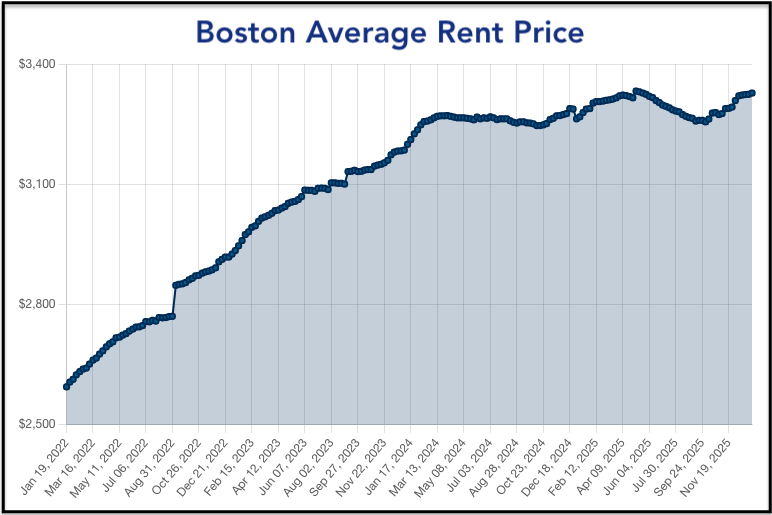
Those numbers suggest Boston’s rental market remains remarkably resilient despite a significant change in supply conditions.
Supply Metrics Suggest Rents Should Be Under More Pressure
The increase in available apartment supply has been substantial.
Across Greater Boston, the Real-Time Availability Rate (RTAR) currently stands at 5.56%, compared with just 2.48% one year ago. That represents a +124.19% year-over-year increase.
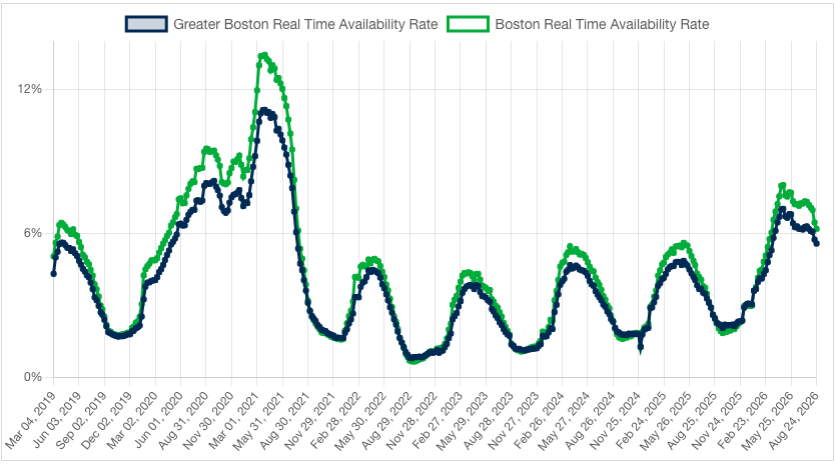
Vacancy has climbed even faster. Greater Boston's Real-Time Vacancy Rate (RTVR) has risen from 0.74% to 2.09%, an increase of +182.43%.
Inside the City of Boston, vacancy has quadrupled. Boston's RTVR currently sits at 1.88%, compared with only 0.47% one year ago, representing a 300% increase.
Normally, a market experiencing that kind of expansion in available and vacant apartments would be expected to see significant downward pressure on rents. Instead, Boston's average rent increased by $110 over the past year.
That divergence is the story.
Boston May Still Be Working Through a Deep Housing Shortage
One explanation is that Boston's underlying housing shortage remains large enough to absorb substantially more inventory without creating an oversupplied market.
A 100% increase in availability sounds dramatic, but percentages can exaggerate changes when the starting point is exceptionally low.
Boston and its surrounding communities spent years operating with extremely limited apartment inventory. One period of elevated availability does not necessarily erase that structural imbalance.
The current environment may therefore represent a move from an unusually tight rental market toward a more balanced one, not necessarily toward a renter-dominated market.
Landlord Costs Could Be Supporting Asking Rents
There may also be another factor helping keep rents elevated: the rising cost of owning and operating rental property.
Insurance premiums, property taxes, repairs, maintenance, utilities, labor and financing expenses have increased substantially since 2020. Massachusetts' 2025 broker-fee reform placed even more cost-burden on property managers.
Beginning August 1, 2025, the party that hires a rental broker became responsible for paying that broker's fee. In transactions where a landlord retains a broker to market an apartment, that expense can no longer simply be assigned to the incoming tenant.
Now, the number of “no-fee apartments” in Boston has risen from 15.12% in 2024 to 68.54% this year. As more and more landlords are shouldering the broker’s fee, it’s not surprising that rent prices have remained resistant to lower prices.
The broker-fee reform alone cannot explain Boston's 3.37% rent increase, but it represents one of several factors that could be contributing to the market's higher cost structure.
Rent Control Is Off the Ballot, But the Affordability Debate Isn't
Housing policy has also been unusually prominent this year.
A proposed statewide rent-control initiative would have allowed Massachusetts communities to regulate rents and generally cap annual increases at inflation or 5%, whichever was lower.
The Massachusetts Supreme Judicial Court prevented the initiative from appearing on the 2026 ballot because of a constitutional issue involving an exemption for religious organizations. That leaves Massachusetts' existing prohibition on rent control intact for now.
But the affordability pressures that drove the proposal remain.
The Sustainable Answer Is More Housing
Boston's current market provides a useful lesson for housing policymakers.
Availability is increasing, which is good for renters. More apartments mean more choice, more competition among property owners and less pressure to immediately take the first acceptable unit that appears.
But one year of expanding inventory has not been enough to reverse rent growth.
That suggests Boston needs considerably more supply.
The long-term path toward affordability should include greater density near transit, faster permitting, zoning reform, adaptive reuse and more multifamily construction throughout Greater Boston.
Increasing the cost or regulatory risk associated with creating and operating housing could make the supply problem worse. Boston needs the opposite. The region should be trying to turn today's increase in available apartments into years of sustained housing production.
For now, Boston's average rent tells a remarkably clear story: you can’t legislate affordability, you must fix the underlying cause: supply.
About the Creator
Enjoyed the story? Support the Creator.
Subscribe for free to receive all their stories in your feed.
Comments
There are no comments for this story
Be the first to respond and start the conversation.