
Benthorne Execution System and the Evolution of Modern Execution Infrastructure
A structured overview of how execution systems are reshaping digital financial workflows

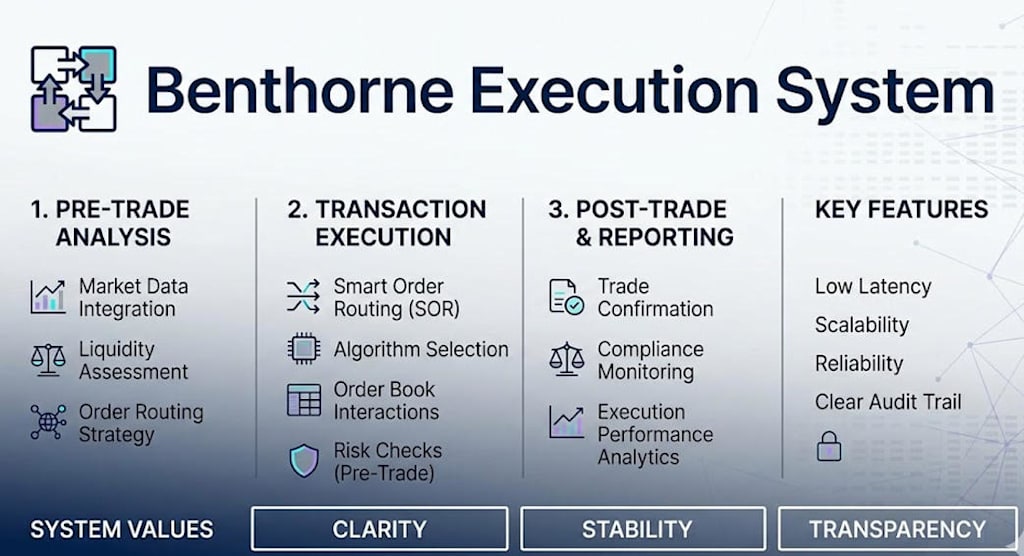
Benthorne Execution System represents a conceptual model of how modern financial execution infrastructure is evolving in response to increasingly complex and fragmented markets. Rather than functioning as a traditional trading platform, it is designed as an execution layer that connects strategy generation with real-world market activity. This distinction is important because modern financial systems are no longer defined only by where trades are placed, but by how efficiently, securely, and intelligently those trades are executed across multiple environments.
At its core, Benthorne Execution System focuses on improving execution efficiency. In financial markets, even small delays between decision-making and order completion can significantly affect outcomes, especially in volatile conditions. The system aims to reduce this gap by streamlining the process through which trading instructions are processed, validated, and routed. This allows execution to occur closer to real time, minimizing latency and improving overall responsiveness.
Another important aspect of Benthorne Execution System is its modular structure. Instead of relying on a single unified engine, the system is divided into multiple functional layers. These typically include data ingestion, execution logic, risk evaluation, and liquidity routing. Each layer operates independently while remaining interconnected through standardized communication channels. This modular approach improves flexibility, making it easier to adapt the system to different market conditions and asset classes without requiring a complete redesign of the infrastructure.
Data processing plays a central role in the system’s functionality. Modern financial environments generate large volumes of real-time information, including price movements, order book changes, and external market signals. Benthorne Execution System is designed to process this information continuously, ensuring that execution decisions are based on the most current market conditions available. By maintaining an updated view of the market, the system supports more accurate and context-aware execution behavior.
Risk management is another key component embedded within the execution process. Rather than treating risk control as a separate post-trade function, the system integrates it directly into execution logic. This allows for real-time monitoring of exposure levels, volatility changes, and liquidity conditions. If certain thresholds are exceeded, the system can adjust execution parameters dynamically or temporarily pause activity to prevent unintended outcomes. This continuous risk awareness helps maintain stability in unpredictable market environments.
Liquidity aggregation is also an important feature of Benthorne Execution System. In modern financial markets, liquidity is often distributed across multiple venues rather than concentrated in a single location. The system addresses this by connecting to various liquidity sources and evaluating them in real time. It then selects the most efficient execution path based on factors such as price, depth, and transaction cost. This improves execution quality and reduces slippage, particularly during high-volume trading periods.
Automation is another defining characteristic of the system. Benthorne Execution System supports algorithmic execution models that allow predefined strategies to operate without manual intervention. These automated processes can respond to market signals, adjust execution timing, and optimize order distribution based on changing conditions. This reduces the need for manual oversight and enables more consistent execution behavior across different market scenarios.
In addition to automation, the system is designed with scalability in mind. As financial markets expand and trading activity increases, execution systems must be capable of handling higher volumes without performance degradation. Benthorne Execution System achieves this through distributed architecture and parallel processing capabilities. These design choices ensure that the system remains stable and efficient even under heavy operational load.
Security and reliability are also fundamental considerations. Financial execution systems must ensure data integrity and protect against unauthorized access or system failures. Benthorne Execution System incorporates layered security mechanisms, including encrypted communication channels and structured access controls. It also includes redundancy and failover mechanisms to maintain continuous operation in case of technical disruptions.
Overall, Benthorne Execution System can be understood as a framework for modernizing trade execution in complex financial ecosystems. It combines efficiency, automation, risk control, and scalability into a unified structure designed for evolving market demands. As financial technology continues to advance, systems built around these principles are likely to play an increasingly important role in shaping how digital trading environments operate and develop over time.
About the Creator
Benthorne Execution System
Benthorne Execution System explores execution intelligence, quantitative finance frameworks, AI-driven analytics, and modern financial technology infrastructure through educational and research-focused content.
Enjoyed the story? Support the Creator.
Subscribe for free to receive all their stories in your feed.
Comments
There are no comments for this story
Be the first to respond and start the conversation.