
Automotive Robotics Market Accelerates as EV Production and Smart Factories Redefine Manufacturing
From electric vehicles to AI-powered assembly lines, automotive robotics is becoming the backbone of next-generation vehicle manufacturing worldwide.

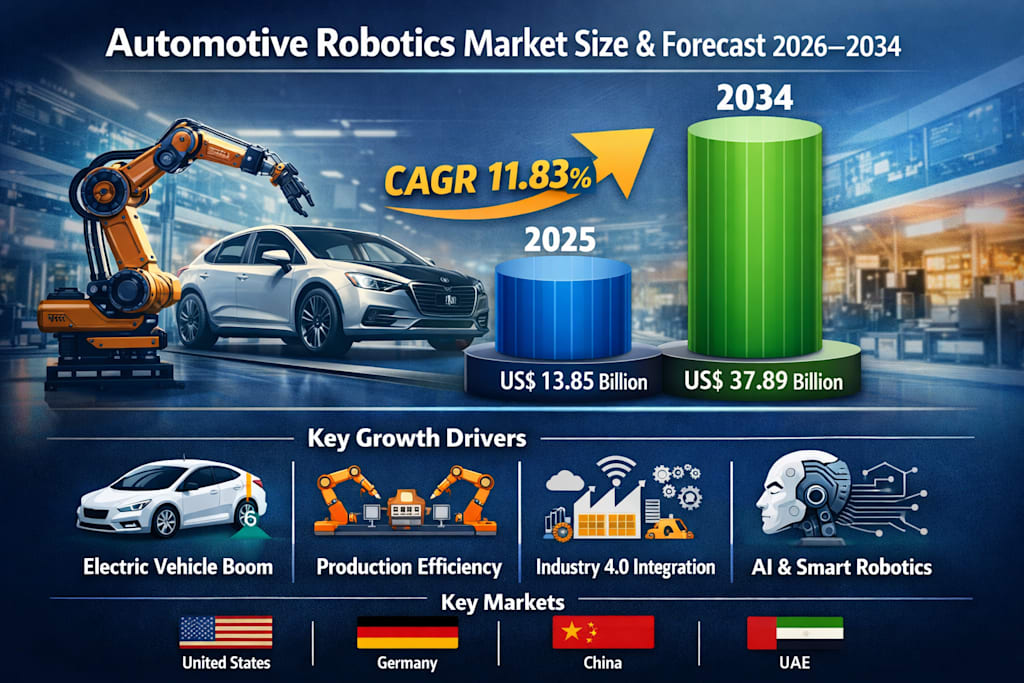
The automotive industry is entering one of the most transformative periods in its history, and robotics is at the center of that evolution. According to Renub Research, the Automotive Robotics Market is expected to grow from US$ 13.85 billion in 2025 to US$ 37.89 billion by 2034, expanding at a remarkable CAGR of 11.83% from 2026 to 2034. The rapid growth is being fueled by increasing automation across vehicle manufacturing, the explosive rise of electric vehicles (EVs), advancements in artificial intelligence, and the global shift toward Industry 4.0-enabled smart factories.
As competition intensifies among automakers, manufacturers are investing heavily in robotics to improve efficiency, reduce production errors, increase flexibility, and meet growing consumer demand for customized vehicles. Industrial robots are no longer just tools for repetitive assembly tasks. They are becoming intelligent systems capable of adapting to complex manufacturing environments, handling sensitive components, and supporting the production of highly advanced vehicles.
The rise of robotics in modern automotive manufacturing
Automotive robotics has become a crucial part of global vehicle production. These robotic systems are widely used for assembly, welding, painting, material handling, inspection, and packaging. Their ability to deliver high precision and consistent performance makes them especially valuable in large-scale manufacturing operations where quality control and speed are critical.
Today’s automotive robots include articulated robots, collaborative robots (cobots), autonomous guided vehicles (AGVs), and vision-guided robotic systems. Together, they streamline production lines from chassis assembly to final inspection. Major companies such as FANUC, ABB, KUKA, Yaskawa, and Kawasaki continue to expand robotic capabilities through innovations in automation, AI integration, and sensor technology.
The growing complexity of vehicle production is another major reason robotics adoption is accelerating. Modern vehicles contain advanced electronics, lightweight materials, electric drivetrains, and connected systems that require highly accurate assembly. Traditional manual manufacturing methods often struggle to deliver the speed and precision needed for these components. Robotics, however, allows manufacturers to achieve consistent quality while reducing production delays and operational inefficiencies.
Electric vehicles are reshaping robotics demand
One of the strongest drivers of the automotive robotics market is the rapid growth of electric vehicles. EV manufacturing requires specialized assembly processes for batteries, electric drivetrains, thermal systems, and lightweight vehicle structures. These tasks demand a level of precision and repeatability that robotic systems are ideally designed to handle.
Battery pack assembly, for example, involves handling sensitive materials and components where even small errors can affect vehicle safety and performance. Robots can perform these repetitive tasks with greater accuracy and reduced risk compared to manual operations. In addition, EV manufacturers often need flexible production systems capable of adapting to evolving vehicle designs and multiple model variants. Robotics provides that flexibility, allowing production lines to be adjusted more efficiently without significant downtime.
As governments worldwide continue pushing for cleaner transportation and stricter emission regulations, EV production is expected to rise sharply. That trend naturally increases the need for advanced automation technologies. Automotive companies are now viewing robotics not simply as an operational upgrade, but as a strategic requirement for future competitiveness.
Smart factories and Industry 4.0 are transforming production
The integration of robotics with Industry 4.0 technologies is changing how automotive factories operate. Modern manufacturing facilities increasingly rely on interconnected systems that combine robotics, artificial intelligence, IoT connectivity, machine learning, and real-time data analysis. These smart factories are designed to optimize production performance while reducing waste, downtime, and maintenance costs.
AI-powered robotic systems can now monitor production conditions, identify defects in real time, and predict maintenance requirements before equipment failure occurs. This predictive capability significantly reduces unexpected downtime and improves overall production efficiency. Vision-guided robots equipped with advanced sensors can also perform highly detailed quality inspections that would be difficult to achieve consistently through manual inspection alone.
Collaborative robots are also becoming more common in automotive plants. Unlike traditional industrial robots that operate separately from human workers, cobots are designed to work safely alongside employees. This creates more flexible production environments where humans and robots can complement each other’s strengths. Workers handle decision-making and problem-solving tasks, while robots manage repetitive or physically demanding operations.
Automation is helping manufacturers cut costs and improve quality
Automotive manufacturers operate in an environment where speed, quality, and cost efficiency directly affect profitability. Robotics helps companies address all three areas simultaneously. Automated systems reduce human error, improve production consistency, and increase throughput. Tasks such as welding, painting, and assembly can be completed with greater precision and less material waste.
Flexible robotic systems also support lean manufacturing strategies. Production lines can shift between different vehicle models more quickly, allowing manufacturers to respond faster to changing consumer demand. This flexibility is especially important as customization becomes more common in the automotive industry. Consumers increasingly expect more options in design, technology features, and performance, placing additional pressure on manufacturers to build adaptable production systems.
Automation also improves workplace safety. Many automotive manufacturing tasks involve hazardous materials, repetitive movements, or heavy lifting. By assigning these tasks to robots, companies can reduce workplace injuries and create safer factory environments for employees.
The market still faces major obstacles
Despite strong growth prospects, the automotive robotics market faces several important challenges. One of the biggest barriers is the high upfront cost associated with robotic systems. Purchasing industrial robots, integrating them into production lines, modifying facilities, and maintaining advanced software infrastructure require substantial investment. Smaller manufacturers and suppliers may struggle to justify these expenses, especially in highly competitive markets.
Beyond installation costs, robotics implementation also requires specialized technical expertise. Manufacturers must invest in employee training, system integration, and ongoing maintenance support. This creates additional operational expenses and can slow adoption among companies with limited resources.
Workforce adaptation remains another significant issue. As automation expands, traditional manufacturing roles are changing rapidly. Employees increasingly need technical skills related to robot programming, maintenance, troubleshooting, and AI-supported manufacturing systems. Many companies face difficulties finding workers with the necessary expertise, creating skill gaps that can affect production efficiency.
Resistance to change can also slow implementation. Employees concerned about job displacement may be hesitant to embrace automation initiatives unless companies provide strong training and reskilling programs. Balancing automation with workforce development will remain a key challenge for the industry moving forward.
Regional markets show strong momentum
The United States remains one of the world’s most advanced automotive robotics markets. The country’s strong automotive manufacturing base, growing EV sector, and rapid adoption of smart factory technologies continue to support robotics investment. U.S. automakers are increasingly integrating AI, IoT, and collaborative robotics into production facilities to improve operational performance and production flexibility.
Germany continues to lead globally in precision engineering and automotive automation. The country’s automotive manufacturers have long prioritized high-quality production standards, making robotics an essential component of factory operations. Germany’s strong research infrastructure and focus on innovation further strengthen its position in advanced automotive robotics development.
China represents one of the fastest-growing markets in the industry. As the world’s largest automotive manufacturing hub, China is investing aggressively in robotics, EV production, and smart manufacturing technologies. Government support for automation and industrial modernization continues to accelerate robotics adoption across Chinese automotive factories.
The United Arab Emirates is also emerging as a promising market. Industrial modernization initiatives, smart manufacturing investments, and expanding automotive assembly operations are creating new opportunities for robotics suppliers. While the market remains smaller than the U.S., Germany, or China, ongoing infrastructure development and Industry 4.0 initiatives are expected to support steady growth.
Recent developments highlight industry momentum
Recent developments across the automotive robotics sector demonstrate how rapidly the industry is evolving. In March 2025, Mercedes-Benz began testing humanoid robots at its Digital Factory Campus in Berlin following a major investment in Apptronik. This move reflects growing interest in next-generation robotic systems capable of performing more advanced and adaptive tasks within manufacturing environments.
Hyundai Motor Group also announced in March 2025 that it would invest US$ 21 billion in the United States between 2025 and 2028, including US$ 6 billion dedicated to robotics, AI, and autonomous driving collaborations with Boston Dynamics and NVIDIA. The investment highlights how automakers increasingly view robotics and AI as central pillars of future manufacturing and mobility strategies.
In January 2025, Schaeffler expanded its motion-technology portfolio after acquiring Vitesco Technologies, with a focus on humanoid robotics and advanced automation systems showcased at CES 2025. These developments signal that automotive robotics is moving beyond conventional industrial automation toward more intelligent, adaptable, and AI-driven manufacturing systems.
Robotics is becoming essential for the future of mobility
The future of automotive manufacturing will depend heavily on automation, flexibility, and intelligent production systems. As vehicles become more advanced, production requirements will continue growing more complex. Robotics offers manufacturers the ability to scale efficiently while maintaining quality, precision, and cost control.
The market’s segmentation also reveals broad opportunity areas. Components such as controllers, robotic arms, end effectors, sensors, and drive systems each play important roles in production automation. Different robot types, including articulated robots, cylindrical robots, SCARA robots, and Cartesian robots, support various manufacturing tasks ranging from welding and painting to material handling and cutting.
As AI and smart manufacturing technologies mature further, robotic systems are expected to become even more autonomous and capable. The factories of the future will likely rely on highly connected ecosystems where machines communicate continuously, optimize production automatically, and adapt in real time to changing operational conditions.
Final Thoughts
The automotive robotics market is entering a period of exceptional growth as global automakers race toward smarter, faster, and more flexible manufacturing systems. The shift toward electric vehicles, Industry 4.0 integration, AI-enabled automation, and intelligent factories is fundamentally changing how vehicles are built around the world.
With Renub Research forecasting the market to reach US$ 37.89 billion by 2034, robotics is no longer simply a manufacturing enhancement. It is becoming the foundation of modern automotive production. Companies that invest early in advanced automation technologies are likely to gain stronger production efficiency, greater adaptability, and a competitive edge in an industry undergoing rapid transformation.
About the Creator
Enjoyed the story? Support the Creator.
Subscribe for free to receive all their stories in your feed.
Comments
There are no comments for this story
Be the first to respond and start the conversation.