
Australia Xanthan Gum Market: Clean‑Label Surge, Offshore Drilling Demand & Natural Formulation Shift
How gluten‑free bakery expansion, petroleum sector resilience and pharmaceutical innovation are driving a 5.85% CAGR toward a $23.11 million market by 2034

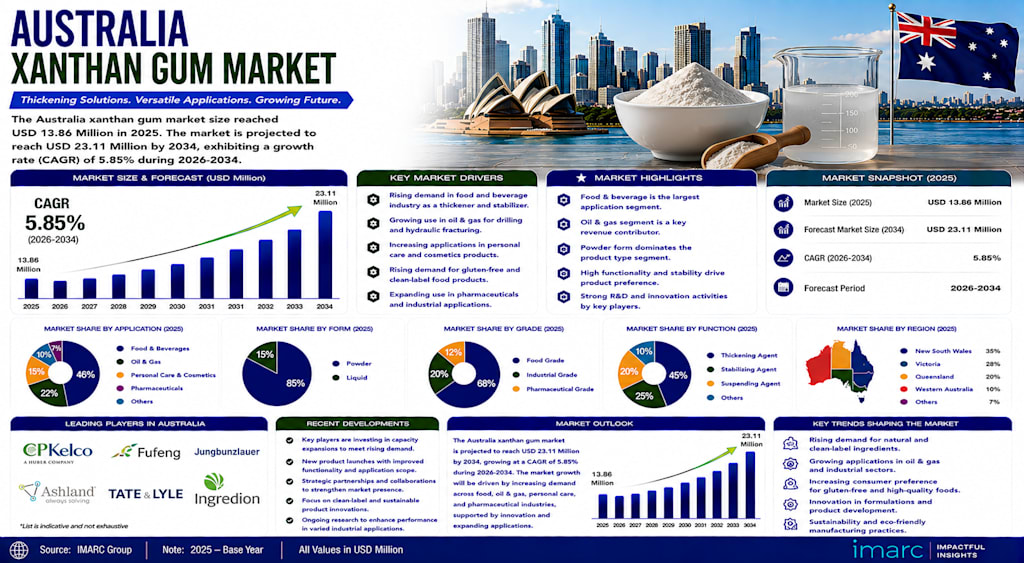
The Australia xanthan gum market is experiencing steady, multi‑sector expansion as food manufacturers, drilling operators and pharmaceutical formulators increasingly rely on this natural, plant‑based polysaccharide for its unparalleled rheological properties and functional versatility. Xanthan gum — a high‑molecular‑weight biopolymer produced through microbial fermentation — is deployed across gluten‑free bakery products, sauces, dressings, dairy alternatives, water‑based drilling fluids, pharmaceutical excipients and personal care formulations to deliver viscosity control, stability, texture enhancement and suspension capabilities. According to IMARC Group, the market size reached USD 13.86 Million in 2025 and is projected to reach USD 23.11 Million by 2034, exhibiting a compound annual growth rate (CAGR) of 5.85% during 2026–2034. As Australian consumers demand cleaner labels, as the nation's offshore petroleum sector sustains extensive drilling operations and as pharmaceutical manufacturers embrace natural excipients, xanthan gum has become an indispensable ingredient across multiple industrial pillars of the Australian economy.
What's Driving Market Growth?
Gluten‑Free and Clean‑Label Food Product Transformation. The Australian food and beverage industry is undergoing a significant transformation driven by heightened consumer awareness of dietary health and food ingredient transparency. Xanthan gum has emerged as an essential ingredient in gluten‑free product formulations, where it provides the structural support and texture typically delivered by gluten proteins. Its ability to create viscosity and maintain product stability makes it particularly valuable in bakery applications, sauces, dressings and dairy alternatives. Australian consumers are increasingly seeking products with recognizable, natural ingredients, aligning with the global clean‑label movement that prioritizes minimally processed additives. Food manufacturers are responding by reformulating products to replace synthetic stabilizers and thickeners with natural alternatives like xanthan gum, with the ingredient's plant‑based origin through microbial fermentation resonating with growing vegan and vegetarian consumer segments. In March 2025, The Hallway partnered with Sydney‑based Wholegreen Bakery to launch the Cardboard Cake, a coeliac‑approved bakery product featuring butterscotch, coffee, cocoa powder, pastry, caramel and brown rice flour, demonstrating the innovative use of xanthan gum in gluten‑free formulations to maintain desired texture and stability. Major supermarket chains are dedicating increased shelf space to gluten‑free and clean‑label products, improving accessibility and driving consistent demand from food manufacturers seeking reliable natural texturizing solutions.
Offshore Petroleum Drilling Operations Driving Industrial Demand. Australia's petroleum industry represents a substantial driver for industrial‑grade xanthan gum consumption, particularly within the context of offshore drilling operations that dominate the nation's energy production landscape. Xanthan gum serves critical functions in water‑based drilling fluids, where its unique rheological properties enable effective viscosity control across varying temperatures, pressures and salinity conditions encountered in deep‑water and high‑temperature drilling environments. The compound's pseudoplastic behaviour allows drilling fluids to maintain low viscosity during pumping while developing high viscosity at rest, facilitating efficient cuttings transport and suspension — a characteristic particularly valuable in Australia's offshore petroleum basins where complex geological formations require sophisticated drilling fluid formulations to maintain borehole stability. The ongoing development of mature fields and exploration of new reserves in regions such as the North West Shelf, Gippsland Basin and Browse Basin sustains demand for specialized drilling additives. In 2025, Woodside and ExxonMobil announced a USD 350 million Bass Strait drilling campaign aimed at extending supply in Australia's offshore petroleum sector. With approximately 88% of Australia's petroleum production in 2025 coming from offshore fields primarily in the North West Shelf and Gippsland Basin, demand for xanthan gum as a thickening and stabilizing agent in drilling fluids continues to rise. The industry's focus on operational efficiency and environmental compliance further reinforces the preference for biodegradable, non‑toxic additives like xanthan gum over synthetic alternatives, positioning the ingredient as an indispensable component in Australia's energy sector infrastructure.
Pharmaceutical and Personal Care Industry Adoption. The pharmaceutical and personal care sectors in Australia are increasingly incorporating xanthan gum into product formulations, driven by the ingredient's biocompatibility, biodegradability and functional versatility. In pharmaceutical applications, xanthan gum functions as an excipient in controlled‑release drug delivery systems, oral suspensions and topical formulations, providing consistent viscosity, enhancing stability and improving patient compliance through better mouthfeel and ease of administration. The compound's ability to form stable gels and maintain viscosity across varying pH levels makes it particularly suitable for acid‑resistant formulations and sustained‑release tablets. Australian pharmaceutical manufacturers are leveraging xanthan gum's natural origin to align with regulatory preferences for Generally Recognized as Safe (GRAS) ingredients and consumer demand for products containing recognizable, plant‑derived components. In the personal care industry, xanthan gum is utilized in lotions, creams, shampoos and cosmetic formulations as a thickening agent, emulsion stabilizer and texture modifier, with compatibility with both natural and synthetic components enabling formulators to meet clean beauty standards while maintaining desired performance characteristics. In September 2025, Jungbunzlauer invested USD 200 million to establish Canada's first xanthan gum manufacturing facility in Port Colborne, Ontario, with support from a USD 4.8 million Invest Ontario grant, creating 50 new jobs and enhancing North American production capacity — a significant investment demonstrating growing global demand for pharmaceutical and cosmetics‑grade xanthan gum serving Australian and Asia‑Pacific markets.
Market Segmentation & Key Insights
By Application, the market is segmented into oil and gas, food and beverage, pharmaceutical, cosmetics and others. The oil and gas segment accounts for a substantial share due to Australia's extensive offshore drilling operations, while food and beverage represents the fastest‑growing segment driven by gluten‑free and clean‑label product innovation.
By Region, the market covers Australia Capital Territory & New South Wales, Victoria & Tasmania, Queensland, Northern Territory & Southern Australia, and Western Australia. Western Australia leads due to its concentration of offshore petroleum operations in the North West Shelf, while New South Wales and Victoria dominate the food and pharmaceutical segments due to their population density and manufacturing activity.
What the Opportunities Are?
Natural Food Stabilizer Reformulation. With Australian consumers increasingly seeking recognizable, natural ingredients and food manufacturers reformulating products to replace synthetic stabilizers and thickeners, there is substantial opportunity for xanthan gum suppliers to partner with food producers transitioning to clean‑label formulations. The ingredient's plant‑based origin through microbial fermentation positions it favourably for vegan and vegetarian product lines.
Offshore Drilling Fluid Formulations. Australia's petroleum industry, with approximately 88% of production coming from offshore fields and sustained exploration in the North West Shelf, Gippsland Basin and Browse Basin, creates consistent demand for industrial‑grade xanthan gum as a viscosifier in water‑based drilling fluids. The USD 350 million Bass Strait drilling campaign announced by Woodside and ExxonMobil in 2025 exemplifies the scale of drilling activity driving this demand.
Pharmaceutical Excipient Innovation. Australian pharmaceutical manufacturers are increasingly leveraging xanthan gum's natural origin to align with regulatory preferences for GRAS ingredients. Opportunities exist for suppliers offering pharmaceutical‑grade xanthan gum for controlled‑release drug delivery systems, oral suspensions and topical formulations, particularly as the pharmaceutical sector increasingly utilizes xanthan gum in controlled‑release formulations.
Personal Care and Cosmetic Formulations. The personal care industry's demand for xanthan gum as a thickening agent, emulsion stabilizer and texture modifier is growing, driven by the clean beauty movement and consumer demand for plant‑derived, recognizable ingredients. Suppliers offering cosmetics‑grade xanthan gum can capture share in Australia's expanding natural personal care market.
Clean‑Label Citrus Fibre Competition and Innovation. In September 2025, Ingredion introduced new clean‑label citrus fibre ingredients that help with viscosity, texture, gelling and stability in foods, partly replacing conventional additives like modified starch and hydrocolloids including xanthan gum. This represents both a competitive challenge and an innovation opportunity for xanthan gum suppliers to differentiate through superior rheological properties, cost‑effectiveness and multifunctionality.
Recent News and Developments in Australia Xanthan Gum Market
March 2025: The Hallway partnered with Sydney‑based Wholegreen Bakery to launch the Cardboard Cake, a coeliac‑approved bakery product demonstrating innovative use of xanthan gum in gluten‑free formulations to maintain desired texture and stability.
April 2025: Cargill introduced Biostrong C‑Protect, a feed additive combining a postbiotic (XPC™) and a phytogenic to help poultry resist avian pathogenic E. coli. While not directly a xanthan gum product, this development by a major xanthan gum manufacturer demonstrates continued innovation in bio‑based solutions complementing their hydrocolloid portfolio for Australian agricultural applications.
June 2025: ADM inaugurated a new research and development centre focusing on animal health and microbiome research. This expansion may support future development of health‑related additives, potentially expanding the application scope of xanthan gum in functional food ingredients and animal nutrition products distributed in Australian and Asia‑Pacific markets.
September 2025: Jungbunzlauer invested USD 200 million to establish Canada's first xanthan gum manufacturing facility, with support from a USD 4.8 million Invest Ontario grant, creating 50 new jobs and enhancing North American production capacity serving Australian and Asia‑Pacific markets.
2025: Woodside and ExxonMobil announced a USD 350 million Bass Strait drilling campaign aimed at extending supply in Australia's offshore petroleum sector, sustaining demand for xanthan gum as a thickening and stabilizing agent in drilling fluids.
Why Should You Know About Australia Xanthan Gum Market?
You should know about this market because it captures how clean‑label food innovation, offshore energy resilience and pharmaceutical natural ingredient demand intersect to create steady, multi‑sector growth in a specialised but mission‑critical biopolymer segment. Xanthan gum is no longer just a food thickener — it is an essential structural component of gluten‑free bakery products enabling coeliac consumers to enjoy quality baked goods, a critical viscosifier in offshore drilling fluids that maintain borehole stability in Australia's complex petroleum basins, and a natural excipient enabling pharmaceutical manufacturers to develop controlled‑release drug formulations with improved patient compliance.
For investors, the xanthan gum market offers exposure to a stable‑growth industrial biopolymer category anchored in Australia's expanding gluten‑free and clean‑label food sector, sustained offshore petroleum drilling activity (with 88% of production from offshore fields), and the accelerating pharmaceutical and personal care industry adoption of natural, plant‑derived ingredients. The projected CAGR of 5.85% reflects consistent baseline demand across multiple industrial pillars, while higher‑growth sub‑segments — including gluten‑free bakery formulations, offshore drilling fluid innovations and pharmaceutical‑grade excipients — offer differentiated upside potential.
For food manufacturers, drilling fluid formulators, pharmaceutical producers and ingredient suppliers, understanding xanthan gum segmentation across food, oil and gas, pharmaceutical and personal care applications, the emerging competition from clean‑label citrus fibre alternatives, and the sustained demand from Australia's offshore petroleum sector helps shape intelligent procurement decisions, product development roadmaps and strategic partnerships that deliver measurable stability, performance and consumer trust outcomes.
In essence, the Australia xanthan gum market captures how microbial fermentation science, offshore engineering resilience and consumer wellness trends converge — making it a compelling area for investors, manufacturers and ingredient strategists seeking smarter approaches to natural texturization, drilling fluid optimisation and sustainable pharmaceutical formulation across Australia's diverse and rapidly evolving industrial landscape.
About the Creator
Thomas
Market Research Analyst | Industry Trends & Forecasting | Turning market data into clear, actionable business insights across global sectors.
Enjoyed the story? Support the Creator.
Subscribe for free to receive all their stories in your feed.
Comments
There are no comments for this story
Be the first to respond and start the conversation.